WTF Bach cover art

WTF Bach

WTF Bach

By: Evan Shinners
Listen for free

About this listen

Hear the music of J.S. Bach with new understanding! For music lovers, to professional musicians, Let Evan Shinners, (aka W.T.F. Bach) guide your mind through a contrapuntal journey. Subscribe at wtfbach.substack.com for the full experience.

wtfbach.substack.comEvan Shinners
Music
Episodes
  • Ep. 124: Joy in G Major. Book One.
    Feb 17 2026

    G Major: Bach’s key of virtuosity, celebration, exuberance (with his occasional contented reflections on mortality.) The passion music and death in the previous prelude and fugue is conquered by this G Major set, BWV 860 from The Well-Tempered Clavier Book One. The fugue is a brilliant model of contrapuntal technique.

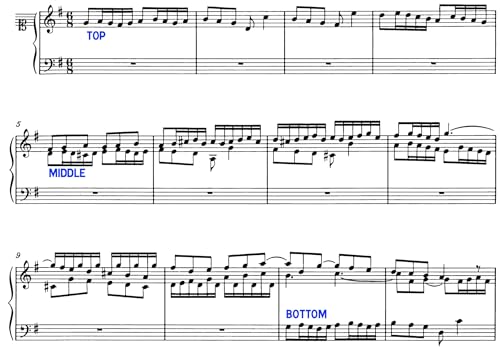
    The three-voice fugue begins:

    But after only a few bars, Bach is ready to bring in all the voices again— this time with the melodies upside down. (Inverted exposition.) N.B. The middle voice’s theme began on the previous page:

    And there are stretti in this fugue, one melody interrupting another. Here’s one where the themes are rhythmically shifted to the second half of the bar:

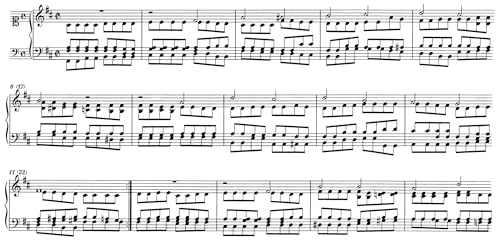
    The prelude is equally joyous. The earliest version of this prelude is a mere 15 bars long, compared to the 19 bars of the latest version. Notice, too, how Bach changed the key signature of only one (!) staff. The earliest version reads:

    But later, on the top staff, Bach changes it to 24/16 (!) in the fair copy, P. 415:

    Want to help this resource? Here’s how:

    We encourage our listeners to become a paid subscriber atwtfbach.substack.comFree subscriptions are also beneficial for our stats. You can make a one-time donation:

    https://www.paypal.me/wtfbachhttps://venmo.com/wtfbach

    Supporting this show ensures its longevity. Thank you for your support!


    Get full access to W.T.F. Bach? at wtfbach.substack.com/subscribe
    Show More Show Less
    51 mins
  • Ep. 123: The Negroni & 'Paradise Lost'
    Feb 10 2026

    A new type of episode, Quodlibets! Quod (what) + libet (it pleases) or, ‘whatever you like,’ ‘anything at all.’ This episode centers on a beautiful chorale prelude, but first, my, Ode to the Negroni: The Meeting of Etymology and Entomology at the top, then some Bach, and finally, how Paradise Lost was written, as explained by the English scholar, John Carey.

    Erbarm dich mein, o Herre Gott, BWV 721, in f-sharp minor (note the Phrygian key signature!) is an extraordinary little piece. Written around 1709, it is a profound and most elusive chord progression. Here is the first page:

    The text from 1524, based on Psalm 51, was translated by the English ecclesiastical reformer Myles Coverdale. I know nothing about him but his Wiki page is fascinating!

    Finally, John Milton. If, one day, you sit down to read Paradise Lost you may feel… well, lost. It was the writing of the late John Carey that led me through this beautiful poem. Spoiler alert: Milton wrote the poem between sleeping and waking, totally blind, by dictating what he was receiving from a ‘Heavenly Muse’ he thought was the same muse responsible for inspiring the Mosaic books of the bible— Wow. Reading the poem with this in mind is a completely different experience. For Milton, the poem was a purely audible experience, hence reading it aloud brings it to life. He, after all, never saw it on a page.

    Got Bach?

    Want to help this resource stick around? Here’s how:

    We encourage our listeners to become a paid subscriber atwtfbach.substack.comFree subscriptions are also beneficial for our numbers.

    You can make a one-time donation:

    https://www.paypal.me/wtfbachhttps://venmo.com/wtfbach

    Supporting this show ensures its longevity. Thank you for your support!

    Concepts Covered: Bach in the Phrygian Mode, Tone III, Missing flats, missing sharps, Bach’s Key signatures, John Milton, how did Milton write Paradise Lost, Etymology and Entomology, The Origins of the Negroni Cocktail

    Source quoted:Leaver, Robin A. Luther's Liturgical Music: Principles and Implications. Eerdmans, 2007.


    Get full access to W.T.F. Bach? at wtfbach.substack.com/subscribe
    Show More Show Less
    47 mins
  • Ep. 122: Was F-Sharp Minor Golgotha?
    Feb 3 2026

    “It’s not that Bach writes music and then sits in an armchair and thinks about God... Bach writing music is Bach thinking about God.”

    Individual keys are often loaded with personal significance to the composer. To what extent was Bach thinking of the double sense of Kreuze— both as ‘cross’ and the musical sign for a sharp?

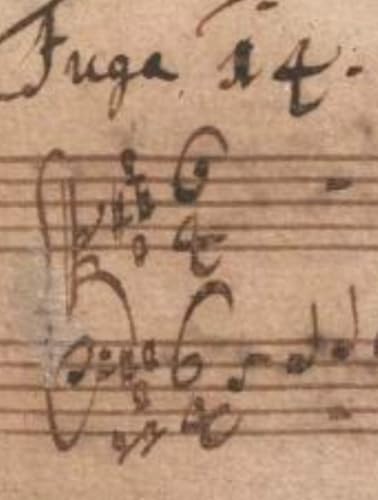
    As discussed in the episode, f# minor wasn’t necessarily the key signature with three ‘crosses,’ as Bach’s f# minor looks like this on the page:

    Is it more likely that Bach saw b minor as the image of Golgotha on the page? Dare we speculate further and claim that the symmetry of the C# between the two F’s is Christus between the two thieves? Speculation adds nothing of substance… but it’s fun! Bach’s b minor on the page:

    In any case, Kreuze was probably never far from Bach’s mind, and f# minor was usually a key for expressing pain and suffering in the cantatas. The fugue from Book One of The Well-Tempered Clavier, BWV 859 is full of blatant passion language, seen in the weeping of the countersubject:

    Does The World Need More Bach?

    One question I have concerning modern editions is the tenor voice in bar 36. In the earliest version, Bach has given— as a cautionary accidental— D natural:

    But in the revision, he forgets the cautionary accidental (or deems it unnecessary.) Does this omission justify D#?! I don’t think so. Both Henle and Bärenreiter suggest D#:

    At the end of the episode, we explore the canon from the sonata in A Major for Violin and Harpsichord, BWV 1015. The third movement (in f# minor) is a strict canon from beginning to end. Check this out:

    Want to support W.T.F Bach? Here’s how:

    The best way is to become a paid subscriber atwtfbach.substack.comYou can also make a one-time donation:

    https://www.paypal.me/wtfbachhttps://venmo.com/wtfbach

    Supporting this show ensures its longevity. Thank you for your support!

    Concepts Covered:

    Bach and religion, composition as theological thought, the symbolic meaning of musical keys in Bach’s works, f♯ minor & b minor, Calvary or Golgotha. Kreuze in Bach studies: the double meaning of “cross” and the sharp (♯) sign in German language. f♯ minor as a key of suffering and affliction in Bach’s cantatas and keyboard works. Passion rhetoric in BWV 859 (WTC I)

    Canon analysis of BWV 1015, the Sonata for Violin and Harpsichord in A major.


    Get full access to W.T.F. Bach? at wtfbach.substack.com/subscribe
    Show More Show Less
    1 hr and 3 mins
No reviews yet
In the spirit of reconciliation, Audible acknowledges the Traditional Custodians of country throughout Australia and their connections to land, sea and community. We pay our respect to their elders past and present and extend that respect to all Aboriginal and Torres Strait Islander peoples today.