The Generalist cover art

The Generalist

The Generalist

By: Mario Gabriele
Listen for free

About this listen

“The future is already here. It’s just not evenly distributed.” The Generalist Podcast brings you weekly conversations with the people who live in these pockets of the future – visionary founders, prescient investors, and original thinkers. Each episode is designed to introduce you to new ideas, technologies, and markets and help you prepare for the world of tomorrow.Mario Gabriele
Episodes
  • The Future Of Drug Discovery Is 4 Billion Years Old (Viswa Colluru, Founder & CEO at Enveda)
    Apr 21 2026

    For decades, drug discovery has shifted away from nature and toward biology-first approaches. Viswa Colluru believes that shift was a catastrophic mistake. His company, Enveda Biosciences, has raised over $500 million to build a “search engine for nature’s chemistry.” The mission is personal: he grew up around his father’s pharmacy in India and later lost his mother to a treatable cancer whose medicine his family couldn’t afford. Many life-changing medicines, including morphine, aspirin, and metformin, originated in nature, but there has never been a reliable, scalable way to systematically explore its chemistry. Colluru founded Enveda in 2019 with $55,000 of his own savings to change that. The company has since identified 18 drug candidates, with three now in clinical trials.


    In our conversation, we explore:

    • Why the pharmaceutical industry abandoned nature (and why that was a massive mistake)
    • How Enveda built a system to decode unknown molecules in nature
    • The deeply personal story of his mother’s battle with leukemia and how it shaped his life’s work
    • Why old ideas, from immunotherapy to natural products, often hold the most latent potential
    • How Enveda developed 18 drug candidates for about $1 million each instead of $10-15 million
    • Enveda’s three leading drug candidates targeting eczema, obesity, and ulcerative colitis
    • Why first-in-class medicines capture the vast majority of returns in pharma
    • What competitive table tennis taught him about building companies

    Thank you to the partners who make this possible

    Brex: The intelligent finance platform.

    Ahrefs Brand Radar: Find your brand in AI results.

    Persona: Trusted identity verification for any use case.

    Timestamps

    (00:00) Introduction to Viswa Colluru

    (03:57) His father’s pharmacy and early exposure to Western and Ayurvedic medicine

    (07:06) Early pull toward technology

    (09:29) His mother’s leukemia diagnosis

    (14:24) Studying Biotechnology

    (16:07) Graduate school

    (17:55) Studying immunotherapy when it was unfashionable

    (24:23) Innovation vs. novelty

    (27:24) Lessons from table tennis

    (32:05) Joining Recursion

    (37:10) Learning urgency and courage

    (40:42) What launched Enveda

    (45:40) The limits of reductionist drug discovery

    (49:53) Chemistry-first approach

    (52:17) Raising $225K and investing $55K personally

    (56:04) Initial studies and targets

    (1:04:30) Three categories of leading drugs: Eczema, obesity, ulcerative colitis

    (1:13:27) Why GLP-1s are not the whole answer

    (1:18:27) Enveda’s long-term vision

    (1:21:31) Book recommendation

    Follow Viswa Colluru

    LinkedIn: https://www.linkedin.com/in/viswacolluru

    X: https://x.com/viswacolluru

    Resources and episode mentions: https://www.generalist.com/p/the-future-of-drug-discovery

    Production and marketing by penname.co. For inquiries about sponsoring the podcast, email jordan@penname.co.

    Show More Show Less
    1 hr and 23 mins
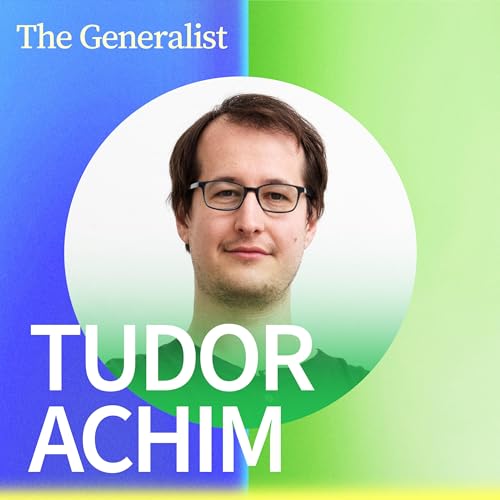
  • How a 20-Person Startup Won Gold at the Math Olympiad—Tying With OpenAI & DeepMind (Tudor Achim, CEO of Harmonic)
    Apr 14 2026

    Tudor Achim is the co-founder and CEO of Harmonic, a startup working to solve one of AI’s hardest problems: mathematical reasoning. In July 2024, Harmonic achieved gold-medal-level performance on International Math Olympiad problems alongside systems from OpenAI and Google DeepMind—but with a key difference: every proof Harmonic submitted was formally verified. Tudor's path to Harmonic wound through competitive piano, computational biology, and autonomous driving. He studied at Carnegie Mellon's music preparatory school, worked on machine learning at Quora, briefly pursued a PhD before dropping out, and then co-founded an autonomous driving company, Helm.ai. Harmonic's core product, Aristotle, uses reinforcement learning and the programming language Lean 4 to solve problems and verify solutions.


    In our conversation, we explore:

    • Why Tudor believes math is the fundamental toolkit to understand the world
    • How Harmonic uses hallucinations as a feature, not a bug
    • How Aristotle works and the applications beyond pure mathematics
    • The reinforcement learning process that lets Harmonic generate synthetic training data and solve problems humans have never attempted
    • Why Tudor believes AI could surpass human mathematicians on specific tasks within 2–3 years
    • Why the future of mathematics looks more like GitHub than academic journals
    • The alternating pattern between intellect leaps and data leaps throughout scientific history
    • How studying piano under an extraordinary teacher taught Tudor discipline and the value of sticking with hard problems

    Thank you to the partners who make this possible

    Brex: The intelligent finance platform.

    Guru: The AI source of truth for work.

    Rippling: Stop wasting time on admin tasks, build your startup faster.

    Transcript: https://www.generalist.com/p/how-a-20-person-startup-won-gold

    Timestamps

    (00:00) Intro

    (03:34) From competitive piano to computer science

    (06:28) The mathematical foundations of music (and why Tudor keeps them separate)

    (08:24) Can AI ever create art with true intent?

    (09:51) Early obsessions

    (12:52) Defining intelligence

    (14:49) Discovering machine learning’s potential at Quora

    (17:30) Why Tudor chose computational biology for his PhD

    (19:19) The decision to drop out and build Helm.ai

    (22:55) The two breakthroughs that made mathematical AI possible in 2023

    (25:28) The importance of Lean 4

    (28:21) How Tudor and Vlad Tenev discovered they shared the same impossible dream

    (32:35) Why formal verification became the core conviction

    (34:21) The timeline for AI surpassing human mathematicians

    (35:25) An overview of Aristotle: the world’s first always-correct mathematical agent

    (38:12) Why Tudor says hallucinations are the engine of creativity

    (39:30) The translation challenge from natural language to formal proof

    (40:40) Reinforcement learning

    (42:10) Why Aristotle is both faster and cheaper than alternatives

    (43:34) Tradeoffs and use cases

    (45:34) Math in AI now and what’s next

    (47:38) Tying with OpenAI and DeepMind at the International Math Olympiad

    (49:08) Democratizing AI and correctness

    (53:13) Tudor’s 2030 thesis

    (56:02) History’s alternating rhythm of thinking and measuring

    (57:53) What Tudor has been wrong about

    (58:52) What Tudor’s best at

    (1:00:18) Final meditations

    Follow Tudor Achim

    LinkedIn: https://www.linkedin.com/in/tudorachim

    X: https://x.com/tachim/with_replies

    Resources and episode mentions: https://www.generalist.com/p/how-a-20-person-startup-won-gold⁠

    Production and marketing by penname.co. For inquiries about sponsoring the podcast, email jordan@penname.co.

    Show More Show Less
    1 hr and 5 mins
  • 30% Of Network Engineers Are Retiring. What Happens Next? (Anil Varanasi, Co-Founder & CEO of Meter)
    Apr 7 2026
    Anil Varanasi, co-founder and CEO of Meter, is building a new kind of networking company for the AI era. Alongside his brother Sunil, he has helped raise more than $250 million to challenge incumbents like Cisco with a vertically integrated approach spanning hardware, software, deployment, and ongoing operations, all delivered through a utility-style model. His view is that networking has remained largely unchanged for decades, even as it has become foundational to everything from AI workloads to real-world infrastructure. Meter’s ambition is not just to improve existing networks, but to make them autonomous over time. Before starting the company, Anil and Sunil were deeply involved in filmmaking, a background that still shapes their philosophy of building with cathedral-level craft across every layer of the stack.Together we explore:The “burden of knowledge” and why progress is getting harder across fieldsWhy most companies over-index on technology and ignore business model innovationThe three ways companies create advantage: technology, delivery, and business modelHow Meter’s trade-in model borrows from the automotive industryWhy networking should function like electricity or water—not hardwareLessons from Japanese vending machine logistics for infrastructure deploymentThe hidden coordination problem behind vertically integrated companiesWhy Anil believes “common knowledge” is often wrongHow COVID forced Meter to abandon geographic constraints and scale nationallyThe case for fully autonomous networks in a world of exploding demand—Thank you to the partners who make this possible.tech domains: An identity for builders at their core.Granola: The app that might actually make you love meetings.Brex: The intelligent finance platform.—Transcript: https://www.generalist.com/p/the-case-for-autonomous-networks—Timestamps(00:00) Introduction to Anil Varanasi and Meter(03:52) The burden of knowledge and slowing innovation(08:18) Losing creativity vs gaining expertise(10:25) What Meter actually does(13:26) Early life, immigration, and upbringing(15:47) Parental influence(20:03) Film, storytelling, and creative influence(22:55) Why Anil didn’t pursue filmmaking(25:44) Parallels between company building and filmmaking(27:00) Early programming and building(28:05) George Mason and understanding systems(29:59) The dynamic of working with his brother as a co-founder(34:03) His first business and lessons learned (or lack thereof)(35:15) Lessons from successful companies(38:16) Japanese vending machines and logistics insight(41:10) Scrapping 18 months of work(42:40) Conviction and long-term company building(46:02) COVID shock and near-death moment(49:59) Building hardware like a cathedral(52:25) Rethinking the networking business model(57:06) Build vs buy and transaction costs(59:39) Networking as infrastructure and utility(01:01:30) The case for autonomous networks(01:03:25) Hiring, talent, and what actually matters(01:06:15) Big unanswered questions (sleep, science)(01:07:28) Rethinking education(01:09:02) Infinite games and long-term thinking—Follow Anil VaranasiLinkedIn: https://www.linkedin.com/in/anilcvX: https://x.com/acvWebsite: https://anilv.com—Resources and episode mentions: https://www.generalist.com/p/the-case-for-autonomous-networks⁠—Production and marketing by penname.co. For inquiries about sponsoring the podcast, email jordan@penname.co.
    Show More Show Less
    1 hr and 11 mins
No reviews yet
In the spirit of reconciliation, Audible acknowledges the Traditional Custodians of country throughout Australia and their connections to land, sea and community. We pay our respect to their elders past and present and extend that respect to all Aboriginal and Torres Strait Islander peoples today.