• Stop Employee Resistance Before It Kills Your Business Growth
    May 19 2026
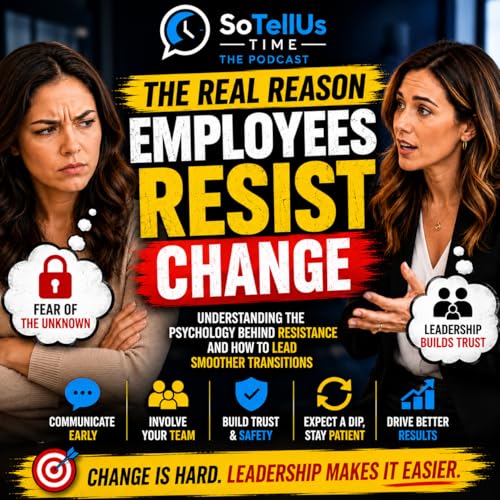
    Have you ever rolled out a new system, process, schedule, software, policy, or expectation in your business… only to have your team push back, complain, avoid it, or quietly refuse to adopt it? Most business owners and leaders assume employees resist change because they are being difficult, lazy, negative, or stuck in their ways. But the truth is deeper than that. In this episode of SoTellUs Time, we break down the real reason employees resist change and how business owners, managers, and leaders can guide their teams through smoother transitions without chaos, confusion, frustration, or loss of trust. Whether you run a childcare center, home service company, med spa, salon, dental office, law firm, restaurant, agency, or local service business, change is unavoidable. Growth requires new systems. Scaling requires better processes. Better customer service requires new expectations. Better operations require better tools. But if your team does not understand the change, trust the process, or feel supported through the transition, even the best idea can fail. The mistake most leaders make is thinking change is about the system. It is not. Change is about people. Your employees are not always resisting the change itself. They are often resisting uncertainty, loss of control, fear of failure, lack of clarity, or the feeling that something familiar is being taken away from them. In this episode, we explain why resistance to change is usually emotional before it is logical, and why great leaders do not take pushback personally. Instead, they get curious, communicate clearly, involve their team, and create the kind of psychological safety that makes adoption easier. You will learn why employees subconsciously ask questions like: "What am I losing?" "Will this make my job harder?" "Am I still valued?" "Will I look incompetent?" "Will I be able to succeed?" "Does leadership actually understand what this means for me?" These questions matter because every business transition creates perceived loss. Employees may feel like they are losing comfort, routine, competence, confidence, status, control, or relationships. That is why a teacher in a childcare center may avoid a new parent communication app, a technician may complain about new scheduling software, or a team member may ignore a new policy even when the change is obviously good for the business. The change may be logical to leadership. But to the employee, it may feel threatening. That is why leaders must communicate more than the "what." They must communicate the "why." If you simply tell your team, "We are switching systems Monday," you leave room for fear, assumptions, frustration, and resistance. But when you explain why the change is happening, how it helps the business, how it improves the customer experience, how it reduces daily stress, and how the team will be supported through it, buy-in increases dramatically. People support what they understand. In this episode, we also talk about the biggest leadership mistake during change: taking resistance personally. When an employee says, "This won't work," "The old way was better," "This is too complicated," or "We already tried that," it may not be rebellion. It may be fear. It may be confusion. It may be insecurity. It may be a lack of trust from past changes that were handled poorly. Great leaders do not get defensive. They ask better questions. "What concerns you most?" "What feels unclear?" "What obstacles do you see?" "What support would help?" "What would make this transition easier?" Those questions lower emotional resistance because they help employees feel heard instead of steamrolled. If you are a business owner, entrepreneur, operator, manager, team leader, or anyone responsible for implementing change, this episode will help you understand how to lead through change with more clarity, confidence, patience, and trust. We cover practical strategies like: Communicating change early before anxiety builds Explaining the "why" repeatedly, not just once Connecting change to the company mission and customer experience Involving employees before implementation Asking for feedback from the people closest to the work Expecting a temporary dip in performance during the learning curve Coaching instead of criticizing during transition Modeling calm and confidence as a leader Creating psychological safety so employees are willing to learn Helping your team feel informed, supported, included, and safe One of the biggest takeaways from this episode is this: The success of change is rarely about the software, system, policy, or process itself. It is about whether your people feel supported through the transition. If your business is growing, your systems will need to change. Your processes will need to improve. Your team will need to adapt. But the way you lead that change will determine whether your employees embrace the next level of growth or quietly resist it. The next time your team pushes back on change,...
    Show More Show Less
    19 mins
  • The Hidden Business Bottleneck Killing Growth
    May 12 2026

    Every growing business eventually hits a wall… but the companies that scale successfully are the ones that identify bottlenecks BEFORE they become full-blown emergencies. In this episode of SoTellUs Time, Trevor and Troy Howard break down how to identify the next bottleneck in your business before it slows growth, hurts customer experience, overwhelms your team, and creates operational chaos.

    Most business owners assume their biggest problems are marketing, competition, or the economy. But in reality, the real issue is often hidden inside their operations. Missed calls, slow response times, employee burnout, overwhelmed leadership, delayed scheduling, fulfillment issues, and communication breakdowns are all signs of a bottleneck forming beneath the surface.

    In this episode, you'll learn how to proactively spot operational constraints, strengthen systems before they fail, scale your business more efficiently, and create sustainable growth without sacrificing customer experience.

    Whether you run a small business, home service company, agency, med spa, dental office, law firm, salon, SaaS company, or growing enterprise, this episode will help you identify the weak points limiting your growth and show you how high-performing businesses solve them before they become expensive problems.

    In This Episode:
    ✔️ What a business bottleneck actually is
    ✔️ Why growth exposes operational weaknesses
    ✔️ Early warning signs your systems are about to fail
    ✔️ How response times quietly destroy revenue
    ✔️ Why "hero employees" create dangerous dependencies
    ✔️ The hidden cost of multitasking and constant interruptions
    ✔️ How overwhelmed teams reduce customer experience
    ✔️ The importance of capacity planning in business growth
    ✔️ How to follow operational friction inside your company
    ✔️ Why scaling too fast breaks weak systems
    ✔️ How to map your customer journey to find delays
    ✔️ The smartest way to prepare for future growth
    ✔️ How proactive leaders solve bottlenecks early
    ✔️ Why systems and automation matter more than motivation
    ✔️ How SOPs, workflows, and processes create stability
    ✔️ Why reactive hiring hurts profitability
    ✔️ How to scale operations without chaos
    ✔️ Leadership habits that uncover problems early
    ✔️ Why every solved bottleneck reveals the next opportunity

    If you've ever felt like your business is growing but somehow becoming harder to manage, this episode is for you.

    📈 Perfect for entrepreneurs, business owners, CEOs, operators, managers, marketers, startups, scaling companies, service businesses, contractors, consultants, sales teams, and leadership teams trying to build a business that grows without breaking.

    Key Takeaway:
    "Growth doesn't break businesses. Unseen bottlenecks do."

    This week's challenge:
    Identify:
    • One area creating friction
    • One overloaded person
    • One system nearing capacity

    Then ask:
    "What can we improve now before it becomes a much bigger problem later?"

    COMMENT BELOW:
    What's the biggest bottleneck currently slowing down your business?

    LIKE this video if you want more business growth strategies
    SUBSCRIBE for weekly business, marketing, automation, customer experience, and scaling insights
    SHARE this episode with another entrepreneur or business owner

    Subscribe to SoTellUs Time:
    https://www.youtube.com/@sotellus

    Learn More About SoTellUs:
    https://www.sotellus.com

    Get More Reviews, More Leads & Better Customer Communication:
    SoTellUs helps businesses automate reviews, referrals, messaging, AI receptionist solutions, customer communication, and reputation management to scale faster and create better customer experiences.

    #BusinessGrowth #Entrepreneurship #ScalingBusiness #BusinessSystems #Leadership #Operations #SmallBusiness #Entrepreneur #BusinessOwner #CustomerExperience #Productivity #BusinessStrategy #Automation #OperationalEfficiency #BusinessTips #CEO #GrowthStrategy #TeamManagement #BusinessSuccess #MarketingStrategy #WorkflowAutomation #BusinessPodcast #SoTellUs #SalesGrowth #CompanyCulture #OperationalExcellence #AIReceptionist #ReputationManagement

    Show More Show Less
    25 mins
  • Stop Losing Great Employees
    May 5 2026

    Ever hired someone you were excited about… only to wonder 3 weeks later what went wrong?

    In this episode of SoTellUs Time, we break down one of the most important but overlooked parts of building a successful business: new employee onboarding.

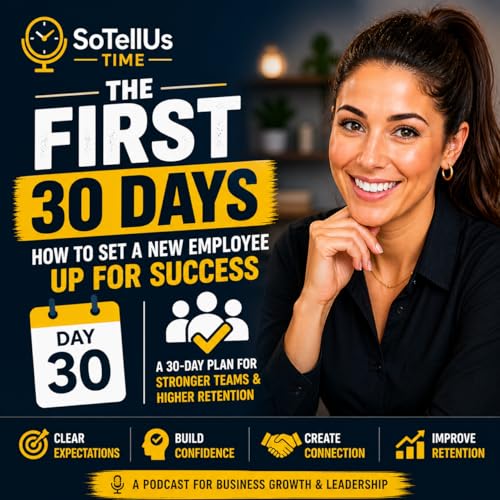
    Most employee turnover happens early, and the first 30 days can determine whether a new hire becomes a confident, productive team member—or another costly hiring mistake. Great onboarding is not just paperwork, policies, and a quick tour of the office. Great onboarding is performance training.

    If you want better employees, higher retention, stronger culture, and a business that can scale, you need a better first 30 days.

    In this episode, we cover:

    ✅ Why onboarding is more than orientation
    ✅ The 3 goals every onboarding system must accomplish
    ✅ How to create clarity, confidence, and connection
    ✅ What new hires need in week 1, week 2, week 3, and week 4
    ✅ The biggest onboarding mistakes business owners make
    ✅ Why "sink or swim" destroys employee performance
    ✅ How weekly check-ins improve accountability
    ✅ How better onboarding leads to faster productivity
    ✅ Why your onboarding system is your scalability system

    Confused employees do not perform. Confident employees do.

    If your new hires are left guessing, your results will always be inconsistent. But when you give employees a clear path, measurable expectations, early feedback, and the right support, you create a team that performs better, stays longer, and helps your business grow.

    Whether you are hiring your first employee, building a growing team, managing a service business, or trying to reduce turnover, this episode will give you a simple framework for building a powerful 30-day employee onboarding plan.

    By the end, you will know how to:

    Create a 30-day plan for every new hire
    Schedule weekly check-ins that actually matter
    Define what success looks like by Day 30
    Avoid information overload
    Train employees without overwhelming them
    Build accountability into your onboarding process
    Turn new hires into confident contributors faster

    Your onboarding system is not just an HR process. It is a business growth system.

    Watch now and learn how to set every new employee up for success from day one.

    Subscribe to SoTellUs Time for more business growth, leadership, marketing, customer experience, automation, reputation management, and team-building strategies.

    Visit: https://youtube.com/sotellus


    #EmployeeOnboarding #BusinessGrowth #Leadership #HiringTips #EmployeeRetention #SmallBusinessTips #TeamBuilding #BusinessSystems #SoTellUsTime #ManagementTips

    Show More Show Less
    21 mins
  • Scaling Your Business? Why Growth Is Breaking Your Systems
    Apr 21 2026

    Is your business growing… but everything feels harder instead of easier?

    In this episode of SoTellUs Time with Trevor & Troy Howard, we break down one of the biggest hidden problems in business growth: the systems that got you here are now holding you back.

    At the beginning, everything works. You know every customer. You handle every call. You control every detail.
    But then growth hits…

    Suddenly you're dealing with:
    ❌ Missed calls
    ❌ Scheduling mistakes
    ❌ Team confusion
    ❌ Inconsistent customer experiences
    ❌ More complaints than ever

    And the worst part? You feel like YOU are the bottleneck.

    Here's the truth: Growth doesn't just expose problems… it creates new ones.

    In this episode, we show you exactly:

    • Why your systems break as you scale
    • The hidden dangers of "just figuring it out as you go"
    • The warning signs your business is outgrowing your structure
    • How to shift from chaos to control with real systems
    • How to build a business that runs WITHOUT you being involved in everything
    TIMESTAMPS

    0:00 Everything worked… until you grew
    2:00 Why growth breaks your business systems
    6:00 Warning signs your systems are failing
    9:00 How to fix broken systems and scale properly
    14:00 Turning growth problems into your biggest advantage

    WHAT YOU'LL LEARN

    If you're a business owner, entrepreneur, or leader trying to scale, this episode will help you:

    ✔️ Stop relying on memory and "hustle" to run your business
    ✔️ Replace inconsistent processes with repeatable systems
    ✔️ Eliminate confusion across your team
    ✔️ Build leadership so you're not the only decision-maker
    ✔️ Implement tools like CRM, automation, and communication systems the RIGHT way
    ✔️ Create predictable growth instead of constant chaos

    KEY TAKEAWAY

    If growth feels harder instead of easier…
    Your systems are behind your business.

    And until you fix that, scaling will always feel stressful.

    REAL BUSINESS APPLICATION

    Whether you run:

    • A home service business
    • A childcare center
    • A salon or med spa
    • A local service company

    This episode will help you fix the operational gaps that are costing you customers, revenue, and sanity.

    POWERFUL FRAMEWORK FROM THIS EPISODE

    ➡️ Move from People-Dependent → System-Dependent
    ➡️ Document everything (SOPs, checklists, processes)
    ➡️ Implement tools AFTER fixing your process
    ➡️ Build leadership layers in your business
    ➡️ Create feedback loops to catch problems early

    CHALLENGE FOR YOU

    What's ONE system in your business that isn't keeping up?

    Fix it this week.
    That's how real growth happens.

    SUBSCRIBE & CONNECT

    Subscribe to SoTellUs Time: https://www.youtube.com/sotellus
    Learn more about SoTellUs: https://www.sotellus.com

    ABOUT SOTELLUS

    SoTellUs helps businesses capture, manage, and amplify customer experiences through reviews, automation, and AI-powered communication tools that drive real growth.

    business growth problems, scaling a business, why businesses fail when scaling, business systems and processes, small business growth strategy, operational systems for business, CRM systems for small business, leadership in business growth, how to scale without chaos, business automation tools, entrepreneur growth tips, systemize your business, customer experience systems, business efficiency strategies

    Show More Show Less
    18 mins
  • How to Run Better One-on-One Meetings With Your Team | Leadership, Accountability & Employee Growth
    Apr 14 2026
    Do your one-on-one meetings feel awkward, inconsistent, or like a waste of time? In this episode of SoTellUs Time, Trevor and Troy Howard break down how to run better one-on-one meetings with your team so they actually improve communication, accountability, performance, and employee growth. If your meetings usually turn into shallow check-ins, uncomfortable conversations, or basic status updates, this episode will show you a simple structure that makes every one-on-one more productive and valuable. Great leaders know that one-on-one meetings are not just another task on the calendar. They are one of the most powerful tools for improving employee retention, team morale, leadership communication, workplace culture, accountability, and professional development. When employees feel heard, supported, and clear on expectations, they perform better, trust leadership more, and are more likely to stay engaged long term. In this episode, we talk about why one-on-one meetings matter more than most leaders realize, especially in businesses where trust, communication, customer experience, and consistency matter every day. Whether you lead a home service company, childcare center, sales team, office staff, field team, or growing small business, effective one-on-ones can help you reduce surprises, prevent burnout, improve execution, and build a stronger culture. We also break down the biggest mistakes leaders make in one-on-ones. Too many managers only meet when there is a problem, which makes the meeting feel negative from the start. Others turn the conversation into a status report instead of a development conversation. Some leaders dominate the conversation instead of listening, while others constantly cancel or reschedule, sending the message that the meeting is not important. These small habits quietly damage trust and make leadership less effective. That is why we share a simple 5-part structure for better one-on-one meetings that you can start using immediately: Personal Check-In – start human, not transactional Wins and Progress – reinforce what is working Challenges and Obstacles – coach through what is getting in the way Accountability and Priorities – get clear on the most important next steps Growth and Feedback – help team members improve and level up over time This structure helps leaders ask better questions, listen more effectively, create clarity, and make one-on-ones a place where trust and growth actually happen. Instead of just reviewing tasks, you will learn how to create a rhythm that improves performance without micromanaging. You will also learn how to use these meetings to strengthen field accountability, improve customer experience, celebrate wins like positive reviews or completed jobs, and help employees stay aligned with business goals. If you are trying to become a stronger leader, build a healthier team culture, improve employee performance, and create better communication with your staff, this episode is for you. In this episode, we cover: How to run better one-on-one meetingsWhy one-on-ones matter for leadership and culture Common one-on-one meeting mistakesA simple structure for productive employee meetingsHow to improve accountability without micromanagingHow to help employees grow through better conversationsHow to build trust and retention with consistent leadership Better management habits for small business owners and team leaders Timestamps: 0:00 – Introduction and hook 1:30 – Why one-on-one meetings matter more than you think 3:30 – The biggest mistakes leaders make 4:30 – A simple 5-part structure for better one-on-ones 12:00 – Pro tips to make one-on-ones actually work 13:30 – Real-world impact of great one-on-one meetings 14:30 – Closing challenge and call to action If you enjoy conversations about leadership, business growth, customer experience, team accountability, marketing, and building better systems, subscribe to SoTellUs Time for more episodes designed to help you grow your business and lead at a higher level. Subscribe to SoTellUs Time: https://www.youtube.com/@sotellus Learn more about SoTellUs: https://www.sotellus.com/ #OneOnOneMeetings #Leadership #TeamManagement #EmployeeRetention #Accountability #BusinessLeadership #ManagementTips #SmallBusiness #WorkplaceCulture #LeadershipDevelopment
    Show More Show Less
    24 mins
  • The Hidden Cost of Average Employees in Business
    Apr 7 2026
    What is "average" really costing your business? In this episode of SoTellUs Time, Trevor Howard and Troy Howard break down the hidden cost of tolerating average performance in your business—and why mediocrity is never neutral. Whether you run a home service business, childcare center, local service company, or growing organization, allowing average employees, average follow-up, average customer service, and average leadership standards can quietly destroy your culture, customer experience, growth, and peace of mind. Too many business owners keep people around because they are "not terrible." They show up. They do enough. They stay just above the line. But here's the real question: would you clone them? Would you want an entire team of people who operate at that level? If the answer is no, then you may already be paying the price for tolerating average without realizing how deep that cost really goes. In this episode, we talk about how average performance spreads across a company. What you tolerate becomes the standard. When one team member gets away with doing the minimum, avoiding initiative, failing to follow up quickly, delivering inconsistent customer experiences, or refusing to take ownership, the rest of the team notices. High performers start asking themselves why they work so hard when others do less and get treated the same. Over time, your strongest people either disengage or leave—and your culture starts drifting toward the lowest acceptable standard. We also break down how average hurts your customer experience. Customers do not judge your business by your intention. They judge it by what they experience. A slow response. A missed call. A weak follow-up. A team member who solves the technical problem but never builds trust. A teacher who supervises children but never truly engages with them or communicates well with parents. These things may seem small in the moment, but they create uncertainty, lower confidence, and erode trust. For childcare businesses, average can show up in teachers or staff members who cover the basics but fail to create meaningful parent communication, child engagement, warmth, and reassurance. Parents are not just paying for supervision—they are trusting you with the people they love most. Even small gaps in communication, enthusiasm, attentiveness, or consistency can create doubts that affect retention, referrals, and reputation. For home service businesses, average often shows up in technicians or office staff who get the job done but fail to create a memorable experience. They may fix the problem, but they do not educate the customer, build connection, communicate clearly, offer additional value, or create the kind of trust that leads to reviews, referrals, repeat business, and long-term loyalty. In a competitive market, being average is expensive. Customers remember how you made them feel, not just whether the task got done. This conversation also covers one of the biggest problems business owners face: average employees cap growth. You cannot scale excellence on an average team. When your team does not execute at a high level, the owner becomes the bottleneck. You end up fixing mistakes, handling escalations, checking work, answering questions that should not need to be asked, redoing tasks, and carrying a mental load that keeps you trapped in the day-to-day. Instead of leading, building systems, improving marketing, growing revenue, and creating the future of the business, you stay stuck managing preventable problems. We also talk about the emotional toll average takes on owners and leaders. The constant frustration. The repeated reminders. The silent disappointment. The energy drain that comes from knowing things are not being done the right way. Many owners live in a cycle of thinking, "Why can't they just do it right?" That frustration affects not only operations, but also leadership clarity, strategic thinking, and personal peace. The longer average is tolerated, the more exhausted the owner becomes. So why do we tolerate average in the first place? In this episode, Trevor and Troy unpack the real reasons. Sometimes it is fear. "It is hard to find good people right now." "At least they show up." "I do not have time to replace them." "I do not want the drama of another hard conversation." Other times it is a leadership issue. Expectations are unclear. Standards are not written down. Performance is not measured. Owners hint instead of being direct. They hope things improve without ever clearly addressing the gap. That is where this episode becomes practical. We do not just talk about the problem—we talk about how to fix it. We walk through how to define what great actually looks like in your business. That means getting specific about response times, communication expectations, ownership, follow-up, customer interaction standards, attitude, consistency, initiative, and performance. Great cannot be vague. If your team cannot see it, they cannot hit it....
    Show More Show Less
    20 mins
  • Why You're Losing Customers Without Knowing It
    Mar 31 2026
    You think you're delivering a great experience… but your customers might be quietly walking away. In this powerful episode of SoTellUs Time, Trevor Howard breaks down one of the most overlooked (and expensive) problems in business today: the Customer Experience Gap. Whether you run a home service business, childcare center, salon, med spa, or any service-based company, this episode will open your eyes to what your customers are actually experiencing—and why small moments are costing you bookings, enrollments, reviews, and long-term loyalty. If you've ever wondered why: Leads don't convertTours don't turn into enrollments Estimates don't close Customers don't come back Reviews are inconsistent 👉 This episode gives you the real answer. 🔥 WHAT YOU'LL LEARN IN THIS EPISODE ⚠️ The Truth About Customer Experience Most business owners believe: "We have great service""We return calls quickly" "Our tours go well" But here's the reality: 👉 Customers don't judge you by your intentions—they judge you by moments. And those moments are where most businesses fail. 📉 THE CUSTOMER EXPERIENCE GAP EXPLAINED There's a massive disconnect between: What you think is happening vs. What your customers actually experience This gap is especially dangerous in industries like: Childcare (trusting you with their kids) Home services (letting you into their home) These are high-trust, high-emotion decisions—and even small breakdowns destroy confidence fast. 👀 THE 5 BIGGEST BLIND SPOTS COSTING YOU CUSTOMERS 📞 1. The First Phone Call (MOST IMPORTANT) Missed calls = lost revenue Cold or rushed tone = no trustNo clear next steps = confusion 👉 If the first interaction feels off… they're gone. 🚪 2. First Impressions (Tours & Service Visits) No greeting = awkward experience Messy appearance = low professionalism Disorganized tour = lost enrollment 👉 Customers decide emotionally within minutes. ⏱️ 3. Waiting & Poor Communication "We'll be there between 12–4"No follow-up after inquiries Delayed responses 👉 Silence creates doubt—and doubt kills decisions. 💬 4. Inconsistent Experiences One great employee, one terrible one Different messaging every timeNo standard process 👉 Your brand = your weakest moment. 💵 5. Closing & Follow-Up Failures No clear explanationNo urgencyNo follow-up 👉 Most businesses don't lose the customer during the sale… they lose them after. 🔍 HOW TO FIND THE PROBLEMS YOU CAN'T SEE Trevor shares practical strategies to uncover the truth: ✔️ Secret shop your own business ✔️ Call your own phone lines at different times ✔️ Submit website inquiries ✔️ Listen to real conversations ✔️ Observe your team in real moments ✔️ Ask better, deeper customer questions 👉 The biggest insights come from the people who didn't choose you. 🛠️ HOW TO FIX THE EXPERIENCE GAP FAST If you want to increase: Conversions Enrollments Bookings Reviews Customer loyalty You need to: ✅ Script key interactions (calls, tours, visits) ✅ Train your team for consistency ✅ Track real metrics (not assumptions) ✅ Build a culture of customer awareness 💡 KEY TAKEAWAY Your customers are making emotional decisions about trust, safety, and reliability. And the experience you THINK you're delivering… is not the one that matters. 👉 The one they FEEL is. 🎯 YOUR CHALLENGE THIS WEEK Go through your own business like a customer: Call your phoneFill out your form Walk through your process Then fix just ONE thing that feels off. That one change could dramatically increase your revenue. 🚀 WANT MORE BUSINESS GROWTH STRATEGIES? Subscribe to SoTellUs Time for weekly insights on: Customer experience Reviews & reputation management Marketing strategies Business growth systemsAI tools for scaling 👉 Subscribe here: https://www.youtube.com/@sotellus 👉 Learn more: https://www.sotellus.com 🔥 ABOUT SOTELLUS SoTellUs helps businesses: Generate more 5-star reviews Capture video testimonials Automate follow-ups Increase conversions Build trust instantly If you're serious about growing your business, your online reputation and customer experience must work together. 📈 KEYWORDS (SEO BOOST) customer experience gap, why customers leave, improve customer experience, business growth strategies, customer service mistakes, home service marketing, childcare enrollment strategies, increase conversions, improve phone calls business, missed calls lost revenue, customer journey optimization, service business tips, reputation management, get more reviews, sotellus, sotellus time podcast, business podcast 2026, marketing strategies for small business, lead conversion strategies, customer retention strategies, improve business systems, client experience optimization #CustomerExperience #BusinessGrowth #MarketingStrategy #HomeServices #ChildcareBusiness #Entrepreneurship #LeadConversion #CustomerService #ReputationManagement #SoTellUs #SoTellUsTime
    Show More Show Less
    25 mins
  • How to Build Momentum When You Feel Stuck
    Mar 24 2026
    Ever feel like you're working hard, but nothing is moving forward? In this episode of SoTellUs Time, Trevor Howard breaks down exactly how to build momentum when you feel stuck in business, leadership, marketing, or life. If you've been feeling overwhelmed, frustrated, plateaued, burned out, or stuck second-guessing your next move, this conversation will help you stop overthinking and start creating real progress. The truth is, momentum is not something you wait for. Momentum is something you create. Most people think being stuck means they need a better strategy, but in many cases, being stuck is really an action problem. When you stop waiting for perfect timing, perfect clarity, and perfect conditions, you can finally start moving again. In this episode, we talk about why people get stuck in the first place. Sometimes it's because there are too many problems and no clear starting point. Sometimes it's perfectionism and fear of making the wrong decision. Sometimes it's discouragement from not seeing immediate results. And sometimes it's plain fatigue and burnout. No matter what the cause is, the solution almost always starts with action. We shares practical ways to create momentum fast, including how to shrink the target so progress feels manageable again. Instead of trying to fix everything at once, focus on one small, meaningful action. One client follow-up. One system improvement. One piece of content. One revenue-producing move. Small wins create big momentum, and the fastest way to get unstuck is to lower the barrier to action. You'll also hear why imperfect action beats overthinking every single time. Clarity does not come from sitting still and analyzing every option forever. Clarity comes from movement. It comes from sending the email, making the uncomfortable call, testing the idea, launching before you feel fully ready, and learning as you go. If you've been waiting until everything feels certain, this episode will help you break that cycle. Another major principle in this episode is learning how to stack small wins daily. Momentum compounds like interest. Trevor shares a simple framework you can use every day: 1 revenue activity 1 operational improvement 1 relationship touchpoint This daily discipline helps build confidence, create visible progress, reduce overwhelm, and keep your business moving forward even when motivation is low. We also talk about something many entrepreneurs and leaders overlook: your environment. Sometimes you are not stuck because your strategy is bad. Sometimes you are stuck because your energy is stale. A change in environment can create a powerful reset. That could mean working from a different location, changing your routine, reviewing your wins from the past 90 days, or talking to someone outside your business who can give you fresh perspective. Sometimes you do not need a new plan. You need new energy. One of the most powerful parts of this episode is the reminder that you do not have to build momentum alone. You can borrow momentum from other people. Accountability partners, team check-ins, coaching, mastermind groups, and public commitments can all help you move faster and stay consistent. Momentum is contagious, and getting around people who are moving can help you start moving too. If you are an entrepreneur, business owner, salesperson, marketer, leader, or anyone trying to grow in business and life, this episode is packed with practical advice to help you take action now. This is not just motivation. This is a simple, tactical framework for getting unstuck and building forward progress. In this episode, we cover: How to build momentum when you feel stuck Why overwhelm and perfectionism keep people frozen How to stop overthinking and take action Why small wins matter more than giant plans How to create clarity through movement A simple daily framework for consistent progress How changing your environment can reset your energy Why accountability and borrowed momentum matter How to overcome burnout, discouragement, and plateaus How business owners and leaders can regain traction quickly If you've been asking yourself how to get unstuck, how to stay motivated, how to regain momentum in business, or how to stop feeling paralyzed by big goals, this episode is for you. Your challenge after watching: What is ONE action you can take in the next hour? You do not need to solve everything today. You just need to start moving. Subscribe for more episodes on business growth, leadership, entrepreneurship, marketing, customer experience, mindset, reviews, systems, sales, and building a better business. Follow SoTellUs Time for more content designed to help entrepreneurs and business leaders grow smarter and faster. SoTellUs Time YouTube Channel: youtube.com/sotellus #BuildMomentum #FeelingStuck #BusinessGrowth #EntrepreneurMindset #LeadershipDevelopment #MotivationForEntrepreneurs #SmallWins #TakeAction #StopOverthinking #BusinessPodcast #SoTellUsTime #...
    Show More Show Less
    27 mins