

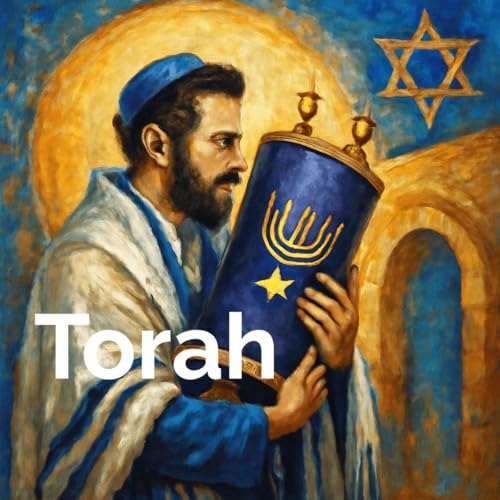
Torah.
Failed to add items
Sorry, we are unable to add the item because your shopping cart is already at capacity.
Add to basket failed.
Please try again later
Add to Wish List failed.
Please try again later
Remove from Wish List failed.
Please try again later
Follow podcast failed
Unfollow podcast failed

Torah.
-
Narrated by:
Summary
Here is a brief description of the five books of the Torah:
- Genesis: This first book of the Torah includes 50 chapters and covers the time period from the creation of all things to the time of Joseph’s death and burial. It includes the account of creation (chapters 1—2), the beginning of human sin (chapter 3), Noah and the ark (chapters 6—9), the tower of Babel (chapters 10—11), the lives of Abraham, Isaac, and Jacob, and an extended narrative of the life of Joseph.
- Exodus: This second book of the Torah includes 40 chapters and covers the period from Jewish slavery in Egypt until the glory of the Lord descended upon the completed tabernacle in the wilderness. It includes the birth of Moses, the plagues of Egypt, the exodus of the Jewish people from Egypt, the crossing of the Red Sea, and the giving of the Law to Moses upon Mount Sinai.
- Leviticus: This third book of the Torah includes 27 chapters and consists largely of the laws regarding sacrifices, offerings, and festivals among the people of Israel.
- Numbers: This fourth book of the Torah includes 36 chapters and covers a span of about 40 years as the Israelites wandered in the wilderness. Numbers provides a census of the people of Israel and some details about their journey toward the Promised Land.
- Deuteronomy: This fifth book of the Torah includes 34 chapters and is called “Deuteronomy” based on a Greek word meaning “second law.” In the book, Moses repeats the Law for the new generation who would enter the Promised Land. Deuteronomy describes the transition of leadership sacerdotally (from Aaron to his sons) and nationally (from Moses to Joshua).
The Torah’s five books have formed the basis of Judaism’s teachings from the time of Moses. Later biblical writers, including Samuel, David, Isaiah, and Daniel, would frequently refer back to the Law’s teachings. The teachings of the Torah are frequently summarized by citing Deuteronomy 6:4–5, called the Shema (or “saying”): “Hear, O Israel: The LORD our God, the LORD is one. You shall love the LORD your God with all your heart and with all your soul and with all your might.” Jesus called this the “first and greatest commandment” (Matthew 22:36–38).
The Torah is considered the inspired Word of God by both Jews and Christians alike. Christians, however, see Jesus Christ as the fulfillment of the Messianic prophecies and believe the Law was fulfilled in Christ. Jesus taught, “Do not think that I have come to abolish the Law or the Prophets; I have not come to abolish them but to fulfill them” (Matthew 5:17).
Copyright Popular Culture and Religion.
Episodes
-
May 11 20264 mins
Failed to add items
Sorry, we are unable to add the item because your shopping cart is already at capacity.Add to basket failed.
Please try again laterAdd to Wish List failed.
Please try again laterRemove from Wish List failed.
Please try again laterFollow podcast failed
Unfollow podcast failed
-
May 11 20266 mins
Failed to add items
Sorry, we are unable to add the item because your shopping cart is already at capacity.Add to basket failed.
Please try again laterAdd to Wish List failed.
Please try again laterRemove from Wish List failed.
Please try again laterFollow podcast failed
Unfollow podcast failed
-
May 11 20265 mins
Failed to add items
Sorry, we are unable to add the item because your shopping cart is already at capacity.Add to basket failed.
Please try again laterAdd to Wish List failed.
Please try again laterRemove from Wish List failed.
Please try again laterFollow podcast failed
Unfollow podcast failed
adbl_web_anon_alc_button_suppression_c
No reviews yet
In the spirit of reconciliation, Audible acknowledges the Traditional Custodians of country throughout Australia and their connections to land, sea and community. We pay our respect to their elders past and present and extend that respect to all Aboriginal and Torres Strait Islander peoples today.