• Pudendal Nerve Entrapment, Decompression Surgery, and 15 Years of Pelvic Pain | Carli Cutchin
    Apr 13 2026

    What does it mean to do everything right for fifteen years — and still not get to the bottom of your pain?

    In this episode, I speak with Carli Cutchin, a writer and disability advocate with a background as a comparative literature scholar. Carli has lived with pudendal neuralgia for fifteen years and writes about chronic pain and disability for publications including Ms. Magazine. She is one of the sharpest thinkers I've come across on this topic, and this conversation goes well beyond the personal story.

    We go into Carli's full fifteen-year journey — from the initial onset of pain, through years of PT, nerve blocks, and conservative treatments that provided only partial relief, to a devastating relapse in 2020 that left her mostly bedridden. We cover the eventual diagnosis of pudendal nerve entrapment, what that actually means and how it differs from pudendal neuralgia, and the decompression surgery with Dr. Hibner that she wishes she'd known about much earlier.

    We also dig into the ideas underneath all of it — how medicine frames chronic pain, the language it uses for these conditions, and what Carli sees as the specific cost of those frameworks for women. Her constructivist perspective on this is something I found myself thinking about long after we finished recording.

    Whether you're navigating pudendal neuralgia yourself, wondering whether entrapment might be relevant to your situation, or just someone who likes to think carefully about the bigger picture — I think you'll take a lot away from this one.

    In this episode:

    • How Carli's pain started and why it took so long to get the right diagnosis
    • The difference between pudendal neuralgia and pudendal nerve entrapment
    • What decompression surgery involves and what recovery looks like
    • The trauma and somatic work Carli did — and why she's clear it didn't cause her pain
    • Her critique of how medicine talks about chronic pain in women
    • What she wishes she'd been told in year one

    • The word "pudendal" — and what it means that it comes from the Latin for shame

    Connect with Carli Cutchin:

    • Instagram: @carlicutchin
    • Website: carlicutchin.com

    Connect with Mathilde:

    • Instagram: @theworldstightestcommunity

    • Website: www.theworldstightestcommunity.com

    Show More Show Less
    1 hr and 9 mins
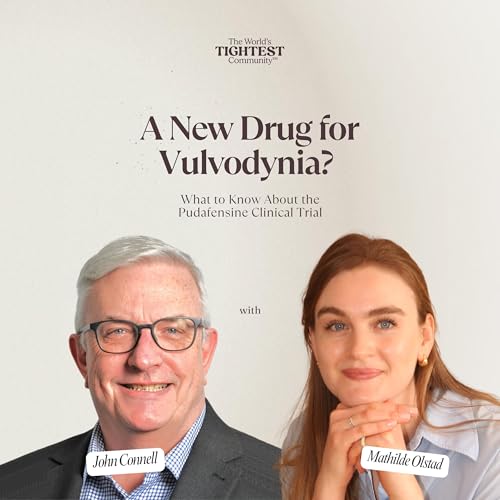
  • A New Drug for Vulvodynia? What to Know About the Pudafensine Clinical Trial
    Apr 6 2026

    There is no medication approved specifically for vulvodynia. Not a single one. John Connell and his team are trying to change that.

    In this episode, I sit down with John Connell, Chief Scientific Officer at MAC Clinical Research — one of the UK's longest-established contract research organisations. John has spent over 35 years in clinical research, and has been working with Danish biotech Initiator Pharma for the past six or seven years to develop pudafensine: a first-of-its-kind drug being investigated specifically for vulvodynia.

    Pudafensine works by increasing dopamine levels in the brain — a chemical messenger most people associate with pleasure and reward, but one that also plays a crucial role in pain modulation. Unlike the treatments many of us are already on (think amitriptyline or SNRIs), pudafensine is not repurposed from another condition. It is being specifically developed with this type of pain in mind. Preclinical studies showed early promise, and in a subsequent study on healthy volunteers using a capsaicin pain model, a single dose reduced allodynia more effectively than pregabalin — and with fewer side effects.

    We get into the science of how the drug works, what the preclinical and early human data is showing, and what it actually looks like to take part in the trial. John also speaks to the bigger picture: why vulvodynia has been so chronically under-researched, why this study is pivotal for the future of drug development in this space, and what it would mean for the field if a positive signal is found.

    If you're in the UK, aged 18–65, and have experienced vulvar pain for 12 months or more (with or without a formal diagnosis), you may be eligible to take part. Participants can receive up to £1,730 plus reasonable travel expenses. Clinics are in Manchester and Blackpool.

    Find out more and sign up here: https://researchforyou.co.uk/vulvodynia-clinical-trial-mac212?utm_source=Mathilde_Influencer&utm_medium=Podcast&utm_campaign=MAC212_MathildePodcast_V1_001

    In paid partnership with @mac_clinicalresearch

    In this episode:

    • Why there is still no approved drug for vulvodynia — and why diagnosis can take years
    • What pudafensine is and how it targets the dopamine system to interrupt pain signalling
    • How it differs from amitriptyline, SNRIs, and other treatments many listeners are already on
    • The capsaicin pain model study: what it showed, and why the results were so significant
    • What the current clinical trial actually involves, from first contact to final visit
    • Who is eligible to take part and what would exclude someone
    • Why this particular study is a pivotal moment for vulvodynia drug development
    • What it would mean — for patients, for the industry — if this works
    Show More Show Less
    45 mins
  • Solo: The Episode I've Been Afraid to Record: My Vulvodynia and Vaginismus Story
    Mar 31 2026

    For a long time, I've been standing slightly to the side of my own experience on this podcast. Today, I step into the center of it.

    In this solo episode, I share my full story with vulvodynia and vaginismus for the first time - from the first symptoms five years ago to the rock bottom moment that broke me open, and eventually, to the unexpected thing that gave me the strength to keep going.

    I talk about what it was like to be dismissed by doctors, to spend years in a treatment rabbit hole trying everything from pelvic floor physiotherapy and nortriptyline to somatic therapy and psychedelic-assisted healing. I share something I've never spoken about publicly before - a trauma history that surfaced at almost exactly the same time as my pain, and how the two were more connected than I understood at the time.

    I also talk about shame, about the grief of feeling like your body is working against you, about the isolating silence that so often surrounds these conditions - and about the Reddit thread that cracked something open in me and became the unexpected seed of this podcast.

    And I share something significant: why this podcast now has a new name.

    This episode doesn't have a clean ending. My story doesn't either - not yet. But if any part of what I've described sounds familiar, this one is for you.

    In this episode:

    • My first symptoms and the dismissal that delayed everything
    • A diagnosis of vulvodynia - and what was missing from it
    • The trauma history I've never spoken about publicly
    • Years of treatment-hopping and why I couldn't stick to my dilator routine
    • The rock bottom moment that broke me
    • Finding community on Reddit and what shifted
    • Why I started this podcast - and its new name

      Connect with me: @theworldstightestcommunity or theworldstightestcommunity.com <3
    Show More Show Less
    37 mins
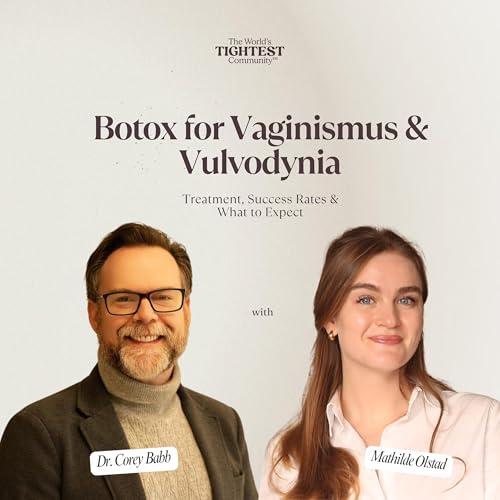
  • Botox for Vaginismus & Vulvodynia: Treatment, Success Rates & What to Expect | Dr. Corey Babb
    Mar 23 2026

    Can Botox really help treat vaginismus and vulvodynia - and if so, how does it actually work?

    In this episode, I sit down with Dr. Corey Babb, a board-certified gynecologist, ISSWSH fellow, and one of only four providers worldwide trained in the Pacik Multimodal Botox Protocol for vaginismus. Dr. Babb is the founder of Haven Center in Tulsa, Oklahoma, and co-authored the landmark research that established the five-point grading scale for vaginismus, now used internationally.

    We go deep into how Botox works physiologically, how it relates to the pain-fear-spasm cycle, who is a good candidate for it, and what the treatment and recovery process actually looks like. Dr. Babb also shares the success rates he's seeing at his clinic (around 95% of patients achieving pain-free penetration within three months), how desire is impacted after years of painful sex, and how Botox can also be used for vulvodynia patients with hypertonic pelvic floor dysfunction. We also discuss trauma-informed care and the importance of patient agency when undergoing this type of procedure.

    This is one of the most detailed and practical conversations on Botox as a treatment for vaginismus and vulvodynia that you'll find anywhere. Whether you're someone navigating one of these conditions, a partner trying to understand, or a clinician - I think you'll take a lot away from this one.

    Connect with Dr. Corey Babb:

    Haven Center: https://havencenter.com

    Instagram: @dr.coreybabb

    Research paper: Pacik PT, Babb CR, et al. "Case Series: Redefining Severe Grade 5 Vaginismus." Sexual Medicine, 2019 - https://pmc.ncbi.nlm.nih.gov/articles/PMC6963107/

    Connect with Mathilde

    IG: @theworldstightestcommunity or mathilde@theworldstightestcommunity.com

    Timestamps:

    00:00 - Welcome & introduction

    01:00 - Dr. Babb's origin story (from music theory to sexual medicine)

    03:09 - The patient case that changed everything

    04:08 - The 2019 research paper & the five-point vaginismus grading scale

    07:49 - Walking through grades 1-5

    10:27 - Measuring hypertonicity vs. psychological distress

    13:11 - How widely adopted is the grading scale?

    15:05 - The GPPPD debate and why vaginismus deserves its own classification

    16:36 - What is Botox and what does it do in the body?

    18:22 - How Botox works for vaginismus (muscles, dilution, injection technique)

    20:49 - Breaking the pain-fear-spasm cycle

    23:32 - Success rates and Botox as an "accelerator"

    25:16 - The missing piece: desire after years of painful sex

    27:18 - Traditional Botox injections vs. the Pacik protocol

    34:36 - Trauma-informed care and patient agency during treatment

    37:34 - The post-procedure protocol (dilators, timelines, what to expect)

    39:56 - Long-term outcomes: why most patients don't relapse

    41:51 - Botox for vulvodynia: who it's for and how it differs

    46:38 - The future of vulvovaginal pain treatment & mast cell activation

    Show More Show Less
    50 mins
  • Solo: ”Women Are Dying of Embarrassment” How Social Media Censorship Hides Womens Health Information
    Mar 16 2026

    Social media platforms are systematically censoring medically accurate women's health content. Words like vulva, vagina, and vulvodynia are being flagged, shadow banned, and suppressed - not because they're explicit, but because the systems designed to moderate content were never built to tell the difference. This is about accurate, life-saving health information being treated as obscene.

    The problem with this is it is enforcing the deep-rooted societal stigma around topics like menstruation, menopause and sexual wellbeing - the very stigma that advocates, clinicians and educators are working to dismantle.

    In this episode, I break down what's actually happening: the data behind the censorship, the companies and creators being penalized, the double standards baked into platform advertising policies, and why self-censorship might be the most damaging consequence of all. I also look at the historical context - how shame was literally built into the language of female anatomy centuries ago, and how that legacy is still shaping what we're allowed to say online today.

    If you've ever wondered why health creators use asterisks in place of vowels or write "s*x" on Instagram, this episode is for you.

    Connect with Mathilde

    IG: @theworldstightestcommunity or mathilde@theworldstightestcommunity.com

    Referenced in this episode:

    • Dr. Aziza Sessai - UK-based GP and women's health advocate, founder of the "They Are Not Bad Words" campaign
    • Dr. Philippa Kaye - GP and women's health advocate
    • Jackie Rotman - Founder of the Center for Intimacy Justice, whose investigation was published in the New York Times (2019) and later cited in US Senate hearings
    • CensHERship - Coalition focused on the censorship of women's health content, authors of the "Censorship Revealed" white paper and the Women's Health Visibility Alliance
    • Rachel E. Gross - Author of "Vagina Obscura"
    • Intimate Rose - Pelvic floor dilator company whose products were classified as adult content by Meta
    • Daye - Diagnostic tampon company for HPV screening whose ads were rejected under adult nudity policies
    • Hanx - Women's libido supplement available in Boots, repeatedly penalized by Meta advertising

    • Hims, Xseed, Mojo - Men's health companies whose equivalent ads were approved without issue

    Show More Show Less
    26 mins
  • The Device Designed to Make Sex Less Painful: Pelva Founder Kelley on Vulvodynia & Vaginismus
    Mar 9 2026

    What if the answer to painful sex wasn't another dilator - but something genuinely novel?

    In this episode, Mathilde sits down with Kelley, co-founder of Pelva and a fellow woman with lived-experience who went from primary vaginismus and provoked vestibulodynia to building one of the most innovative femtech products in the vulvovaginal pain space.

    Kelley breaks down exactly how Pelva's hydrogel vaginal liner works - and why the science of nociception (how pain receptors respond to pressure, friction, and force) is at the heart of its design. Think of it like an insole for your vagina: a plant-based, water-hydrated cushioning barrier that reduces concentrated pressure on the hypersensitive vestibular tissue that so many of us know too well.

    In this episode:

    • Kelley's personal journey from vaginismus to provoked vestibulodynia - and how her biomedical engineer husband helped build the solution
    • The nociceptor science behind Pelva and why cushioning is the key mechanism
    • Who the product works best for: PVD, vaginismus, GSM
    • How Pelva bridges the gap between dilator therapy and partnered sex
    • What beta testing revealed
    • Securing an NIH grant for a sexual health device (yes, really)
    • The honest reality of fundraising in femtech as a female founder

    Whether you're in active treatment for vulvodynia, vaginismus, or genitopelvic pain - or you're a pelvic health provider looking for new tools - I think you will love this episode.

    Purchase liners at www.pelva.com

    Special discount code: Baubo10 for 10% off

    Provider sample signup: here or on the clinician page on our website: https://pelva.com/pages/for-providers

    Connect on instagram: @pelvahealth @kelleysatoski

    Connect with Mathilde

    IG: @theworldstightestcommunity or mathilde@theworldstightestcommunity.com

    Show More Show Less
    39 mins
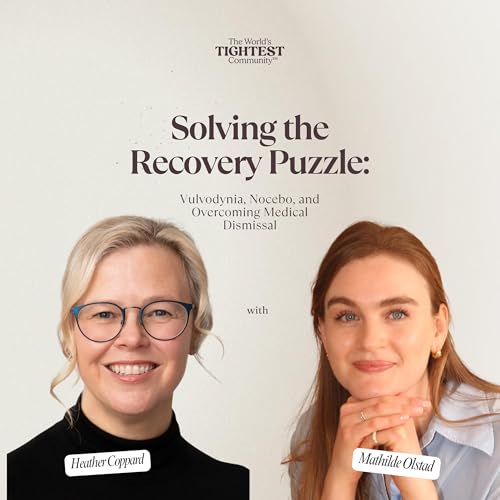
  • Solving the Recovery Puzzle: Vulvodynia, Nocebo, and Overcoming Medical Dismissal
    Mar 2 2026

    In this episode, I'm joined by Heather Coppard - nurse, hypnotherapist, and author.

    Heather spent years navigating the healthcare system as a patient with persistent vulval pain, experiencing firsthand the dismissal, gaslighting, and harmful messaging that so many of us know all too well. One particularly devastating appointment with a specialist became the turning point that drove her to write her book, set up a vulval pain support group, and dedicate her work to ensuring no other woman walks away from a consultation feeling the way she did that day.

    In this episode we cover a lot of ground - from the nocebo effect and how the language healthcare providers use can directly worsen pain outcomes, to the biopsychosocial model of persistent pain and why a multidisciplinary approach was the key to Heather's own recovery jigsaw. We also talk openly about hypnotherapy - a modality Heather was initially skeptical of as a clinician - and how it became one of the most powerful tools in her healing process alongside pharmacological intervention, CBT, pelvic floor physiotherapy, and mindfulness-based stress reduction.

    This is a hopeful episode. Heather recovered, and she has a lot of wisdom to share about what that journey looked like and what she wishes she had known at the start.

    Show Notes:

    🔗 Find Heather Coppard: Website: www.heathercoppard.com Instagram: @heather_coppard

    📖 Heather's Book: Optimising Recovery for Vulval and Vaginal Pain — available globally on Amazon and to order from all major bookstores including Barnes & Noble (US) and Waterstones (UK)

    🏥 Organisations & Resources Mentioned: The Vulval Pain Society — www.vulvalpainsociety.org The British Society for the Study of Vulval Disease (BSSVD) — www.bssvd.org NICE guidelines on hypnotherapy for IBS — www.nice.org.uk


    Connect with Mathilde

    IG: @theworldstightestcommunity or mathilde@theworldstightestcommunity.com

    Show More Show Less
    50 mins
  • Solo: What the World's Top Sexual Medicine Conference Means for Women w/ Vulvovaginal & Pelvic Pain
    Feb 19 2026

    I just got back from the ISSWSH (International Society for the Study of Women's Sexual Health) annual meeting in Long Beach, California - and I couldn't wait to bring everything I heard straight to you. This solo episode is part conference recap, part deep dive into the research I think matters most for anyone living with vulvovaginal pain, pelvic pain, or sexual pain of any kind.

    In this episode I cover:

    • What sexual medicine actually is - and why a whole field exists around it
    • Vulvodynia subtypes and treatment matching - new data showing that hormonally-driven vulvodynia has a 70% response rate to estrogen/testosterone therapy, and why getting the wrong treatment for the wrong subtype may be why nothing has worked for you
    • Endometriosis and neuroproliferative dyspareunia - a newly validated subtype of deep endo pain that is nerve-driven and needs an entirely different treatment approach
    • Pelvic venous disorder (PEVD) - essentially varicose veins inside the pelvis, and why almost no one is being checked for it despite its links to chronic pelvic pain and conditions like POTS, MCAS and hypermobility
    • The vaginal estrogen update - why the removal of the black box warning on low-dose vaginal estrogen is such a big deal, and why these symptoms aren't just a menopause issue
    • Why women's pain is still being dismissed - a powerful presentation on the clinical gaze, pain measurement, gendered bias in medicine, and the feedback loop between underfunding and misdiagnosis. Plus: the dismissal of women's pain is not evenly distributed, and we need to talk about that.
    • Access and equity - new data showing Manhattan has 60x more pelvic floor physios per capita than the Bronx, with only 21% of practices accepting Medicaid

    I also share something personal about privilege, what it means to be in a room like this, and who I'm really doing this for.

    Resources & links mentioned:

    • 🔗 ISSWSH — International Society for the Study of Women's Sexual Health
    • 🔗 @painsdownthere / @ThrushSupport - follow her on Instagram for important work on the link between recurrent thrush and vulvar nerve damage
    • 📖 When Sex Hurts: Understanding and Healing Pelvic Pain by Goldstein, Pukall, Goldstein & Krapf - the book on vulvodynia subtypes I recommend bringing to your doctor
    • 🔗 My Instagram: @theworldstightestcommunity

    If anything in this episode resonated, please reach out - I read every message. And if you're finding this podcast helpful, sharing it with someone who needs it is the biggest thing you can do.

    Show More Show Less
    36 mins