The World's Tightest Community Podcast cover art

The World's Tightest Community Podcast

The World's Tightest Community Podcast

By: Mathilde Olstad
Listen for free

About this listen

The World's Tightest Community Podcast is hosted by Mathilde. The podcast sheds light on vulvodynia and vaginismus, two conditions that affect many women but remain shrouded in taboo, under-researched and under-funded. Mathilde invites top experts across multiple fields to deliver up to date and relevant information to help people experiencing these conditions, whilst sharing her own experience with vulvodynia and vaginismus.

2025 Mathilde Olstad
Hygiene & Healthy Living
Episodes
  • Pudendal Nerve Entrapment, Decompression Surgery, and 15 Years of Pelvic Pain | Carli Cutchin
    Apr 13 2026

    What does it mean to do everything right for fifteen years — and still not get to the bottom of your pain?

    In this episode, I speak with Carli Cutchin, a writer and disability advocate with a background as a comparative literature scholar. Carli has lived with pudendal neuralgia for fifteen years and writes about chronic pain and disability for publications including Ms. Magazine. She is one of the sharpest thinkers I've come across on this topic, and this conversation goes well beyond the personal story.

    We go into Carli's full fifteen-year journey — from the initial onset of pain, through years of PT, nerve blocks, and conservative treatments that provided only partial relief, to a devastating relapse in 2020 that left her mostly bedridden. We cover the eventual diagnosis of pudendal nerve entrapment, what that actually means and how it differs from pudendal neuralgia, and the decompression surgery with Dr. Hibner that she wishes she'd known about much earlier.

    We also dig into the ideas underneath all of it — how medicine frames chronic pain, the language it uses for these conditions, and what Carli sees as the specific cost of those frameworks for women. Her constructivist perspective on this is something I found myself thinking about long after we finished recording.

    Whether you're navigating pudendal neuralgia yourself, wondering whether entrapment might be relevant to your situation, or just someone who likes to think carefully about the bigger picture — I think you'll take a lot away from this one.

    In this episode:

    • How Carli's pain started and why it took so long to get the right diagnosis
    • The difference between pudendal neuralgia and pudendal nerve entrapment
    • What decompression surgery involves and what recovery looks like
    • The trauma and somatic work Carli did — and why she's clear it didn't cause her pain
    • Her critique of how medicine talks about chronic pain in women
    • What she wishes she'd been told in year one

    • The word "pudendal" — and what it means that it comes from the Latin for shame

    Connect with Carli Cutchin:

    • Instagram: @carlicutchin
    • Website: carlicutchin.com

    Connect with Mathilde:

    • Instagram: @theworldstightestcommunity

    • Website: www.theworldstightestcommunity.com

    Show More Show Less
    1 hr and 9 mins
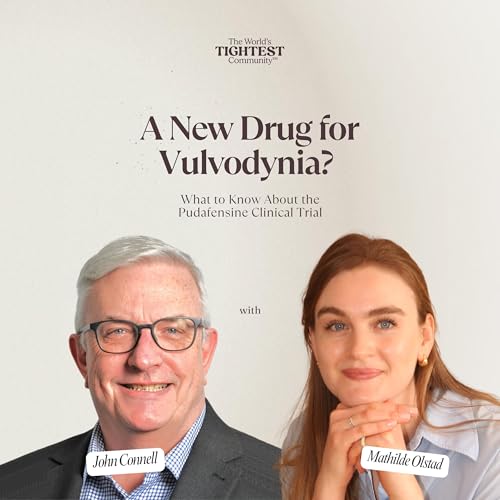
  • A New Drug for Vulvodynia? What to Know About the Pudafensine Clinical Trial
    Apr 6 2026

    There is no medication approved specifically for vulvodynia. Not a single one. John Connell and his team are trying to change that.

    In this episode, I sit down with John Connell, Chief Scientific Officer at MAC Clinical Research — one of the UK's longest-established contract research organisations. John has spent over 35 years in clinical research, and has been working with Danish biotech Initiator Pharma for the past six or seven years to develop pudafensine: a first-of-its-kind drug being investigated specifically for vulvodynia.

    Pudafensine works by increasing dopamine levels in the brain — a chemical messenger most people associate with pleasure and reward, but one that also plays a crucial role in pain modulation. Unlike the treatments many of us are already on (think amitriptyline or SNRIs), pudafensine is not repurposed from another condition. It is being specifically developed with this type of pain in mind. Preclinical studies showed early promise, and in a subsequent study on healthy volunteers using a capsaicin pain model, a single dose reduced allodynia more effectively than pregabalin — and with fewer side effects.

    We get into the science of how the drug works, what the preclinical and early human data is showing, and what it actually looks like to take part in the trial. John also speaks to the bigger picture: why vulvodynia has been so chronically under-researched, why this study is pivotal for the future of drug development in this space, and what it would mean for the field if a positive signal is found.

    If you're in the UK, aged 18–65, and have experienced vulvar pain for 12 months or more (with or without a formal diagnosis), you may be eligible to take part. Participants can receive up to £1,730 plus reasonable travel expenses. Clinics are in Manchester and Blackpool.

    Find out more and sign up here: https://researchforyou.co.uk/vulvodynia-clinical-trial-mac212?utm_source=Mathilde_Influencer&utm_medium=Podcast&utm_campaign=MAC212_MathildePodcast_V1_001

    In paid partnership with @mac_clinicalresearch

    In this episode:

    • Why there is still no approved drug for vulvodynia — and why diagnosis can take years
    • What pudafensine is and how it targets the dopamine system to interrupt pain signalling
    • How it differs from amitriptyline, SNRIs, and other treatments many listeners are already on
    • The capsaicin pain model study: what it showed, and why the results were so significant
    • What the current clinical trial actually involves, from first contact to final visit
    • Who is eligible to take part and what would exclude someone
    • Why this particular study is a pivotal moment for vulvodynia drug development
    • What it would mean — for patients, for the industry — if this works
    Show More Show Less
    45 mins
  • Solo: The Episode I've Been Afraid to Record: My Vulvodynia and Vaginismus Story
    Mar 31 2026

    For a long time, I've been standing slightly to the side of my own experience on this podcast. Today, I step into the center of it.

    In this solo episode, I share my full story with vulvodynia and vaginismus for the first time - from the first symptoms five years ago to the rock bottom moment that broke me open, and eventually, to the unexpected thing that gave me the strength to keep going.

    I talk about what it was like to be dismissed by doctors, to spend years in a treatment rabbit hole trying everything from pelvic floor physiotherapy and nortriptyline to somatic therapy and psychedelic-assisted healing. I share something I've never spoken about publicly before - a trauma history that surfaced at almost exactly the same time as my pain, and how the two were more connected than I understood at the time.

    I also talk about shame, about the grief of feeling like your body is working against you, about the isolating silence that so often surrounds these conditions - and about the Reddit thread that cracked something open in me and became the unexpected seed of this podcast.

    And I share something significant: why this podcast now has a new name.

    This episode doesn't have a clean ending. My story doesn't either - not yet. But if any part of what I've described sounds familiar, this one is for you.

    In this episode:

    • My first symptoms and the dismissal that delayed everything
    • A diagnosis of vulvodynia - and what was missing from it
    • The trauma history I've never spoken about publicly
    • Years of treatment-hopping and why I couldn't stick to my dilator routine
    • The rock bottom moment that broke me
    • Finding community on Reddit and what shifted
    • Why I started this podcast - and its new name

      Connect with me: @theworldstightestcommunity or theworldstightestcommunity.com <3
    Show More Show Less
    37 mins
No reviews yet
In the spirit of reconciliation, Audible acknowledges the Traditional Custodians of country throughout Australia and their connections to land, sea and community. We pay our respect to their elders past and present and extend that respect to all Aboriginal and Torres Strait Islander peoples today.