• Survivorship Bias
    Nov 18 2026

    When failures vanish from view, the survivors look like the whole story.

    Survivorship bias is the mistake of studying only the people, companies or things that made it through, while forgetting the ones that didn't. In this episode: the wartime bombers that came back covered in bullet holes, and why, as the story is usually told, the mathematician Abraham Wald saw that the armour belonged where the holes weren't. Then the fund scorecards S&P Dow Jones Indices has published since 2002, which count the funds that quietly closed. Then three places the bias catches us day to day: success stories at work, investing, and health advice.

    One question to take away: where are the ones who didn't make it?

    A way of thinking, not financial or medical advice.

    Also on YouTube: https://www.youtube.com/watch?v=dZqp6g62EwA
    Read more about Survivorship Bias: https://mentalmodelsdaily.com/models/survivorship-bias/
    All 365 mental models, plus the Mental Models Daily books and cards: https://mentalmodelsdaily.com

    Instagram: https://www.instagram.com/mentalmodelsdaily/
    X: https://x.com/mindmodelsdaily

    Show More Show Less
    6 mins
  • Non-Response Bias
    May 11 2025

    The people who stay silent can change the answer as much as those who reply.

    Non-Response Bias happens when the people who answer a survey, review or feedback form differ in important ways from those who stay silent. Even a well-chosen sample can produce misleading results if only certain kinds of people reply.

    Whenever you rely on responses, ask who did not answer and why. Treat low response rates as a warning sign, follow up with quieter people directly, and look for patterns across many reviews rather than the loudest stories. Silence is data too.

    Read more about Non-Response Bias: https://mentalmodelsdaily.com/models/non-response-bias/
    More models for evidence: https://mentalmodelsdaily.com/explore/evidence/

    Watch on YouTube: https://www.youtube.com/watch?v=N5YG-O5Nlzs
    All 365 mental models, plus the Mental Models Daily books and cards: https://mentalmodelsdaily.com

    Instagram: https://www.instagram.com/mentalmodelsdaily/
    X: https://x.com/mindmodelsdaily

    Our Podcast music was provided by The Podcast Host and Alitu: The Podcast Maker app.

    Show More Show Less
    6 mins
  • Theory of Mind
    May 10 2025

    Other people act on what they know and believe, not on what you know.

    Theory of mind is the ability to recognise that other people have their own beliefs, desires and emotions, and to predict what they will do based on what they know, not what you know. Psychologists test it with tasks like the Sally-Anne false-belief test.

    Use it before important conversations: ask what the other person knows, wants and fears. Explain ideas from your listener's starting point, and treat your guesses about others as hypotheses to check.

    Read more about Theory of Mind: https://mentalmodelsdaily.com/models/theory-of-mind/
    More models for people: https://mentalmodelsdaily.com/explore/people/

    Watch on YouTube: https://www.youtube.com/watch?v=8Tcm5HTx1yY
    All 365 mental models, plus the Mental Models Daily books and cards: https://mentalmodelsdaily.com

    Instagram: https://www.instagram.com/mentalmodelsdaily/
    X: https://x.com/mindmodelsdaily

    Our Podcast music was provided by The Podcast Host and Alitu: The Podcast Maker app.

    Show More Show Less
    6 mins
  • Satisficing
    May 9 2025

    Set a bar for good enough, and stop searching when something clears it.

    Satisficing, a word coined by Herbert Simon, means setting a bar for good enough and choosing the first option that clears it. Because our time, information and attention are limited, chasing the perfect choice often costs more than it gains.

    To use it, define your must-have criteria before you start looking, then stop at the first option that meets them. Save exhaustive searching for high-stakes decisions like hiring, health or major investments.

    Read more about Satisficing: https://mentalmodelsdaily.com/models/satisficing/
    More models for decisions: https://mentalmodelsdaily.com/explore/decisions/

    Watch on YouTube: https://www.youtube.com/watch?v=vBKLFU3rJZA
    All 365 mental models, plus the Mental Models Daily books and cards: https://mentalmodelsdaily.com

    Instagram: https://www.instagram.com/mentalmodelsdaily/
    X: https://x.com/mindmodelsdaily

    Our Podcast music was provided by The Podcast Host and Alitu: The Podcast Maker app.

    Show More Show Less
    6 mins
  • Replication Crisis
    May 8 2025

    A finding earns trust only when others repeat the work and get the same result.

    The replication crisis is the finding that many published studies cannot be reproduced. Small samples, lucky noise, flexible analysis and pressure to publish exciting results can all create effects that vanish on a second try.

    Use it as a filter: treat one striking study, headline or success as a starting point, not a fact. Look for independent confirmation, rerun your own wins before scaling them, and let confidence grow as evidence repeats.

    Read more about Replication Crisis: https://mentalmodelsdaily.com/models/replication-crisis/
    More models for evidence: https://mentalmodelsdaily.com/explore/evidence/

    Watch on YouTube: https://www.youtube.com/watch?v=S9MtYLl9Kac
    All 365 mental models, plus the Mental Models Daily books and cards: https://mentalmodelsdaily.com

    Instagram: https://www.instagram.com/mentalmodelsdaily/
    X: https://x.com/mindmodelsdaily

    Our Podcast music was provided by The Podcast Host and Alitu: The Podcast Maker app.

    Show More Show Less
    5 mins
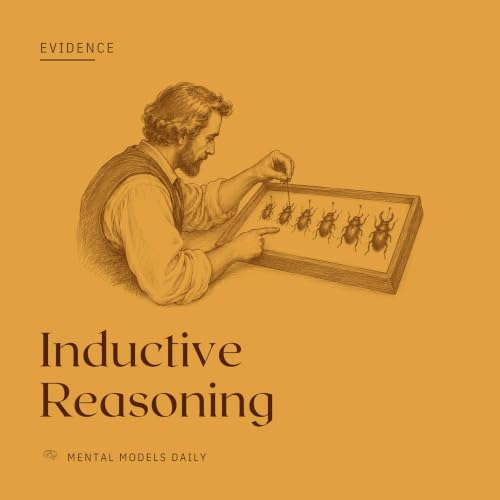
  • Inductive Reasoning
    May 7 2025

    Experience suggests what will happen next, but it can never promise it.

    Inductive reasoning is how we learn from experience: we see a pattern repeat and expect it to continue. It is essential, but its conclusions are only probable. A long streak of past observations cannot promise the future.

    Use it wisely by asking how many cases you have, how varied they are, and what could break the pattern. Hold beliefs with confidence that matches your evidence, and keep a cushion for the day the trend reverses.

    Read more about Inductive Reasoning: https://mentalmodelsdaily.com/models/inductive-reasoning/
    More models for evidence: https://mentalmodelsdaily.com/explore/evidence/

    Watch on YouTube: https://www.youtube.com/watch?v=ABpYjBJ8874
    All 365 mental models, plus the Mental Models Daily books and cards: https://mentalmodelsdaily.com

    Instagram: https://www.instagram.com/mentalmodelsdaily/
    X: https://x.com/mindmodelsdaily

    Our Podcast music was provided by The Podcast Host and Alitu: The Podcast Maker app.

    Show More Show Less
    5 mins
  • Hindsight Bias
    May 6 2025

    Once we know how things turned out, the outcome seems to have been obvious all along.

    Hindsight bias is the 'I knew it all along' effect. Once we learn an outcome, our memory quietly rewrites what we expected, making surprises look obvious and making us overconfident about predicting the future.

    To counter it, write down your predictions and reasons before results arrive, then compare. When judging past decisions, yours or anyone else's, ask what could reasonably have been known at the time, not what is known now.

    Read more about Hindsight Bias: https://mentalmodelsdaily.com/models/hindsight-bias/
    More models for your own mind: https://mentalmodelsdaily.com/explore/your-own-mind/

    Watch on YouTube: https://www.youtube.com/watch?v=mxkccjfi244
    All 365 mental models, plus the Mental Models Daily books and cards: https://mentalmodelsdaily.com

    Instagram: https://www.instagram.com/mentalmodelsdaily/
    X: https://x.com/mindmodelsdaily

    Our Podcast music was provided by The Podcast Host and Alitu: The Podcast Maker app.

    Show More Show Less
    5 mins
  • Freudian Slip
    May 5 2025

    A slip of the tongue can sometimes reveal what we really think.

    A Freudian Slip is a stumble in speech that may expose what we really think. Freud's classic case was a parliament president who opened a session by declaring it closed, and Gerald Ratner's joke mocking his own jewellery cost his company dearly.

    Use it with care: notice repeated slips and patterns rather than single mistakes, watch what your jokes reveal in public, and treat your own slips as prompts for honest self-reflection, not proof.

    Read more about Freudian Slip: https://mentalmodelsdaily.com/models/freudian-slip/
    More models for your own mind: https://mentalmodelsdaily.com/explore/your-own-mind/

    Watch on YouTube: https://www.youtube.com/watch?v=xWyhyMJI4xE
    All 365 mental models, plus the Mental Models Daily books and cards: https://mentalmodelsdaily.com

    Instagram: https://www.instagram.com/mentalmodelsdaily/
    X: https://x.com/mindmodelsdaily

    Our Podcast music was provided by The Podcast Host and Alitu: The Podcast Maker app.

    Show More Show Less
    5 mins