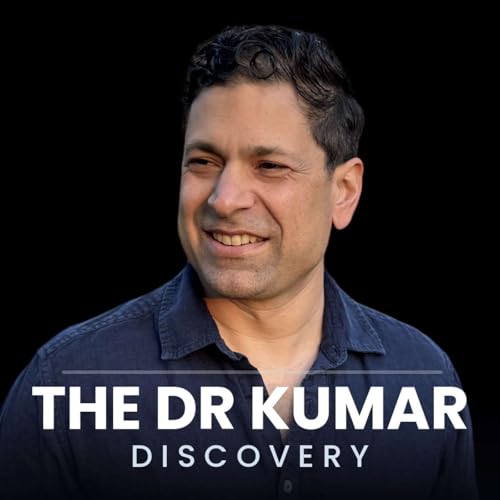
The Dr Kumar Discovery cover art

The Dr Kumar Discovery

The Dr Kumar Discovery

By: Dr Ravi Kumar MD
Listen for free

About this listen

Welcome to The Dr Kumar Discovery Podcast, where Dr Kumar challenges conventional medical dogma and offers fresh perspectives on optimizing health and wellness.2025 Kumar Media LLC Hygiene & Healthy Living Physical Illness & Disease
Episodes
  • TMS: A Game Changer for Depression and Dementia
    Dec 7 2025
    Transcranial Magnetic Stimulation (TMS) is one of the most promising, evidence-based, noninvasive treatments in modern neuroscience, yet most people, including many physicians, have never heard of it. In this episode, Dr. Ravi Kumar sits down with neurologist Dr. Ali Elahi, who has spent years treating depression, dementia, OCD, PTSD, ADHD, addiction, neuropathic pain, and post-stroke deficits using advanced, targeted TMS protocols. Unlike medications, TMS requires no anesthesia, no surgery, and no daily pills, and carries an extraordinarily low risk profile. And the clinical results, especially for treatment-resistant depression and early dementia, are often life-changing. As Dr. Elahi explains, TMS can activate underperforming brain circuits, restore connectivity, enhance neuroplasticity, and even improve biological markers of Alzheimer’s pathology. If you or someone you love has felt stuck, discouraged, or told there are “no more options,” this episode offers a rare window into a therapy that is transforming lives quietly, safely, and profoundly. WHAT WE COVER IN THIS EPISODEWhat TMS actually isA noninvasive brain-modulation therapy that uses targeted electromagnetic pulses to activate or inhibit specific neural networks—without pain, chemicals, or downtime. Why most people, including doctors, still haven’t heard of it TMS has decades of high-quality research, but minimal financial incentives behind it. Medications get advertising; TMS gets overlooked. Conditions TMS can treatTreatment-resistant depressionOCDPTSDAddictionDementia and memory disordersPost-stroke paralysis and speech recoveryChronic neuropathic painMigrainesSelect peripheral nerve injuriesADHDHow a TMS session actually feels and looks No MRI tubes. No sedation. You sit comfortably in a chair while a figure-8 magnetic coil gently “taps” on the scalp, often described as a rhythmic tapping sensation. Real-world outcomes: Dr. Elahi’s family stories From bipolar depression to peripartum anxiety to ADD, Dr. Elahi shares the dramatic improvements he saw when he treated his own family members to validate the therapy’s safety and effectiveness. Depression: Why TMS outperforms medication for many patientsMedications help 30–40% of patients; much of that is placeboStandard TMS achieves 40–60% response even in patients who already failed medicationsWith personalized targeting (MRI navigation, biomarkers), success rates can reach 80–90%Remission rates reach 40–60%, something antidepressants rarely achieve Side effects: Among the lowest of any neuropsychiatric therapyMild scalp discomfort or headacheRare transient fatigueSeizure risk: 1 in 30,000, lower than common antidepressantsNo weight gain, sexual dysfunction, emotional flattening, or daily pill burdenAccelerated protocols: How Stanford reduced 36 days of treatment to 5 days The SAINT protocol delivers multiple short sessions daily for one week, producing >90% response rates in severe depression. Why patients often feel their best 2–3 weeks after finishing therapy Neural networks continue reorganizing after the final session, leading to delayed, compounding improvements in mood and function. The misunderstood serotonin story Why the classic “low serotonin causes depression” model has been scientifically dismantled, and why TMS mechanisms are actually better understood than those of many antidepressants. Dementia: Why TMS may offer more hope than medicationsClinical trials show measurable improvements in cognitive scoresHelps reduce agitation, improve memory, increase motivationBiomarkers such as phosphorylated tau and amyloid ratios appear to normalize after TMSEnhances microglial cleanup, vascular flow, and synaptic connectivityNo known serious adverse effectsTargeting dementia with TMS Stimulation typically includes bilateral prefrontal cortex, precuneus, parietal regions, and sometimes temporal lobes—areas involved in memory, attention, and executive function. Why the FDA rejects dementia TMS trials but approves $50,000 monoclonal infusionsA candid discussion about financial incentives, regulatory culture, and why effective, low-profit treatments struggle for visibility. ABOUT DR. ALI ELAHIAli Elahi, MD is a board-certified neurologist and director of NeuroSpa Brain Rejuvenation, where he specializes in advanced, personalized TMS treatment for depression, dementia, chronic pain, OCD, PTSD, and post-stroke recovery. His approach integrates clinical neuroscience with individualized brain mapping to maximize response rates and minimize relapse. Dr. Elahi has treated thousands of patients and is pioneering the use of TMS in memory disorders, including emerging biomarker-guided protocols. He is passionate about providing safe, effective alternatives to medications, especially for patients who feel they’ve run out of options. Website: https://neurospabrain.com Clinic Phone: (949) 652-7301 YouTube: https://www.youtube.com/@neurospabrain CONNECT WITH DR...
    Show More Show Less
    1 hr and 39 mins
  • Turkey, Tryptophan, and the Biochemical Magic of Thanksgiving
    Nov 26 2025

    Thanksgiving relaxation isn’t just folklore or “turkey makes you sleepy.” It’s a real collision of biochemistry, nutrition, and human connection that shifts the body into calm, balance, and deep sleep. This episode explains how tryptophan becomes serotonin and melatonin, why carbohydrates amplify the effect, and why feeling safe with people you love may be the most powerful physiology of all.


    In this episode, you will discover:


    • What tryptophan is and why the brain depends on it

    • How tryptophan converts to serotonin and melatonin

    • Why carbs and insulin help tryptophan enter the brain

    • How “rest and digest” physiology follows a large meal

    • The role serotonin plays in calm, mood, and emotional steadiness

    • Why melatonin is a timing signal, not a sedative

    • How social connection lowers stress and signals safety to the nervous system

    • Why belonging, laughter, and gratitude may improve sleep more than food alone


    Who this episode is for:


    • Anyone curious why Thanksgiving feels uniquely calming and sleepy

    • Listeners who want a clear, science-based explanation of tryptophan and mood

    • Anyone looking to understand how biology and connection shape well-being


    Key takeaway:


    It’s not the turkey alone. The magic comes from protein plus carbohydrates, serotonin and melatonin signaling, parasympathetic “rest and digest,” and the deep biologic safety of human connection.


    Disclaimer:


    This episode is for educational purposes only and is not medical advice. Always talk to your healthcare provider about personal medical decisions or sleep concerns, especially if symptoms are persistent, severe, or worsening.


    Listen on your favorite platform:


    Apple Podcasts → https://podcasts.apple.com/us/podcast/the-dr-kumar-discovery/id1808415094

    Spotify → https://open.spotify.com/show/3UJhg3Y5jjLP8zO6hbpwfT


    Explore more episodes and references:


    https://drkumardiscovery.com/podcast/


    Follow The Dr Kumar Discovery:


    Website → https://drkumardiscovery.com/

    YouTube → https://www.youtube.com/@TheDrKumarDiscovery

    Instagram → https://www.instagram.com/thedrkumardiscovery/

    TikTok → https://www.tiktok.com/@thedrkumardiscovery


    Cheers,

    Dr. Ravi Kumar


    Show More Show Less
    11 mins
  • Iron Lungs, Fear, and a Miracle: How We Stopped Polio
    Nov 23 2025

    What if summer once meant danger instead of vacations? What if a simple dip in a swimming pool could change a child’s life forever?

    In this episode, Dr. Ravi Kumar takes you back to the terrifying era of polio in mid-20th century America, a time when hospitals filled with iron lungs, cities closed public spaces, and parents lived in constant fear. You will uncover how a mysterious virus crippled a generation, and how a global race for a vaccine transformed medicine and changed the fate of the world.

    Travel from the panic-filled summers of the 1950s to the scientific breakthroughs that led to one of the most successful vaccines in human history, and learn how the courage of scientists, volunteers, and families helped bring polio to the brink of eradication.

    In this episode, you will discover:

    • Why polio became more dangerous after sanitation improved

    • How the virus attacks the nervous system and causes paralysis

    • What iron lungs actually did and why they became symbols of the epidemic

    • The story of Paul Alexander, who lived 72 years inside an iron lung

    • How Franklin D. Roosevelt launched the March of Dimes and fueled vaccine research

    • Jonas Salk’s bold bet on a killed-virus vaccine that defied scientific dogma

    • The massive 1954 field trial involving 1.8 million Polio Pioneers

    • The Cutter incident and how it reshaped vaccine safety

    • Albert Sabin’s oral vaccine and the United States and Soviet partnership that surprised the world

    • How global vaccination campaigns drove polio cases down 99 percent

    • Why polio eradication is closer than ever, but not guaranteed


    Key Takeaways

    • Polio was once the most feared disease in America, paralyzing thousands of children every year

    • Iron lungs provided negative-pressure ventilation for children who could no longer breathe

    • Jonas Salk’s inactivated polio vaccine and Albert Sabin’s oral vaccine worked together to end widespread transmission

    • The March of Dimes was one of the earliest national crowdfunding movements for medical research

    • Polio remains endemic in only two countries, which shows that eradication is possible but requires vigilance

    • When diseases become invisible, public memory fades, and motivation to vaccinate can fall

    Why This Story Matters Today

    Polio shows how fear, science, innovation, cooperation, and public courage can shape human destiny. It reminds us that vaccines did not just prevent illness, they reshaped modern life. The lessons of polio continue to guide how we face outbreaks, medical uncertainty, and public skepticism today.

    References and Further Exploration

    Visit drkumardiscovery.com/podcast for source materials, historical references, and related episodes on medical breakthroughs and global health.

    Stay Connected

    Podcast Sign-up: drkumardiscovery.com/podcast-signup

    Website: drkumardiscovery.com

    Instagram: @thedrkumardiscovery

    Facebook: The Dr Kumar Discovery

    TikTok: @thedrkumardiscovery

    Show More Show Less
    22 mins
No reviews yet
In the spirit of reconciliation, Audible acknowledges the Traditional Custodians of country throughout Australia and their connections to land, sea and community. We pay our respect to their elders past and present and extend that respect to all Aboriginal and Torres Strait Islander peoples today.