Episodes

  • Building a dev experience for Postgres in VS Code with Rob Emanuele
    Nov 7 2025

    What do guitar busking, geospatial queries, and agentic coding have to do with Postgres? In Episode 33 of Talking Postgres, principal engineer Rob Emanuele at Microsoft shares his winding path from Venice Beach to building a new VS Code extension for PostgreSQL—that works with any Postgres, anywhere. We dig into GitHub Copilot, ask vs. agent mode, and how Rob now codes in English—and then spends even more time in code review to decide what’s good, what’s bad, and what’s dangerous. Also: how PyCon changed his life; his work on the Microsoft Planetary Computer with spatio-temporal queries and PostGIS; and how music, improv, and failure shape his approach to developer experience.


    Links mentioned in this episode:

    • Visual Studio Marketplace: VS Code extension for PostgreSQL with ~261K downloads to date
    • GitHub repo: VS Code extension for PostgreSQL (for issues/discussions)
    • Docs: GitHub Copilot agent mode
    • POSETTE 2025 Talk: Introducing Microsoft’s VS Code Extension for PostgreSQL, by Matt McFarland
    • VS Code Live: Working with PostgreSQL databases with the Microsoft PostgreSQL VS Code extension, with Olivia Guzzardo & Rob Emanuele
    • Talking Postgres Ep30: AI for data engineers with Simon Willison
    • Postgres Meetup for All: VS Code Tools for Postgres, happening on Thu Dec 11, 2025
    • Wikipedia: Dogfooding
    • Talking Postgres Ep07: Why people care about PostGIS and Postgres with Paul Ramsey & Regina Obe
    • POSETTE 2024 keynote: The Open Source Geospatial Community, PostGIS, & Postgres, by Regina Obe
    • Website: Microsoft Planetary Computer
    • GitHub repo: PgSTAC
    • Cal invite: LIVE recording of Ep34 of Talking Postgres to happen on Wed Dec 10, 2025
    Show More Show Less
    1 hr and 19 mins
  • The Fundamental Interconnectedness of All Things with Boriss Mejías
    Oct 10 2025

    What do chess clocks, jazz, and Postgres replication have in common? In Episode 32 of Talking Postgres, solution architect Boriss Mejías shares how the idea of “interconnectedness”—inspired by Douglas Adams—can help you untangle complex Postgres questions. We explore OpenAI’s approach to scaling Postgres, how Postgres active-active mirrors Sparta’s dual kingship, and how a holistic approach can reveal the behavior of synchronous replication. Also: Beethoven’s 17 drafts, and why chasing perfection can hold you back. Listen to learn more about Boriss, Postgres, and the fundamental interconnectedness of all things.


    Links mentioned in this episode:

    • Podcast Ep32 of Talking Postgres: What went wrong (& what went right) with AIO with Andres Freund
    • Podcast Ep03 of Talking Postgres: Why give talks at Postgres conferences with Álvaro Herrera & Boriss Mejías:
    • Wikipedia: Dirk Gently’s Holistic Detective Agency, by Douglas Adams
    • Talk at PGConf NYC 2025: Scaling Postgres to the Next Level at OpenAI, by Bohan Zhang
    • Video of PGConf.dev 2025 talk: Scaling Postgres to the Next Level at OpenAI, by Bohan Zhang
    • Talk at PGConf NYC 2025: Improved Freezing in Postgres Vacuum: From Idea to Commit, by Melanie Plageman
    • Talk at PGConf NYC 2025: Database Modeling to Study the New York Jazz Scene, by Boriss Mejías
    • Jazz Club in NYC: Patrick’s Place in Harlem
    • Video of PGConf EU 2024 talk: Sparta’s Dual-Kingship and PostgreSQL Active-Active, by Boriss Mejías
    • Video of POSETTE 2025 talk: Postgres Storytelling: Cunning Schema Design with Creative Data Modeling, by Boriss Mejías & Sarah Conway
    • Talk at FOSDEM PGDay 2024: High Availability Configurations Are Very Common for PostgreSQL, But How Do You Investigate Performance Problems When the Standby Can’t Keep Up? by Boriss Mejías and Derk van Veen
    • Conference: PGDay Lowlands 2025, the second year of this “second-best Postgres conference in Europe”
    • Conference Schedule: upcoming PGConf EU 2025 in Latvia
    • Wikipedia: Chess clock
    • Book: Daily Rituals, by Mason Currey
    • Article: It Takes Two to Think, by Itai Yanai & Martin J. Lercher
    • Poem: The Rime of the Ancient Mariner, by Samuel Coleridge
    • Wikipedia: City of Bruges Belgium, a good place for beer and cheese
    • Cal invite: LIVE recording of Ep33 of Talking Postgres to happen on Wed Nov 5, 2025
    Show More Show Less
    1 hr and 18 mins
  • What went wrong (& what went right) with AIO with Andres Freund
    Sep 19 2025

    Six years, a prototype, and a brief multi-layered descent into “wronger and wronger” design—what does it take to land a major architectural change in Postgres? In Episode 31 of Talking Postgres, Andres Freund—major contributor, Postgres committer, and lead of the Asynchronous I/O project—shares the wins, the missteps, and why he thinks AIO definitely took too long. We dig into io_uring in Linux, direct I/O, streaming reads, technical leadership, and exactly when is the right time to stop working on a prototype. If you’ve ever wondered how big architectural changes happen, or why they sometimes take years, this episode is for you.

    Links mentioned in this episode:

    • Talking Postgres podcast: How I got started as a developer (& in Postgres) with Andres Freund & Heikki Linnakangas
    • Release Notes: PostgreSQL 18 release notes
    • News: PostgreSQL RC 1 Released on Sep 04 2025
    • Wikipedia page: io_uring
    • PostgreSQL: Join the PostgreSQL Hacking Discord
    • Video of talk: What went wrong with AIO by Andres Freund at PGConfdev 2025
    • Commit: Add core asynchronous I/O infrastructure to PostgreSQL
    • Wiki page: AIO project in PostgreSQL with state, sub-projects, and work still to be done
    • Upcoming Talk: AIO in PG 18 and Beyond at PGConf NYC on 30 Sep 2025
    • Upcoming Talk: AIO in PG 18 and Beyond at PGConf EU on 23 Oct 2025
    • Wikipedia page: XZ Utils backdoor discovery by Andres Freund
    • Cal invite: LIVE recording of Ep32 of Talking Postgres to happen on Wed Oct 8, 2025
    Show More Show Less
    1 hr and 13 mins
  • Talking Postgres with Claire Giordano – Trailer
    Aug 15 2025

    Why do Postgres developers, contributors, and users do what they do? In each episode of Talking Postgres, Claire Giordano talks to people from across the Postgres ecosystem—how they got started, what they’ve learned, and what they’re still figuring out. This 3-minute trailer offers a fast-paced glimpse into the fun, surprising, and deeply human stories behind Postgres, including failures, wins, obstacles—and all the messy parts in between. New episodes monthly. Always on Fridays. Subscribe wherever you get your podcasts.

    Episodes from Talking Postgres with guests featured in the trailer (in order of appearance):

    Episode 01: Working in public on open source with Simon Willison and Marco Slot

    Episode 18: How I got started as a developer (& in Postgres) with David Rowley

    Episode 20: How I got started as a developer (& in Postgres) with Tom Lane

    Episode 07: Why people care about PostGIS and Postgres with Paul Ramsey & Regina Obe

    Episode 29: How I got started leading database teams with Shireesh Thota

    Episode 25: Why Python developers just use Postgres with Dawn Wages

    Episode 19: Becoming a Postgres committer with Melanie Plageman

    Episode 24: Why mentor Postgres developers with Robert Haas

    Episode 04: How I got started as a dev (& in Postgres) w/Melanie Plageman & Thomas Munro

    Show More Show Less
    3 mins
  • AI for data engineers with Simon Willison
    Aug 8 2025

    It’s always a good day if you see a pelican. In Episode 30 of Talking Postgres with Claire Giordano, open source developer Simon Willison—creator of Datasette and co-creator of Django—joins to explore how AI is useful for data engineers today. We move past the hype and boosterism to dig into example after example: structured data extraction, alt text and accessibility, safety and security (aka the fiddly bits), and why Postgres’s fine-grained permissions are such a good fit for AI-powered workflows. Also: Pulitzer-worthy data tooling, the science fiction of the 10X engineer, agents, MCP, RAG, the multitude of models, and why Simon spends so many waking hours on the jagged frontier of AI.


    Links mentioned in this episode:

    • Blog: Simon Willison’s Weblog
    • Blog: Simon’s Willison’s TIL - Things I’ve Learned
    • Podcast episode: Working in public on open source with Simon Willison and Marco Slot
    • Project page: Django Web Framework
    • Project page: Datasette, for finding stories in data
    • GitHub repo: llm CLI tool and Python library
    • Demo: Language models on the command-line w/ Simon Willison
    • Blog post: OpenAI’s new open weight (Apache 2) models are really good, by Simon Willison
    • Podcast episode: Accessibility and Gen AI podcast with guest Simon Willison
    • Blog post: New dashboard: alt text for all my images, by Simon Willison
    • Keynote talk: Big Opportunities in Small Data, by Simon Willison at Citus Con: An Event for Postgres 2023
    • Blog post: How OpenElections Uses LLMs, by Derek Willis
    • Blog posts tagged with pelican-riding-a-bicycle on Simon Willison’s Weblog
    • Blog post: No, AI is not Making Engineers 10x as Productive, via Colton Voege, featured on Simon’s weblog
    • GitHub repo: pgvector extension to Postgres
    • Cal invite: LIVE recording of Ep31 of Talking Postgres to happen on Wed Sep 17, 2025
    Show More Show Less
    1 hr and 16 mins
  • How I got started leading database teams with Shireesh Thota
    Jul 11 2025

    From dreaming of driving a bus to leading database engineering at Microsoft. In Episode 29 of Talking Postgres with Claire Giordano, Shireesh Thota traces his path to becoming CVP of Azure databases—rooted in a love of math, early BASIC programming, and a certainty that he’d become an engineer. We dig into the shift from engineer to manager (if only people came with documentation); why it’s so important for Microsoft to contribute to the PostgreSQL open source project—not just consume it; and whether Shireesh has a favorite database (hint: it better be Postgres.)

    Links mentioned in this episode:

    • Blog post excerpt: Why we have a Postgres open source contributor team at Microsoft
    • Podcast episode: Leading engineering for Postgres on Azure with Affan Dar
    • VS Code Marketplace: New VS Code extension for PostgreSQL
    • POSETTE 2025 talk: Introducing Microsoft’s VS Code extension for Postgres by Matt McFarland
    • LinkedIn post: PGConf.dev 2025 talk on “The trouble with extensions” by Marco Slot
    • Podcast episode: How I got started as a developer (& in Postgres) with David Rowley
    • Book: Who Moved My Cheese
    • Cal invite: LIVE recording of Ep30 of Talking Postgres to happen on Wed Aug 6, 2025
    Show More Show Less
    57 mins
  • 12 years of Postgres Weekly with Peter Cooper
    Jun 20 2025

    What drives someone to publish 600+ issues of a Postgres newsletter for over a decade? In Episode 28 of Talking Postgres with Claire Giordano, Peter Cooper—creator of Postgres Weekly—shares how his days of rustic programming and QBASIC fanzines on Usenet led to a newsletter empire that now reaches nearly half a million developers each week. We dig into the BBC's "big tent" editorial influence, an accidental business model that just worked, and the perils of "temporary" hacks. Plus: spam filters, a Photoshop addiction, and one very cheesy story (dairy-free).

    Links mentioned in this episode:

    • Newsletter: Postgres Weekly
    • Cooperpress: List of newsletters
    • Newsletter: Latest issue of Postgres Weekly on Jun 19, 2025
    • Newsletter: Postgres Weekly issue with horrible graphic
    • Newsletter: Very first issue of Postgres Weekly on Mar 13, 2013
    • Newsletter: Ruby Weekly, the first Cooperpress newsletter
    • Book: Beginning Ruby Third Edition, by Peter Cooper
    • Podcast episode: How I got started as a developer (& in Postgres) with David Rowley
    • Feed reader: Feedbin
    • GitHub repo: feedbin/feedbin
    • Feed reader: Feeder
    • Email testing software: Litmus
    • GitHub repo: MGML markup language for email
    • Paper: The Design of Postgres
    • GitHub repo: PGRX for building Postgres extensions in Rust
    • Podcast news: Podnews.net for daily briefings about podcasts
    • Wikipedia page: BBC Micro
    • Wikipedia page: ZX Spectrum
    • Cal invite: LIVE recording of Ep29 of Talking Postgres to happen on Wed Jul 9, 2025
    Show More Show Less
    1 hr and 17 mins
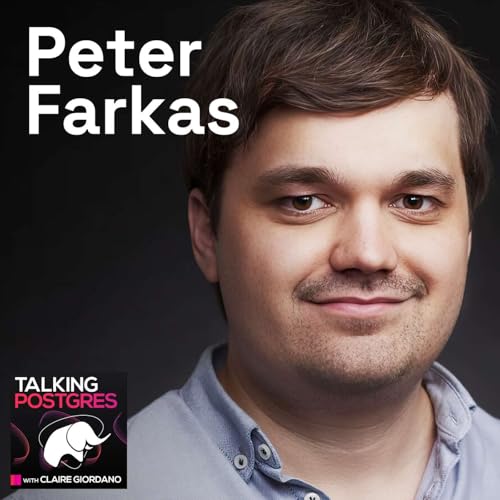
  • How I got started with FerretDB (& why we chose Postgres) with Peter Farkas
    May 9 2025

    How does a trek to K2 base camp in the Himalayas spark the idea for a database company? In Episode 27 of Talking Postgres with Claire Giordano, guest Peter Farkas—CEO and co-founder of FerretDB—shares the origin story of this open source MongoDB alternative. (Spoiler: “Ferret” wasn’t the original name). We dig into why Postgres was the obvious choice, what “true open source” means to Peter, and how FerretDB is now powered by the open source DocumentDB extension from Microsoft. Plus, why Hungarian Trappist cheese might deserve a footnote in database history.

    Links mentioned in this episode:

    • GitHub: FerretDB/FerretDB repo
    • Blog: FerretDB 2.0 GA: Open Source MongoDB alternative, ready for production
    • ACM SIGMOD: The Design of Postgres, published 15 June 1986
    • Postgres Weekly: Issue 591 featuring FerretDB
    • GitHub: Microsoft/DocumentDB open source repo
    • Conference talk: From MongoDB to Postgres: Building an Open Standard for Document Databases at POSETTE 2025
    • OSI Blog: The SSL is Not an Open Source License
    • RedMonk Blog: OSS: Two Steps Forward, One Step Back, by Stephen O’Grady
    • Talking Postgres Ep18: How I got started as a developer (& in Postgres) with David Rowley
    • OpenDocDB: initiative to define an open standard
    • Wikipedia: K2 (yes, the mountain)
    • Go Blog: The Go Gopher
    • xkcd: webcomic 927 on Standards
    • Wikipedia: Trappista cheese
    • Cal invite: LIVE recording of Ep28 of Talking Postgres to happen on Wed Jun 18, 2025
    Show More Show Less
    1 hr and 30 mins