• Navigating Dental Treatment with Sensory Differences
    Mar 17 2026

    This week, for the Spring Equinox and World Oral Health Day, I’m sharing some self-care ideas for supporting yourself through dental treatment with sensory differences.

    I’d been feeling quite proud of myself for handling the gum surgery and all it brought up (flashbacks etc) but then, boom, dental claim rejected.

    So this whole episode about advocating for yourself, with sensory differences and other AuDHD traits and symptoms, while helpful, didn’t help me with the finances of it all as I’d thought I had been advocating for myself and don’t know enough about dentist language to be able to discern in the same way that the insurance people do. I’d never had to deal with it before. So while I’m improving with the self-compassion but am feeling pretty frustrated that am €500 short and need to pay out loads more in two weeks!

    And that’s life!

    Progress not perfection!

    Healing being far from linear!

    And, with my ongoing aim to not argue with reality and ask how any problem is actually trying to help me, I guess I needed the gum surgery and couldn’t have made it happen had I known it wouldn’t have been covered.

    What I really notice is that even with my lack of dental and periodontal jargon knowhow, my attitude towards myself is kinder. For most of my 50 years, I’d have been, “I should have somehow KNOWN” whereas now I’m like, you know what? I’m not a dentist. I have no idea what any of the labels mean and that’s on them for being misleading and not at least having a glossary with lay terms.

    How about YOU?

    As you watched or listened and scanned all your parts (including your teeth!) from the soles of your feet to your soul, what needs YOUR attention?

    Are you fobbing yourself off in any way?

    Look after yourself and let me know what helps you do the far less pampery and indulgent but very important types of self-care in terms of looking after your teeth, your finances and this one and only body you have for your entire life…

    Le grá (with love),

    Eve

    CHAPTERS

    0:00 Finding support and community around sensory differences

    0:43 Podcast introduction and Eve’s background

    5:09 World Oral Health Day and anxiety about dental care

    6:03 Neurodivergence, shame and struggles with dental hygiene

    8:49 Advocating for sensory needs during dental treatment

    11:42 Healing after surgery and the impact of long-term infection

    15:04 Using the Feel. Love. Heal. framework for medical anxiety

    17:52 Self-compassion and asking for support during treatment

    23:10 Collective care and involving others in your healing

    25:06 Encouragement to seek treatment and share experiences

    27:18 Reflection and closing thoughts

    LINKS

    World Oral Health Day -

    https://www.worldoralhealthday.org/

    Book bonus videos - https://solestosoul.ie/book/yoga-videos/

    Metta meditation - https://solestosoul.ie/2019/10/02/self-care-metta-meditation-for-when-the-news-is-especially-challenging/

    #worldoralhealthday

    #audhd

    #trauma

    #dentist

    #solestosoulcarefortraumaandaudhd

    #evemenezescunningham


    Show More Show Less
    28 mins
  • Josephine Hughes on God's Love for Us ALL
    Mar 10 2026

    It was such a delight to talk to Therapy Growth Group and Good Enough Counsellors founder and fellow ADHDer Josephine Hughes again for Episode 101. Josephine hosts two podcasts (there’s a link to an episode I was on with her in the links below), Good Enough Counsellors and Gloriously Unready.

    Previously, the Feel Better Every Day Podcast, you’re listening to what’s now the Soles to Soul Care for Trauma and AuDHD with Eve Menezes Cunningham podcast. Learn to love and care for all your parts, including your AuDHD and trauma, from the soles of your feet to your soul.

    This week, Josephine shared her love of chocolate with my Míle Buíochas Mondays subscribers and in this full episode of the podcast, Josephine talks about the journey she took with her church community in terms of becoming more inclusive and loving.

    “You can be fully inclusive and therefore be in line theologically with the Bible, or you can say, no, no, no, that’s not what the Bible says at all. And really between the two positions, people try and fudge it, but it’s either one or the other. So our church, very fortunately, decides to go for full inclusivity. And it was a journey we all went on together, but we did lose a lot of people.”

    She also shares her love of music and ever-increasing self-compassion.

    Again, as you listen, notice what you’re most aware of in your physical, energetic, emotional, mental and spiritual bodies as you scan all your parts, from the soles of your feet to your soul.

    Let me know in the comments or by emailing me at eve@solestosoul.ie

    le grá (with love),

    Eve

    HASHTAGS

    #josephinehughes

    #evemenezescunningham

    #goodenoughcounsellors

    #faith

    CHAPTERS

    0:00 Self-criticism and the idea of being good enough

    0:19 Podcast introduction and Eve’s background

    4:30 Re-introducing Josephine Hughes

    6:03 The Good Enough Counsellors community and imposter syndrome

    12:09 Ideal vs good-enough self-care

    15:06 The importance of being heard and understood

    16:20 Music, faith and feeling loved and accepted

    21:02 Community care and finding an inclusive church

    24:28 Advice to a younger self about self-worth

    28:27 Where to find Josephine and her work

    29:45 Reflections and mini energy and body scan

    LINKS

    https://solestosoul.ie/book for free resources including book bonus videos for 365 Ways to Feel Better

    Episode 23: Josephine Hughes

    Eve guesting on Josephine’s Good Enough Counsellors Podcast

    Connect with Josephine

    Good Enough Counsellors:

    https://josephinehughes.com/

    Gloriously Unready Podcast: https://gloriouslyunready.com/podcast/

    Facebook Good Enough Counselling Community: https://www.facebook.com/groups/goodenoughcounsellors

    Imposter Syndrome

    https://paulineroseclance.com/impostor_phenomenon.html

    Read my interview with Marianne Williamson from Rapport, Spring 2009 https://issuu.com/rapportmag/docs/rapport_spring_09/24

    Show More Show Less
    31 mins
  • Dr Miguel Toribio-Mateas on ADHD Body and Mind
    Mar 3 2026
    Happy 100th Episode to Soles to Soul Care for Trauma and AuDHD with Eve Menezes Cunningham (formerly Feel Better Every Day)! Am sorting all the links to ensure my biggest rebrand since 2010 and some aren’t there yet so while I’m hoping you can watch or listen wherever you get your podcasts, please let me know if you have any issues (as well as any feedback, comments or questions!).Am so delighted to have the fantabulous Dr Miguel Toribio-Mateas back with me to talk about how his self-care, Self care and collective care have evolved (since episode 24!) and his new book, ADHD Body and Mind: A Compassionate Guide to Rewilding Your Nervous System with Neuroscience, Nutrition, and Gut-Brain Health.Described as “a book that speaks to both your biology and your belonging. It’s a unique, neurodiversity-affirmative resource that reframes ADHD as a natural neurotype, a different way of living and making sense of the world, rather than a disorder. It expands neuroscience beyond the brain and into the whole body. Showing how gut, microbes, breath, heart, hormones and immune system are always in conversation. ADHD Body and Mind reimagines nutrition and gut-brain health through a non-diet lens, offering flexible, compassionate tools that nourish body and mind without rules, shame or restriction and extends gentle invitations, not prescriptions, to honour your ADHD as a whole body-mind experience, rather than reducing it to symptoms to be managed. In a nutshell, ADHD Body and Mind is a companion, offering space to breathe, reflect, and return to yourself, again and again. It will help you reconnect with your body’s natural rhythms, release some of the weight of shame and perfectionism, and discover a way of living with ADHD that feels not just manageable, but meaningful.”I am so looking forward to reading it! I’ve pre-ordered my copy (it’s out on 21st April!) and you can too, wherever you buy your books.In the meantime, I hope you’ll enjoy listening as much as I enjoyed talking to him again.le grá (with love),EveLINKSDr Miguel Toribios-Mateas:Listen to our previous conversation, episode 24 of the Feel Better Every Day Podcast wherever you get your podcasts or at https://evemc.substack.com/p/the-feel-better-every-day-podcast-b80?utm_source=publication-searchInstagram: https://www.instagram.com/drmiguelmateasWebsite:https://drmiguelmateas.com/My new sitehttps://solestosoul.ieCHAPTERS(Maybe slightly off as re-recorded intro to go with the rebrand from Feel Better Every Day to Soles to Soul Care for Trauma and AuDHD)0:00 - Being present and meeting others with kindness0:47 - Celebrating episode 1000:54 - Introducing Dr Miguel Toribio-Mateas2:09 - A compassionate guide to ADHD body and mind6:14 - Listening to your needs without forcing others12:11 - Mindfulness, love and connection through animals20:50 - Community, belonging and protecting your energy27:24 - Learning self-acceptance over time31:04 - Where to connect and final reflections32:02 - Podcast closing and listener invitationFULL TRANSCRIPTPresent means that if there is somebody else in the room and they have other needs, you appreciate that their needs are different, and how can you be kind towards them so when you expect them to understand that you need to stand up and fix the curtain, whatever that might be for you. The situation of the curtain is going to be different to different people, and how can you do it in a way that you’re kind to them so when you expect them to be kind to you and not tell you god you’re such a weirdo and feel oh I feel attacked because I’ve just been told that I’m like I’m a weirdo, but you know do things in a way that you find the middle ground and present.Previously the Feel Better Every Day Podcast, this is now Soles to Soul Care for Trauma and AuDHD with Eve Menezes Cunningham. Learn to love and care for all your parts (including your trauma and AuDHD) from the soles of your feet to your soul.Welcome to episode 100 of the formerly Feel Better Every Day now Soles to Soul Care for Trauma and AuDHD Podcast. I’m delighted to welcome back one of my early guests from episode 24, Dr Miguel Toribio-Mateas.I still remember how nervous I was sending him that initial message asking if he’d like to be a guest when I was beginning. And he was the first person I heard the term AuDHD from, and he’s been such an inspiration and kind guide on this journey for me personally, just an absolute delight, so I’m so happy to have him back where he’ll be talking about how his own self-care has evolved but most excitingly his new book.I hope you love the episode as much as I adore this person who has done so much to help me and others accept and work with our differently wired brains. Let me know what you’re going to do differently as a result of listening.So thank you so much for coming back Dr Miguel Toribio-Mateas.Thank you for having me.You’re so welcome.I wanted you here to help me celebrate my 100th ...
    Show More Show Less
    37 mins
  • Defy Dystopia! Energy Clearing Meditation for Trauma and AuDHD
    Feb 24 2026
    This week’s episode follows on from Episode 98 and the seemingly endless trauma triggers from the news. It feels like it’s been getting more triggering for years and years but amping up even more recently. I keep telling myself it’s all coming up for healing and sunlight is the best disinfectant. That, ultimately, we are in the process of remembering we’re all connected, we all deserve safety, connection, love and the potential to thrive and we’re creating a new, more peaceful, free and equitable – for ALL – world.And we can do nothing to help ourselves or anyone else if we’re quietly rocking back and forth, in floods of tears, feeling helpless and hopeless. By coming together, supporting and speaking up for each other, we can find joy and hope (while doing the work we all need to do in the giant group project called life) in more sustainable ways.This simple, quick and easy (the more you practice, the quicker it gets) not only helps to clear our own energy fields and connect with our own miraculous Self but it helps us clear the space in meetings, communities and the world at large so we’re ultimately defying the dystopia some people are perfectly happy for us to feel is inevitable. It is not. We get to remember the power we all have as individuals and to amplify it by working together, energetically and in practical ways, too.Let me know a) how you get on with the meditation and b) what kind of world you’d LIKE to help contribute to building – comment or email eve@selfcarecoaching.netle grá (with love),EveThis week’s episode follows on from Episode 98 and the seemingly endless trauma triggers from the news. It feels like it’s been getting more triggering for years and years but amping up even more recently. I keep telling myself it’s all coming up for healing and sunlight is the best disinfectant. That, ultimately, we are in the process of remembering we’re all connected, we all deserve safety, connection, love and the potential to thrive and we’re creating a new, more peaceful, free and equitable – for ALL – world.And we can do nothing to help ourselves or anyone else if we’re quietly rocking back and forth, in floods of tears, feeling helpless and hopeless. By coming together, supporting and speaking up for each other, we can find joy and hope (while doing the work we all need to do in the giant group project called life) in more sustainable ways.This simple, quick and easy (the more you practice, the quicker it gets) not only helps to clear our own energy fields and connect with our own miraculous Self but it helps us clear the space in meetings, communities and the world at large so we’re ultimately defying the dystopia some people are perfectly happy for us to feel is inevitable. It is not. We get to remember the power we all have as individuals and to amplify it by working together, energetically and in practical ways, too.Let me know a) how you get on with the meditation and b) what kind of world you’d LIKE to help contribute to building – comment or email eve@selfcarecoaching.netle grá (with love),EveCHAPTERS0:00 Power, self-connection and the benefits of this energy clearing meditation0:51 Podcast intro, resources and weekly nervous system support2:52 Defying dystopia through self-care, boundaries and compassion3:53 Introducing the magnet clearing meditation5:03 Why this meditation is quick, adaptable and beginner-friendly6:09 Grounding the body and preparing the nervous system6:36 Clearing above and below to release inauthentic energy7:48 Clearing front and back for fears, pain and past experiences9:08 Clearing left and right for giving, receiving and contribution11:25 Filling the energy field with golden healing light13:30 Clearing the path ahead and staying in your miraculous Self14:59 Using the practice in daily life and difficult moments17:02 Closing reflections, ripple effects and staying connectedFULL TRANSCRIPTBut as with all of my work, I’m wanting you to remember that we have more power than we think we do. Wherever we are in the world, whatever’s going on around us, the more we connect with and look after our own self, that highest, wisest, truest, wildest, most joyful, brilliant and miraculous part of yourself, the more we connect with our own energies and work with them, befriending our trauma, histories and ADHD brains, helping ourselves heal with compassion for ourselves and others. Yes, absolutely setting boundaries. And this is where this meditation comes in.Hi, I’m Eve Menezes Cunningham and you’re listening to the Feel Better Every Day Podcast. You can find out more and access older episodes at thefeelbettereverydaypodcast.com and you can also access loads of free resources and find out more about the book, 365 Ways to Feel Better: Self-care Ideas for Embodied Wellbeing, the column I write for Platinum every month, other titles I contribute to, my work, loads of free resources I’ve created over the years.I really hope...
    Show More Show Less
    19 mins
  • Self Care When Trauma Triggers are Everywhere
    Feb 17 2026
    This is an unexpected episode on account of the pain the news is causing so many survivors (myself included!). How do we continue to function let alone thrive when the messages we keep on getting is that perpetrators rights to do whatever they feel like doing trump our basic human rights including safety?I realise that this is a very sensitive topic and it is also a topic that impacts an enormous amount of people, huge amount of people, not just women but predominantly women and girls.An enormous amount is coming up for healing. Sunlight is a wonderful disinfectant but if you’re feeling raw, tender, hopeless or anything else right now, know that you’re not alone. Know that you looking after yourself (and accessing all the available supports and resources you want and need) and not giving up is a radical act.You deserve love. You deserve safety. You deserve care. You deserve pleasure. You deserve ALL good things and I hope the resources I share in this week’s episode will help you reconnect with your own favourites, too.Let me know how you’re getting on by email or in the comments.le grá (with love),EveCHAPTERS [these may be a little off this week due to episode order changing]0:00 News, sexual violence and collective triggering0:27 Podcast intro, resources, and newsletter3:04 Bandwidth, dysregulation and the Feel. Love. Heal. framework4:46 Feel – nervous system regulation and embodied safety5:45 Love – radical self-acceptance in painful times6:15 Heal – community, accountability and collective care7:39 Reclaiming your body and sensory self-regulation10:06 Healing is not linear – from despair to thriving13:19 Co-regulation, belonging and survivor communities16:24 Survivor stories, activism and the power of solidarity18:49 Power, oppression and not giving in to despair19:45 Choosing gentleness and imagining a better world20:47 Episode closing and next week’s episodeLINKS7 Simple and Effective Self-care Tools for Trauma Survivorshttps://selfcarecoaching.net/2018/09/28/7-simple-and-effective-self-care-tools-for-trauma-survivors/https://selfcarecoaching.net/trauma/ Access more self-care, Self care and collective care resourceshttps://selfcarecoaching.net/feline Find out more about the Polyvagal Purrs approachFULL TRANSCRIPTWe’re basically being given the message time and time again with Irish headlines about [convicted] sexual predators getting less [time in prison] than speeding offenders, with the whole Epstein files… So many examples of sexual predators getting away with it and that can be incredibly triggering.Hi, I’m Eve Menezes Cunningham and you’re listening to the Feel Better Every Day Podcast.You can find out more and access older episodes at thefeelbettereverydaypodcast.com and you can also access loads of free resources and find out more about the book 365 Ways to Feel Better: Self-care Ideas for Embodied Wellbeing and the column I write for Platinum every month, other titles I contribute to, my work, loads of free resources I’ve created over the years. I really hope you enjoy this episode and if you haven’t already signed up for my free newsletter it goes out on a Monday, Míle Buíochas Mondays. Míle buíochas means a thousand thank yous in Irish which I’m very slowly learning and the idea is it’s polyvagal informed journal prompts to help you each week.There’s the gratitude practice element, figuring out more of what brings you joy on a daily basis, what helps you feel in that ventral vagal energy (what I call Purr!) when I use the rescue cats with the Polyvagal Purrs approach. I also share some of my own gratitude, some of the things that have helped me feel more in ventral vagal that week. Some of those will be resources that might benefit you and I also share news about upcoming events, special offers, things like that.The journal prompts also include encouragement to look at what is creating sympathetic survival responses (that Hiss! with the Polyvagal Purrs approach) and potentially the dorsal vagal (Freeze!) It’s really helping you learn to map your own nervous system, get to know yourself and get to support yourself. And it’s all free so if you haven’t already you can sign up at selfcarecoaching.net and if you have any questions again let me know eve@selfcarecoaching.net. I hope you enjoy this episode.Welcome to episode 98 [I CHANGED THE ORDER] of the Feel Better Every Day Podcast and I’m wondering how you’re doing with everything that’s going on in the news and I know that a lot of people are being triggered. We’re basically being given the message time and time again with Irish headlines about sexual predators getting less than speeding offences in prison with the whole Epstein files.So many examples of sexual predators getting away with it and that can be incredibly triggering. I mean there’s a sexual predator, self-confessed sexual predator in the White House. He still owes E. Jean Carroll millions and millions having been found ...
    Show More Show Less
    22 mins
  • Movement and Meaning: John Wilson's Self-care
    Feb 10 2026
    “We get a lot of meaning from creating spaces where people can come and connect, and feel like they’re in a place where they’re welcomed, and that some good things can happen.” ~ John Wilson, Co-director, Online EventsIt was SUCH a joy to talk to Online Events’ co-director, John Wilson. As well as talking about his own ideal and actual self-care, Self care and collective care practices, he shares some of what he’s learned through co-creating such a nourishing online community for therapists, counsellors and supervisors.Chapters0:01–2:26 Introduction, movement and nervous system support2:26–3:38 Welcoming John Wilson of Online Events3:38–6:22 John’s work, community building and setting the context6:22–9:10 The Feel part: movement, walking, and self-regulation9:10–12:16 Sleep, flexibility, and adapting self-care when plans change12:16–14:04 Letting go of perfection and allowing partial practices14:04–16:59 The Love part: nature, presence, and remembering connection16:59–19:01 The Heal part: community, meaning, and shared purpose at work19:01–22:38 Leadership, slowing down, and staying connected under pressure22:38–24:04 Advice to a younger self and sustaining long-term projects24:04–26:39 Closing reflections, where to find John, and final notesLinksWhere to find Online Events:Website:https://OnlinEvents.co.uk/Instagram: https://www.instagram.com/Online Eventscpd/Facebook: https://www.facebook.com/Online EventsLinkedIn: https://www.linkedin.com/company/Online Events/Twitter: https://twitter.com/Online Events_sazEpisode 86: Tracy Otsuka on the 43% of ADHDers with Excellent Mental HealthFULL TRANSCRIPTDefinitely movement is helpful for me. I’m not really a stationary person so anything that has movement in it is helpful for me. And that’s both physically and psychologically.Hi, I’m Eve Menezes Cunningham, and you’re listening to the Feel Better Every Day Podcast. You can find out more, and access older episodes, at thefeelbettereverydaypodcast.com, and you can also access loads of free resources, and find out more about the book 365 Ways to Feel Better: Self-care Ideas for Embodied Wellbeing, the column I write for Platinum every month, other titles I contribute to, my work, loads of free resources I’ve created over the years.I really hope you enjoy this episode, and if you haven’t already signed up for my free newsletter, it goes out on a Monday, Míle Buíochas Mondays. Míle Buíochas means a thousand thank yous in Irish, which I’m very slowly learning.It’s polyvagal informed journal prompts, to help you each week. There’s the gratitude practice element, figuring out more of what brings you joy on a daily basis, what helps you feel in that ventral vagal, what I call Purr! when I use the rescue cats, with the Polyvagal Purrs approach and I also share some of my own gratitudes, some of the things that have helped me feel more in the ventral vagal that week. Some of those will be resources that might benefit you.I also share news about upcoming events, special offers, things like that, but the journal prompts also include encouragement to look at what is creating sympathetic survival responses (that Hiss! with the Polyvagal Purrs approach) and, potentially, the dorsal vagal (Freeze!).It’s really helping you learn to map your own nervous system, get to know yourself, and get to support yourself, and it’s all free. So if you haven’t already, you can sign up at selfcarecoaching.net, and if you have any questions, again let me know eve@selfcarecoaching.netI hope you enjoy this episode.Welcome John Wilson, thank you so much for joining me!Thank you, yes, thank you for having me on the podcast.My absolute pleasure. I know you through Online Events, I was one of the presenters at the conference last year for neurodivergence around the rescue cats [Polyvagal Purrs – selfcarecoaching.net/feline], and I just think you’ve done so incredibly with what you’ve created, and providing so much support to so many people. And I also, really obviously, I don’t know you very well, but you seem to embody this calm, or you exude this calm, where I imagine your life is anything but, with all you’re dealing with.I ask my guests about their ideal and actual self-care, but I’ll start by just asking you to introduce yourself, and maybe say a little bit about Online Events, and anything you want to allow people to find, where they can find you online, or anything you want to plug or promote.Thank you Eve, well, thank you for having me on the podcast, that’s very generous, and it’s lovely to be here, and be in the conversation with you, and the listeners as well. As you say, I’m part of Online Events, I’m one of two directors, a director with my sister Sandra Wilson, so we’re a sibling team. What can I say about Online Events, we started in 2009, so we were really early in the online learning space, particularly in the helping professions, so we’ve had ...
    Show More Show Less
    27 mins
  • Sensory Soothers for Trauma and AuDHD this Brigid
    Feb 3 2026
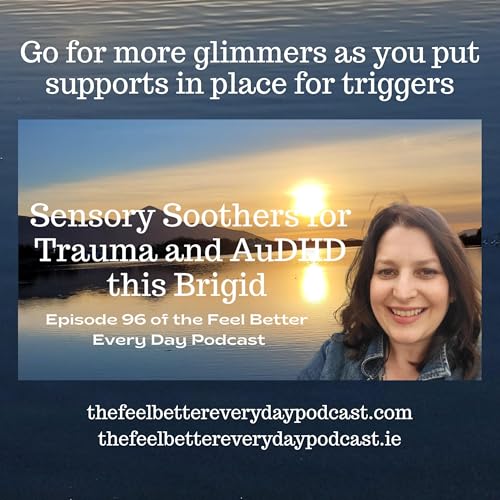
    Sensory Soothers for Trauma and AuDHD this Brigid: Episode 96 of the Feel Better Every Day PodcastDo you want to learn to soothe and support your extra sensitive (whether through trauma/s, AuDHD (autism and ADHD) or anything else) nervous system?The Goddess Brigid (we had a bank holiday yesterday to honour her, as well as her namesake, St Brigid, yesterday) is associated with so many wonderful qualities. Use her inspiration, healing and wisdom energies to protect and work with your sensitive nervous system instead of pushing through.I share some of my personal journey with swimming and sensory challenges, offering practical strategies for finding activities that bring you joy (glimmers) as well as triggering more challenging sensory issues. Navigate sensory triggers with self-compassion and create a self-care practice that honours your AuDHD brain.#brigid#sensorydifferences#sensitivenervoussystem#audhd#traumaCHAPTERS0:00–2:24 Introduction, AuDHD, balance, and nervous system support2:24–3:13 Honouring Brigid and working with an extra-sensitive nervous system3:13–6:03 Swimming as sensory soothing, regulation and coming home to the body6:03–8:16 Glimmers, play, balance and how swimming supports ADHD symptoms8:16–10:23 The Feel part: identifying glimmers, benefits and sensory blocks10:23–12:28 The Love part: self-compassion, adaptation, and working with sensory needs12:28–14:04 The Heal part: community, co-regulation and choosing when togetherness helps14:04–15:50 Closing reflections, encouragement and next episodeFULL TRANSCRIPTI love the balancing elements in terms of ADHD, balance is really helpful in terms of working with the cerebellum part of the brain and that’s really helpful in terms of some of our symptoms.Hi, I’m Eve Menezes Cunningham and you’re listening to the Feel Better Every Day Podcast. You can find out more and access older episodes at thefeelbettereverydaypodcast.com and you can also access loads of free resources and find out more about the book, 365 Ways to Feel Better: Self-care Ideas for Embodied Wellbeing, the column I write for Platinum every month, other titles I contribute to, my work, loads of free resources I’ve created over the years.I really hope you enjoy this episode and if you haven’t already signed up for my free newsletter, it goes out on a Monday, Míle Buíochas Mondays. Míle Buíochas means a thousand thank yous in Irish, which I’m very slowly learning. It’s polyvagal informed journal prompts to help you each week. There’s the gratitude practice element, figuring out more of what brings you joy on a daily basis, what helps you feel in that ventral vagal state (I call Purr! when I use the rescue cats with the Polyvagal Purrs approach) and I also share some of my own gratitudes, some of the things that have helped me feel more in ventral vagal that week.Some of those will be resources that might benefit you and I also share news about upcoming events, special offers, things like that. The journal prompts also include encouragement to look at what is creating sympathetic survival responses (that Hiss! with the Polyvagal Purrs approach) and potentially the dorsal vagal (Freeze!). It’s really helping you learn to map your own nervous system, get to know yourself and to support yourself and it’s all free. If you haven’t already, you can sign up at selfcarecoaching.net and if you have any questions again, let me know eve at selfcarecoaching.net. I hope you enjoy this episode.Welcome to episode 96 of the Feel Better Every Day Podcast and this week we’re honouring the Goddess and Saint Brigid. It’s a new bank holiday in Ireland the last few years and Brigid has enormous associations with many, many things but particularly healing, inspiration, wisdom and protection.I thought that for today’s episode we’d look at ways in which you might be inspired to heal and protect your extra-sensitive nervous system and to have that wisdom to stop pushing through and to actually work with what you need.We’re going for sensory soothers. A few weeks ago I shared some of the ways in which I’ve made yoga more accessible to myself. Yoga, breath work and meditation as well as with countless clients and students. I was thinking about it when I was swimming and if you know me at all you probably know that I adore swimming, absolutely love it, but I’m also very averse to many elements of it.Not just the cold getting into the sea but the getting changed, the noise, the hairdryer, hand dryers, any smells if people are spraying things, wet floors and ickiness in general. I struggle with an enormous amount but because I know how much I benefit from being in the water, I do it.If I’m at the sea [or a lake or river] there’s the cold, the unpredictability of it all. There are lots of things and I think I realised I don’t remember swimming at school as a child, I remember I’ve got a picture of me as a small child at infant school, I remember us ...
    Show More Show Less
    16 mins
  • RSD Part 1: Embrace Your Inner Farty McFartface
    Jan 27 2026
    Rejection Sensitivity Dysphoria (RSD) can feel debilitating when you’re living with AuDHD (autism and ADHD). In this episode, I share some of my personal journey with RSD - even at age 50! - and introduce some practical tools that help me and which can support you in stopping rejecting yourself.CHAPTERS0:00–2:22 Introduction to RSD and nervous system–informed support2:22–5:23 Why RSD is so excruciating and how self-rejection develops5:23–8:15 Early criticism, negative conditioning, and the ADHD/RSD cycle8:15–11:47 RSD in creativity, work, relationships, and self-worth11:47–13:45 Self-acceptance, self-love, and healing RSD in community13:45–15:58 Expanding life again: stopping self-rejection and finding support15:58–19:40 The Feel Love Heal framework and non-violent communication19:40–24:52 Giraffe and jackal energy: compassion, blame, and nervous system responses24:52–27:54 Fear of rejection, shame, and a very human yoga story27:54–31:55 Integration, encouragement, and closing reflectionsLINKSEpisode 71: Shadow Work with Black Cats and SharksEpisode 72: The “Independent Woman” Trap365 Ways to Feel Better: Self-care Ideas for Embodied Wellbeing https://selfcarecoaching.net/book/https://selfcarecoaching.net/2018/12/05/wellbeing-wednesday-advent-gratitude-practice-and-giraffes-and-jackals-for-better-communication-with-yourself-and-others/FULL TRANSCRIPTWelcome to Episode 95 of the Feel Better Every Day Podcast and it’s part one of on RSD, Rejection Sensitivity Dysphoria, which is so prevalent with AuDHD and that’s autism and ADHD. And it can feel debilitating.Hi, I’m Eve Menezes Cunningham and you’re listening to the Feel Better Every Day Podcast. You can find out more and access older episodes at thefeelbettereverydaypodcast.com and you can also access loads of free resources and find out more about the book, 365 Ways to Feel Better: Self-care Ideas for Embodied Wellbeing, the column I write for Platinum every month, other titles I contribute to, my work, loads of free resources I’ve created over the years.I really hope you enjoy this episode and if you haven’t already signed up for my free newsletter, it goes out on a Monday, Míle Buíochas Mondays. Míle buíochas means a thousand thank yous in Irish, which I’m very slowly learning and it’s polyvagal-informed journal prompts to help you each week. There’s the gratitude practice element, figuring out more of what brings you joy on a daily basis, what helps you feel in that ventral vagal (I call Purr!) when I use the rescue cats with the Polyvagal Purrs approach. And I also share some of my own gratitude, some of the things that have helped me feel more in ventral vagal that week. Some of those will be resources that might benefit you and I also share news about upcoming events, special offers, things like that.The journal prompts also include encouragement to look at what is creating sympathetic survival responses (that Hiss! with the Polyvagal Purrs approach) and potentially the dorsal vagal (Freeze!) It’s really helping you learn to map your own nervous system, get to know yourself and get to support yourself and it’s all free. If you haven’t already you can sign up at selfcarecoaching.net and if you have any questions again let me know either in the comments or at selfcarecoaching.netI hope you enjoy this episode. I’m not normally someone who re-records things, my style is quite natural and unpolished and sometimes haphazard, but this is possibly the latest, since I started doing the podcast, that I’ve left it in terms of getting the episodes to my amazing virtual assistant who then sorts transcription and all out for me in terms of getting it all scheduled and ready for going out on Tuesday.But I just woke up this morning thinking what I’d recorded I couldn’t share, I rejected it and that wasn’t my first attempt. It’s really weird. This is part one of a series, an occasional series, I was going to say part two would follow in a couple of weeks but I’m not going to put that pressure on myself.RSD, Rejection Sensitivity Dysphoria, Rejection Sensitivity Disorder, it is one of the most debilitating, excruciating elements of being alive with AuDHD, autism and ADHD. And I had no idea what it was until I began exploring ADHD however many years ago now and more so with the autism, with the ADHD medication treating so many of those symptoms.But I’m 50 years old and I’ve spent much of the past nine months or so feeling like a teenager in terms of the RSD. I’m feeling it so, so strong and it always makes me laugh when people have other impressions of me because I know how excruciating life can feel from the inside out and also I’m aware that my bandwidth is lower with various things going on in life.I thought I’d do this episode and I’m going to share some ways in which you can work with your own as well as giving you a bit more understanding around what it is. If you haven’t ...
    Show More Show Less
    32 mins