Episodes

  • Roles and the Responsibility Matrix
    Nov 10 2026

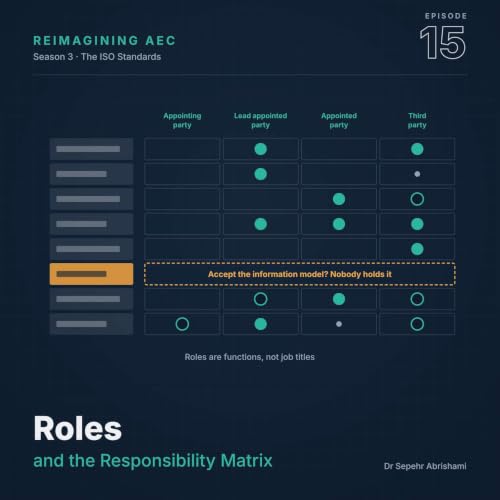
    On Reimagining AEC, his own podcast, Dr Sepehr Abrishami asks which organisation has failed when an information management task on a project goes undone, and how anyone could prove it in writing. A hypothetical council building a community hub, whose consultant's delegated scope stops at appointment, carries the argument through the four parties and the single information management function of ISO 19650, the principle at clause 7.1 of Part 1 that roles are not job titles, a reading of a project team appointment by appointment, the two matrices that share one name, a populated assignment matrix built from the clause text of ISO 19650-2, and a four-move written defence of a contested allocation.

    Chapters

    • 0:00 Opening: the information model nobody was appointed to accept
    • 2:48 Four parties and one function: parties, teams, delegation and accountability
    • 7:13 Roles are not job titles: clause 7.1 of Part 1 and a typical roles guide
    • 11:36 Reading the team against the standard: the appointment map and three defects
    • 15:52 One name, two matrices: Annex A and the responsibility matrix for information deliverables
    • 19:48 Populating the empty matrix: the two rules, the Ferrybank allocation and the arguable row
    • 26:19 Defending the boundary: the four moves, false defences and a forward look
    • 30:07 Close

    After listening, you should be able to:

    • Distinguish the appointing party, lead appointed party, appointed party and third party from the project, delivery and task teams, name an organisation's role once for each appointment it holds, and explain why responsibility can be delegated under clauses 5.1.1 and 5.3.1 of ISO 19650-2 while accountability cannot.
    • Apply clause 7.1 of ISO 19650-1 to separate job titles from functions, and identify the three faults in a roles document that uses job titles as party columns or attributes named roles to the standard.
    • Map a project team by its appointments rather than its organisation chart, find a title that spans two roles, a title that misdescribes the work and a duty with no owner, and write each finding by clause and accountable party.
    • Distinguish the informative assignment matrix in Annex A of ISO 19650-2 from the required responsibility matrix for information deliverables at clauses 5.3.2, 5.4.1 and 5.4.2, and describe a tender commitment to either without overclaiming.
    • Populate an assignment matrix from clause text, fixing the accountable entry from the party each clause names and the responsible, consulted and informed entries from the project's appointments, including a delegation shown through the third party column.
    • Defend a contested allocation, such as the common data environment row at clause 5.1.7, in four moves, and recognise statements that are offered as defences but are not.

    References

    British Standards Institution. (2013). PAS 1192-2:2013 Specification for information management for the capital/delivery phase of construction projects using building information modelling. BSI. (Withdrawn, cited as history.)

    British Standards Institution. (2018). BS EN ISO 19650-1:2018 Organization and digitization of information about buildings and civil engineering works, including building information modelling (BIM). Information management using building information modelling. Part 1: Concepts and principles. BSI.

    British Standards Institution. (2018). BS EN ISO 19650-2:2018 Organization and digitization of information about buildings and civil engineering works, including building information modelling (BIM). Information management using building information modelling. Part 2: Delivery phase of the assets (incorporating corrigendum February 2021, including UK National Annex). BSI.

    British Standards Institution. (2019). PD 19650-0:2019 Transition guidance to BS EN ISO 19650 (incorporating corrigendum No. 1). BSI. (Withdrawn, cited as history.)

    nima. (2025, May 30). New IMI Framework to extend UK BIM Framework. https://wearenima.im/new-imi-framework/

    nima. (2026, February 25). Proposed changes to ISO 19650 outlined in BSI/nima webinar. https://wearenima.im/proposed-changes-to-iso-19650-outlined-in-bsi-nima-webinar/

    Royal Institute of British Architects. (2020). RIBA plan of work 2020 overview. RIBA.

    UK BIM Framework. (2019). Information management according to BS EN ISO 19650: Guidance Part 1: Concepts (Edition 2). UK BIM Framework.

    UK BIM Framework. (2021). Information management according to BS EN ISO 19650: Guidance Part A: The information management function and resources (Edition 2). UK BIM Framework.

    Reimagining AEC is Dr Sepehr Abrishami's own podcast. For related subjects, hear Information Management in ISO 19650 Part 1: Concepts and Principles and The Delivery Phase in ISO 19650 Part 2.

    Show More Show Less
    33 mins
  • The Delivery Plans
    Nov 10 2026
    On Reimagining AEC, his own podcast, Dr Sepehr Abrishami asks how many task team plans become one master plan whose dates hold, and what a lead appointed party must do when they cannot. A hypothetical community hub, whose three task plans each look sound until they are combined, carries the argument through clauses 5.4.4 and 5.4.5 of ISO 19650-2: who owns the task information delivery plan, the six things it records for every container, setting dates backwards from the milestone, aggregating the master information delivery plan, telling a sequencing conflict from a shortage of time, and the duties to baseline, notify and inform the appointing party.Chapters0:00 Opening: three task plans that each meet the deadline until they are combined3:01 The plan every task team keeps: ownership, maintenance and the five matters to weigh8:16 Six fields for every container, and what a template adds13:12 From scope to schedule: dates set backwards, credible durations and external dependencies17:18 One plan from many: aggregation, the two review windows and the small appointment21:36 Making the dates work: two conflicts and the achievability test27:02 Baseline, notify, inform: the duties once the master plan exists, and a forward look32:08 CloseAfter listening, you should be able to:State who establishes a task information delivery plan under clause 5.4.4 of ISO 19650-2, that it is maintained throughout the appointment, and the five matters a task team weighs before scheduling, including the four activities that make up production time.Record the six things a task plan holds for every information container, explain why the estimated production duration and the information author must be stated rather than inferred, and separate required content from added management content such as status codes.Turn a task team scope into a container list, set dates backwards from an information delivery milestone through the two review windows, and record an external dependency precisely enough for another party to act on it.Explain why the master information delivery plan is aggregated rather than authored, name the four matters the lead appointed party weighs under clause 5.4.5, and say what change control as an appointment document under clause 5.4.6 means for it, including on an appointment with no appointed parties.Aggregate several task plans, find a cross-team dependency collision, and test a milestone for achievability with three questions asked in the right order, distinguishing a sequencing conflict from a shortage of available time.Baseline a master plan, write a notification a task team can act on, and recognise when the duty to inform the appointing party of a risk to a milestone is triggered, as opposed to quietly rescheduling.ReferencesBritish Standards Institution. (2013). PAS 1192-2:2013 Specification for information management for the capital/delivery phase of construction projects using building information modelling. BSI. (Withdrawn, cited as history.)British Standards Institution. (2018). BS EN ISO 19650-1:2018 Organization and digitization of information about buildings and civil engineering works, including building information modelling (BIM). Information management using building information modelling. Part 1: Concepts and principles. BSI.British Standards Institution. (2018). BS EN ISO 19650-2:2018 Organization and digitization of information about buildings and civil engineering works, including building information modelling (BIM). Information management using building information modelling. Part 2: Delivery phase of the assets (incorporating corrigendum February 2021, including UK National Annex). BSI.British Standards Institution. (2019). PD 19650-0:2019 Transition guidance to BS EN ISO 19650 (incorporating corrigendum No. 1). BSI. (Withdrawn, cited as history.)British Standards Institution. (2020). BS EN 17412-1:2020 Building information modelling. Level of information need. Part 1: Concepts and principles. BSI. (Withdrawn, superseded by BS EN ISO 7817-1:2024, cited as history.)British Standards Institution. (2020). BS EN ISO 19650-3:2020 Organization and digitization of information about buildings and civil engineering works, including building information modelling (BIM). Information management using building information modelling. Part 3: Operational phase of the assets. BSI.British Standards Institution. (2024). BS EN ISO 7817-1:2024 Building information modelling. Level of information need. Part 1: Concepts and principles. BSI.nima. (2026, February 25). Proposed changes to ISO 19650 outlined in BSI/nima webinar. https://wearenima.im/proposed-changes-to-iso-19650-outlined-in-bsi-nima-webinar/nima. (2026, May 18). Consultation on revisions to ISO 19650 Part 3 opens. https://wearenima.im/consultation-on-revisions-to-iso-19650-part-3-opens/Royal Institute of British Architects. (2020). RIBA plan of work 2020 overview. RIBA.UK BIM Framework. (2021). Information management according to BS EN ISO 19650: ...
    Show More Show Less
    35 mins
  • The BIM Execution Plan
    Nov 10 2026
    On Reimagining AEC, his own podcast, Dr Sepehr Abrishami asks how one BIM execution plan can serve both the tender and the appointment. A hypothetical community hub for a district council, whose tender cites a withdrawn standard, carries the argument from the six areas of clause 5.3.2 of ISO 19650-2, through four drafting techniques and the formal raising of a defective requirement, to confirmation under clause 5.4.1, the five completed appointment documents under change control, and the audit of a template that lags the standard.Chapters0:00 Opening: the Ferrybank tender and the requirement that cannot be answered2:36 One plan, two states: method statement, authorship and the tender response7:42 Reading the tender: the five parts of a requirement and the six areas of clause 5.3.213:36 Drafting the skeleton: eight sections, four techniques and the defect raised18:57 Confirming the plan: agreement and the six actions of clause 5.4.124:02 The appointment document set: five documents, change control and sequencing29:11 Completing the template: carried, confirmed, added and the legacy audit33:11 CloseAfter listening, you should be able to:Define the BIM execution plan from ISO 19650-2, distinguish its pre-appointment and confirmed states by author, governing clause and contractual status, and place the plan among the four tender response documents of clause 5.3.7.Read an invitation to tender in all five parts of each exchange information requirement and name the six areas that clause 5.3.2 requires a pre-appointment plan to consider.Structure a pre-appointment plan from the standard alone, answer every requirement through a response matrix, keep the proposed apart from the assumed, and raise a defective or superseded requirement through an amendment, an issue and a recorded assumption.Run a confirmation under clause 5.4.1 as an agreement with each appointed party through its six actions, and audit a plan for proposal language that should not survive confirmation.Name the five completed appointment documents of clause 5.4.6 and their mirror at clause 5.4.7, explain change control as the condition that binds them, defend settling the level of information need before the plan is confirmed, and answer the single task team question from the UK guidance.Convert a pre-appointment plan into a confirmed plan by sorting each entry as carried, confirmed or added, and correct a template where it lags the current standard.ReferencesBritish Standards Institution. (2013). PAS 1192-2:2013 Specification for information management for the capital/delivery phase of construction projects using building information modelling. BSI. (Withdrawn, cited as history.)British Standards Institution. (2018). PAS 1192-6:2018 Specification for collaborative sharing and use of structured health and safety information using BIM. BSI. (Withdrawn, cited as history.)British Standards Institution. (2018). BS EN ISO 19650-2:2018 Organization and digitization of information about buildings and civil engineering works, including building information modelling (BIM). Information management using building information modelling. Part 2: Delivery phase of the assets (incorporating corrigendum February 2021, including UK National Annex). BSI.British Standards Institution. (2020). BS EN 17412-1:2020 Building information modelling. Level of information need. Part 1: Concepts and principles. BSI. (Withdrawn, superseded by BS EN ISO 7817-1:2024, cited as history.)British Standards Institution. (2020). BS EN ISO 19650-3:2020 Organization and digitization of information about buildings and civil engineering works, including building information modelling (BIM). Information management using building information modelling. Part 3: Operational phase of the assets. BSI.British Standards Institution. (2020). BS EN ISO 19650-5:2020 Organization and digitization of information about buildings and civil engineering works, including building information modelling (BIM). Information management using building information modelling. Part 5: Security-minded approach to information management. BSI.British Standards Institution. (2024). BS EN ISO 7817-1:2024 Building information modelling. Level of information need. Part 1: Concepts and principles. BSI.British Standards Institution. (2025). BS EN ISO 19650-6:2025 Organization and digitization of information about buildings and civil engineering works, including building information modelling (BIM). Information management using building information modelling. Part 6: Health and safety information. BSI.nima. (2024, November 11). Construction Leadership Council and nima launch Information Management Initiative (IMI). https://wearenima.im/construction-leadership-council-and-nima-launch-information-management-initiative-imi/nima. (2025, May 30). New IMI Framework to extend UK BIM Framework. https://wearenima.im/new-imi-framework/nima. (2026, February 25). Proposed changes to ISO 19650 outlined in BSI/nima webinar. https://...
    Show More Show Less
    36 mins
  • The UK BIM Framework and the Move from PAS 1192
    Nov 10 2026
    On Reimagining AEC, his own podcast, Dr Sepehr Abrishami asks what the UK BIM Framework is and is not, and how a legacy document set maps onto the standards in force today. A hypothetical council's information pack, inherited from a 2016 project and about to go out with a tender, carries the argument through the framework and its renaming as the IMI Framework, routing a question to the right guidance and recording the answer, the National Foreword, National Annex and February 2021 corrigendum, the information management mandate, the Construction Playbook and Government Soft Landings, the document-level supersession map of the 1192 suite, and clause-level mapping with the withdrawn transition guidance PD 19650-0.Chapters0:00 Opening: a council's information pack inherited from 20163:31 What the framework is, who built it, who maintains it, and three things it is not8:07 Finding the answer: two guidance series, four routing decisions and a four-field record12:19 The UK layer: National Foreword, National Annex, the 2021 corrigendum, the mandate, the playbook and soft landings18:18 The supersession map: withdrawn versus superseded, and five ways a legacy document resolves23:36 Clause-level mapping with PD 19650-0: four shapes, changed vocabulary, the EIR trap and a five-move method30:54 CloseAfter listening, you should be able to:Explain what the UK BIM Framework is, name the three organisations that launched it in 2019, say who maintains it now under its current name, the IMI Framework, and state why a clause requiring compliance with the framework should point at the standard instead.Route a practitioner question to the standard, the numbered or lettered guidance, the National Annex or the transition guidance, and record the answer with the document title, edition, clause and date consulted.State what the UK edition of an ISO standard adds through its National Foreword and National Annex, explain why a citation of BS EN ISO 19650-2 should say whether it incorporates the February 2021 corrigendum, and identify the public policy, the information management mandate and the Construction Playbook, that makes the framework a procurement condition.Distinguish withdrawal from supersession, and state the current position of each document of the 1192 suite and of BS EN 17412-1, with its withdrawal date and its successor or the absence of one.Use Annex A of PD 19650-0, withdrawn transition guidance read as history, to map a legacy clause, read whether it resolves as a direct move, a split, a move into the National Annex or not applicable, and decide what to cite or require in each case.Translate legacy vocabulary into the current terms, recognise that EIR survives with a changed meaning, and verify a 2019 mapping against the current edition of the standard before relying on it.ReferencesBritish Standards Institution. (2007). BS 1192:2007+A2:2016 Collaborative production of architectural, engineering and construction information. Code of practice. BSI. (Withdrawn, cited as history.)British Standards Institution. (2013). PAS 1192-2:2013 Specification for information management for the capital/delivery phase of construction projects using building information modelling. BSI. (Withdrawn, cited as history.)British Standards Institution. (2014). BS 1192-4:2014 Collaborative production of information. Part 4: Fulfilling employer's information exchange requirements using COBie. Code of practice. BSI. (Withdrawn, cited as history.)British Standards Institution. (2014). PAS 1192-3:2014 Specification for information management for the operational phase of assets using building information modelling. BSI. (Withdrawn, cited as history.)British Standards Institution. (2015). PAS 1192-5:2015 Specification for security-minded building information modelling, digital built environments and smart asset management. BSI. (Withdrawn, cited as history.)British Standards Institution. (2018). PAS 1192-6:2018 Specification for collaborative sharing and use of structured health and safety information using BIM. BSI. (Withdrawn, cited as history.)British Standards Institution. (2018). BS EN ISO 19650-1:2018 Organization and digitization of information about buildings and civil engineering works, including building information modelling (BIM). Information management using building information modelling. Part 1: Concepts and principles. BSI.British Standards Institution. (2018). BS EN ISO 19650-2:2018 Organization and digitization of information about buildings and civil engineering works, including building information modelling (BIM). Information management using building information modelling. Part 2: Delivery phase of the assets (incorporating corrigendum February 2021, including UK National Annex). BSI.British Standards Institution. (2019). PD 19650-0:2019 Transition guidance to BS EN ISO 19650 (incorporating corrigendum No. 1). BSI. (Withdrawn, cited as history.)British Standards Institution. (2020). BS EN 17412-1:2020 Building ...
    Show More Show Less
    34 mins
  • Management Systems for Information
    Nov 10 2026
    On Reimagining AEC, his own podcast, Dr Sepehr Abrishami asks where information management should sit inside an organisation's quality, risk and safety systems, and what changes when it sits there. A hypothetical design and build contractor, certified to two standards and missing a health and safety exchange milestone, carries the argument through the harmonised structure shared by ISO 9001 and ISO 45001, the common data environment as documented information control, accountability and competence for the information management function, information risk under ISO 31000, corrective action and the normative bridge from ISO 19650-6, and the choice between one system and many, with drafting, audit and the editions now changing.Chapters0:00 Opening: a missed milestone at Block A and a contractor with two certificates3:50 One skeleton, three standards: the harmonised structure, certification and the editions in force11:55 Documented information and the common data environment17:25 Leadership, accountability, competence and the task team as an external provider24:31 Risk applied to information under ISO 31000: framework, process and register31:43 Incidents, corrective action and the bridge from ISO 19650-6 to ISO 45001 and ISO 3100038:26 One system or many: integration, drafting, audit and staying current44:56 CloseAfter listening, you should be able to:Place the commitments of a management system on the harmonised structure, clauses 4 to 10, distinguish the requirements standards ISO 9001 and ISO 45001 from the guidelines standard ISO 31000, and read a British Standard designation to separate its content, adoption and amendment years.Map the controls of a common data environment onto the documented information requirements of clause 7.5, and name the three places where the mapping breaks.Assign accountability for the information management function under clauses 4.4, 5.1 and 5.3 of ISO 9001 without inventing a role, and build the resourcing case from clauses 7.1.6, 7.2, 7.3, 7.4 and 8.4.Apply the ISO 31000 process to information risks with criteria inherited from the organisation, justify a treatment, and distinguish a risk register from a risk management framework.Trace an information nonconformity and incident through clause 10.2 of ISO 45001 to a management system cause, and explain how ISO 19650-6 depends on ISO 31000 and ISO 45001 through undated normative references.Evaluate the options for locating information management in an organisation's systems, draft clauses that pass the four tests, turn them into audit criteria, and keep the edition register current.ReferencesBritish Standards Institution. (2018). BS ISO 31000:2018 Risk management. Guidelines. BSI.British Standards Institution. (2018). BS EN ISO 19650-1:2018 Organization and digitization of information about buildings and civil engineering works, including building information modelling (BIM). Information management using building information modelling. Part 1: Concepts and principles. BSI.British Standards Institution. (2018). BS EN ISO 19650-2:2018 Organization and digitization of information about buildings and civil engineering works, including building information modelling (BIM). Information management using building information modelling. Part 2: Delivery phase of the assets (incorporating corrigendum February 2021, including UK National Annex). BSI.British Standards Institution. (2020). BS EN ISO 19650-5:2020 Organization and digitization of information about buildings and civil engineering works, including building information modelling (BIM). Information management using building information modelling. Part 5: Security-minded approach to information management. BSI.British Standards Institution. (2024). BS EN ISO 9001:2015+A1:2024 Quality management systems. Requirements. BSI. (Superseded by BS EN ISO 9001:2026 and to be withdrawn. Cited for the clause numbers used in the episode.)British Standards Institution. (2024). BS EN ISO 45001:2023+A1:2024 Occupational health and safety management systems. Requirements with guidance for use. BSI.British Standards Institution. (2025). BS EN ISO 19650-6:2025 Organization and digitization of information about buildings and civil engineering works, including building information modelling (BIM). Information management using building information modelling. Part 6: Health and safety information. BSI.British Standards Institution. (2026). BS EN ISO 9001:2026 Quality management systems. Requirements. BSI.British Standards Institution. (2026). BS EN ISO 19011:2026 Guidelines for auditing management systems. BSI.British Standards Institution. (2026, September 16). BSI and ISO update world's most used quality standard for global trade [Press release]. https://www.bsigroup.com/en-GB/insights-and-media/media-centre/press-releases/2026/september/bsi-and-iso-update-worlds-most-used-quality-standard-for-global-trade/British Standards Institution. (n.d.). ISO 45001 key changes and guidance. https://...
    Show More Show Less
    48 mins
  • Information Delivery Manuals in ISO 29481
    Nov 10 2026
    On Reimagining AEC, his own podcast, Dr Sepehr Abrishami asks how an information exchange can be specified precisely enough that every party can agree to it and software can check it. A hypothetical college teaching block, where a cost consultant receives room data it cannot trust, carries the argument through the three components of an information delivery manual under ISO 29481-1:2025, the use case and its header, interaction maps, transactions and process maps, exchange requirements built from information units and constraints, the six standard project phases and the standards around the manual, and the step from natural language to exchange view definitions, Industry Foundation Classes and the buildingSMART Information Delivery Specification.Chapters0:00 Opening: the room data a cost consultant cannot trust3:09 Why specify delivery, the three components and what the third edition changed7:21 The use case description and the common header10:27 The business context: interaction maps, transactions and process maps18:49 The exchange requirement: preconditions, information units, constraints and the level of information need boundary27:11 Project phases, the phase mapping and the standards around the manual33:03 From natural language to machine readable: exchange view definitions, Industry Foundation Classes and the Information Delivery Specification38:56 CloseAfter listening, you should be able to:Explain why information delivery has to be specified rather than assumed, name the three components clause 5.1 of ISO 29481-1 requires in order, and state what the 2025 edition changed from the withdrawn 2016 text.Write a use case description with a complete common header and the five required statements, and test an aim as a purpose rather than a deliverable.Analyse a business context with an interaction map and a process map, name the initiator and executor of each transaction, expand a transaction into its messages, and identify where the exchange requirement attaches.Specify an exchange requirement as preconditions, nested information units with unambiguous descriptions, and type and rule constraints, and state where it stops and the level of information need framework of ISO 7817-1 begins.Map the six standard project phases of ISO 22263 to a local plan of work in one of the three permitted patterns, and route a practitioner's question to the standard that governs it, distinguishing an exchange requirement from an exchange information requirement under ISO 19650.Describe what an exchange view definition does and does not do, state the current positions of ISO 16739-1:2024 and the buildingSMART Information Delivery Specification version 1.0, and explain why open information exchange is more than open file transfer.ReferencesBritish Standards Institution. (2018). BS EN ISO 19650-1:2018 Organization and digitization of information about buildings and civil engineering works, including building information modelling (BIM). Information management using building information modelling. Part 1: Concepts and principles. BSI.British Standards Institution. (2018). BS EN ISO 19650-2:2018 Organization and digitization of information about buildings and civil engineering works, including building information modelling (BIM). Information management using building information modelling. Part 2: Delivery phase of the assets (incorporating corrigendum February 2021, including UK National Annex). BSI.British Standards Institution. (2022). BS EN ISO 19650-4:2022 Organization and digitization of information about buildings and civil engineering works, including building information modelling (BIM). Information management using building information modelling. Part 4: Information exchange (including UK National Annex). BSI.British Standards Institution. (2024). BS EN ISO 7817-1:2024 Building information modelling. Level of information need. Part 1: Concepts and principles. BSI.British Standards Institution. (2026). PAS 1958:2026 Built environment data and information standards landscape. Guide. BSI.buildingSMART International. (2024). Information Delivery Specification (IDS) version 1.0. https://www.buildingsmart.org/standards/bsi-standards/information-delivery-specification-ids/buildingSMART International. (2024, June 4). Information Delivery Specification (IDS) v1.0 is approved as a final standard. https://www.buildingsmart.org/?p=30065International Organization for Standardization. (2008). ISO 22263:2008 Organization of information about construction works. Framework for management of project information. ISO.International Organization for Standardization. (2012). ISO 29481-2:2012 Building information models. Information delivery manual. Part 2: Interaction framework. ISO. (Withdrawn, cited as history.)International Organization for Standardization. (2013). ISO/IEC 19510:2013 Information technology. Object Management Group Business Process Model and Notation. ISO.International Organization for Standardization. (2016). ISO ...
    Show More Show Less
    42 mins
  • Classification and Structured Data
    Nov 10 2026
    On Reimagining AEC, his own podcast, Dr Sepehr Abrishami asks what it takes for information to be machine readable rather than merely digital. A hypothetical council school campus, whose appointment asks only for information classified to Uniclass, carries the argument through the three jobs of classification, level of information need and data templates, the classification framework of ISO 12006-2, Uniclass and how to read a code, properties and data dictionaries under ISO 23386, data templates under ISO 23387 and who supplies their content, and the drafting of classification and structured data requirements that a supplier can price, answer and be tested against.Chapters0:00 Opening: the campus whose tender returns cannot be compared2:49 Three jobs and three standards: classification, level of information need and the data template, and what the golden thread law says7:30 The classification framework in ISO 12006-2: the process model, classes, definitions, the one class rule, conformity and limits14:25 Uniclass: what it is and is not, the fifteen tables, the Systems table, reading a code aloud, the UK National Annexes and classification as metadata23:17 Properties and data dictionaries under ISO 23386: attributes, groups, governance and mapping29:31 Data templates under ISO 23387: the four concepts, one template for one purpose, and who supplies the content34:46 Writing the two requirements: the six things, level by purpose, where each part belongs, the checks, and the data schedule43:53 Close: the campus answeredAfter listening, you should be able to:Distinguish classification, level of information need and the data template as three separate requirements, name the standard that governs each, and state accurately what the golden thread regulations in England do and do not require.Place an object in the correct class of ISO 12006-2 from its definition, apply the rule that an object holds one class and one classification per table, and appraise a classification system for conformity, including the supporting document required when it departs from the recommended tables.Map the Uniclass tables onto the framework, explain the role of the Systems table and the out-of-date mapping in the UK National Foreword, read a Uniclass code level by level, and apply the UK National Annexes to ISO 19650-2 and ISO 19650-4, holding classification as metadata.Distinguish a data dictionary from a data template and a classification table, state the attributes an author must supply for a property under ISO 23386, and explain how replacement, fragmentation and merging of a property can break a requirement.Describe the four concepts and the relationship rules of a data template under ISO 23387, state its scope limit on content, and choose and justify a source of property content for a given procurement.Draft classification and structured data requirements, allocate each part to the project's information standard or the exchange information requirements with a clause reference, keep both distinct from the level of information need, and state which checks are mechanical and which need judgement.ReferencesBritish Standards Institution. (2018). BS EN ISO 19650-1:2018 Organization and digitization of information about buildings and civil engineering works, including building information modelling (BIM). Information management using building information modelling. Part 1: Concepts and principles. BSI.British Standards Institution. (2018). BS EN ISO 19650-2:2018 Organization and digitization of information about buildings and civil engineering works, including building information modelling (BIM). Information management using building information modelling. Part 2: Delivery phase of the assets (incorporating corrigendum February 2021, including UK National Annex). BSI.British Standards Institution. (2019). PD 19650-0:2019 Transition guidance to BS EN ISO 19650 (incorporating corrigendum No. 1). BSI. (Withdrawn, cited as history.)British Standards Institution. (2020). BS EN ISO 12006-2:2020 Building construction. Organization of information about construction works. Part 2: Framework for classification. BSI.British Standards Institution. (2020). BS EN ISO 23386:2020 Building information modelling and other digital processes used in construction. Methodology to describe, author and maintain properties in interconnected data dictionaries. BSI.British Standards Institution. (2020). PAS 14191:2020 Built environment. Management and operation of interconnected construction data dictionaries. Specification. BSI.British Standards Institution. (2022). BS EN ISO 19650-4:2022 Organization and digitization of information about buildings and civil engineering works, including building information modelling (BIM). Information management using building information modelling. Part 4: Information exchange (including UK National Annex). BSI.British Standards Institution. (2024). BS EN ISO 7817-1:2024 Building information modelling. Level of ...
    Show More Show Less
    47 mins
  • Information Exchange in ISO 19650 Part 4
    Nov 10 2026
    On Reimagining AEC, his own podcast, Dr Sepehr Abrishami asks what decides whether information may move from one party to another, and what the party receiving it may check. A hypothetical transport interchange whose asset data schedule arrives corrupted at the last gate carries the argument through the three actors of ISO 19650-4, the route from work in progress to publication with the mobilisation test and change actions, decision A and the exception at clause 6.4, decision B and its two steps, and the seven criteria clauses of clause 7, including the one the Five Cs shorthand leaves out. The episode closes on what a review record must carry, where COBie belongs, and which parts of a review a machine can take.Chapters0:00 Opening: the asset data schedule that opened cleanly and was wrong3:00 Three actors: provider, receiver and reviewer, and the automated reviewer6:34 The route: four process steps, the mobilisation test, the states and change actions13:07 Decision A, the provider's gate, and the exchange that never reaches shared19:40 Decision B, the two-step split, the chain behind the package and partial acceptance25:39 The seven criteria clauses, from the common data environment criterion to clause 7.734:58 The record, COBie, the machine reviewer and a forward look38:25 CloseAfter listening, you should be able to:Name the information provider, receiver and reviewer defined at clause 3.2 of ISO 19650-4, allocate them exchange by exchange, and state what note 3 to clause 3.2.3 on automated reviewers does and does not change.Place any exchange on the four process steps of clause 5, explain the mobilisation test required by clause 5.1.2 and why it comes before requirements are finalised, and trace a change action under clause 5.4 including the rule that only the provider may revise its own container.Take and record decision A under clause 6.1, including the consideration of quality assurance and quality control, and apply the exception at clause 6.4 to decide whether a container that will not be revised may leave the review, with the residual check the receivers still owe.Determine whether decision B under clause 6.2 needs one step or two, cite the clauses of ISO 19650-2 and ISO 19650-3 behind each step and the status codes S4 and S5, and handle a proposed partial acceptance honestly.Apply the seven criteria clauses of clause 7 to a container, explain why a checklist built from the Five Cs omits the mandatory criterion at clause 7.1, diagnose a communication failure, and treat clause 7.7 as informative.State what a review record must carry, place COBie accurately in relation to Part 4 and its UK National Annex, and say which review judgements resist automation and why.ReferencesBritish Standards Institution. (2014). BS 1192-4:2014 Collaborative production of information. Part 4: Fulfilling employer's information exchange requirements using COBie. Code of practice. BSI. (Withdrawn, cited as history.)British Standards Institution. (2018). BS EN ISO 19650-1:2018 Organization and digitization of information about buildings and civil engineering works, including building information modelling (BIM). Information management using building information modelling. Part 1: Concepts and principles. BSI.British Standards Institution. (2018). BS EN ISO 19650-2:2018 Organization and digitization of information about buildings and civil engineering works, including building information modelling (BIM). Information management using building information modelling. Part 2: Delivery phase of the assets (incorporating corrigendum February 2021, including UK National Annex). BSI.British Standards Institution. (2020). BS EN 17412-1:2020 Building information modelling. Level of information need. Part 1: Concepts and principles. BSI. (Withdrawn, superseded by BS EN ISO 7817-1:2024, cited as history.)British Standards Institution. (2020). BS EN ISO 19650-3:2020 Organization and digitization of information about buildings and civil engineering works, including building information modelling (BIM). Information management using building information modelling. Part 3: Operational phase of the assets. BSI.British Standards Institution. (2020). BS EN ISO 19650-5:2020 Organization and digitization of information about buildings and civil engineering works, including building information modelling (BIM). Information management using building information modelling. Part 5: Security-minded approach to information management. BSI.British Standards Institution. (2022). BS EN ISO 19650-4:2022 Organization and digitization of information about buildings and civil engineering works, including building information modelling (BIM). Information management using building information modelling. Part 4: Information exchange (including UK National Annex). BSI.British Standards Institution. (2024). BS EN ISO 7817-1:2024 Building information modelling. Level of information need. Part 1: Concepts and principles. BSI.British Standards Institution. (...
    Show More Show Less
    41 mins