Reimagining AEC cover art

Reimagining AEC

Reimagining AEC

By: Sepehr Abrishami
Listen for free

This Season's Biggest Deal | $0.99/mo for 3 months + $20 Audible bonus

Auto-renews at $8.99/mo. after 3 months - terms apply.
Summary
Reimagining AEC is Dr Sepehr Abrishami's independent podcast on how the built environment handles information. Each episode takes one subject from digital construction, from the ISO 19650 series and the common data environment to the golden thread, soft landings and the arrival of artificial intelligence in design and surveying practice, and tells it as a single argument built on the published standards, guidance and evidence. Sepehr is a researcher and former architect who leads the Centre for AI in Construction and teaches building information modelling at master's level. The episodes are written for postgraduate students and practitioners who want the reasoning behind the rules, not a summary of them.© 2026 Sepehr Abrishami. All rights reserved. Education
Episodes
  • Roles and the Responsibility Matrix
    Nov 10 2026

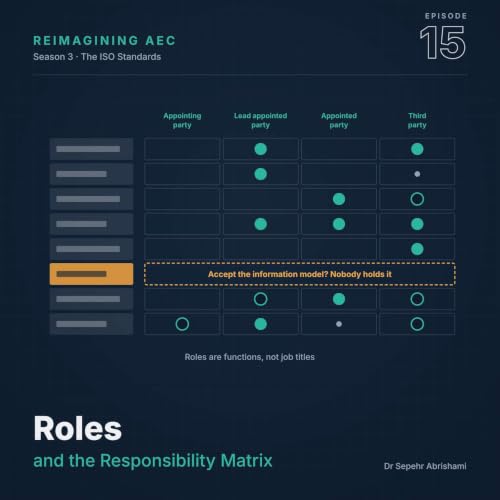
    On Reimagining AEC, his own podcast, Dr Sepehr Abrishami asks which organisation has failed when an information management task on a project goes undone, and how anyone could prove it in writing. A hypothetical council building a community hub, whose consultant's delegated scope stops at appointment, carries the argument through the four parties and the single information management function of ISO 19650, the principle at clause 7.1 of Part 1 that roles are not job titles, a reading of a project team appointment by appointment, the two matrices that share one name, a populated assignment matrix built from the clause text of ISO 19650-2, and a four-move written defence of a contested allocation.

    Chapters

    • 0:00 Opening: the information model nobody was appointed to accept
    • 2:48 Four parties and one function: parties, teams, delegation and accountability
    • 7:13 Roles are not job titles: clause 7.1 of Part 1 and a typical roles guide
    • 11:36 Reading the team against the standard: the appointment map and three defects
    • 15:52 One name, two matrices: Annex A and the responsibility matrix for information deliverables
    • 19:48 Populating the empty matrix: the two rules, the Ferrybank allocation and the arguable row
    • 26:19 Defending the boundary: the four moves, false defences and a forward look
    • 30:07 Close

    After listening, you should be able to:

    • Distinguish the appointing party, lead appointed party, appointed party and third party from the project, delivery and task teams, name an organisation's role once for each appointment it holds, and explain why responsibility can be delegated under clauses 5.1.1 and 5.3.1 of ISO 19650-2 while accountability cannot.
    • Apply clause 7.1 of ISO 19650-1 to separate job titles from functions, and identify the three faults in a roles document that uses job titles as party columns or attributes named roles to the standard.
    • Map a project team by its appointments rather than its organisation chart, find a title that spans two roles, a title that misdescribes the work and a duty with no owner, and write each finding by clause and accountable party.
    • Distinguish the informative assignment matrix in Annex A of ISO 19650-2 from the required responsibility matrix for information deliverables at clauses 5.3.2, 5.4.1 and 5.4.2, and describe a tender commitment to either without overclaiming.
    • Populate an assignment matrix from clause text, fixing the accountable entry from the party each clause names and the responsible, consulted and informed entries from the project's appointments, including a delegation shown through the third party column.
    • Defend a contested allocation, such as the common data environment row at clause 5.1.7, in four moves, and recognise statements that are offered as defences but are not.

    References

    British Standards Institution. (2013). PAS 1192-2:2013 Specification for information management for the capital/delivery phase of construction projects using building information modelling. BSI. (Withdrawn, cited as history.)

    British Standards Institution. (2018). BS EN ISO 19650-1:2018 Organization and digitization of information about buildings and civil engineering works, including building information modelling (BIM). Information management using building information modelling. Part 1: Concepts and principles. BSI.

    British Standards Institution. (2018). BS EN ISO 19650-2:2018 Organization and digitization of information about buildings and civil engineering works, including building information modelling (BIM). Information management using building information modelling. Part 2: Delivery phase of the assets (incorporating corrigendum February 2021, including UK National Annex). BSI.

    British Standards Institution. (2019). PD 19650-0:2019 Transition guidance to BS EN ISO 19650 (incorporating corrigendum No. 1). BSI. (Withdrawn, cited as history.)

    nima. (2025, May 30). New IMI Framework to extend UK BIM Framework. https://wearenima.im/new-imi-framework/

    nima. (2026, February 25). Proposed changes to ISO 19650 outlined in BSI/nima webinar. https://wearenima.im/proposed-changes-to-iso-19650-outlined-in-bsi-nima-webinar/

    Royal Institute of British Architects. (2020). RIBA plan of work 2020 overview. RIBA.

    UK BIM Framework. (2019). Information management according to BS EN ISO 19650: Guidance Part 1: Concepts (Edition 2). UK BIM Framework.

    UK BIM Framework. (2021). Information management according to BS EN ISO 19650: Guidance Part A: The information management function and resources (Edition 2). UK BIM Framework.

    Reimagining AEC is Dr Sepehr Abrishami's own podcast. For related subjects, hear Information Management in ISO 19650 Part 1: Concepts and Principles and The Delivery Phase in ISO 19650 Part 2.

    Show More Show Less
    33 mins
  • The Delivery Plans
    Nov 10 2026
    On Reimagining AEC, his own podcast, Dr Sepehr Abrishami asks how many task team plans become one master plan whose dates hold, and what a lead appointed party must do when they cannot. A hypothetical community hub, whose three task plans each look sound until they are combined, carries the argument through clauses 5.4.4 and 5.4.5 of ISO 19650-2: who owns the task information delivery plan, the six things it records for every container, setting dates backwards from the milestone, aggregating the master information delivery plan, telling a sequencing conflict from a shortage of time, and the duties to baseline, notify and inform the appointing party.Chapters0:00 Opening: three task plans that each meet the deadline until they are combined3:01 The plan every task team keeps: ownership, maintenance and the five matters to weigh8:16 Six fields for every container, and what a template adds13:12 From scope to schedule: dates set backwards, credible durations and external dependencies17:18 One plan from many: aggregation, the two review windows and the small appointment21:36 Making the dates work: two conflicts and the achievability test27:02 Baseline, notify, inform: the duties once the master plan exists, and a forward look32:08 CloseAfter listening, you should be able to:State who establishes a task information delivery plan under clause 5.4.4 of ISO 19650-2, that it is maintained throughout the appointment, and the five matters a task team weighs before scheduling, including the four activities that make up production time.Record the six things a task plan holds for every information container, explain why the estimated production duration and the information author must be stated rather than inferred, and separate required content from added management content such as status codes.Turn a task team scope into a container list, set dates backwards from an information delivery milestone through the two review windows, and record an external dependency precisely enough for another party to act on it.Explain why the master information delivery plan is aggregated rather than authored, name the four matters the lead appointed party weighs under clause 5.4.5, and say what change control as an appointment document under clause 5.4.6 means for it, including on an appointment with no appointed parties.Aggregate several task plans, find a cross-team dependency collision, and test a milestone for achievability with three questions asked in the right order, distinguishing a sequencing conflict from a shortage of available time.Baseline a master plan, write a notification a task team can act on, and recognise when the duty to inform the appointing party of a risk to a milestone is triggered, as opposed to quietly rescheduling.ReferencesBritish Standards Institution. (2013). PAS 1192-2:2013 Specification for information management for the capital/delivery phase of construction projects using building information modelling. BSI. (Withdrawn, cited as history.)British Standards Institution. (2018). BS EN ISO 19650-1:2018 Organization and digitization of information about buildings and civil engineering works, including building information modelling (BIM). Information management using building information modelling. Part 1: Concepts and principles. BSI.British Standards Institution. (2018). BS EN ISO 19650-2:2018 Organization and digitization of information about buildings and civil engineering works, including building information modelling (BIM). Information management using building information modelling. Part 2: Delivery phase of the assets (incorporating corrigendum February 2021, including UK National Annex). BSI.British Standards Institution. (2019). PD 19650-0:2019 Transition guidance to BS EN ISO 19650 (incorporating corrigendum No. 1). BSI. (Withdrawn, cited as history.)British Standards Institution. (2020). BS EN 17412-1:2020 Building information modelling. Level of information need. Part 1: Concepts and principles. BSI. (Withdrawn, superseded by BS EN ISO 7817-1:2024, cited as history.)British Standards Institution. (2020). BS EN ISO 19650-3:2020 Organization and digitization of information about buildings and civil engineering works, including building information modelling (BIM). Information management using building information modelling. Part 3: Operational phase of the assets. BSI.British Standards Institution. (2024). BS EN ISO 7817-1:2024 Building information modelling. Level of information need. Part 1: Concepts and principles. BSI.nima. (2026, February 25). Proposed changes to ISO 19650 outlined in BSI/nima webinar. https://wearenima.im/proposed-changes-to-iso-19650-outlined-in-bsi-nima-webinar/nima. (2026, May 18). Consultation on revisions to ISO 19650 Part 3 opens. https://wearenima.im/consultation-on-revisions-to-iso-19650-part-3-opens/Royal Institute of British Architects. (2020). RIBA plan of work 2020 overview. RIBA.UK BIM Framework. (2021). Information management according to BS EN ISO 19650: ...
    Show More Show Less
    35 mins
  • The BIM Execution Plan
    Nov 10 2026
    On Reimagining AEC, his own podcast, Dr Sepehr Abrishami asks how one BIM execution plan can serve both the tender and the appointment. A hypothetical community hub for a district council, whose tender cites a withdrawn standard, carries the argument from the six areas of clause 5.3.2 of ISO 19650-2, through four drafting techniques and the formal raising of a defective requirement, to confirmation under clause 5.4.1, the five completed appointment documents under change control, and the audit of a template that lags the standard.Chapters0:00 Opening: the Ferrybank tender and the requirement that cannot be answered2:36 One plan, two states: method statement, authorship and the tender response7:42 Reading the tender: the five parts of a requirement and the six areas of clause 5.3.213:36 Drafting the skeleton: eight sections, four techniques and the defect raised18:57 Confirming the plan: agreement and the six actions of clause 5.4.124:02 The appointment document set: five documents, change control and sequencing29:11 Completing the template: carried, confirmed, added and the legacy audit33:11 CloseAfter listening, you should be able to:Define the BIM execution plan from ISO 19650-2, distinguish its pre-appointment and confirmed states by author, governing clause and contractual status, and place the plan among the four tender response documents of clause 5.3.7.Read an invitation to tender in all five parts of each exchange information requirement and name the six areas that clause 5.3.2 requires a pre-appointment plan to consider.Structure a pre-appointment plan from the standard alone, answer every requirement through a response matrix, keep the proposed apart from the assumed, and raise a defective or superseded requirement through an amendment, an issue and a recorded assumption.Run a confirmation under clause 5.4.1 as an agreement with each appointed party through its six actions, and audit a plan for proposal language that should not survive confirmation.Name the five completed appointment documents of clause 5.4.6 and their mirror at clause 5.4.7, explain change control as the condition that binds them, defend settling the level of information need before the plan is confirmed, and answer the single task team question from the UK guidance.Convert a pre-appointment plan into a confirmed plan by sorting each entry as carried, confirmed or added, and correct a template where it lags the current standard.ReferencesBritish Standards Institution. (2013). PAS 1192-2:2013 Specification for information management for the capital/delivery phase of construction projects using building information modelling. BSI. (Withdrawn, cited as history.)British Standards Institution. (2018). PAS 1192-6:2018 Specification for collaborative sharing and use of structured health and safety information using BIM. BSI. (Withdrawn, cited as history.)British Standards Institution. (2018). BS EN ISO 19650-2:2018 Organization and digitization of information about buildings and civil engineering works, including building information modelling (BIM). Information management using building information modelling. Part 2: Delivery phase of the assets (incorporating corrigendum February 2021, including UK National Annex). BSI.British Standards Institution. (2020). BS EN 17412-1:2020 Building information modelling. Level of information need. Part 1: Concepts and principles. BSI. (Withdrawn, superseded by BS EN ISO 7817-1:2024, cited as history.)British Standards Institution. (2020). BS EN ISO 19650-3:2020 Organization and digitization of information about buildings and civil engineering works, including building information modelling (BIM). Information management using building information modelling. Part 3: Operational phase of the assets. BSI.British Standards Institution. (2020). BS EN ISO 19650-5:2020 Organization and digitization of information about buildings and civil engineering works, including building information modelling (BIM). Information management using building information modelling. Part 5: Security-minded approach to information management. BSI.British Standards Institution. (2024). BS EN ISO 7817-1:2024 Building information modelling. Level of information need. Part 1: Concepts and principles. BSI.British Standards Institution. (2025). BS EN ISO 19650-6:2025 Organization and digitization of information about buildings and civil engineering works, including building information modelling (BIM). Information management using building information modelling. Part 6: Health and safety information. BSI.nima. (2024, November 11). Construction Leadership Council and nima launch Information Management Initiative (IMI). https://wearenima.im/construction-leadership-council-and-nima-launch-information-management-initiative-imi/nima. (2025, May 30). New IMI Framework to extend UK BIM Framework. https://wearenima.im/new-imi-framework/nima. (2026, February 25). Proposed changes to ISO 19650 outlined in BSI/nima webinar. https://...
    Show More Show Less
    36 mins
No reviews yet
In the spirit of reconciliation, Audible acknowledges the Traditional Custodians of country throughout Australia and their connections to land, sea and community. We pay our respect to their elders past and present and extend that respect to all Aboriginal and Torres Strait Islander peoples today.