Episodes

  • Fun Facts About Impressionism
    Nov 17 2026
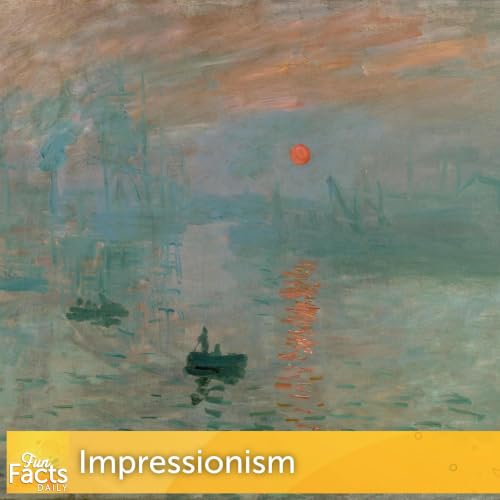
    Impressionism emerged in 19th-century France as a radical departure from academic traditions, driven by artists seeking to capture fleeting atmospheric conditions, shifting sunlight, and contemporary daily life through visible brushwork and impasto texture. The movement's iconic moniker originated as a derogatory review by critic Louis Leroy following the anonymous cooperative society exhibition of 1874, where Claude Monet's Impression, Sunrise was singled out for its sketch-like quality; rather than rejecting the insult, the artists embraced the title. Technological advancements played a pivotal role in enabling plein-air painting, particularly John Goffe Rand's 1841 invention of the collapsible tin paint tube, which replaced fragile pig-bladder pouches and allowed artists to work portably outdoors alongside newly developed synthetic pigments like cobalt blue and viridian. Key figures shaped both the aesthetic trajectory and institutional permanence of Impressionism. Mary Cassatt provided a vital American perspective within the Parisian avant-garde, focusing her canvases on intimate domestic moments and leveraging her exhibitions to support women's suffrage and major museum acquisitions. Meanwhile, Gustave Caillebotte acted as a crucial patron and organizer, utilizing his personal wealth to fund exhibitions, support struggling contemporaries like Monet and Pierre-Auguste Renoir, and assemble a foundational collection later bequeathed to the French state. Monet himself pushed optical experimentation to its limits through methodical series painting, such as his celebrated Grainstacks, and continued innovating even after 1923 cataract surgery granted him perception into the ultraviolet light spectrum, permanently altering his color palette and cementing Impressionism as a cornerstone of modern art. More episodes to explore: Who ARTed | Cassatt Who ARTed | Caillebotte ⁠Who ARTed | Monet⁠ ⁠Who ARTed | Renoir⁠ ⁠Listen Ad-Free on Patreon. ⁠ For just $3 per month, you can get ad-free versions of Fun Facts Daily, Who ARTed and Art Smart. Head over to ⁠https://www.patreon.com/cw/FunFactsDailyPod⁠ if you are interested. Want to learn more? Head over to my website www.funfactsdailypod.com and be sure to listen to my other podcasts Who ARTed: Weekly Art History for All Ages or Art Smart. For family fun, check out my son's podcast Rainbow Puppy Science Lab The image used in the episode cover art is Monet's Impression Sunrise, the painting that gave the movement its name. Fun Facts Daily is an Airwave Media Podcast. If you are interested in advertising on this or any other Airwave Media show, email: advertising@airwavemedia.com Learn more about your ad choices. Visit megaphone.fm/adchoices
    Show More Show Less
    18 mins
  • Fun Facts About the Svalbard Global Seed Vault
    Nov 16 2026
    The Svalbard Global Seed Vault is a vital international agricultural failsafe, housing duplicate seed samples from gene banks across the globe deep within the permafrost of Spitsbergen, Norway. Designed to withstand natural and man-made disasters, the facility operates under a "black box" storage model where depositing nations retain 100% legal ownership of their seeds, ensuring neutrality and confidentiality even among geopolitical rivals. Situated inside a mountain tunnel shielded by advanced security systems and natural sub-zero rock insulation, the vault maintains active storage rooms at -18°C (-0.4°F) to preserve crop genetic diversity for future generations. Beyond its core preservation mission, the facility features striking architectural integration, including Norwegian artist Dyveka Sanne’s public art installation "Perpetual Repercussion," which illuminates the entrance with fiber optics reflecting polar night and midnight sun cycles. The vault also facilitates long-term scientific research, such as a century-long germination experiment tracking seed longevity across diverse staple crops, while handling critical emergency withdrawals like the 2015 crop rescue for war-displaced agricultural research in the Middle East. By safeguarding orthodox seeds, which tolerate desiccation and freezing, the seed vault provides an indispensable ecological safety net for global food security. ⁠Listen Ad-Free on Patreon. ⁠ For just $3 per month, you can get ad-free versions of Fun Facts Daily, Who ARTed and Art Smart. Head over to ⁠https://www.patreon.com/cw/FunFactsDailyPod⁠ if you are interested. Want to learn more? Head over to my website www.funfactsdailypod.com and be sure to listen to my other podcasts Who ARTed: Weekly Art History for All Ages or Art Smart. For family fun, check out my son's podcast Rainbow Puppy Science Lab The image used in the episode cover art came from Adobe's stock assets. Fun Facts Daily is an Airwave Media Podcast. If you are interested in advertising on this or any other Airwave Media show, email: advertising@airwavemedia.com Learn more about your ad choices. Visit megaphone.fm/adchoices
    Show More Show Less
    16 mins
  • Fun Facts About Batteries
    Nov 13 2026
    Batteries are portable devices that store chemical energy and convert it into electricity through three main internal components: a negative anode, a positive cathode, and an electrolyte. While everyday devices rely on single electrochemical cells like AA and AAA batteries, true batteries, a term coined by Benjamin Franklin in 1749, consist of multiple cells wired together, such as the six 1.5-volt cells inside a standard 9-volt rectangular battery. The path to modern battery technology began in 1800 when Alessandro Volta invented the voltaic pile, creating the first continuous flow of electrical current and resolving a famous scientific debate with Luigi Galvani over "animal electricity". Centuries earlier, ancient artisans in Mesopotamia even constructed the Baghdad Battery, a terracotta jar containing a copper cylinder and iron rod capable of generating a small electric charge when filled with an acidic liquid. Modern battery sizing standards were established in the early 20th century to replace custom shapes, evolving from early A and B radio batteries to the standardized AA, AAA, C, and D cells used today. Battery technology also drove the early automotive industry; at the turn of the 20th century, roughly one-third of American cars were electric, and a Belgian electric car was the first vehicle to surpass 60 miles per hour. For optimal battery care and longevity, modern alkaline and lithium batteries should be stored in a cool, dry place at room temperature rather than in a refrigerator or freezer, as cold moisture can corrode metal terminals and reduce performance. To quickly test if an alkaline battery is fresh or dead, a simple drop test on a hard surface will reveal a dull thud for a fresh cell and a springy bounce for a depleted one due to the solidification of zinc oxide inside. ⁠Listen Ad-Free on Patreon. ⁠ For just $3 per month, you can get ad-free versions of Fun Facts Daily, Who ARTed and Art Smart. Head over to ⁠https://www.patreon.com/cw/FunFactsDailyPod⁠ if you are interested. Want to learn more? Head over to my website www.funfactsdailypod.com and be sure to listen to my other podcasts Who ARTed: Weekly Art History for All Ages or Art Smart. For family fun, check out my son's podcast Rainbow Puppy Science Lab The image used in the episode cover art came from Adobe's stock assets. Fun Facts Daily is an Airwave Media Podcast. If you are interested in advertising on this or any other Airwave Media show, email: advertising@airwavemedia.com Learn more about your ad choices. Visit megaphone.fm/adchoices
    Show More Show Less
    19 mins
  • Fun Facts About Email
    Nov 12 2026
    Electronic mail has evolved from a localized experimental file-transfer utility into the foundational communication backbone of the modern digital world, with billions of users exchanging hundreds of billions of messages every day. The technological framework for networked email was established in late 1971 by computer engineer Ray Tomlinson, who integrated messaging capabilities across the ARPANET system and popularized the iconic @ symbol to designate specific users on distinct computer hosts. Over the subsequent decades, digital communication expanded rapidly across academic, governmental, and commercial sectors, ultimately becoming a mandatory requirement for online authentication, digital receipts, and global commerce. Milestones in email history extend far beyond terrestrial computer networks, including the historic transmission of the first space-based electronic message by astronauts aboard the Space Shuttle Atlantis in August 1991 using AppleLink software. As digital correspondence grew, the phenomenon of unsolicited bulk messaging, commonly called "spam" after a famous Monty Python sketch involving canned pork, necessitated advanced cybersecurity measures, transitioning from early keyword filters to sophisticated Bayesian probability algorithms. Today, modern email infrastructure processes millions of messages per second while relying on automated spam detection systems to intercept the vast majority of unwanted traffic before it reaches user inboxes. ⁠Listen Ad-Free on Patreon. ⁠ For just $3 per month, you can get ad-free versions of Fun Facts Daily, Who ARTed and Art Smart. Head over to ⁠https://www.patreon.com/cw/FunFactsDailyPod⁠ if you are interested. Want to learn more? Head over to my website www.funfactsdailypod.com and be sure to listen to my other podcasts Who ARTed: Weekly Art History for All Ages or Art Smart. For family fun, check out my son's podcast Rainbow Puppy Science Lab The image used in the episode cover art came from Adobe's stock assets. Fun Facts Daily is an Airwave Media Podcast. If you are interested in advertising on this or any other Airwave Media show, email: advertising@airwavemedia.com Learn more about your ad choices. Visit megaphone.fm/adchoices
    Show More Show Less
    18 mins
  • Fun Facts About Robert Smalls
    Nov 11 2026
    Robert Smalls was an amazing hero of the American Civil War. He gained his freedom and helped the war effort by orchestrating a daring escape aboard the Confederate steamer CSS Planter in May 1862. Working as an enslaved wheelman aboard the ship the twenty-three-year-old Smalls took advantage of the ship's white officers sleeping ashore, disguised himself in the captain’s wide-brimmed straw hat, picked up his family and fellow crew members, and navigated past five Confederate checkpoints in Charleston Harbor to surrender the ship and valuable military intelligence to the Union naval blockade. Classified legally as a "contraband of war," Smalls received congressional prize money, met with President Abraham Lincoln to advocate for the enlistment of Black soldiers, and went on to pilot armed Union vessels. In December 1863, after refusing to surrender under heavy artillery fire in Folly Island Creek, he was appointed captain of the Planter, becoming the first African American to command a United States military vessel. Following the Civil War, Smalls championed civil rights, public education, and political reform throughout Reconstruction and the late nineteenth century. After being forcibly removed from a segregated streetcar in Philadelphia in 1864, he helped lead a three-year public boycott and lobbying campaign that resulted in Pennsylvania outlawing transit discrimination in 1867. Despite having been legally barred from learning to read as an enslaved youth, he mastered literacy as an adult and served as a delegate to South Carolina's 1868 Constitutional Convention, where he authored the resolution creating the state's first free, compulsory public school system. Smalls went on to serve in the South Carolina Legislature, won five terms in the United States House of Representatives, and purchased the Beaufort mansion where he had once been enslaved, later sheltering his former enslaver's impoverished widow until her death. His enduring legacy is commemorated across the military, including the Army vessel USAV Major General Robert Smalls and the Navy guided-missile cruiser USS Robert Smalls. ⁠Listen Ad-Free on Patreon. ⁠ For just $3 per month, you can get ad-free versions of Fun Facts Daily, Who ARTed and Art Smart. Head over to ⁠https://www.patreon.com/cw/FunFactsDailyPod⁠ if you are interested. Want to learn more? Head over to my website www.funfactsdailypod.com and be sure to listen to my other podcasts Who ARTed: Weekly Art History for All Ages or Art Smart. For family fun, check out my son's podcast Rainbow Puppy Science Lab Fun Facts Daily is an Airwave Media Podcast. If you are interested in advertising on this or any other Airwave Media show, email: advertising@airwavemedia.com Learn more about your ad choices. Visit megaphone.fm/adchoices
    Show More Show Less
    18 mins
  • Fun Facts About Toast
    Nov 10 2026
    Toasting bread transforms ordinary slices through a complex chemical process known as the Maillard reaction, which occurs when amino acids and simple sugars are exposed to heat between 280 and 330 degrees Fahrenheit. Discovered by French physician Louis-Camille Maillard in 1912, this reaction creates distinct aromas, browning, and flavor compounds by rearranging molecular structures into Amadori compounds and chain-like polymers. Beyond culinary enhancement, historical techniques for toasting bread originated as practical preservation methods in ancient Egypt and Rome to remove excess moisture, prevent mold growth, and salvage stale loaves during long journeys. Over centuries, this culinary staple evolved significantly, transitioning from open-fire cooking and spiced wine additions in medieval Europe to the invention of the automatic pop-up toaster by Charles Strite in 1919 and Otto Rohwedder's bread-slicing innovations in 1928. The physics behind the common observation that dropped toast frequently lands butter-side down has even captured scientific attention, famously studied by physicist Robert Matthews, who demonstrated that standard table heights and rotational torque give a falling slice just enough time for a half-rotation. While heat drives off roughly 15 to 20 percent of a slice's moisture, toasting does not eliminate calories or carbohydrates; instead, it alters starch structures to lower the glycemic index compared to fresh bread. Whether exploring the etymological roots shared with coffee roasting and mineral torrefaction or choosing the ideal slice thickness and toaster settings to achieve a crispy exterior while preserving a soft interior, understanding the science and history of toast reveals a fascinating intersection of chemistry, physics, and culinary tradition. ⁠Listen Ad-Free on Patreon. ⁠ For just $3 per month, you can get ad-free versions of Fun Facts Daily, Who ARTed and Art Smart. Head over to ⁠https://www.patreon.com/cw/FunFactsDailyPod⁠ if you are interested. Want to learn more? Head over to my website www.funfactsdailypod.com and be sure to listen to my other podcasts Who ARTed: Weekly Art History for All Ages or Art Smart. For family fun, check out my son's podcast Rainbow Puppy Science Lab The image used in the episode cover art came from Adobe's stock assets. Fun Facts Daily is an Airwave Media Podcast. If you are interested in advertising on this or any other Airwave Media show, email: advertising@airwavemedia.com Learn more about your ad choices. Visit megaphone.fm/adchoices
    Show More Show Less
    15 mins
  • Fun Facts About Squid
    Nov 9 2026
    Squid are highly evolved marine mollusks renowned for their complex physiology, rapid camouflage capabilities, and specialized anatomy. Their circulatory system features three hearts: two branchial hearts that pump oxygen-poor blood through the gills and a central systemic heart that circulates oxygenated blood using copper-based hemocyanin, which gives their blood a vibrant blue color. Additionally, squid have a unique ring-shaped brain that encircles the esophagus, requiring them to use a hard chitinous beak and a radula to grind food into fine pieces before swallowing to prevent neurological damage. Their skin is embedded with thousands of microscopic elastic sacs called chromatophores, which are controlled directly by nerve impulses to alter color and pattern in a fraction of a second. Beyond basic anatomy, various squid species exhibit remarkable survival adaptations, ranging from deep-sea giants to jet-propelled gliders. The colossal squid holds the title of the heaviest invertebrate on Earth, possessing eyes up to eleven inches in diameter to detect bioluminescent prey in the pitch-black depths of the Antarctic. Meanwhile, neon and Pacific flying squids can launch themselves out of the water using high-pressure water jets, gliding over one hundred feet through the air at speeds reaching twenty-five miles per hour. Furthermore, the giant nerve axons discovered in longfin squids proved instrumental in twentieth-century neurobiology, allowing scientists to decode the electrical action potentials of nerve cells and earning a Nobel Prize, while smaller species like the Hawaiian bobtail squid utilize symbiotic bioluminescent bacteria for counterillumination camouflage. ⁠Listen Ad-Free on Patreon. ⁠ For just $3 per month, you can get ad-free versions of Fun Facts Daily, Who ARTed and Art Smart. Head over to ⁠https://www.patreon.com/cw/FunFactsDailyPod⁠ if you are interested. Want to learn more? Head over to my website www.funfactsdailypod.com and be sure to listen to my other podcasts Who ARTed: Weekly Art History for All Ages or Art Smart. For family fun, check out my son's podcast Rainbow Puppy Science Lab The image used in the episode cover art came from Adobe's stock assets. Fun Facts Daily is an Airwave Media Podcast. If you are interested in advertising on this or any other Airwave Media show, email: advertising@airwavemedia.com Learn more about your ad choices. Visit megaphone.fm/adchoices
    Show More Show Less
    17 mins
  • Fun Facts About Kid Inventors
    Nov 6 2026
    The history of innovation is filled with remarkable breakthroughs pioneered by young minds, showing that age is no barrier to creative problem-solving. From everyday household items to life-changing technological advancements, children and teenagers have consistently designed, patented, and brought practical inventions to market that continue to shape modern society. These young inventors often draw inspiration from personal frustrations and everyday observations, turning simple ideas into functional prototypes using basic materials and independent ingenuity. Kids have invented all sorts of things from toys and sports gear to assistive devices and communication technology. Young visionaries have tackled complex engineering challenges, like electronic image transmission and thermal energy generation. Educational initiatives and invention conventions worldwide continue to support this spirit of ingenuity, encouraging students of all ages to observe their surroundings, identify design flaws, and engineer original solutions. ⁠Listen Ad-Free on Patreon. ⁠ For just $3 per month, you can get ad-free versions of Fun Facts Daily, Who ARTed and Art Smart. Head over to ⁠https://www.patreon.com/cw/FunFactsDailyPod⁠ if you are interested. Want to learn more? Head over to my website www.funfactsdailypod.com and be sure to listen to my other podcasts Who ARTed: Weekly Art History for All Ages or Art Smart. For family fun, check out my son's podcast Rainbow Puppy Science Lab Fun Facts Daily is an Airwave Media Podcast. If you are interested in advertising on this or any other Airwave Media show, email: advertising@airwavemedia.com Learn more about your ad choices. Visit megaphone.fm/adchoices
    Show More Show Less
    17 mins