Episodes

  • This AI Agent Answers the Phone, Qualifies, then Book's Calls
    Nov 20 2026

    I sat down with Tom English, who runs the marketing department at 800.com, about the company's inbound AI receptionist. We talk about how it trains on a business's website, qualifies leads, books appointments, and steps in when a call would otherwise go to voicemail.

    DESCRIPTION
    Tom English runs the marketing department at 800.com. He has been there almost five years, and in March it will be five. The company started with business phone numbers and call forwarding. It now offers an inbound AI receptionist for small businesses and entrepreneurs who were sending missed calls to voicemail.

    You set it up by entering your website. It scrapes the main pages, builds a knowledge base, and learns what you do, your hours, and frequent questions. You can add documents, edit prompts, and, for lead qualification, have it pull the same fields as a quote form on your site. Every call is recorded, transcribed, and summarized. You can see a score on each call and improve the prompt or add documents so the agent handles the next one better. The main skills Tom walked through are answering questions, qualifying leads, and booking appointments. You can also have it take a message. You can run more than one agent, including a front office that transfers calls and a qualifying agent that follows your script and scores leads for you to review the next day. It can send calendar links as well.

    Tom's view is that this is not mainly a 24/7 replacement for a team. It is what you use instead of voicemail when you are on the job, after hours, on weekends, or over the holidays. The AI can hand a call to a human if the caller asks for one, in an emergency, or if the agent is failing. 800.com is focused on B2C work: home services, real estate agents, property managers, business consultants, professional coaches, and solopreneurs who cannot take a new-client call while they are already with a client. Tom said they have not gone toe to toe with full call centers, and that their agents cannot take payment over the phone yet, though that could change in 2027. He pointed to a customer, Zero Empty Spaces in Florida, who uses the agent on weekends and while traveling. His own example: when he bought a house, he searched home services on Google Maps, called the first one, and if no one picked up, he called the next. Missed calls, he said, are missed opportunities. Tom said there are many different voices, and that they had just added holiday-themed ones, including Santa and elves. 800.com has a 7-day free trial, and Tom said you can try it at 800.com/AI agents or by calling 844-TRY-800-AI.

    KEY TAKEAWAYS
    - This is an inbound AI receptionist, built as something better than voicemail for missed calls.
    - The agent is trained on your website, including hours and frequent questions, and you can keep training it with documents and prompts.
    - For lead qualification, it can use the same fields as a form on your site, follow your script, and score the leads.
    - Every call is recorded, transcribed, and summarized, so you can review the score and improve the prompt.
    - It can answer questions, qualify leads, book appointments, send calendar links, take a message, and transfer calls.
    - It hands off to a human if the caller asks, in an emergency, or if the AI is failing.
    - 800.com is focused on B2C operators, such as home services and solopreneurs, not full call centers. The agents cannot take payment over the phone yet.

    CHAPTERS
    00:00 Teaser
    00:27 Welcome and introductions
    01:26 An AI receptionist instead of voicemail
    02:08 Training the agent on your website
    03:08 Recorded calls, transcripts, and scores
    04:08 Answering, qualifying, and booking
    05:35 After hours, instead of voicemail
    06:21 When the AI hands off to a human
    07:32 Missed calls and a customer example
    08:58 Free trial and voices
    09:47 Who it's for, and who it's not
    13:13 How to reach Tom

    NOTABLE QUOTE
    Tom English: "Because missed calls are missed opportunities, and if you're in, say, home services, like, every call's a potential lead."

    LINKS
    AGENT SHOCK: Surviving and Profiting from the Rise of AI Agents and Robots, the book I wrote with Jas Dhillon, is out in early December. You can reserve a copy at https://www.agentized.com/book

    Agentized: https://www.agentized.com
    My LinkedIn: https://www.linkedin.com/in/fidelman/
    X: https://x.com/markfidelman
    Instagram: https://www.instagram.com/markfidelman/
    YouTube: https://www.youtube.com/@AIMarketingMark

    Show More Show Less
    14 mins
  • Dad & Daughter Built a $10M Brand From Their Basement. Their AI Secret Is Wild
    Nov 12 2026
    Mark Fidelman talks with Andrew Vitale, co-owner of the women's sneaker and apparel boutique Lilac Blonde, about how a small team grew a Shopify store to $10M in revenue. They get into how Lilac Blonde owns its customer data instead of selling through Amazon, how its stack and AI chatbot shape the customer experience, and how an internal AI tool connects inventory and marketing data so ad money isn't wasted on products that are running out of sizes. Guest Andrew Vitale, co-owner of Lilac Blonde. He has 15+ years in e-commerce, including replatforming a multi-billion-dollar U.S. retailer and growing its online business to about $100M, and he started his own agency in 2017. (Andrew's intro, 2:50) Timestamps and key points [2:50] Andrew's background. He replatformed a large retailer using Oracle and Adobe, grew it to about $100M online, and left in 2017 to start an agency. (Guest intro)[3:52] Starting Lilac Blonde. He and his daughter Abby launched it in 2021 to test whether women would buy sneakers from an online boutique, and to learn Shopify from scratch. It's on track for $10M and about 60,000 orders this year on Shopify Plus, with AI used heavily across marketing, analytics and customer interaction. (Lilac Blonde origin story)[5:00] Ideal customer and products. Their core customer is U.S. women aged 30–50. Top sneaker brands include Nike, Adidas, Dr. Martens and Steve Madden, and they added clothing a couple of years ago to "complete the look from the shoes up." The ongoing focus is winning new customers and raising the returning-customer rate. (ICP and product mix)[6:03] Why customers choose them over Amazon. They know their customer well and sell curated products: unusual colorways and leopard prints tested in small batches, then scaled based on the data. (Curation strategy)[7:18] Owning the customer. Amazon is "very transactional," so they skipped it to own their customer data. That data feeds their rewards program, Klaviyo and their own AI tools. (First-party data strategy)[8:19] Tech stack. Klaviyo handles email and SMS. They moved there from Mailchimp as their list and segments grew. Andrew notes that every platform they use now has some AI built in. (Klaviyo and stack)[9:31] After the first purchase. Shopify's app ecosystem lets you add banners, free-shipping offers and loyalty programs. Amazon can personalize more because its catalog is so large. (Shopify ecosystem)[10:31] Personal touch plus automation. Orders come bubble-wrapped with a handwritten thank-you card and a purple bag of emojis and small toys, a habit from when they shipped out of the basement. New buyers then get a Klaviyo welcome series by email and SMS. (Unboxing and welcome flows)[11:36] Paid media segmentation. On Meta and Google they target browsers and customers separately and build lookalike audiences from customers. Both platforms' AI changes this year have had "ups and downs." (Segmentation and lookalikes)[12:46] Customer-facing AI. First-party pixel data goes to Google Analytics, Google Ads and Meta. For two years they've used Rep AI as both a sales chatbot and a customer service tool. The top question is "How do they fit?", so they now show fit details like "true to size" and "fits large" on the site. (Rep AI chatbot)[13:50] Back-end AI and broken size runs. Their internal AI tool connects siloed data: marketing, inventory and capital. Example: the best-selling Adidas Samba red leopard might show 57 pairs in stock but be missing the most popular sizes. (Back-end AI)[15:00] Protecting ad spend. If ad AI keeps pushing a top seller whose sizes are running out, cost per conversion goes up and ROI goes down. Their AI watches every channel and flags when to restock, protect a product, or promote one that's well stocked and showing strong buying signals. (Restock and promote signals)[16:05] AI for loyalty. "AI is only as good as its source of truth." Feeding it unvetted third-party data can make it "go a little haywire." (Source of truth)[17:07] How loyalty works today. They check first-party data for accuracy, track lifetime value and returning-customer KPIs, and group customers who buy more than once a year. Their loyalty platform runs on automation but has no AI built in yet. (Loyalty segments and KPIs)[18:13] Customer zero. They built their AI platform on about 100,000 customer records and five years of Lilac Blonde data, starting from business rules, because they couldn't easily answer basic business questions across siloed reports. (Building the platform)[19:29] The market opportunity. The platform is built for Shopify Plus stores: about 59,000 in the U.S., earning $2M to $100M+ a year. They use it alongside Shopify's own AI assistant, Sidekick. (Shopify Plus opportunity) Key takeaways for marketers Own your customer data. It's what makes personalization, loyalty programs and AI work. (7:18)Use chatbot conversations as research. The most common question can tell you what to change on product pages. (...
    Show More Show Less
    29 mins
  • The Marketing Dashboard Is Dead: AI Agents Are Taking Over
    Nov 5 2026

    Sign up free for NitroSend via this link

    Marketing dashboards were built for humans to click through. George Hartley thinks AI agents will make most of that clicking unnecessary.

    In this episode of AI Marketing, Mark Fidelman talks with George Hartley, co-founder of Nitro Send, about the shift from traditional marketing software to agent-first systems that work directly through Claude, Codex and other AI assistants.

    George explains why his team designed Nitro Send with the agent as the primary user and the human interface as the backup. The result: 98% of the activity on the platform last month was completed through AI agents rather than its dashboard.

    The conversation goes beyond email. Mark and George discuss what happens when CRMs become little more than databases, agents monitor buying signals automatically, follow-ups write themselves and marketers stop spending half their day bouncing between browser tabs.

    What you'll learn
    • Why traditional marketing dashboards may become largely irrelevant

    • How AI agents can build complete email lifecycle campaigns in minutes instead of weeks

    • Why most CRM software could eventually become a background data layer

    • How agents can enrich leads, identify buying signals and draft follow-ups

    • Why outbound email requires different safeguards than newsletters and transactional email

    • How Nitro Send handles customer data and reduces the risk of inaccurate results

    • What goal-based marketing could look like when agents optimize campaigns autonomously

    • Why George believes much of traditional SaaS will be pushed behind the AI assistant

    Episode highlights
    • 00:31 George's background and the launch of Nitro Send

    • 01:51 Why existing email marketing tools were painful to use

    • 03:52 Building software where the AI agent is the primary user

    • 04:16 Why 98% of Nitro Send activity now happens through agents

    • 05:41 The problems with AI-powered prospecting and follow-up

    • 06:58 Building complete customer lifecycle campaigns with an agent

    • 09:47 Creating and redesigning newsletters through a single prompt

    • 10:38 The move toward autonomous, goal-based marketing

    • 11:43 Will AI agents replace traditional CRMs?

    • 14:10 Why expensive CRM dashboards may become unnecessary

    • 17:00 Lead enrichment, lookalike audiences and automated prospecting

    • 18:57 How Nitro Send approaches AI hallucinations and data accuracy

    • 22:01 Product availability, outbound beta and the roadmap

    • 23:19 How to try Nitro Send

    • 24:39 Connecting your business domain and email

    About George Hartley

    George Hartley is a repeat technology founder and co-founder of Nitro Send, an agent-first email marketing platform designed to run through tools such as Claude and Codex. He previously helped build Australia's largest online art marketplace and co-founded SmartrMail, an ecommerce email automation company that was acquired in 2022.

    Try Nitro Send

    Sign up free for NitroSend via this link or ask your AI agent to install Nitro Send. The platform offers a free account that includes up to 5,000 emails.

    George is also on X at @GTHartley.

    Get AgentShock

    AgentShock: Surviving and Profiting from the Rise of AI Agents and Robots, by Jas Dhillon and Mark Fidelman, explains what happens as AI moves from answering questions to completing work, directing workflows and running entire business functions.

    Learn more and get the book at Agentized.com/book.

    Show More Show Less
    21 mins
  • Would You Let an AI Unlock Your Rental Property for a Stranger?
    Oct 29 2026
    Episode Show Notes: AI in Real Estate Leasing with Ran Fridman

    Episode: AI Marketing Podcast — AI in Real Estate Leasing
    Host: Mark E. Fidelman
    Guest: Ran Fridman, founder of MyRemotely
    Website: myremotely.ai

    Episode overview

    Ran Fridman joins Mark to discuss how the challenges of managing rental properties across multiple states led him to build an AI-powered leasing and property-management workflow. The conversation covers self-guided property tours, identity verification, connected lockboxes, automated lead follow-up, and how human staff and landlords remain involved in application decisions.

    What they discuss
    • Ran's real estate journey [05:06–07:00]: Originally from Ukraine, Ran moved to Chicago after living in China for eight years. He began investing by purchasing and renovating six foreclosures on Chicago's South Side, then expanded his personal portfolio to 22 units across Illinois, Indiana, and Wisconsin.
    • The challenge of remote showings [07:13–09:54]: With properties in three states, Ran couldn't personally handle every showing. After struggling to find a property manager suited to the logistics, he and his wife started their own technology-focused property management company.
    • How the leasing system works [10:02–11:04]: Ran describes an AI agent that responds to leads from platforms such as Zillow and Apartments.com, reportedly in under 30 seconds, and helps prospects schedule self-guided tours.
    • Identity verification and property access [08:00–08:41; 11:42–12:29]: Before a tour, prospective renters verify their identity using identification and face recognition. Ran says the system uses a connected digital lockbox to provide time-limited access, and that visitors are notified that tours are monitored by video and audio.
    • After-tour follow-up [13:44–15:08]: The system can follow up by text, email, or phone. Interested prospects can receive an application link; those who aren't interested can be asked for feedback about the property.
    • Human review and landlord decisions [15:08–15:59]: Ran says staff monitor the process and review submitted applications. The landlord retains the final decision on applicants.
    • From internal tools to a public product [16:36–17:56]: Ran explains that the software and lockbox were built to solve problems in his own business and are now being offered to other landlords and property managers. He directs interested listeners to myremotely.ai.
    Key takeaways
    • Remote leasing can help property owners and managers serve prospective tenants across different locations and schedules.
    • Ran's workflow combines AI lead response and follow-up with identity checks, self-guided tours, and a connected lockbox.
    • Automation supports the leasing process, but people remain involved: staff review applications and landlords make the final approval decision.
    • MyRemotely's tools grew out of operational challenges in Ran's own rental portfolio and property management business.
    Show More Show Less
    14 mins
  • How to Build an E-Commerce Company With AI
    Oct 23 2026
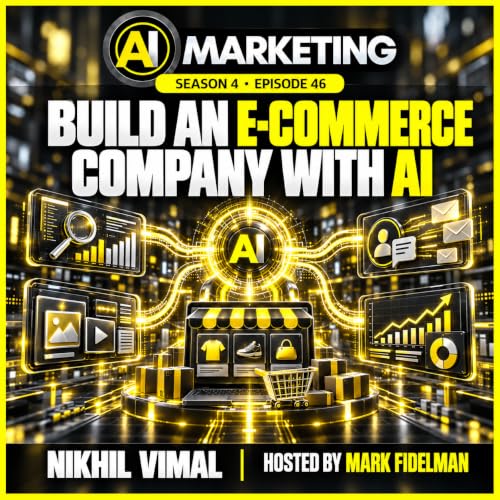
    Guest: Nikhil Vimal Host: Mark Fidelman Starting an e-commerce company used to mean assembling a small army: researchers, marketers, content creators, media buyers, customer-support reps, and operations people. AI has changed that equation. In this episode, Mark Fidelman sits down with AI strategist, entrepreneur, and author Nikhil Vimal to map out how they would build an e-commerce business today. Their playbook starts with AI-powered market research, moves through content creation and campaign execution, and closes the loop with monitoring systems that learn from every result. The bigger opportunity is a connected system of AI agents that can watch competitors, spot cultural moments, create and repurpose content, re-engage customers, and improve over time—with a human responsible for every important approval. Mark's take: Founders who use AI for isolated tasks will save time. Founders who build a learning system around it will build an advantage. ## What You'll Learn - Why AI agents can replace much of the early infrastructure once required to launch a direct-to-consumer brand - How to automate competitive research across promotions, ads, creators, partnerships, and adjacent industries - How AI can turn market intelligence into seasonal campaigns, product images, video, copy, and content calendars - Why "clipping" and content repurposing can turn 20 original assets into 100 distribution-ready pieces - How to react quickly to viral cultural moments without forcing a founder to live on social media - Why every agent still needs a human owner who approves consequential work - How observability and monitoring help the system learn from wins, misses, and customer behavior - Where AI voice agents fit into 24/7 customer support - Why Shopify, Perplexity, Claude, ChatGPT, HubSpot, Buffer, and Zapier are practical places to begin - What Zapier still does well: visual workflow design, collaboration, connection monitoring, and operational visibility ## Episode Chapters - **00:00** — Welcome and Nikhil Vimal's background - **01:42** — The challenge: build an e-commerce company with today's AI tools - **02:12** — AI agents as an on-demand marketing and growth team - **04:34** — Step 1: continuous research and market analysis - **06:02** — Learning from winning ads and adjacent industries - **07:16** — Step 2: campaign preparation and generative content - **08:22** — Why a human must own every AI agent - **09:08** — Step 3: execution, outreach, UGC, and content calendars - **09:52** — Scaling content through clipping and repurposing - **10:53** — Using AI to react to viral moments in real time - **13:32** — Step 4: observability, monitoring, and continuous improvement - **14:54** — The central lesson: build systems, not scattered automations - **15:54** — AI voice agents and the customer-support opportunity - **17:35** — Where a new e-commerce founder should start - **19:19** — The practical starter stack - **20:25** — Why Zapier still matters in the era of connected LLMs - **23:00** — Final lessons and a preview of agentic AI at enterprise scale - **24:18** — Where to find Nikhil and his forthcoming book ## The Operating Model 1. **Research:** Track competitors, adjacent categories, creators, ads, promotions, and market shifts. 2. **Prepare:** Convert that intelligence into campaign concepts, product visuals, video, copy, and calendars. 3. **Execute:** Publish, distribute, follow up with customers, recruit creators, and repurpose the best material. 4. **Observe:** Measure results, identify why something worked or failed, and feed those lessons back into the next cycle. 5. **Approve:** Keep a named human accountable for the decisions that can affect customers, pricing, reputation, or revenue. ## Tools Mentioned - Perplexity for research and market analysis - ChatGPT and Claude for preparation, execution, and connected workflows - Shopify for commerce infrastructure and educational resources - Zapier for visual automation, workflow orchestration, and monitoring - HubSpot for marketing and customer operations - Buffer for content calendars and publishing workflows - Notion, ClickUp, and Asana for project and workflow management - Midjourney, Higgsfield, and Seedance for image and video creation - Meta Business Suite and Marketo for marketing operations and analytics ## About Nikhil Vimal Nikhil Vimal is an AI strategist, entrepreneur, investor, advisor, and author who has spent roughly 15 years working across startups, e-commerce brands, agencies, and large enterprises. His forthcoming book, *The Essential Pivot*, focuses on navigating change and separating signal from noise. Connect with Nikhil on [LinkedIn](https://www.linkedin.com/in/nikhilvimal) and visit [nvimal.com](https://nvimal.com). ## Closing Thought AI can help one founder operate with the reach of a much larger company. But the advantage doesn't come from collecting more tools. It comes from connecting the work,...
    Show More Show Less
    26 mins
  • How AI Is Transforming Marketing Analytics
    Oct 8 2026

    Host: Mark Fidelman
    Guest: Aksel Bedikyan, marketing research and analytics practitioner based in Montreal, Canada

    Episode description

    How is AI changing marketing analytics—and what remains valuable when AI can write code, analyze data, and automate reports? Mark Fidelman talks with Axel Benikian about AI agents, the changing role of data science, and practical ways marketers can get more insight from the data they already have.

    Axel explains how his team uses AI to automate recurring analysis and presentation work, while emphasizing that useful insights still depend on access to good data. His advice to businesses: map your existing data first, use AI to explore what it can tell you, and turn to custom research when important questions can't be answered with public or existing data.

    Key takeaways
    • AI is broadening access to data science. Coding may become less central to some roles, while more people use AI to build apps, models, and tools for business questions.
    • AI can automate repetitive analytics work. Aksel's team uses Claude to help generate analyses and recurring PowerPoint reports, including brand trackers.
    • Start with the data you already have. Map your internal data and connect it to the questions you want to answer before investing in new data collection.
    • AI has limits when it comes to proprietary information. LLMs can help analyze available data, but they don't automatically have access to a company's private customer or business data.
    • Custom research still matters. Interviews, focus groups, ethnography, and surveys can fill gaps when existing data can't answer new questions.
    • Learn by doing. Aksel recommends experimenting with AI tools and sharing what you learn with others.
    Episode timestamps
    • 00:27 —Aksel's background in aerospace engineering, consulting, and market research
    • 02:36 — Will AI replace data scientists?
    • 05:25 — AI agents: risks to jobs and opportunities for innovation
    • 07:05 — How Aksel's team applies AI to marketing analytics
    • 09:54 — Automating recurring analyses and PowerPoint reports
    • 11:46 — How marketers can make better use of existing data
    • 15:13 — When AI needs to be supplemented with custom research
    • 15:47 — Staying curious and learning through hands-on experimentation
    Links
    • Mark Fidelman's book, Agent Shock: agentize.com/book
    • Aksel Bedikyan: OG Insights · Find Axel on LinkedIn
    Show More Show Less
    19 mins
  • AI Agents, Dashboards, and Work Slop: What Marketers Need to Know
    Sep 25 2026

    Stop Chasing AI Tools: What Marketers Should Actually Do With AI

    AI marketing is moving fast and the constant stream of new tools can leave even experienced marketers feeling behind. In this episode, Mark Fidelman talks with marketing educator Will Francis about how to put AI to work without getting swept up in the hype.

    Will shares why he recommends starting with one primary AI assistant, how desktop apps can help marketers work directly with their files, and why he prefers practical workflows over complicated agent hierarchies. He also walks through his own AI-powered dashboard, explains how he uses voice dictation throughout the day, and discusses where human judgment still matters.

    The conversation also covers Will's AI for Marketing community, which he said was planned to launch in mid-October at the time of recording.

    Key takeaways
    • Start with one main AI workspace instead of trying every new tool.
    • Look for useful outcomes—like organizing documents or creating a daily briefing—before building a complex AI setup.
    • Treat AI agents as assistants that need direction and review; left unchecked, they can produce "work slop."
    • Connect AI to the systems and data you actually use if you want a more complete picture.
    • Make room for human judgment, strategy, and leadership—and step away from AI during the day.
    In this episode
    • 00:04:20 Will's background and his practical approach to AI education
    • 00:07:29 How to avoid getting overwhelmed by AI tools
    • 00:10:30 Will's tool recommendations for marketers
    • 00:12:30 Why he's skeptical of complex, always-on agent systems
    • 00:18:02 Practical ways CMOs can get started with AI
    • 00:22:09 AI as a sounding board—and the continuing role of human judgment
    • 00:25:15 Will's daily AI workflow and custom dashboard
    • 00:30:30 The AI for Marketing community and workshops

      Sign up for my book AgentShock
    About Will Francis

    Will Francis is a marketing educator and creator with 25 years of experience, including work at MySpace, advertising agencies, and his own agency. He creates practical, no-hype content to help people use AI for marketing.

    Learn more: willfrancis.com

    Show More Show Less
    28 mins
  • Answer Engine Optimization (AEO): How to Rank in AI & Capture 4–12x
    Sep 18 2026
    AI Marketing Podcast – AEO (Answer Engine Optimization) with Elina Panteleyeva Guest: Elina Panteleyeva, Founder of ShowUpWithAI Host: Mark Fidelman Topic: How to rank in AI answers (AEO) and capture high-intent leads from ChatGPT, Claude, Gemini, etc. Episode Overview In this episode, Mark and Elina break down Answer Engine Optimization (AEO)—how to become the brand that AI agents and chatbots recommend first. Elina shares: Why AI-driven leads convert 4–12x betterHow to optimize your website, content, and off-site signals for AIWhat's changing from traditional SEO to AEO/GEOReal-world case studies of brands exploding inbound leads in 15–60 daysWhy agentic commerce is the next big wave—and how to get ahead of it Timestamps & Segments [0:02:46–0:04:52] Warm-up & context Light banter about calls and busy schedules.Mark mentions bringing a company public (Exascale Labs) and dealing with heavy legal sign-offs on marketing.Sets the stage that this is an AI + marketing focused audience. [0:04:52–0:08:59] Guest intro & origin story Your setup and question: 0:04:41 Mark: "All right, so we're going to talk about the AEO… I'm going to be the voice of the listener and walk through it as if you were talking to me for the first time." Key points: 0:07:39 Elina's background: Founder of ShowUpWithAIWorked at an AI startup, got laid off in 2023.Bootstrapped an e‑commerce brand to seven figures.Noticed people using ChatGPT to choose doctors, therapists, services. Realization: "There's no page two of chat."She spent hundreds of hours studying documentation, signals, and how LLMs evaluate brands.That research became ShowUpWithAI [0:08:59–0:12:13] Why AEO matters now Your question: 0:08:59 Mark: "Okay, so why should anyone care about AEO?" Key points: People coming from AI/chat are 4–12x more likely to convert. They've already discussed their problem with an AI.They trust the model and are now ready for a solution. AI is always recommending someone—you or your competitor.It's still early: Most businesses aren't optimizing for AI yet.Results can come within 30–60 days. Elina: AEO is "the biggest ROI you can get in 2026." Your follow-up question: 0:10:13 Mark: "What if 1,000 plumbers are doing this? How does ChatGPT know which one to recommend?" Key points: Right now, 1,000 plumbers are not doing it, which is why starting now matters.LLMs care deeply about recommendation quality: If they recommend bad options, users switch models (Claude, Perplexity, etc.). Models use specific signals different from traditional SEO: On-site: technical optimization, schema, phrasing, blogs, structure.Off-site: Reddit threads, YouTube, reviews, third‑party mentions. [0:12:13–0:15:05] Signals, platforms & AI-optimized content Your question: 0:12:13 Mark: "Is that primarily how you rank… or is there something else you have to do to make sure you're top of mind, especially locally, for ChatGPT, Gemini, or Claude?" Key points: It's industry-dependent: Some spaces are Reddit-heavy.Others lean on YouTube, Trustpilot, or specific review sites. Local AEO: Google Business Profile + reviews are critical. Website & content structure matter a lot: Blogs should be AI-optimized, not "typical" blogs.Key elements: Summary at the topFAQs at the bottomExternal citations to credible sourcesInternal linking: blogs → service pages; services → blogs There are "100+ more" technical and structural factors behind the scenes. Your next question: 0:13:51 Mark: "So it's no longer the link-sharing game with SEO or trying to get links in high-traffic sites?" Key points: Big difference vs. traditional SEO: Backlinks still help, but…AI can infer trust from unlinked brand mentions. Example: Someone mentions your brand on Reddit without a link.If your website is properly set up, AI can: Recognize the entityAttribute that mention back to your site and brandTreat it as a credibility signal [0:15:05–0:18:07] Search behavior shift & Google's AI overview Your question: 0:15:05 Mark: "Do you have any breakdown of how many people are doing Google searches vs AI now… it used to be like 99/1?" Key points: Tracking is tricky: People find you via chat/AI then go Google your brand.In Google Search Console, you'll see a spike in branded searches if AEO is done right. Behavior changes: People still use Google, but: They rarely scroll far.They definitely don't hit page two. The new game: "How do you get into that Google AI overview box?"That's where the real battle is now. Your commentary: You share your own behavior: You now start most product/service discovery via ChatGPT/Claude/Gemini, not Google.You trust AI to synthesize reviews, source data, and filter out "gamed" SEO. Strategic takeaway: If you're paying 30% to Amazon vs 0% on your own site, AEO is crucial.Do "whatever you can" to rank high in AI results. Your next question: 0:17:06 Mark: "Is there any ...
    Show More Show Less
    20 mins