• WBSP822: Scale Growth by Learning from Enterprise Software Stories - Dec 2025, Ep 40, an Objective Panel Discussion
    Mar 3 2026

    Send a text

    This cluster of enterprise software announcements highlights how vendors are rapidly embedding AI, expanding ecosystem integrations, and strengthening vertical depth to drive measurable operational outcomes. From Camunda’s integrations with ServiceNow to Pipefy’s launch of next-generation AI agents and Coupa’s introduction of agentic AI capabilities, the focus is shifting toward autonomous execution layers that can orchestrate workflows, enforce policies, and improve decision speed. At the same time, platform expansions such as ECI’s NET1 Commerce Suite, HighByte’s Intelligence Hub updates, and Deltek’s platform enhancements demonstrate continued investment in unified operational and data architectures to support increasingly complex digital environments. Strategic moves—including Rootstock’s acquisition of Praxis Solutions and Provus’ partnership with Kantata—underscore how vendors are closing functional gaps through targeted acquisitions and alliances rather than rebuilding entire platforms. Finally, initiatives such as Sage’s AI Trust Label and Flowfinity’s AI service expansion reflect a growing emphasis on governance, transparency, and trust as AI becomes embedded infrastructure across the enterprise stack.

    In today's episode, we invited a panel of industry analysts for a live discussion on LinkedIn to analyze current enterprise software stories. We covered many grounds, including the direction and roadmaps of each enterprise software vendor. Finally, we analyzed future trends and how they might shape the enterprise software industry.

    Video: https://www.youtube.com/watch?v=Yzfdn7jJiVg
    Questions for Panelists?
    🔗Sam Gupta: linkedin.com/in/samguptausa/
    🔗Robert Kramer: linkedin.com/in/robert-kramer-58239b22/
    🔗Michael Fauscette: linkedin.com/in/mfauscette/
    🔗Brian Jackson: linkedin.com/in/urbanpaddler/
    🔗John Santaferraro: linkedin.com/in/johnsantaferraro/

    Background Soundtrack: Away From You – Mauro Somm

    For more information on growth strategies for SMBs using ERP and digital transformation, visit our community at wbs. rocks or elevatiq.com. To ensure that you never miss an episode of the WBS podcast, subscribe on your favorite podcasting platform.

    Show More Show Less
    1 hr and 3 mins
  • WBSP821: Scale Growth by Learning the Top TMS Systems In 2026 w/ Sam Gupta
    Mar 2 2026

    Send a text

    Transportation management has evolved into a strategic control point for cost optimization, service reliability, and long-term supply chain resilience. As freight networks grow more fragmented and execution complexity increases, selecting a TMS is no longer about basic load planning or freight rating—it is about architectural fit, operating model alignment, and the platform’s ability to support your logistics strategy over time. In this video, we examine the top TMS systems for 2026, beginning with the critical decision factors that should shape your evaluation before reviewing any vendor list. We clarify the differences between true best-of-breed TMS platforms and ERP-embedded or broader supply-chain-suite offerings, and why those distinctions materially impact flexibility, neutrality, and scalability. We also explore the implications of choosing independent software vendors versus platforms tied to logistics service providers, including the tradeoffs between software independence, managed services integration, and network effects. Finally, we discuss how company size, operating model complexity, and industry context influence which TMS architectures are structurally aligned—or misaligned—with your organization’s future state.

    In this episode, our host Sam Gupta discusses the top TMS systems in 2026. He also discusses several variables that influence the rankings of these TMS systems. Finally, he shares the pros and cons of each TMS system.

    Video: https://www.youtube.com/watch?v=fNaOtCGwdaI
    Read: https://www.elevatiq.com/post/top-tms-systems/

    Questions for Panelists?
    🔗Sam Gupta: linkedin.com/in/samguptausa/r-58239b22/

    Background Soundtrack: Away From You – Mauro Somm

    For more information on growth strategies for SMBs using ERP and digital transformation, visit our community at wbs. rocks or elevatiq.com. To ensure that you never miss an episode of the WBS podcast, subscribe on your favorite podcasting platform.

    Show More Show Less
    21 mins
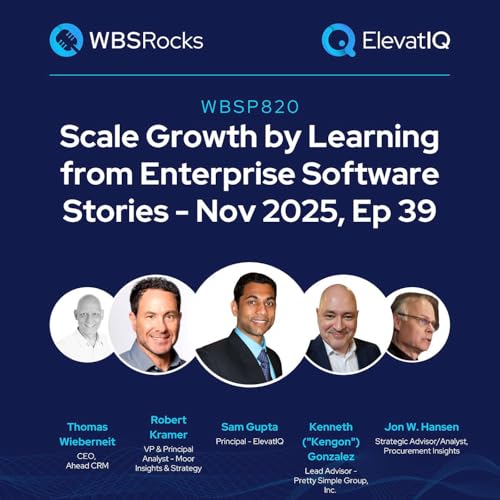
  • WBSP820: Scale Growth by Learning from Enterprise Software Stories - Nov 2025, Ep 39, an Objective Panel Discussion
    Feb 24 2026

    Send a text

    This week’s enterprise software announcements reflect a broad, coordinated push toward AI-native experiences layered across collaboration, operations, finance, and core business platforms. Salesforce’s latest version of Slack, Oracle’s role-based AI agents for Fusion Cloud, and SAP’s extension of its business suite all signal that hyperscalers are embedding AI directly into day-to-day workflows rather than positioning it as a standalone add-on. In parallel, Sprinklr’s new AI capabilities and Upstream Works’ enhanced agent desktop extend this trend into customer experience and contact center operations, while Kantata’s new AI platform targets the specialized needs of professional services firms. NetSuite’s “Next” roadmap reinforces Oracle’s mid-market modernization strategy, and ScienceLogic’s reimagined applications highlight how observability and IT operations are also being reshaped by AI-first design principles. Rounding out the picture, Cleo’s invoice payment and financing solution underscores growing pressure to modernize B2B financial operations, while Sage’s acquisition of Criterion signals continued consolidation in the HCM space—together illustrating a market that is rapidly standardizing on AI-driven interaction layers even as vendors compete to redefine their category boundaries.

    In today's episode, we invited a panel of industry analysts for a live discussion on LinkedIn to analyze current enterprise software stories. We covered many grounds including the direction and roadmaps of each enterprise software vendors. Finally, we analyzed future trends and how they might shape the enterprise software industry.

    Video: https://www.youtube.com/watch?v=P-5FOS9QamY
    Questions for Panelists?
    🔗Sam Gupta: linkedin.com/in/samguptausa/
    🔗Robert Kramer: linkedin.com/in/robert-kramer-58239b22/
    🔗Thomas Wieberneit: linkedin.com/in/thomaswieberneit/
    🔗Jon W. Hansen: linkedin.com/in/jwhansen/
    🔗Kenneth ("Kengon") Gonzalez: linkedin.com/in/kengon/

    Background Soundtrack: Away From You – Mauro Somm

    For more information on growth strategies for SMBs using ERP and digital transformation, visit our community at wbs. rocks or elevatiq.com. To ensure that you never miss an episode of the WBS podcast, subscribe on your favorite podcasting platform.

    Show More Show Less
    1 hr and 1 min
  • WBSP819: Scale Growth by Learning the Top WMS Systems In 2026 w/ Sam Gupta
    Feb 23 2026

    Send a text

    When evaluating WMS systems for 2026, it is essential to recognize that this is a structurally best-of-breed category rather than an extension of ERP or eCommerce platforms. This analysis deliberately excludes lightweight warehouse workflows embedded in broader systems, which are primarily designed to pass transactions downstream into a true WMS and lack the functional depth, orchestration complexity, and automation readiness required by serious distribution operations. True WMS platforms represent a category in their own right, with broader suites, richer integration patterns, and materially different architectural demands. Compounding this complexity is the diversity of operational models the category must support, from 3PL-centric environments focused on billing logic, client segregation, SLAs, and rapid customer onboarding, to manufacturing- and retail-centric value chains that prioritize production staging, kitting, reverse logistics, store replenishment, and omnichannel fulfillment. These differences are further reinforced by the technical segmentation of the category into WMS, WCS, and WES layers, with some vendors offering unified suites and others remaining purely transactional without deep integration into ASRS, robotics, conveyors, or advanced warehouse technologies—distinctions that materially affect long-term system fit and scalability.

    In this episode, our host Sam Gupta discusses the top WMS systems in 2026. He also discusses several variables that influence the rankings of these WMS systems. Finally, he shares the pros and cons of each WMS system.

    Video: https://www.youtube.com/watch?v=78YHLvbCbuA
    Read: https://www.elevatiq.com/post/top-wms-systems/

    Questions for Panelists?
    🔗Sam Gupta: linkedin.com/in/samguptausa/r-58239b22/

    Background Soundtrack: Away From You – Mauro Somm

    For more information on growth strategies for SMBs using ERP and digital transformation, visit our community at wbs. rocks or elevatiq.com. To ensure that you never miss an episode of the WBS podcast, subscribe on your favorite podcasting platform.

    Show More Show Less
    15 mins
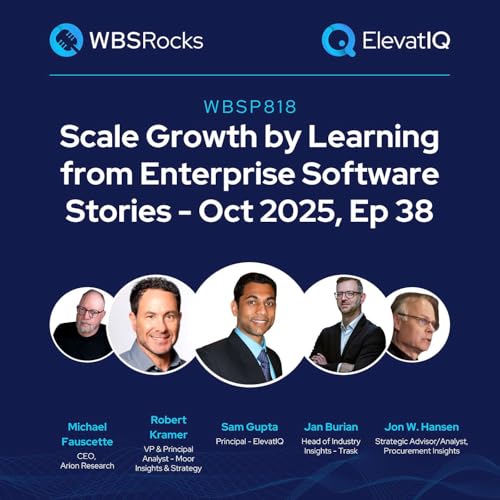
  • WBSP818: Scale Growth by Learning from Enterprise Software Stories - Oct 2025, Ep 38, an Objective Panel Discussion
    Feb 17 2026

    Send a text

    This week’s enterprise software developments underscore a widening gap between rapid AI-driven platform innovation and the unresolved execution risks embedded in large-scale ERP programs. On one side of the ledger, Mendix and OutSystems both advanced their agentic AI roadmaps with new releases aimed at operationalizing autonomous workflows, while ServiceNow’s unveiling of its AI Experience, Sprinklr’s new AI capabilities, and Braze’s product enhancements at Forge 2025 reinforce how aggressively vendors across ITSM, CX, and marketing automation are repositioning around AI-first interaction layers. Salesforce’s latest Slack updates and Upstream Works’ enhanced agent desktop further extend this trend into collaboration and contact center operations, signaling that AI augmentation is now table stakes across front-office and service environments. In parallel, Plex’s expanded connected worker integrations highlight how these same concepts are being pushed into manufacturing execution and workforce enablement, while Cleo’s invoice payment and financing solution reflects growing pressure to modernize B2B financial operations. Yet this innovation narrative is tempered by Daedong USA’s loss of an injunction in its ERP dispute—placing its $11.4 billion suit in jeopardy—which serves as a reminder that beneath the AI acceleration, legacy implementation failures, legal exposure, and governance breakdowns continue to create material risk for enterprises betting on large transformation programs.

    In today's episode, we invited a panel of industry analysts for a live discussion on LinkedIn to analyze current enterprise software stories. We covered many grounds including the direction and roadmaps of each enterprise software vendors. Finally, we analyzed future trends and how they might shape the enterprise software industry.

    Video: https://www.youtube.com/watch?v=_Arr9GjwOBs

    Questions for Panelists?
    🔗Sam Gupta: linkedin.com/in/samguptausa/
    🔗Robert Kramer: linkedin.com/in/robert-kramer-58239b22/
    🔗Michael Fauscette: linkedin.com/in/mfauscette/
    🔗Jon W. Hansen: linkedin.com/in/jwhansen/
    🔗Jan Burian: linkedin.com/in/janburian/

    Background Soundtrack: Away From You – Mauro Somm

    For more information on growth strategies for SMBs using ERP and digital transformation, visit our community at wbs. rocks or elevatiq.com. To ensure that you never miss an episode of the WBS podcast, subscribe on your favorite podcasting platform.

    Show More Show Less
    1 hr
  • WBSP817: Scale Growth by Learning the Top HCM Software In 2026 w/ Sam Gupta
    Feb 16 2026

    Send a text

    HCM operates under a different operational gravity, shaped by higher data sensitivity, greater regulatory exposure, and people-centric workflows that do not map cleanly to financial or supply chain logic. HR data carries a uniquely elevated risk profile, and processes such as payroll, benefits, compliance, recruiting, onboarding, training, and performance management introduce specialized data models and integration needs that demand purpose-built platforms. Adoption also follows a different maturity curve, with most organizations starting from basic payroll—often via a PEO or standalone system—and gradually layering in more strategic HR capabilities as workforce size and complexity increase. Because HCM spans multiple micro-segments and specialization layers that vary materially by industry, geography, and workforce composition, it must be evaluated as its own architectural layer, not merely as an ERP add-on, to ensure long-term system fit and operational resilience.

    In this episode, our host Sam Gupta discusses the top HCM software in 2026. He also discusses several variables that influence the rankings of these HCM software. Finally, he shares the pros and cons of each HCM software.

    Video: https://www.youtube.com/watch?v=LVe9TBkCoG0
    Read: https://www.elevatiq.com/post/top-hcm-software/

    Questions for Panelists?
    🔗Sam Gupta: linkedin.com/in/samguptausa/r-58239b22/

    Background Soundtrack: Away From You – Mauro Somm

    For more information on growth strategies for SMBs using ERP and digital transformation, visit our community at wbs. rocks or elevatiq.com. To ensure that you never miss an episode of the WBS podcast, subscribe on your favorite podcasting platform.

    Show More Show Less
    17 mins
  • WBSP816: Scale Growth by Learning from Enterprise Software Stories - Oct 2025, Ep 37, an Objective Panel Discussion
    Feb 10 2026

    Send a text

    This week’s enterprise software headlines highlight a market simultaneously accelerating into agentic AI while still wrestling with the structural and legal fallout of past transformation failures. On the innovation front, Genstore’s $10M seed round, Tray.ai’s launch of the Tray Agent Hub, and new agentic releases from Mendix and OutSystems underscore how aggressively vendors are repositioning around autonomous workflows and AI-first orchestration layers. ServiceNow’s unveiling of its AI Experience and Plex’s connected worker integration push the same narrative into IT service management and manufacturing operations, signaling that agentic concepts are no longer confined to experimental edges of the stack. At the same time, a parallel storyline of governance and execution risk is playing out, with Zimmer Biomet’s $172M ERP lawsuit against Deloitte, Europe’s continued delays fixing a troubled Oracle system, Daedong USA’s faltering ERP injunction, and the EU Commission’s investigation into SAP’s practices reinforcing how fragile large-scale enterprise transformations remain. Together, these developments paint a bifurcated 2026 landscape: rapid platform innovation driven by AI ambition on one side, and unresolved accountability, regulatory scrutiny, and implementation risk on the other.

    In today's episode, we invited a panel of industry analysts for a live discussion on LinkedIn to analyze current enterprise software stories. We covered many grounds including the direction and roadmaps of each enterprise software vendors. Finally, we analyzed future trends and how they might shape the enterprise software industry.

    Video: https://www.youtube.com/watch?v=m3VmbEsy5uQ
    Questions for Panelists?
    🔗Sam Gupta: linkedin.com/in/samguptausa/
    🔗Robert Kramer: linkedin.com/in/robert-kramer-58239b22/
    🔗Kenneth ("Kengon") Gonzalez: linkedin.com/in/kengon/
    🔗Thomas Wieberneit: linkedin.com/in/thomaswieberneit/
    🔗Charles Brennan: linkedin.com/in/charles-brennan-048901132/

    Background Soundtrack: Away From You – Mauro Somm

    For more information on growth strategies for SMBs using ERP and digital transformation, visit our community at wbs. rocks or elevatiq.com. To ensure that you never miss an episode of the WBS podcast, subscribe on your favorite podcasting platform.

    Show More Show Less
    1 hr and 1 min
  • WBSP815: Scale Growth by Learning the Top Marketing Automation Systems In 2026 w/ Sam Gupta
    Feb 9 2026

    Send a text

    While most modern CRMs offer basic marketing automation, those native modules are typically optimized for simple campaign execution and lead nurturing and often lack the depth, specialization, and innovation velocity of dedicated platforms. This list therefore prioritizes best-of-breed systems that function as a true operational hub for marketing teams and demonstrate meaningful ecosystem penetration across data platforms, content systems, ad-tech tools, and analytics layers. Because integration complexity in this category is generally lower than in core transactional systems, a best-of-breed strategy is structurally viable, ensuring the platforms included are tightly aligned with the real-world needs of modern marketing organizations rather than serving as secondary feature sets within sales- or service-centric suites.

    In this episode, our host Sam Gupta discusses the top marketing automation systems in 2026. He also discusses several variables that influence the rankings of these marketing automation systems. Finally, he shares the pros and cons of each marketing automation system.

    Video: https://www.youtube.com/watch?v=88hYJ_rw3v4
    Read: https://www.elevatiq.com/post/top-marketing-automation-systems/

    Questions for Panelists?
    🔗Sam Gupta: linkedin.com/in/samguptausa/r-58239b22/

    Background Soundtrack: Away From You – Mauro Somm

    For more information on growth strategies for SMBs using ERP and digital transformation, visit our community at wbs. rocks or elevatiq.com. To ensure that you never miss an episode of the WBS podcast, subscribe on your favorite podcasting platform.

    Show More Show Less
    20 mins