WBSRocks: Scaling Growth with AI, Enterprise Software, and Digital Transformation cover art

WBSRocks: Scaling Growth with AI, Enterprise Software, and Digital Transformation

WBSRocks: Scaling Growth with AI, Enterprise Software, and Digital Transformation

By: Sam Gupta
Listen for free

About this listen

WBSRocks podcast features in-depth conversations on AI-enabled business models, customer experience, digital transformation, supply chain, eCommerce, industry 4.0, and enterprise software categories such as CRM, ERP, or analytics suites. The purpose of the show is to help CFOs, COOs, CEOs, and business owners with their daily commercial, operational, or financial challenges by taking a deep dive into business cases and processes, technology strategy and architecture, transformation initiatives, and business models. The show also offers an independent analysis of technology trends, various enterprise software vendors and solutions, and their mergers and acquisitions. Subscribe today to stay on top of digital transformation trends!

© 2026 WBSRocks: Scaling Growth with AI, Enterprise Software, and Digital Transformation
Economics Management Management & Leadership
Episodes
  • WBSP821: Scale Growth by Learning the Top TMS Systems In 2026 w/ Sam Gupta
    Mar 2 2026

    Send a text

    Transportation management has evolved into a strategic control point for cost optimization, service reliability, and long-term supply chain resilience. As freight networks grow more fragmented and execution complexity increases, selecting a TMS is no longer about basic load planning or freight rating—it is about architectural fit, operating model alignment, and the platform’s ability to support your logistics strategy over time. In this video, we examine the top TMS systems for 2026, beginning with the critical decision factors that should shape your evaluation before reviewing any vendor list. We clarify the differences between true best-of-breed TMS platforms and ERP-embedded or broader supply-chain-suite offerings, and why those distinctions materially impact flexibility, neutrality, and scalability. We also explore the implications of choosing independent software vendors versus platforms tied to logistics service providers, including the tradeoffs between software independence, managed services integration, and network effects. Finally, we discuss how company size, operating model complexity, and industry context influence which TMS architectures are structurally aligned—or misaligned—with your organization’s future state.

    In this episode, our host Sam Gupta discusses the top TMS systems in 2026. He also discusses several variables that influence the rankings of these TMS systems. Finally, he shares the pros and cons of each TMS system.

    Video: https://www.youtube.com/watch?v=fNaOtCGwdaI
    Read: https://www.elevatiq.com/post/top-tms-systems/

    Questions for Panelists?
    🔗Sam Gupta: linkedin.com/in/samguptausa/r-58239b22/

    Background Soundtrack: Away From You – Mauro Somm

    For more information on growth strategies for SMBs using ERP and digital transformation, visit our community at wbs. rocks or elevatiq.com. To ensure that you never miss an episode of the WBS podcast, subscribe on your favorite podcasting platform.

    Show More Show Less
    21 mins
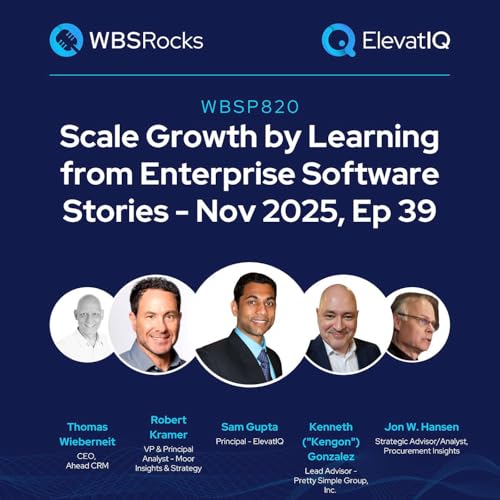
  • WBSP820: Scale Growth by Learning from Enterprise Software Stories - Nov 2025, Ep 39, an Objective Panel Discussion
    Feb 24 2026

    Send a text

    This week’s enterprise software announcements reflect a broad, coordinated push toward AI-native experiences layered across collaboration, operations, finance, and core business platforms. Salesforce’s latest version of Slack, Oracle’s role-based AI agents for Fusion Cloud, and SAP’s extension of its business suite all signal that hyperscalers are embedding AI directly into day-to-day workflows rather than positioning it as a standalone add-on. In parallel, Sprinklr’s new AI capabilities and Upstream Works’ enhanced agent desktop extend this trend into customer experience and contact center operations, while Kantata’s new AI platform targets the specialized needs of professional services firms. NetSuite’s “Next” roadmap reinforces Oracle’s mid-market modernization strategy, and ScienceLogic’s reimagined applications highlight how observability and IT operations are also being reshaped by AI-first design principles. Rounding out the picture, Cleo’s invoice payment and financing solution underscores growing pressure to modernize B2B financial operations, while Sage’s acquisition of Criterion signals continued consolidation in the HCM space—together illustrating a market that is rapidly standardizing on AI-driven interaction layers even as vendors compete to redefine their category boundaries.

    In today's episode, we invited a panel of industry analysts for a live discussion on LinkedIn to analyze current enterprise software stories. We covered many grounds including the direction and roadmaps of each enterprise software vendors. Finally, we analyzed future trends and how they might shape the enterprise software industry.

    Video: https://www.youtube.com/watch?v=P-5FOS9QamY
    Questions for Panelists?
    🔗Sam Gupta: linkedin.com/in/samguptausa/
    🔗Robert Kramer: linkedin.com/in/robert-kramer-58239b22/
    🔗Thomas Wieberneit: linkedin.com/in/thomaswieberneit/
    🔗Jon W. Hansen: linkedin.com/in/jwhansen/
    🔗Kenneth ("Kengon") Gonzalez: linkedin.com/in/kengon/

    Background Soundtrack: Away From You – Mauro Somm

    For more information on growth strategies for SMBs using ERP and digital transformation, visit our community at wbs. rocks or elevatiq.com. To ensure that you never miss an episode of the WBS podcast, subscribe on your favorite podcasting platform.

    Show More Show Less
    1 hr and 1 min
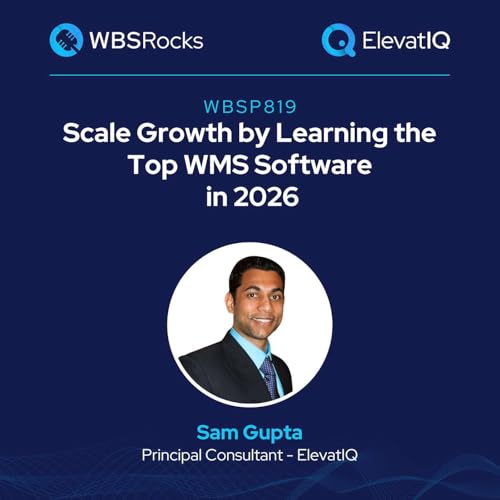
  • WBSP819: Scale Growth by Learning the Top WMS Systems In 2026 w/ Sam Gupta
    Feb 23 2026

    Send a text

    When evaluating WMS systems for 2026, it is essential to recognize that this is a structurally best-of-breed category rather than an extension of ERP or eCommerce platforms. This analysis deliberately excludes lightweight warehouse workflows embedded in broader systems, which are primarily designed to pass transactions downstream into a true WMS and lack the functional depth, orchestration complexity, and automation readiness required by serious distribution operations. True WMS platforms represent a category in their own right, with broader suites, richer integration patterns, and materially different architectural demands. Compounding this complexity is the diversity of operational models the category must support, from 3PL-centric environments focused on billing logic, client segregation, SLAs, and rapid customer onboarding, to manufacturing- and retail-centric value chains that prioritize production staging, kitting, reverse logistics, store replenishment, and omnichannel fulfillment. These differences are further reinforced by the technical segmentation of the category into WMS, WCS, and WES layers, with some vendors offering unified suites and others remaining purely transactional without deep integration into ASRS, robotics, conveyors, or advanced warehouse technologies—distinctions that materially affect long-term system fit and scalability.

    In this episode, our host Sam Gupta discusses the top WMS systems in 2026. He also discusses several variables that influence the rankings of these WMS systems. Finally, he shares the pros and cons of each WMS system.

    Video: https://www.youtube.com/watch?v=78YHLvbCbuA
    Read: https://www.elevatiq.com/post/top-wms-systems/

    Questions for Panelists?
    🔗Sam Gupta: linkedin.com/in/samguptausa/r-58239b22/

    Background Soundtrack: Away From You – Mauro Somm

    For more information on growth strategies for SMBs using ERP and digital transformation, visit our community at wbs. rocks or elevatiq.com. To ensure that you never miss an episode of the WBS podcast, subscribe on your favorite podcasting platform.

    Show More Show Less
    15 mins
No reviews yet
In the spirit of reconciliation, Audible acknowledges the Traditional Custodians of country throughout Australia and their connections to land, sea and community. We pay our respect to their elders past and present and extend that respect to all Aboriginal and Torres Strait Islander peoples today.