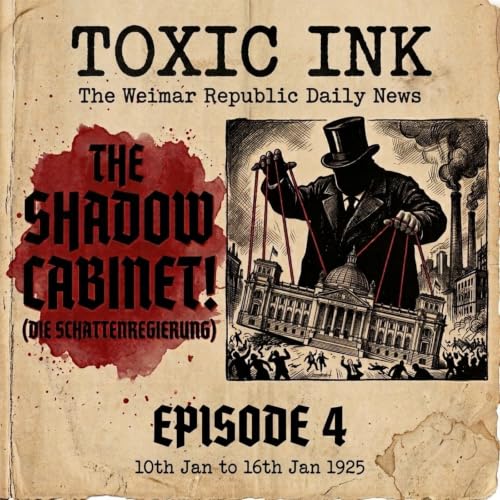
📝 SynopsisIn the volatile final days of December 1924, Berlin press broadsheets captured a fragile democracy teetering on the edge of ruin. Across the political spectrum, Germany confronted severe diplomatic isolation and explosive financial scandals. The Allied decision to delay evacuating the Cologne military zone ignited intense ideological warfare. Nationalist editors denounced foreign imperialism, while liberal and socialist newspapers defended state compliance and rejected claims of illegal rearmament. Simultaneously, the massive Barmat and Seehandlung corruption scandals rocked the Prussian State Bank, exposing million mark bribery schemes that energized both far right and far left critics. From judicial attacks targeting President Friedrich Ebert to rising right wing violence and comparisons with Italian fascism, press dispatches revealed a nation where currency stabilization could not heal institutional rot. As assassin Tillessen escaped justice, this chronicle illustrated how press venom, financial greed, and political betrayal threatened to destroy Weimar democracy from the very inside out.📍Chronological Chapter Markers[00:15] - Opening Hook & Intro [01:44] - Saturday, Dec 27: The Disarmament Debate & Cologne Crisis[07:18] - Sunday, Dec 28: Allied Evacuation Delay & The Defense Counter-Attack[13:40] - Monday, Dec 29: Communist Agitation, Magdeburg Trial & Seehandlung Scandal[20:34] - Tuesday, Dec 30: Judicial Battles & The Reichsbanner Flag Controversy[25:49] - Wednesday, Dec 31: Barmat Brothers Raid & Financial Corruption[33:38] - Thursday, Jan 1: Currency Stabilization & Economic Governance[40:43] - Friday, Jan 2: The Barmat Collapse & The Fall of Democracy[47:05] - Episode Sign-Off & CreditsEpisode 2 Context: Figures, Factions, and CrisesKey Figures at the PrecipiceThe final week of December 1924 unfolds through high-stakes political and diplomatic maneuvering across Europe. French Prime Minister Herriot is branded "The lame Herriot" (Der lahme Herriot) by liberal editors and compared to Poincaré amid allegations of hidden weapon caches at Krupp and Wittenau, while French hardliners like Marshal Foch and General Walch review intelligence reports. Reichswehr Minister Dr. Otto Gessler systematically dismantles these allegations, proving that barrel castings and steel blanks were legal civilian goods or obsolete parts. President Friedrich Ebert faces severe attacks from right-wing nationalist organs following the Magdeburg trial, which validated treason labels concerning his 1918 munitions strike role at Treptower Park. Foreign Minister Gustav Stresemann struggles to hold a compliant diplomatic line for the Cologne evacuation amid domestic fragmentation. Simultaneously, speculative billionaires Julius, Salomon, and Henri Barmat along with financier Iwan Kutisker are dramatically arrested in overnight police raids on Schwanenwerder for orchestrating a colossal 15-million-Goldmark state bank fraud. In the shadows, the notorious Erzberger assassins, Tillessen and Schulz, successfully flee across Austrian borders into Spain using forged passports, evading republican justice entirely, while in Rome, leaked memos link Benito Mussolini to the murder of socialist deputy Giacomo Matteotti.The Warring Political FactionsBerlin's newspaper desks operate as fierce ideological battlegrounds reflecting a deeply fractured society. The left-liberal Berliner Tageblatt, anchored by Chief Editor Theodor Wolff and Ernst Feder, warns of diplomatic ruin over Cologne, mocks French security paranoia as international pot-banging (internationales Topfschlagen), and castigates the reactionary judiciary for weaponizing the legal system against republican statesmen. The socialist central organ Vorwärts attacks the German right for providing French imperialists with free ammunition, celebrates strong electoral showings with eight million voters, and defends against communist purges and state bank scandal blowback. The conservative Protestant Der Reichsbote, featuring essays by Wolfgang Eisenhart and Kirchenrat Schiffler, diagnoses the republic's soul as mentally ill (seelisch krank), lamenting moral decay and foreign disease. On the extreme right, the radical Deutsche Zeitung screams of national treason (Landesverrat), brands the democratic system a floundering system (Das zappelnde System), and attacks party mania. The communist Hamburger Volkszeitung demands a red front, denounces police brutality as a rubber truncheon salad (Gummiknüppelsalat), and rails against capitalist theater, while the bourgeois Tägliche Rundschau and Catholic Center Sächsische Volkszeitung urge strict legal compliance and warn against constitutional collapse.The Broader Structural CrisesUnderlying the Republic's fragile stabilization via Dawes Plan foreign loans are crushing structural crises spanning diplomacy, finance, and social survival. The primary macro-crisis centers on the unanimous Allied decision to suspend the scheduled ...
Show More
Show Less


 1 hr and 1 min
 1 hr and 15 mins
 1 hr and 15 mins
 53 mins
 Sep 5 202651 mins
 Aug 29 202650 mins
 48 mins
 43 mins