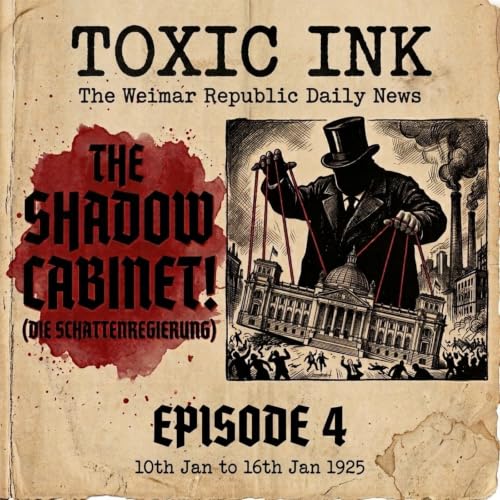
Episode 4: A Masked Bourgeois Block cover art

Episode 4: A Masked Bourgeois Block

Episode 4: A Masked Bourgeois Block

Listen for free

View show details

This Season's Biggest Deal | $0.99/mo for 3 months + $20 Audible bonus

Auto-renews at $8.99/mo. after 3 months - terms apply.
Summary
📝 SynopsisGermany, January 1925, teeters on the brink.As Chancellor Marx's government collapses, the republic descends into a maelstrom of political infighting, economic hardship, and ideological warfare.Chancellor-designate Luther battles to form a conservative cabinet, facing a paralyzed parliament and a fracturing center. Newspapers across the spectrum unleash venomous attacks, exposing scandals, purges, and clandestine maneuvers.Amidst skyrocketing living costs, general strikes, and a catastrophic train crash, the nation grapples with foreign occupation, territorial amputations, and the legacy of Versailles.The week culminates in a desperate attempt to legitimize Luther's right-wing cabinet, integrating former enemies while the capital descends into chaos, questioning which political extreme will ultimately seize control.📍 Chronological Chapter Markers[02:29] - Saturday: The week begins with a press war[10:50] - Sunday: Struggle to form a new cabinet[16:34] - Monday: Government formation and macroeconomic shock[22:59] - Tuesday: The conservative takeover attempt and train disaster[29:08] - Wednesday: International finance and internal party divorces[32:04] - Thursday: Escalating political violence and a fractured state[41:40] - Friday: Luther's cabinet formed amid chaosEpisode 4 Context: Figures, Factions, and CrisesKey Figures at the Precipice:The political landscape of January 1925 is dominated by aggressive, clandestine maneuvering at the highest levels of the Republic. Chancellor Dr. Wilhelm Marx surrendered his mandate to form a government to President Friedrich Ebert, triggering a frantic scramble for power. Finance Minister Dr. Hans Luther became the central operator, attempting to engineer a non-partisan transition cabinet by pulling in conservative elites like Martin Schiele, Graf Kuno von Westarp, and Dr. Max Wallraf. The liberal press castigated Dr. Gustav Stresemann as a puppet for the reactionary right. Further fracturing the establishment, former Chancellor Dr. Joseph Wirth led a mutiny within the left-wing of the Zentrum party against his own caucus leadership to block a conservative alliance. Meanwhile, figures like Prussian Interior Minister Carl Severing and suspended Berlin police president Richter were ensnared in the exploding Barmat corruption scandal. Extreme elements also mobilized; Communist leader Ruth Fischer aggressively purged her party's dissidents, while right-wing figures like Dr. Albert Neuhaus were exposed for their historical complicity in shielding assassins.The Warring Political Factions:The daily broadsheets transformed into vicious ideological battlegrounds as the government crisis deepened. Left-liberal papers like the Berliner Tageblatt and Berliner Volks-Zeitung fiercely attacked Luther's attempts to form a government, warning that his non-partisan facade was merely a masked "bourgeois block" inviting anti-republican monarchists into the executive branch. The Social Democratic organ, Vorwärts, waged a defensive war for the republic, threatening sharpest opposition to the new coalition and fighting back against corrupt justice systems prosecuting loyal whistleblowers. Conversely, the pan-German radical press, led by the Deutsche Zeitung and Der Reichsbote, aggressively demanded total destruction of parliamentarism and a complete rupture from the moderate Zentrum. The Catholic Zentrum itself found its leadership paralyzed, offering only passive, non-binding approval to the right-wing cabinet, while the communist Hamburger Volkszeitung dismissed the entire crisis as the corruption of bourgeois scum.The Broader Structural Crises:Beneath the parliamentary chaos, the Weimar Republic suffered from severe macroeconomic and infrastructural breakdowns. Diplomatic tensions skyrocketed as unilateral Allied trade rights expired, leading to a breakdown in German-French commercial treaty negotiations and the looming threat of a catastrophic full tariff war. Concurrently, the French occupation persisted illegally in the northern Rhineland and forcibly amputated the Saarland economy. The domestic justice system operated with fierce bias, shielding illegal monarchist weapon caches while sentencing striking workers to decades of penal servitude. For the ordinary citizen, the state was failing on a physical level: basic food costs like butter and veal soared beyond the reach of working families, the capital's transit system was frequently blinded by dense fog, and the crumbling civic infrastructure culminated in a horrific, fatal express train collision in Westphalia.📰 Historical Newspaper RegistryKommunistische Partei Deutschlands (KPD) / Hamburger Volkszeitung:The central communist organ, it views the entire political establishment as corrupt and exposes systemic injustices, including the persecution of working-class agitators and financial bleeding in occupied zones.Sozialdemokratische Partei Deutschlands (SPD) / Vorwaerts: The central organ of the Social ...
No reviews yet
In the spirit of reconciliation, Audible acknowledges the Traditional Custodians of country throughout Australia and their connections to land, sea and community. We pay our respect to their elders past and present and extend that respect to all Aboriginal and Torres Strait Islander peoples today.