• How and Who You Love Shapes Who You Are
    Feb 2 2026
    Today, in the month of love, we talk about sacrificial love in your neurodiverse marriage. Many view this month of love and Valentine's Day as a day for big romantic gestures, but what about living out love every day? How is your love beneficial and sacrificial without giving up yourself? Dying to yourself does mean abandonment of self, but often there are competing needs and wants in an ND marriage.

    Part 2 will be on Patreon, and we will share more of what is going on in our personal lives, how, and what this means for us right now!

    Are you able to join hands or lock arms in hard times? Are you walking through life as friends, lovers, enemies, or strangers?
    Show More Show Less
    32 mins
  • Black Friday, Cul de Sacs and Happy New Next
    Jan 26 2026
    Summary:
    In this first episode of the year, the guys crack open the idea of what it means to be new—not just with gym memberships and resolutions, but deep in the rewiring of old patterns, assumptions, and emotional blind spots.
    Dan kicks things off by admitting his old “default setting” was to walk in the door wondering what he’d done wrong—proof that sometimes the battlefield is the hallway between the garage and the living room. From there, Jeremy confesses his own default: being right about everything. But a surprising comment from his son at a hockey game (“There’s so much more going on than what’s on TV”) hits him like a puck to the head and opens up a whole new way of seeing relationships.
    Kevin brings in the pastor’s line, “Do you want to be right, or do you want to win?”—and discovers that relational victory doesn’t always mean keeping score. Dan, meanwhile, reflects on curiosity as an antidote to assumption, while Jeff learns that geology may rock, but people matter more.
    Between dad jokes about rock stars, cul-de-sacs, and Fraggle Rock sing-alongs, the group lands somewhere between reflection and revelation:
    Becoming aware of your patterns.
    Accepting feedback without self-defense.
    Taking action toward connection, not correction.
    By the end, they circle back to hope. If yesterday was about living on autopilot, this year is about choosing manual drive. “Participating in my own discovery,” Dan quips, “gives me the opportunity to participate in my own recovery.”
    So whether you’re trying to read a face, repair a marriage, or just survive mornings before coffee, this conversation reminds you—every default can be rewritten.
    Pull Quotes
    “There’s so much more going on than what’s on the screen.”
    “Do you want to be right, or do you want to win?”
    “Participating in my own discovery gives me the opportunity to participate in my own recovery.”
    #justtheguys #danholmes #actuallyautistic #neurodiversecoupletips #neurodiverse men

    Show More Show Less
    42 mins
  • PART 1 - Is your NeuroDiverse Christian Coach_Counsel Gold Standard with ND Peer Panel
    42 mins
  • NEW Lens NEW Perspective: NeuroDiversity is the New Piece Not the Only Piece
    Jan 12 2026
    New year - new you- or at least a new perspective of yourself and your neurodiverse marriage! So many times, once the diagnosis is made, the sole focus can become the autism/neurodiversity, but Dr. Stephanie & Barbara talk about the many complexities that make up a neurodiverse Christian marriage!
    Show More Show Less
    51 mins
  • Atomic Habits for the New Year for Your NeuroDiverse Relationship Part 1
    Jan 5 2026
    It's 2026, and Dan and Stephanie start our podcast series this year on Atomic Habits. The month of January is all about NEW! Remember, Patreon is new! Part 2 of the discussion is on Patreon.
    In Atomic Habits, James Clear reminds us that real change doesn’t come from dramatic overhauls but from small, consistent actions that add up over time. For neurodiverse marriages, this principle is especially powerful. Many couples feel stuck because change seems overwhelming or unpredictable. But Clear’s 1% rule—tiny improvements repeated daily—offers a realistic, hopeful path forward for both partners.

    Clear also emphasizes identity formation, teaching that habits don’t just shape what we do; they shape who we believe we are. “Every action is a vote for the type of person you wish to become.” This aligns beautifully with the work Dan and Stephanie bring in from Dr. Jim Wilder, who teaches that identity is formed through relational attachment, joy, and repeated experiences of being our best self with others. When neurodiverse couples practice small relational habits—brief check-ins, shared cues, predictable routines—they aren’t only improving communication; they're also building trust. They are reinforcing a shared identity as a couple who grow, learns, and repair together.

    Starting small is essential for neurodiverse relationships. A five-minute conversation, one shared calendar habit, a single expression of appreciation, or one consistent environmental cue (like a reminder note or visual schedule) can be far more effective than trying to overhaul everything at once. Slow, steady repetition makes habits dependable, which builds trust and safety—core needs for both neurodiverse and neurotypical partners.

    The message is simple and deeply encouraging: meaningful change in a neurodiverse marriage doesn’t require perfection or intensity. It requires small, steady steps and a shared commitment to becoming the couple God is forming you to be—one daily habit at a time.
    Show More Show Less
    35 mins
  • From Victim Mindset to Staying Well in your Neurodiverse Marriage with Leslie Vernick
    50 mins
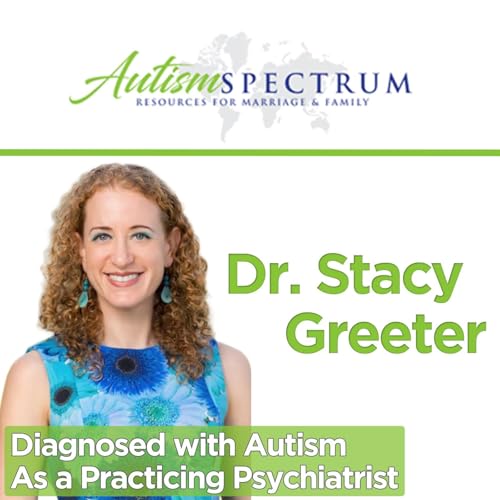
  • Diagnosed with Autism As a Practicing Psychiatrist with Dr. Stacy Greeter
    Dec 22 2025
    Today, Dr. Holmes talks with neurodivergent psychiatrist, Dr. Stacy Greeter.

    Topics discussed:
    Dr. Greeter's diagnosis journey at the age of 40 as a practicing psychiatrist.
    Growing understanding of Autism
    Myths about Autism
    Different presentations of girls/women in Autism
    Gender Fluidity & Autism
    Medications and How to be a psychiatric patient and advocate for yourself as an autistic patient
    About our Guest:
    Dr. Stacy Greeter is board-certified in both child/adolescent and adult psychiatry. She collaborates with children, adults, and their families to design a comprehensive individualized treatment plan.
    Dr. Greeter graduated summa cum laude from Duke University, where she was inducted into the Phi Beta Kappa Honor Society and received her Doctor of Medicine degree from the University of North Carolina at Chapel Hill under the Morehead Medical Scholarship. During her undergraduate and medical training, Dr. Greeter conducted extensive clinical research funded by the Howard Hughes Medical Institute on autism and on OCD. She completed both her adult studies and her child and adolescent subspecialty training at Northwestern University in Chicago, where she trained with nationally and internationally renowned psychiatrists. She is also certified in Internal Family Systems Therapy.
    More info: https://www.stacygreetermd.com/about-us
    Disclaimer:
    When we have guests on the ASR podcast, they are recognized for their expertise in autism as advocates, self-advocates, clinicians, parents, or other professionals in the field. They may or may not be part of the faith community; having a guest on the broader topic of autism does not reflect complete agreement with the guest, just as many guests may disagree with our faith perspective. Guests are chosen by topic for the selected podcast discussion and are not necessarily in complete agreement with all the beliefs of the selected guest(s).
    Show More Show Less
    48 mins
  • Showing Up With Your Own Face Faith, Masking, and the Autistic Pastor
    Dec 17 2025
    In this powerful and deeply introspective episode of Just the Guys, host Dan Holmes sits down with pastor, musician, and spiritual director Josh Davis—also known as the “Autistic Pastor.” Josh shares his personal journey from a masked life of ministry and performance to one of authenticity, self-discovery, and spiritual transformation following his autism and ADHD diagnosis in adulthood.
    Together, they explore themes such as:
    The mental toll of lifelong masking and how dropping the mask opened up a more vivid, emotionally connected life.
    Discovering new ways to connect with God that honor neurodivergent wiring—including journaling, songwriting, and contemplative walking.
    Reimagining spiritual practices beyond traditional “quiet time” models and embracing embodied faith.
    The role of music, special interests, and authentic emotional expression in spiritual growth.
    What it means to show up to God—and others—with your own face, not someone else’s version of what faith should look like.
    This is a rich conversation for anyone exploring their identity, navigating neurodivergence, or longing to experience God in more personal, integrated ways.
    📌 Resources Mentioned:
    Josh’s podcast: Neurodivergent Faith
    Series: “Connecting with God in Neurodivergent Ways”
    Book: Practicing the Presence of God by Brother Lawrence

    Show More Show Less
    57 mins