• Financial Tips: He emphasizes the importance of hard work, faith, planning, and leveraging government contracts .
    Mar 16 2026

    Listen and subscribe to Money Making Conversations on iHeartRadio, Apple Podcasts, Spotify, www.moneymakingconversations.com/subscribe/ or wherever you listen to podcasts. New Money Making Conversations episodes drop daily. I want to alert you, so you don’t miss out on expert analysis and insider perspectives from my guests who provide tips that can help you uplift the community, improve your financial planning, motivation, or advice on how to be a successful entrepreneur. Keep winning!

    Two-time Emmy and Three-time NAACP Image Award-winning, television Executive Producer Rushion McDonald interviewed Tim Mercer.

    Author of Bootstrap Millionaire and CFO of Cadence Ventures, Inc.:

    🎯 Purpose of the Interview

    To inspire and educate aspiring entrepreneurs and professionals by sharing Tim Mercer’s journey from humble beginnings to financial success, emphasizing the importance of hard work, faith, planning, and leveraging government contracts and nontraditional financing.

    🗝️ Key Takeaways

    1. Background & Journey

      • Tim Mercer grew up in Mullins, South Carolina, in modest circumstances.
      • His path to success began with military service, which broadened his worldview and led him to entrepreneurship.
    2. Bootstrap Millionaire Philosophy

      • The term “bootstrap” symbolizes hard work, sacrifice, and perseverance.
      • Mercer emphasizes that success doesn’t come overnight—it requires grinding, planning, and faith.
    3. Importance of a Business Plan

      • A solid business plan is essential for securing funding and guiding business growth.
      • Mercer shares real-life examples of people failing to secure support due to lack of planning.
    4. Cadence Ventures, Inc.

      • A boutique private equity firm offering nontraditional financing for real estate investors.
      • Focuses on investment properties and uses the property itself as collateral.
    5. Government Contracting

      • Mercer began in government contracting in 2012 and credits it with helping him scale his business.
      • He stresses that while it’s complex and paperwork-heavy, it’s a valuable opportunity for minority-owned businesses.
      • Free resources like SAM.gov and Georgia Tech’s GT PAC can help entrepreneurs navigate the process.
    6. Success Requires Sacrifice

      • Mercer highlights that every successful person has a story of struggle and sacrifice.
      • His book’s first chapter, “See the Glory, Don’t Know the Story,” encapsulates this message.

    💬 Notable Quotes

    • “If you want to have the things tomorrow that other people won’t have, then you got to be willing to do the things today that other people won’t do.” — Tim Mercer quoting Les Brown
    • “There’s no success without sacrifice.” — Tim Mercer
    • “You can only make as much as the customer that you have.” — Tim Mercer on scaling through government contracts
    • “See the glory, don’t know the story.” — Chapter title from Bootstrap Millionaire

    #SHMS #STRAW #BEST

    See omnystudio.com/listener for privacy information.

    Show More Show Less
    26 mins
  • Family Business: He started the successful business to teach his sons about money—earning, saving, investing, and giving.
    Mar 16 2026

    Listen and subscribe to Money Making Conversations on iHeartRadio, Apple Podcasts, Spotify, www.moneymakingconversations.com/subscribe/ or wherever you listen to podcasts. New Money Making Conversations episodes drop daily. I want to alert you, so you don’t miss out on expert analysis and insider perspectives from my guests who provide tips that can help you uplift the community, improve your financial planning, motivation, or advice on how to be a successful entrepreneur. Keep winning!

    Two-time Emmy and three-time NAACP Image Award-winning television Executive Producer Rushion McDonald interviewed Marcus Sonnier.

    Founder of Snowie Atlanta:

    🎯 Purpose of the Interview

    To showcase Marcus Sonnier’s journey from corporate America to entrepreneurship, highlight the inspiration behind Snowie Atlanta, and share insights on financial literacy, legacy-building, and faith-driven decision-making.

    🔑 Key Takeaways 1. From Corporate VP to Entrepreneur

    • Marcus left a successful career as VP of PR supervision at a financial services firm to start Snowie Atlanta.
    • He worked both jobs for five years before fully transitioning.
    • His leap was guided by faith and a desire for self-reliance.

    “I looked at my wife and said, ‘Hey, I'm getting one more bonus check. And then I'm jumping off the plane.’”

    2. The Product: Shaved Ice with a Twist

    • Snowie Atlanta offers customizable shaved ice with self-serve flavor stations.
    • Inspired by childhood experiences in Louisiana with snowball stands.

    “We give away the shaved ice, but we sell you the smiles.”

    3. Family Legacy & Financial Literacy

    • Marcus started the business to teach his sons about money—earning, saving, investing, and giving.
    • His sons were involved from the beginning, learning entrepreneurship firsthand.

    “I said, guys, look, we're going to be entrepreneurs in this business. We're going to do it together.”

    4. Faith as a Driving Force

    • Marcus credits divine guidance for his journey and connections.
    • He views his business as a calling and a platform for community impact.

    “I could feel God in my spirit saying, ‘Oh, you trust me, you really do.’”

    5. Community Impact & Expansion

    • The goal is to become a staple attraction and enhance the fan experience.

    “I want all kids to want to go to a Braves game… to get a Snowie and have an experience.”

    6. Giving Back

    • Snowie Atlanta participates in fundraising for schools, churches, and nonprofits.
    • Marcus finds joy in writing checks back to organizations that serve the community.

    💬 Notable Quotes

    • “You may not get everything you work for, but you will work for everything you get.”
    • “We serve memories.”
    • “I’m just trying to be obedient and do what I think God wants me to do in this business.”

    #SHMS #STRAW #BEST

    See omnystudio.com/listener for privacy information.

    Show More Show Less
    22 mins
  • Brand Building: He gives insights on relationship-building, authenticity, and visibility—reinforcing that in the digital era, it’s not just “who you know,” but who knows you.
    Mar 16 2026
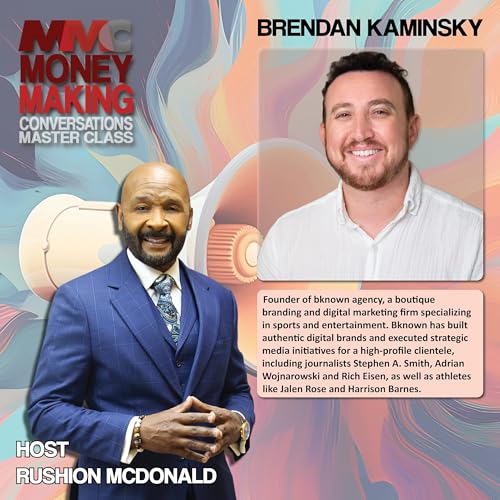
    Listen and subscribe to Money Making Conversations on iHeartRadio, Apple Podcasts, Spotify, www.moneymakingconversations.com/subscribe/ or wherever you listen to podcasts. New Money Making Conversations episodes drop daily. I want to alert you, so you don’t miss out on expert analysis and insider perspectives from my guests who provide tips that can help you uplift the community, improve your financial planning, motivation, or advice on how to be a successful entrepreneur. Keep winning! Two-time Emmy and three-time NAACP Image Award-winning television Executive Producer Rushion McDonald interviewed Brendan Kaminsky. Founder of B Known Agency, a boutique branding and digital marketing firm specializing in sports and entertainment. Kaminsky shares his journey from consulting, to working at ESPN, to eventually launching his own agency. He discusses helping major personalities like Stephen A. Smith, Jalen Rose, Harrison Barnes, and Rich Eisen develop strong social media identities and storytelling strategies. Brendan explains why he left ESPN after six and a half years—despite the security, prestige, and Disney benefits—to pursue entrepreneurship. He describes how brand building has shifted from traditional media to a landscape where relatability, vertical video, audience engagement, and consistent content matter more than follower counts. He also talks about the pressure of managing public-facing work in real time, the importance of being accessible to high‑profile clients, the rising role of AI in content creation, and how social platforms have become core to modern marketing strategies. Additionally, Brendan shares specific examples of working with Jalen Rose on mixing sports commentary with community-focused storytelling and describes how Rich Eisen’s annual “Run Rich Run” 40‑yard dash evolved into a signature charitable brand moment. The interview closes with insights on relationship-building, authenticity, and visibility—reinforcing that in the digital era, it’s not just “who you know,” but who knows you. PURPOSE OF THE INTERVIEW 1. To highlight Brendan Kaminsky’s entrepreneurial journey McDonald explores how Kaminsky transitioned from a major corporation (ESPN) to founding a successful agency. 2. To educate listeners on the evolving world of branding and digital media Kaminsky explains how branding now depends on relatability, vertical video, and engagement over follower count. 3. To provide actionable guidance for entrepreneurs and creators The interview teaches how consistency, accessibility, and storytelling help build a recognizable digital brand. 4. To show how athletes and media personalities use content to expand influence Brendan walks through real client strategies—from Jalen Rose’s community work to Rich Eisen’s fundraising dash. 5. To explore the role of AI in modern marketing Kaminsky discusses how AI assists with analytics, research, and identifying viral content moments. KEY TAKEAWAYS 1. Relatability drives modern branding People connect with authenticity, not polished promotion. Talk to your audience, not at them. 2. Engagement matters more than follower count Algorithms reward content that resonates, regardless of how many people follow you. A creator with 10,000 followers can hit a million views. 3. Social media requires presence and accessibility High-profile clients expect responsiveness; being available is key to agency success. 4. Vertical video is the new standard Optimizing content for mobile consumption is essential—TV graphics no longer dictate how content is built. 5. AI is an asset, not a threat Kaminsky uses AI for virality scoring, caption suggestions, research, and identifying strong clips from long-form content. 6. Data tells the story Success can be clearly measured through views, engagement, and growth—unlike billboards or traditional media. 7. Use “hot topics” to highlight deeper work For clients like Jalen Rose, trending sports conversations help drive attention to community-focused initiatives like his leadership academy. 8. Brand moments can start from something small Rich Eisen’s 40-yard dash evolved into a signature charity event and content anchor. 9. Entrepreneurship requires trusting your gut He left ESPN without telling anyone beforehand to avoid discouragement—because he felt the pull to build his own vision. 10. Visibility creates opportunity In the digital era, it’s not just who you know—it’s who knows you. NOTABLE QUOTES On entrepreneurship “I trusted my gut… I didn’t tell one person I was leaving ESPN because I didn’t want anyone to make me doubt myself.” On branding “People want to relate to you. They want to get to know you.” “Talk directly to your audience.” On social metrics “It’s become a lot more about engagement and views than total follower number.” On accessibility “You could be the best at your job, but if a client can’...
    Show More Show Less
    28 mins
  • Financial Tips: Her interview educates people on entrepreneurship, financial literacy, credit repair, estate planning.
    Mar 16 2026
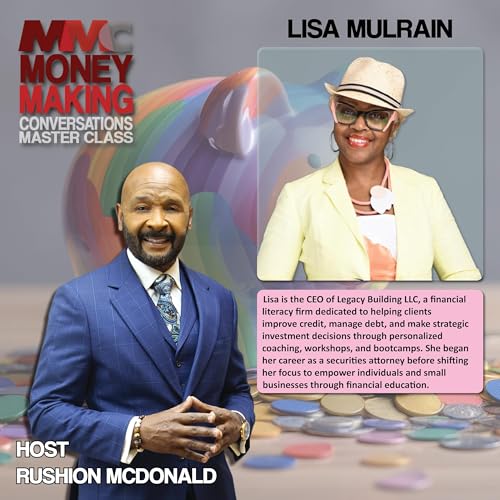
    Listen and subscribe to Money Making Conversations on iHeartRadio, Apple Podcasts, Spotify, www.moneymakingconversations.com/subscribe/ or wherever you listen to podcasts. New Money Making Conversations episodes drop daily. I want to alert you, so you don’t miss out on expert analysis and insider perspectives from my guests who provide tips that can help you uplift the community, improve your financial planning, motivation, or advice on how to be a successful entrepreneur. Keep winning! Two-time Emmy and Three-time NAACP Image Award-winning, television Executive Producer Rushion McDonald interviewed Lisa Mulrain. CEO of Legacy Building LLC and founder of Mulrain Law, in a wide‑ranging conversation about financial literacy, credit repair, estate planning, community impact, and the mindset shifts required for long-term financial success. The discussion highlights her personal journey, her transition from federal service to entrepreneurship, and her mission to educate and empower individuals—especially in minority communities—to build and protect wealth. 🎯 Purpose of the Interview The purpose of Lisa’s appearance on Money Making Conversations Masterclass was to: 1. Educate listeners on financial literacy She breaks down credit repair, debt management, estate planning, and smart investing in simple, actionable terms. 2. Promote her services Lisa shares how Legacy Building LLC helps clients strengthen their financial footing and how Moraine Law protects the assets they build. 3. Inspire financial empowerment Lisa’s personal story—from growing up in a financially challenged environment to becoming a securities attorney and entrepreneur—reinforces the idea that financial transformation is possible for anyone. 4. Encourage mindset change She stresses that financial improvement begins with understanding one’s money mindset, especially for people raised in environments of scarcity. 💡 Key Takeaways Below are the major themes and lessons Lisa shares throughout the discussion. 1. Your Money Mindset Shapes Your Financial Life Lisa emphasizes that many financial problems stem from long‑standing beliefs formed during childhood—especially in communities where money was scarce. People often develop a “lack mentality”, influencing decisions like using credit irresponsibly or putting bills in a child’s name. She teaches clients to first understand why they ended up in financial trouble before addressing how to fix it. 2. Credit Repair Requires Understanding the Root Cause Lisa rejects quick‑fix credit repair approaches. Instead, she helps clients: Assess what led to their financial hardshipIdentify self-inflicted issues (overspending, poor planning)Contact creditors directlyNegotiate payoffs or settlementsAvoid repeating the same mistakes She notes that high‑interest credit cards (often 20%+) make it nearly impossible to pay off debt without a consolidation strategy. 3. Estate Planning Is Essential—Not Optional Lisa stresses that everyone, not just wealthy people or seniors, needs an estate plan. Key points: A will and trust prevent the state from deciding what happens to your assets.Even celebrities like Prince and Aretha Franklin suffered consequences of no estate plan, leading to long probate battles.Trusts allow individuals to manage their own assets during life and ensure smooth transfer after death.Estate planning protects homes, bank accounts, cars, jewelry, and other valuables. She also explains that a trust must be funded and a will acts as a secondary backup. 4. Smart Investing Starts Early and Happens Consistently Lisa outlines a clear investing roadmap: ✔ Use employer 401(k) match Not contributing at least, the match percentage (e.g., 4% in federal roles) means leaving free money on the table. ✔ Open and fund a Roth IRA After‑tax money → tax‑free growthContributions can be withdrawn without penalty before age 59½ in emergenciesLimits vary by age and year (e.g., $7,000 to $8,500) ✔ Open a brokerage account She prefers long‑standing firms like Charles Schwab and Fidelity that allow fractional investing. ✔ Time in the market beats timing the market Small consistent investments grow over time; you don't need large sums to start. ✔ Always research Look at a company’s history, layoffs, strategy, and performance over time before investing. 5. Combining Law + Finance Gives Clients Full Protection Lisa explains the unique advantage of running a financial literacy firm and a law firm: Legacy Building: teaches people to build assetsMoraine Law: protects those assets This integrated model helps clients avoid mistakes, shield wealth, and plan for long-term financial security. 6. Her Vision for Legacy Building LLC In 5 years, she sees: National and international expansionPartnerships with small businessesPartnerships with government agencies where employees earn good salaries but lack financial educationIncreased financial literacy and asset ...
    Show More Show Less
    29 mins
  • Music Icon: He shares real-world lessons from a 40+ year entertainment career. Highlight professional preparation, mindset, and integrity.
    Mar 16 2026
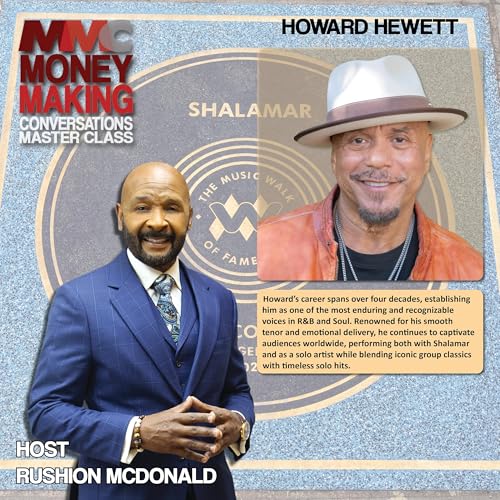
    Listen and subscribe to Money Making Conversations on iHeartRadio, Apple Podcasts, Spotify, www.moneymakingconversations.com/subscribe/ or wherever you listen to podcasts. New Money Making Conversations episodes drop daily. I want to alert you, so you don’t miss out on expert analysis and insider perspectives from my guests who provide tips that can help you uplift the community, improve your financial planning, motivation, or advice on how to be a successful entrepreneur. Keep winning! Two-time Emmy and Three-time NAACP Image Award-winning, television Executive Producer Rushion McDonald interviewed Howard Hewett. Legendary R&B vocalist and former frontman of Shalamar—joins Rushion McDonald to reflect on his early career, his rise through the music industry, and the philosophy that fueled his longevity. Hewett recounts growing up in Akron, Ohio, his early professional singing experiences, and ultimately his path to Los Angeles where he worked in show groups before joining Shalamar. A large portion of the discussion focuses on preparation, visualization, integrity, and being ready when opportunities show up. Hewett reveals the remarkable story of how he joined Shalamar: a surprise phone call during a tense meeting at the Motown building, followed by an audition the next day, a flight to meet the group, and a TV performance within 72 hours. The interview blends career storytelling, business lessons, and personal philosophy—making it valuable for creatives, entrepreneurs, and anyone pursuing long-term success. 🎯 Purpose of the Interview Rushion McDonald brings Hewett on to: Share real-world lessons from a 40+ year entertainment career.Highlight professional preparation, mindset, and integrity as keys to sustained success.Inspire listeners to embrace vision, self-belief, and business readiness—especially small business owners and creatives.Pull back the curtain on the origin story of Shalamar's most iconic lineup and Hewett’s personal development journey. This episode is crafted as both an inspirational masterclass and a historical narrative. 💡 Key Takeaways 1. Preparation is the difference-maker Hewett emphasizes that being in the right place is useless unless you’re prepared. His decades of singing before Shalamar prepared him for the moment he had to sing on the spot for Dick Griffey. Lesson: Preparation turns chance into opportunity. 2. Visualization is a powerful tool After moving to California, Hewett meditated and visualized every day by the pool—imagining performing for audiences of thousands and negotiating high-paying gigs. Lesson: Vision boards and mental rehearsal help create your future. 3. Integrity is a non-negotiable asset Even when offered the biggest opportunity of his life (joining Shalamar), Hewett insisted on giving Motown a chance to fix their mistake because he gave them his word. Lesson: Integrity strengthens your reputation more than any contract. 4. Career breakthroughs come fast—when you’re ready Within three days: Friday: received offer from ShalamarSaturday: auditioned for Dick GriffeySunday: rehearsedMonday: filmed a TV performance Lesson: Momentum happens suddenly, but only to the prepared. 5. Value of small beginnings From gospel singing at 10 to small clubs, to overseas show groups—every stage built foundation and resilience. Lesson: Don’t despise early stages; they prepare you for later success. 6. The music industry requires adaptability & consistency Hewett’s story shows how artists must navigate gigs, shaky contracts, and unreliable companies—but maintain professionalism. Lesson: Talent opens the door; discipline keeps you in the room. 🗣️ Notable Quotes (From the Transcript) On professionalism: “You're professional when you can sustain yourself… when this is how you pay your bills.” On visualization: “Every day… I would go down to the pool and just visualize what I wanted to do.”“I visualize singing in front of thousands of people.” On preparation: “Right place, right time is important. But people forget the most important part—be prepared.” On integrity: “Your word is worth more than any piece of paper you could ever sign.” On the Shalamar turning point: “That changed my whole life.”“If I wasn’t what they needed right then, they already had another cat in mind.” On life purpose: “All those things… were preparing me for that moment.” #SHMS #STRAW #BESTSee omnystudio.com/listener for privacy information.
    Show More Show Less
    33 mins
  • Uplift: She founded Jackets for Jobs-it has provided professional attire and career training to more than 40,000 job seekers.
    Mar 7 2026
    Listen and subscribe to Money Making Conversations on iHeartRadio, Apple Podcasts, Spotify, www.moneymakingconversations.com/subscribe/ or wherever you listen to podcasts. New Money Making Conversations episodes drop daily. I want to alert you, so you don’t miss out on expert analysis and insider perspectives from my guests who provide tips that can help you uplift the community, improve your financial planning, motivation, or advice on how to be a successful entrepreneur. Keep winning! Two-time Emmy and Three-time NAACP Image Award-winning, television Executive Producer Rushion McDonald interviewed Dr. Alison Vaughn. International speaker, author, and CEO/founder of Jackets for Jobs, a Detroit-based nonprofit that, for over 26 years, has provided professional attire and career training to more than 40,000 job seekers. Rushion McDonald leads a deep-dive conversation into her origin story, faith-driven entrepreneurship, struggles, workforce development, women’s empowerment, and the profound human stories behind her mission. Purpose of the Interview The interview aims to: 1. Inspire entrepreneurs and community leaders By showing how faith, persistence, and purpose can build a 26‑year nonprofit that changes lives. 2. Highlight the importance of appearance and confidence in employment Vaughn explains how professional attire boosts self‑esteem and job‑seeker success. 3. Showcase the impact of Jackets for Jobs and encourage public support She explains donation needs, especially professional clothing and plus‑size attire. 4. Educate listeners about workforce development and women’s empowerment She outlines common barriers job seekers face and how proper support transforms families and communities. Key Takeaways 1. The “Catch‑22” That Sparked Her Mission Job seekers often lack professional clothing. Without clothing, they can’t get interviews; without interviews, they can’t get jobs. Jackets for Jobs was built to break that cycle. 2. Faith Was the Foundation Vaughn repeatedly attributes her longevity to divine guidance—leaving a career at United Airlines to follow a vision she didn’t fully understand at the time.“I stepped out on faith… God gave me the vision. 3. Longevity: 26 Years in a Tough Sector With most small businesses lasting 5–10 years, surviving 26 years—especially as a nonprofit—is extraordinary.Over 40,000 job seekers have been served. 4. Self-Education in Entrepreneurship With limited internet 26 years ago, she learned business through library books, including Grant Writing for Dummies and other “Dummies” titles.Her story was later featured in the Detroit News and USA Today, and the Dummies publishers even sent her books. 5. Workforce Development Explained Workforce development means helping unemployed residents gain jobs and stability—critical in Detroit, where unemployment has historically been high. 6. Women’s Empowerment: Changing Mindsets She noticed many women on government assistance had low confidence or relied on men financially.She wrote “Ms. Goal Digger, Not Gold Digger” to teach self-sufficiency, financial independence, and professional self-presentation. 7. Appearance = Confidence = Currency Professional attire changes posture, self-worth, and interview success.Clients leave “with a pep in their step,” she says. 8. The Emotional Toll and Motivation She recalls stories of clients who: survived sex trafficking,were sleeping in cars,struggled with multiple children and no resources,or rode the bus with infants in freezing weather. These moments keep her going but also weigh heavily.She emphasizes hiring staff who have compassion and resist judgment.] 9. Entrepreneurship vs. 9–5 Reality Entrepreneurship is “24/7,” especially in nonprofits where money must be accounted for with precision.People don’t just give to a cause—they give to a leader they trust. 10. Success Defined While she has celebrated major achievements like ringing the NASDAQ closing bell twice, she says real success is:“When someone unemployed calls me and tells me they have a job.”. Notable Quotes (All from Transcript) On Founding Her Nonprofit “I stepped out on faith… God gave me the vision.”.“If you didn’t have an outfit for an interview, you didn’t go… It was a catch‑22.”. On Longevity “To be able to say I have lasted 26 years… that’s a testimony in itself.” On Confidence “Confidence is currency.”.“Their posture is different… that’s why they’re going to get that job.”. On Entrepreneurship “If you want to start a nonprofit, be prepared for 24/7 and a lot of paperwork.”. “There’s a difference between day wear and date wear.”“I want you to change your mindset.”. On Impact “Everyone that walks through has a story… you have to have compassion and not judge.” On True Success “Helping someone get a job… that’s success to me.”. #SHMS #BEST #STRAWSee omnystudio.com/listener for privacy ...
    Show More Show Less
    28 mins
  • Brand Building: He discusses $1M AI Health Equity Prize and need to prepare younger generations for healthier futures.
    Mar 2 2026
    Listen and subscribe to Money Making Conversations on iHeartRadio, Apple Podcasts, Spotify, www.moneymakingconversations.com/subscribe/ or wherever you listen to podcasts. New Money Making Conversations episodes drop daily. I want to alert you, so you don’t miss out on expert analysis and insider perspectives from my guests who provide tips that can help you uplift the community, improve your financial planning, motivation, or advice on how to be a successful entrepreneur. Keep winning! Two-time Emmy and Three-time NAACP Image Award-winning, television Executive Producer Rushion McDonald interviewed Demond Martin. Co‑founder and CEO of Well With All, a Black‑owned purpose‑driven wellness brand—joins Rushion McDonald to discuss health equity, entrepreneurship, his life story, his upcoming book Friends of the Good, and his new $1M AI Health Equity Prize. Martin shares how his difficult upbringing in the projects and rural North Carolina shaped his commitment to giving back. After a successful 21‑year career as the only Black partner at a major hedge fund, he launched Well With All to merge consumer products, wellness, and social impact. The brand donates 20% of its profits to health‑equity initiatives. He discusses product innovation, the importance of supplements in underserved communities, the power of Black longevity, and the need to prepare younger generations for healthier futures. He also explains his upcoming book—which uses Aristotle’s philosophy of “friends of the good” to show how meaningful relationships enable success. The conversation is energetic, inspirational, and focused on using business as a force for social good. 🎯 Purpose of the Interview The interview aims to: 1. Introduce Well With All A wellness company offering supplements and energy drinks while funding health‑equity solutions. 2. Share Martin’s Personal Journey From poverty, trauma, and instability → to White House, Harvard Business School, and a top hedge fund. 3. Promote His Book, Friends of the Good A philosophy‑driven exploration of friendship, mentorship, and community. 4. Announce the $1 Million AI Prize A major initiative to scale AI tools that close health‑equity gaps. 5. Encourage Health Awareness in Underserved Communities Particularly around longevity, dietary choices, energy consumption, and supplement use. 🔑 Key Takeaways 1. Health Equity Drives the Mission Martin emphasizes that health is a human right and disparities in nutrition, maternal health, and mental‑health access must be addressed. 2. Well With All = Social Impact + Consumer Products The company donates 20% of profits and creates healthier alternatives (energy drinks, supplements) to replace harmful daily habits like sugary sodas. 3. Personal Story Fuels Commitment He overcame poverty, a traumatic home life, and limited opportunity—and believes he survived because others poured into him. 4. Mentorship Changed His Life Major turning points included: Student body president at UNC CharlotteAssistant to the White House Chief of StaffHBS acceptanceTraining under hedge‑fund leader Phil Gross 5. Expertise Matters His success with Well With All is grounded in 21 years as an investor specializing only in consumer companies. 6. AI Can Close Health Gaps The $1M Well With All Prize supports AI tools already impacting at least 1,000 lives with the potential to scale to 100,000+. 7. Black Longevity Documentary His company created a film (NAACP Image Award–nominated) featuring Black elders aged 85–106 to redefine narratives around Black health. 8. The Power of Friendship His book teaches readers how to identify “friends of the good,” the relationships that define one’s path and joy. 🗣️ Notable Quotes from Demond Martin (from the transcript) (All quotes sourced from:) On Health Equity “Health is a human right. Everyone deserves nutritious food… everyone deserves to see a doctor.”“Where With All is not just a brand—it's a movement.” On His Upbringing “I grew up in the projects… lived in a trailer… had a heroin addict as a stepfather. I’ve seen things that gave me perspective.” On Perspective and Survival “If this was me at 14… I’d be dead or in jail.” On His Mission “I need to start giving back today. I’ve lived a life of giving back—my parents and grandparents instilled that in me.” On Product Philosophy “Small, incremental choices add up. Replacing one sugary soda a day is 45,000 fewer calories a year.” On Expertise “All I did for 21 years is invest in consumer companies. That was my expertise.” On Friendship & His Book “Show me your friends, I’ll show you your future.”“Friendship is one of the most essential elements of joy.” On Confidence & Mastery “Five years into my career, I knew I knew what the hell I was doing.” On AI “We’re not rewarding ideas—we’re rewarding impact.” #SHMS #STRAW #BESTSee ...
    Show More Show Less
    33 mins
  • Financial Tips: Educates you on how to avoid student loan debt and developed a process to simplify scholarship applications.
    Mar 1 2026

    Listen and subscribe to Money Making Conversations on iHeartRadio, Apple Podcasts, Spotify, www.moneymakingconversations.com/subscribe/ or wherever you listen to podcasts. New Money Making Conversations episodes drop daily. I want to alert you, so you don’t miss out on expert analysis and insider perspectives from my guests who provide tips that can help you uplift the community, improve your financial planning, motivation, or advice on how to be a successful entrepreneur. Keep winning!

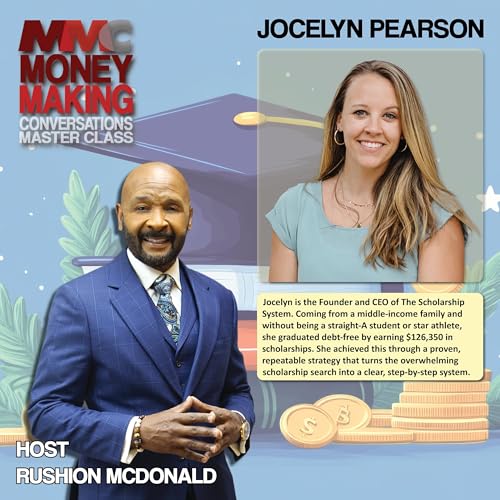
    Two-time Emmy and Three-time NAACP Image Award-winning, television Executive Producer Rushion McDonald, interviewed Jocelyn Pearson.

    Purpose of the Interview

    The interview on Money Making Conversations Masterclass with Rushion McDonald and Jocelyn Pearson aimed to:

    • Share Jocelyn’s journey of graduating debt-free by securing $126,350 in scholarships.
    • Educate families on how to avoid student loan debt through her proven system, The Scholarship System.
    • Dispel myths about scholarships and provide actionable steps for parents and students.

    Key Takeaways

    1. Scholarship System Approach

      • Jocelyn developed a six-step process to simplify scholarship applications and avoid overwhelm.
      • Focus on breaking the process into small, manageable steps rather than a vague “go get money” directive.
    2. Common Myths Debunked

      • Too early or too late to apply: Start by junior year; it’s never too late—even college seniors can apply.
      • Only perfect students or low-income families qualify: Many scholarships don’t require high GPA or athletic ability.
      • All good scholarships are gone: Smaller, local scholarships ($500–$5,000) add up over time.
      • It takes too much time: With a system and reusable materials, effort decreases each year.
    3. Avoiding Scholarship Scams

      • Beware of “easy,” “enter to win,” or sweepstakes-style scholarships—they often sell personal data.
      • Real scholarships require effort and personalization.
    4. Role of Parents

      • Parents should help with planning and identifying legitimate scholarships but not complete applications for students.
      • Committees can detect when parents write essays.
    5. AI in Scholarship Applications

      • Jocelyn warns against copy-pasting AI-generated essays.
      • Her platform introduced TESS, an AI assistant for ethical guidance and support.
    6. Financial Aid Basics

      • Submit FAFSA even if you think you won’t qualify; some colleges and states require it.
      • Combine all sources—government aid, institutional aid, and private scholarships.
    7. For Current College Students

      • Check with financial aid offices, academic departments, and organizations for scholarships available after freshman year.
    8. Entrepreneurial Journey

      • Jocelyn turned her passion into a business by starting with a book, building an email list, and launching webinars.
      • She emphasizes persistence and ignoring naysayers.

    Notable Quotes

    • “I had to accumulate my way to getting college paid for—the mere mortals’ way to going to college without tons of debt.”
    • “Most families want scholarships, but they get stuck in the overwhelm.”
    • “There’s no big red easy button—but with clear steps, it feels less daunting.”
    • “We’re saying no to the broken system… It takes, on average, 21 years to pay off student loans.”
    • “With great power comes great responsibility—AI can help, but only if used ethically.”

    #SHMS #STRAW #BEST

    See omnystudio.com/listener for privacy information.

    Show More Show Less
    29 mins