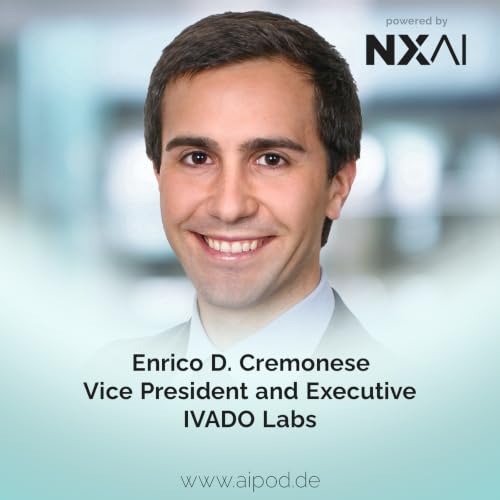
• SPS 26: Beyond Components: AI and electrical topologies
    Nov 20 2026
    In this episode, I talk to Dr. Fabian Distel and Dr. Julian Feinauer (Murrelektronik)about using AI to rethink how machines are designed, installed, and maintained. Their U-Konn-X Creaited uses specialized machine-learning models and engineering rules to generate and validate electrical topologies, while keeping the system open to components from different vendors. We also get into why an LLM isn’t the right tool for every industrial problem, how agents could make these systems easier to use, and what it takes to turn digital tools into a business. The bigger question: can AI help manufacturers improve the whole system—not just shave a little cost off one component?
    Show More Show Less
    39 mins
  • MCP, MHS and the End of the Automation Pyramid?
    Nov 18 2026
    Is the traditional automation pyramid becoming obsolete? And what happens when AI agents can directly interact with industrial machines, laboratory equipment and production systems? In this episode of the Industrial AI Podcast, host Peter Sieberg welcomes Jan Wokittel, Director Smart Manufacturing at Roche, to explore how artificial intelligence, open standards and new protocols could fundamentally reshape industrial automation. At the center of the discussion are Model Context Protocol (MCP) and Model Hardware Standard (MHS), two emerging approaches that could enable AI agents to move beyond analyzing data and generating code toward interacting with physical equipment. Jan shares insights into Roche's experience with emerging AI technologies, including discussions with Anthropic and the potential implications for established automation ecosystems built around OPC UA, MQTT and traditional industrial software. In this episode: The end of the automation pyramid? Why traditional hierarchical architectures may no longer meet the demands of modern manufacturing. MCP and MHS: How new interfaces could connect AI agents with industrial hardware. Anthropic versus traditional automation: Why AI companies could challenge established players such as Siemens and ABB. Closing the loop: How AI agents could move from data analysis to executing actions in the physical world. The future of industrial software: Why AI-powered development and open-source technologies could dramatically reduce software costs. From concept to factory: How Jan used AI agents to design a virtual chocolate production line over a weekend. Safety and validation: Why regulated pharmaceutical manufacturing presents particular challenges for autonomous AI systems. One of the most provocative questions of the conversation: What happens to the value of industrial software when AI makes developing it dramatically faster and cheaper? A conversation about the future of manufacturing, the growing influence of AI companies on industrial automation, and why machine builders may need to rethink their technology strategies. Guest: Jan Wokittel, Director Smart Manufacturing, Roche Host: Peter Seeberg, Industrial AI Podcast Presented by NXAI — Your partner for time-series foundation models and Physical AI.
    Show More Show Less
    48 mins
  • Learnings From AI on the Volcano
    Nov 11 2026
    We also get into learnable simulation, physical AI, robot safety, and the practical business value of industrial AI. The big question isn’t just which models to use—it’s how to make the right decisions under uncertainty.
    Show More Show Less
    52 mins
  • From Sandbox to 25,000 Users: How Bayer Scales AI
    Nov 4 2026
    How do you scale AI in a heavily regulated company with more than 100,000 employees? Jan Tönnissen has spent over 18 years at Bayer, most recently leading an IT delivery platform behind MyGenesis. The internal GenAI and agentic platform grew from a few hundred users to 25,000 and more than 60,000 assistants. He also built Bayer’s AI community of 19,000 colleagues. In this episode, Jan explains why guardrails don’t have to slow people down and can instead pave the way. He also describes how the EU AI Act became a catalyst rather than a hindrance. He walks through Bayer’s Agent Hub, a “telephone book” for every agent in the company, and the AI gateway that gives full transparency over LLM and token consumption. We also cover: Real use cases: research literature screening cut from weeks to days, marketing content, and “Friday,” Bayer’s new agentic assistant for every employee The token debate: from maximizing to minimizing use, self-hosted open-weight models, small language models, and counting token costs as CapEx AI-assisted engineering: where it delivers 10x and where it delivers 3x Who owns agents in production, and why ownership has to sit with the business The next wave: physical AI and agents moving closer to the shop floor Three takeaways for midsize machine builders: build a coalition of the willing, choose your first battle carefully, and define your build-vs-buy decision tree up front And one closing reminder: if you can’t measure it, you can’t steer it.
    Show More Show Less
    36 mins
  • Flat Earth: Are Engineering Tools About to Disappear?
    Oct 28 2026
    We’re seeing an explosion of AI in engineering: models turning drawings into 3D designs, agents helping create plant layouts, and new tools challenging the way engineers work. So where will the value come from next—engineering software, AI platforms, or the context data behind them? I also explore whether agents could leap across the traditional automation pyramid and connect directly with industrial systems. Then I talk with Bosch’s Thorsten Brach about connecting AI agents to industrial robots using MCP, MHS, and SRCI. We get practical about robot integration, deterministic PLC functions, and why wheeled robots may arrive in factories before legged humanoids. The big question: how do we make these systems easier to use without losing the expertise needed to keep them safe and reliable?
    Show More Show Less
    1 hr and 17 mins
  • The Navier–Stokes Problem and the Agents
    Oct 21 2026
    Did OpenAI really solve the Navier–Stokes problem? In this episode, we ask mathematician Gonzalo Caolabora. and AI professor Günter Klambauer what the proof means, why it has been difficult to verify, and whether large language models are discovering mathematics or combining ideas from existing research. We also discuss why AI can excel at problems with verifiable answers, where today’s systems still struggle, and how AI could reshape mathematical research and careers. The big question: as proofs become more automated, what will mathematicians focus on next?
    Show More Show Less
    27 mins
  • PI and AI
    Oct 8 2026
    In this episode, I sit down with David Rodriguez to explore how large language models are reshaping the way we interact with industrial data. We dive into the Pi System’s pivotal role across foundational industries and discuss practical strategies for integrating AI—without compromising sensitive operational information. David shares his experience on creating actionable knowledge graphs, running local LLMs, and the evolving relationship between human operators, agents, and data visualization. If you’re curious about the real-world challenges and future promise of AI in manufacturing, this conversation delivers clear insights and actionable takeaways. Join me as we unpack what it takes to move from data to decision—safely, efficiently, and intelligently.
    Show More Show Less
    40 mins