• Flow-Matched Neural Operators for Continuous PDE Dynamics
    Dec 9 2025

    The episode describes the Continuous Flow Operator (CFO), a novel neural framework for learning the continuous-time dynamics of Partial Differential Equations (PDEs), aimed at overcoming limitations found in conventional models like autoregressive schemes and Neural Ordinary Differential Equations (ODEs). CFO's key innovation is the use of a flow matching objective to directly learn the right-hand side of the PDE dynamics, utilizing the analytic velocity derived from spline-based interpolants fit to trajectory data. This approach uniquely allows for training on irregular and subsampled time grids while enabling arbitrary temporal resolution during inference through standard ODE integration. Across four benchmarks (Lorenz, 1D Burgers, 2D diffusion-reaction, and 2D shallow water equations), the quintic CFO variant demonstrates superior long-horizon stability and significant data efficiency, often outperforming autoregressive baselines trained on complete datasets even when trained on only 25% of irregularly sampled data.

    Show More Show Less
    12 mins
  • Ep. 11: Principals of Diffusion Models
    Nov 5 2025

    This episode provides a comprehensive monograph on diffusion models, detailing their foundational principles through three unifying perspectives: the Variational View (related to VAEs and DDPMs), the Score-Based View (rooted in EBMs and Score SDEs), and the Flow-Based View (connecting to Normalizing Flows and Flow Matching). The core concept involves defining a continuous forward process that adds noise and then learning a corresponding reverse process—a Stochastic Differential Equation (SDE) or Probability Flow Ordinary Differential Equation (PF-ODE)—to transform noise back into data. Much of the discussion focuses on the mathematical equivalence of these different formulations, the tractable training objectives (like Denoising Score Matching), and advanced techniques for accelerating the slow sampling process, including sophisticated numerical ODE solvers (like DPM-Solver) and distillation methods (such as Consistency Models). Finally, the monograph explores the theoretical connection between diffusion models and Optimal Transport (OT), suggesting that diffusion is related to, but not generally equivalent to, solving the optimal transport problem.

    Reference:

    Lai, C. H., Song, Y., Kim, D., Mitsufuji, Y., & Ermon, S. (2025). The Principles of Diffusion Models. arXiv preprint arXiv:2510.21890.

    Show More Show Less
    18 mins
  • Ep 10. RainSeer: Physics-Guided Fine-Grained Rainfall Reconstruction
    Oct 9 2025

    This episode introduces RainSeer, a novel, structure-aware framework for reconstructing high-resolution rainfall fields by treating radar reflectivity as a physically grounded structural prior. The authors argue that existing interpolation methods fail to capture localized extremes and sharp transitions crucial for applications like flood forecasting. RainSeer addresses two main challenges: the spatial resolution mismatch between volumetric radar scans and sparse ground-level station measurements (AWS), and the semantic misalignment caused by microphysical processes like melting and evaporation between the radar's view aloft and the rain that reaches the ground. The framework employs a Structure-to-Point Mapper for spatial alignment and a Geo-Aware Rain Decoder with a Causal Spatiotemporal Attention mechanism to model the physical transformation of hydrometeors during descent, demonstrating significant performance improvements over state-of-the-art baselines on two public datasets.

    Show More Show Less
    19 mins
  • Ep. 9: FlowCast-ODE Cntinuous Hourly Weather Forecasting with Dynamic Flow Matching and ODE Integration
    Sep 21 2025

    This episode dives into FlowCast-ODE, a novel deep learning framework designed to achieve accurate and continuous hourly weather forecasting. The model tackles critical challenges in high-frequency prediction, such as the rapid accumulation of errors in autoregressive rollouts and temporal discontinuities inherent in the ERA5 dataset stemming from its 12-hour assimilation cycle. FlowCast-ODE models atmospheric state evolution as a continuous flow using a two-stage, coarse-to-fine strategy: it first learns dynamics on 6-hour intervals via dynamic flow matching and then refines hourly forecasts using an Ordinary Differential Equation (ODE) solver to maintain temporal coherence. Experiments demonstrate that FlowCast-ODE outperforms strong baselines, achieving lower root mean square error (RMSE) and reducing blurring to better preserve fine-scale spatial details. Furthermore, the model is highly efficient, reducing its size by about 15% using a lightweight low-rank modulation mechanism, and achieves the capability for hourly forecasting that previously required four separate models in approaches like Pangu-Weather.

    Show More Show Less
    16 mins
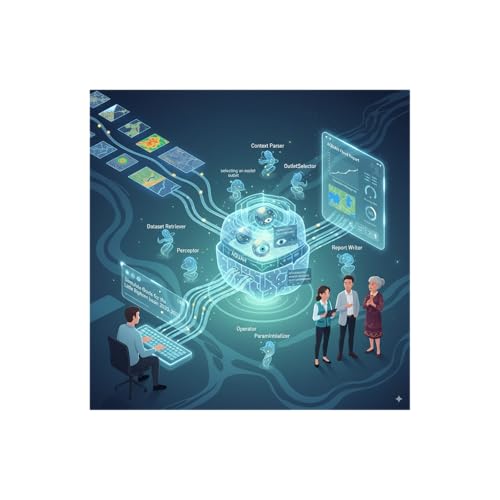
  • Ep.8 AQUAH: An Automatic Quantification and Unified Agent in Hydrology
    Sep 3 2025

    Welcome to a new episode where we dive into AQUAH, the Automatic Quantification and Unified Agent in Hydrology! This groundbreaking system is the first end-to-end language-based agent specifically designed for hydrologic modeling.

    In this episode, we'll explore how AQUAH tackles the persistent challenges in water resource management, such as fragmented workflows, steep technical requirements, and lengthy model-setup times that often limit access for non-experts and slow down rapid-response applications. Traditional hydrologic tools demand significant manual effort for data download, model configuration, and output interpretation, requiring both domain knowledge and programming skills. AQUAH aims to bridge this gap and enhance communication in hydrologic simulation.

    You'll discover how AQUAH transforms a simple natural-language prompt (e.g., “simulate floods for the Little Bighorn basin from 2020 to 2022”) into autonomous, end-to-end hydrologic simulations and narrative reports. It leverages vision-enabled large-language models (LLMs) to interpret maps and rasters on the fly, automating key decisions like outlet selection and parameter initialization that previously required expert human intervention.

    This system enables fully automated hydrologic simulations within data-available regions, particularly across the contiguous United States (CONUS). Initial experiments demonstrate that AQUAH can complete cold-start simulations and produce analyst-ready documentation without manual intervention, generating results that hydrologists judge as clear, transparent, and physically plausible.

    We'll also touch on the evaluation process, where AQUAH-generated reports were scored by professional hydrologists and LLM co-evaluators on criteria such as Model Completeness, Simulation Results, Reasonableness, and Clarity. While various vision-capable LLMs like GPT-4o, Claude-Sonnet-4, and Gemini-2.5-Flash were benchmarked, Claude-4-opus achieved the highest average score. We'll discuss how these LLMs perform in tasks like gauge selection and parameter initialization, highlighting that while some LLMs like GPT-4o can produce outstanding results, others like Claude-Sonnet-4 offer more consistent performance for first-guess parameterization.

    Join us to understand how AQUAH represents a significant leap towards democratizing access to complex environmental modeling, lowering the barrier between Earth-observation data, physics-based tools, and decision-makers, and pointing the way toward fully autonomous hydrologic modeling agents.

    Show More Show Less
    16 mins
  • Ep 7. cBottle: Climate in a bottle - foundational AI weather prediction
    Aug 5 2025

    cBottle, developed by NVIDIA, is a generative diffusion-based framework that acts as a generative foundation model for the global atmosphere. It directly tackles the challenge of petabyte-scale climate simulation data, which is currently almost impossible to access and interact with easily due to immense storage and data movement issues1....

    This revolutionary system works in two stages: a coarse-resolution generator that creates 100-kilometer global fields, followed by a super-resolution stage that upscales to incredibly detailed 5-kilometer fields. The results are astonishing: cBottle achieves an extreme 3000x compression ratio per sample over raw data, encapsulating vast climate outputs into just a few gigabytes of neural network weights. This enables low-latency generation of realistic kilometer-scale data whenever you need it.

    Beyond mere emulation, cBottle demonstrates remarkable versatility. It can bridge different climate datasets like ERA5 and ICON, perform zero-shot bias correction, fill in missing or corrupted data channels (like fixing streaking artifacts in ERA5 radiation fields), and even generate spatio-temporally coherent weather sequences. By faithfully reproducing diurnal-to-seasonal scale variability, large-scale atmospheric modes, and even tropical cyclone statistics, cBottle is poised to transform climate informatics. It's a significant step towards building interactive digital twins of Earth, making high-fidelity climate projections accessible and usable for everyone."

    Show More Show Less
    20 mins
  • Ep.6 How to fine tune a weather foundation model to hydrological variables?
    Jun 30 2025

    This research evaluates the performance of the Aurora weather foundation model by using lightweight decoders to predict hydrological and energy variables not included in its original training. The study highlights that this decoder-based approach significantly reduces training time and memory requirements compared to fine-tuning the entire model, while still achieving strong accuracy. A key finding is that decoder accuracy is influenced by the physical correlation between the new variables and those initially used for pretraining, suggesting that Aurora's latent space effectively captures meaningful physical relationships. The authors argue that the ability to extend foundation models to new variables without full fine-tuning is an important quality metric for Earth sciences, promoting accessibility for communities with limited computational resources. They conclude that rich latent space representations allow for accurate predictions of new variables using lightweight extensions, advocating for future foundation models that encompass a broad range of physical processes.

    Reference:

    Lehmann, F., Ozdemir, F., Soja, B., Hoefler, T., Mishra, S., & Schemm, S. (2025). Finetuning a Weather Foundation Model with Lightweight Decoders for Unseen Physical Processes. arXiv preprint arXiv:2506.19088.

    Show More Show Less
    10 mins
  • Ep.5 What is foundation model - drawing from numerical simulation
    Jun 3 2025

    When we talk about foundation models, what are we talking about? This is a reflection piece on foundation models by drawing an analogy from numerical solutions in fluid dynamics.

    This paper explore the challenges in building these models for science and engineering and introduce a promising framework called the Data-Driven Finite Element Method (DD-FEM), which aims to bridge traditional numerical methods with modern AI to provide a rigorous foundation for this exciting new field.

    Choi, Y., Cheung, S. W., Kim, Y., Tsai, P. H., Diaz, A. N., Zanardi, I., ... & Heinkenschloss, M. (2025). Defining Foundation Models for Computational Science: A Call for Clarity and Rigor. arXiv preprint arXiv:2505.22904.

    Show More Show Less
    29 mins