

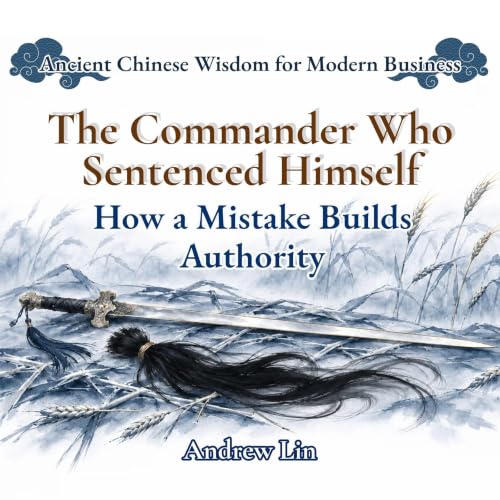
The Commander Who Sentenced Himself: How a Mistake Builds Authority
Failed to add items
Sorry, we are unable to add the item because your shopping cart is already at capacity.
Add to basket failed.
Please try again later
Add to Wish List failed.
Please try again later
Remove from Wish List failed.
Please try again later
Follow podcast failed
Unfollow podcast failed
$0.99/mo for 3 months + $20 Audible bonus voucher
Auto-renews at $8.99/mo after 3 months. Cancel anytime.
Offer ends on 28 December, 2026.

The Commander Who Sentenced Himself: How a Mistake Builds Authority
Narrated by:
AI Voice
Buy Now for $4.55
-
Narrated by:
-
AI Voice
-
By:
-
Andrew Lin

This title uses virtual voice narration
Virtual voice is computer-generated narration for audiobooks.
Summary
In the summer of 198, Cao Cao led his army past fields of ripe wheat and gave a simple order: anyone who tramples the crops will be beheaded. His soldiers dismounted and carried the wheat aside by hand. Then a startled bird sent his own horse charging into the field. The man who made the law had just broken it, and thousands of soldiers and farmers were watching to see what he would do.
What he did next became one of the most famous moments in Chinese history. It turned a patchwork army into the most disciplined force of its time. It also raises hard questions that leaders still face today. Is a symbolic punishment real leadership or a clever performance? And who has the right to judge the person at the top?
This twenty-minute audiobook tells the full story, then brings it into the modern workplace through a factory floor, a restaurant group, a hospital hallway, and two cautionary cases. It shows why a rule is truly tested the day its maker breaks it, how to pay a price people can actually see, and why every leader needs someone they cannot control to hold them to their own rules.
Part of the Ancient Chinese Wisdom for Modern Business series by Andrew Lin.
No reviews yet
In the spirit of reconciliation, Audible acknowledges the Traditional Custodians of country throughout Australia and their connections to land, sea and community. We pay our respect to their elders past and present and extend that respect to all Aboriginal and Torres Strait Islander peoples today.