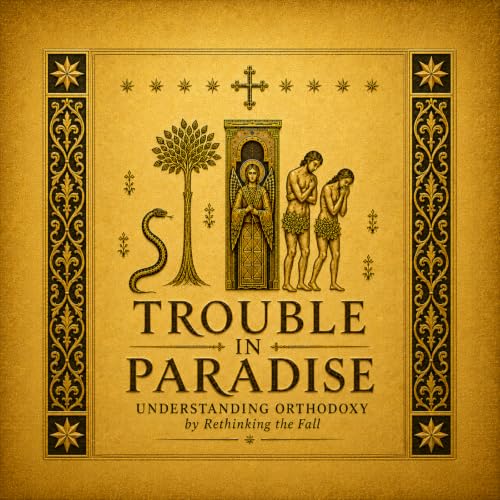
Trouble in Paradise - Understanding Orthodoxy by Rethinking the Fall cover art

Trouble in Paradise - Understanding Orthodoxy by Rethinking the Fall

Trouble in Paradise - Understanding Orthodoxy by Rethinking the Fall

By: Matthew Lyon
Listen for free

About this listen

Trouble in Paradise explores why Eastern Orthodoxy often seems confusing to other Christians — and how rethinking Original Sin reshapes the entire Christian story.

Through personal story, historical theology, and spiritual reflection, this podcast walks listeners through the crisis and discovery that can occur when those assumptions are challenged.

For Protestants, Catholics, and Orthodox Christians seeking a deeper understanding of the Christian story.

Matthew Lyon 2026
Christianity Philosophy Social Sciences Spirituality
Episodes
  • Very Good Is a Long Way from Perfect - Part 3 - Collapse, Inability, and the Logic of the Cross
    Feb 24 2026

    Episode 3

    In Part 3, we follow the implications of one foundational question:

    Did Genesis describe Adam as perfect — or as very good?

    We explore how imagining a perfected Adam logically leads to:

    • Collapse/Corpse anthropology
    • Inability to will salvific good
    • Monergistic grace
    • Meticulous providence
    • The “inevitability instinct”
    • Intensified penal substitution

    We then contrast this with the Orthodox diagnosis of the Fall as mortality, corruption, and fear of death — not metaphysical annihilation of the will.

    It is an examination of premises.

    Key Biblical Texts

    • Genesis 1:31 — “Very good” (tov me’od)
    • Romans 8:7–13 — “Those who are in the flesh cannot please God”
    • Hebrews 2:14–15 (KJV) — Fear of death and lifelong bondage

    Key Confessional Sources (Western)

    Thirty-Nine Articles (1563)

    Drafted during the English Reformation under Elizabeth I to define doctrine within the Church of England.

    Article IX:

    “Original sin… is the fault and corruption of the Nature of every man… whereby man is very far gone from original righteousness…”

    Westminster Confession of Faith (1646)

    “Man… hath wholly lost all ability of will to any spiritual good accompanying salvation.”

    1689 London Baptist Confession

    “Man… hath wholly lost all ability of will to any spiritual good accompanying salvation.”

    Arminian Sources

    John Wesley

    “By nature every man is dead in sin… void of all power to do good… and has no free will, unless it be to do evil.”

    Jacobus Arminius

    “In his lapsed and sinful state, man is not capable… to think, to will, or to do that which is really good… unless he be regenerated and renewed by God in Christ.”

    Evangelical Language of Inability

    Even outside confessional Calvinism, collapse anthropology persists in revival preaching:

    Chuck Smith

    “Man in his natural state is spiritually dead… incapable of coming to God apart from the work of the Holy Spirit.”

    The Logical Chain Examined

    Perfect Adam → Catastrophic collapse → Inability to will salvific good → Monergistic grace → Meticulous sovereignty → Inevitability instinct → Wrath-intensified penal substitution

    Orthodox Diagnosis

    Athanasius of Alexandria

    Humanity became “corruptible” and “held fast by the law of death.”

    Maximus the Confessor

    • Natural will remains.
    • Fallen mode of willing becomes distorted.
    • Inability is bondage under death, not ontological erasure.

    Analogy used in the episode:

    The will is like a compass near a magnet — still present, but pulled off course.

    Core Question Raised

    Does replacing inherited infinite guilt with mortality, corruption, Satan, and fear of death reduce the seriousness of sin?

    Or does it reframe it?

    “The question is not whether sin is serious. The question is what makes it serious — how it destroys, and why.”

    What This Episode Is Not

    • Not a denial of sin.
    • Not a denial of grace.
    • Not a denial of substitution.
    • Not an attack on Evangelicals or Catholics.
    • Not a rejection of Scripture.

    It is an examination of anthropology.

    Show More Show Less
    16 mins
  • Very Good Is a Long Way from Perfect - Part 2
    Feb 18 2026

    Episode 4

    If Adam was created perfect… why did he fall?

    And if God knew he would fall… what does that mean for evil?

    In Part 2 of Very Good Is Far from Perfect, we follow the logic of perfection all the way to the edge — into the question many people are afraid to ask:

    Does our theology accidentally make evil necessary?

    In this episode:

    • Why “perfect Adam” creates pressure in theodicy
    • A simple breakdown of free will: libertarianism, determinism, and compatibilism
    • Why Arminians and Calvinists may share more assumptions than they realize
    • What “God permitted the Fall” really means — and how that differs in Western and Orthodox theology
    • Leibniz and the “Best of All Possible Worlds”
    • Why evil becomes instrumental in some systems
    • Evil as parasitic, not necessary
    • “I am the Vine, you are the branches” — an organic vision of salvation

    This episode isn’t about attacking traditions.

    It’s about asking whether our starting assumptions — especially the idea that Adam was created perfect — force us into theological tensions that never fully resolve.

    What if the problem isn’t sovereignty versus free will?

    What if the problem is the assumption that Adam was perfect?

    Very good is far from perfect.

    And that difference changes how we speak about God.

    Show More Show Less
    12 mins
  • Very Good Is a Long Way from Perfect – Part 1
    Feb 16 2026

    Episode 3 - What if the entire Western understanding of salvation rests on a word the Bible never uses?

    Genesis does not say Adam was created perfect. It says he was very good.

    In this episode, we explore how that distinction reshapes everything:

    • Was Adam created finished — or with potential?
    • If humanity was perfect, why probation?
    • Why command Adam to subdue the earth if creation was already complete?
    • Why is Scripture filled with imagery of ascent — Jacob’s ladder, mountains, transformation “from glory to glory”?

    We examine:

    • The early Church Fathers (Irenaeus, Athanasius, Basil)
    • Conditional immortality and participation in divine life
    • Augustine’s shift toward inherited guilt
    • How Covenantal probation assumes growth
    • Calvin, decree, and the pressure toward inevitability
    • The Essence–Energies distinction and divine freedom

    We also ask uncomfortable questions:

    If you define the Gospel as “going from hell to heaven,” are you already operating inside the framework of inherited condemnation — even if you say you reject Original Sin?

    What does our treatment of children — communion, baptism, “age of accountability” — reveal about our anthropology?

    If Adam was not created perfect but called to grow into communion, then salvation is not merely legal acquittal.

    It is healing. Resurrection. Participation.

    Very good, not perfect. Communion, not probation. Freedom, not inevitability.

    And that difference changes everything.

    Show More Show Less
    14 mins
No reviews yet
In the spirit of reconciliation, Audible acknowledges the Traditional Custodians of country throughout Australia and their connections to land, sea and community. We pay our respect to their elders past and present and extend that respect to all Aboriginal and Torres Strait Islander peoples today.