• Episode 60 | Growth Mindset with Suresh Panicker
    Nov 14 2026

    You’ve decided Monday is the day you’ll start.

    Then you sleep badly, your pain flares, and an appointment gets moved.

    By lunchtime, the plan has gone out the window. Before you have a go at yourself, what actually got in the way?This week on The Support and Kindness Podcast, Rich, Liam, Sarah, and I sit down with Suresh Panicker.

    Suresh served in the Indian Army and now runs Omni Wellness in Sweden.

    He tells us about his FLOW Method and asks a question worth sitting with: What gives you energy, and what drains it?Rich asks where you can start if money is tight or you can’t get to a gym.

    Liam asks what one missed day really means.

    Sarah asks what helpful support sounds like after a rough week.

    And in “What’s on Your Heart?”, Rich shares something he realised while we were recording.

    Health problems took him away from coaching football. Listening to Suresh, he could hear the coach in himself again.

    This week, pick whichever challenge suits you.

    One Small Experiment.

    After your morning tea or coffee, try writing down one thing you need that day. Or pick a small action of your own.

    Try it up to three times this week if that feels manageable. Afterwards, ask yourself, “Did this help? What would make it easier next time?”Change the Question.

    The next time you catch yourself saying, “I never stick with anything,” try asking, “What got in the way this time?”

    Then ask what support or change might help. Once this week is enough.Find Suresh and his book, Resilient by Designhttps://flowmethodcoaching.comListen to more episodeshttps://kindnessrx.org/listenJoin our free online peer support groupshttps://kindnessrx.org/groupsShare this episodehttps://KindnessRX.org/60We share lived experience and general information.

    For advice about your own health, speak with your healthcare team.Greg Shaw

    Show More Show Less
    55 mins
  • Episode 59: Toxic Positivity - When Good Vibes Only Goes Wrong
    Nov 6 2026

    Episode 59: Toxic Positivity

    When “Good Vibes Only” Goes Wrong

    • “Just stay positive.” “Everything happens for a reason.”
    • “At least it could be worse.”

    We might mean well. But what happens when the person hearing those words just needs us to listen?

    This week, Greg, Rich, Liam, and Sarah talk about toxic positivity, the pressure to put a cheerful spin on things when life is hard.

    We share where we’ve heard it, how we’ve used it ourselves, and what helps us feel heard.

    We get into faith, chronic pain, disability, childhood experiences, and the urge to fix things for people we love.

    We also talk about comparing our struggles, the pressure to be “strong,” and setting boundaries when someone keeps brushing our feelings aside.

    There’s room for hope, gratitude, anger, and grief in the same conversation.

    00:00 Intro

    01:18 What is toxic positivity?

    06:14 Faith, good intentions, and feeling unheard

    14:53 Why we rush to fix someone’s pain

    22:11 Taking ownership when our words hurt

    22:41 “Other people have it worse”

    29:13 Can gratitude and grief exist together?

    30:39 Social media and the parts we don’t see

    32:14 When a boss or caregiver dismisses you

    33:59 Asking what kind of support someone wants

    34:27 Boundaries when someone keeps minimising your feelings

    35:41 What honest hope sounds like

    37:47 What’s on Your Heart This Week?

    44:30 Closing thoughts and weekly challenge


    The next time someone tells you something difficult, pause before offering reassurance.

    Ask: “Would you like me to listen or would you like some help with the next step? And what would be useful?”

    Then give them time to answer.

    If you’re struggling yourself, try: “Today, I feel… And what I could use is…”

    It might be rest, company, help, or space. It’s okay if you don’t know yet.

    More episodes: https://kindnessrx.org/listen

    Our online support groups: https://kindnessrx.org/groups

    Mentioned by Sarah: Opportunities for Ohioans with Disabilities. Explore employment support and eligibility:

    https://ood.ohio.gov/information-for-individuals/services/vocational-rehabilitation-services

    Further watching: Susan David’s TED Talk, The Gift and Power of Emotional Courage:

    https://www.ted.com/talks/susan_david_the_gift_and_power_of_emotional_courage

    If this conversation helped, follow the podcast and share it with someone who could use it.

    Contains strong language and discussion of grief, depression, chronic illness, disability, childhood trauma, and abuse. This is peer support and general information, not medical advice.

    In the US, call or text 988 for crisis support, or visit https://988lifeline.org. If there is immediate danger or a medical emergency, call 911.

    Show More Show Less
    46 mins
  • Body Image When Your Body Has Changed | Episode 58
    Oct 30 2026

    What happens when the body you live in no longer feels like the one you know?Maybe it changed after an illness, an injury, surgery, or years of pain. Maybe other people cannot see the change at all. Either way, “just love your body” can feel like a lot to ask.This week, I’m joined by Rich, Liam, and Sarah for an honest conversation about body image after your body has changed. We talk about the things a mirror cannot show. The fatigue. The grief. The loss of privacy. The comments that stay with you long after someone has said them.I share my own struggle with weight and self-criticism. Sarah talks about life after a spinal cord injury, scars, and finding someone who understood. Liam shares what it feels like to use a cane and be judged before people know you. Rich reflects on belonging and finally finding his people.There is room for a laugh here, too. These are difficult things to live with. It helps to talk about them with people who get it.In this episode:• Why body image is about more than appearance• Grieving a change without turning on yourself• Mobility aids that bring freedom and complicated feelings• Privacy, personal questions, and asking before helping• Social comparison, relationships, and honest conversations• Body neutrality and care when body love feels out of reach• Knowing when you may need professional supportTHIS WEEK’S CHALLENGEChoose one act of body respect and one boundary. Rest when you need to. Wear the aid that helps you get out. Put away clothes that make you feel worse. Try saying, “Please do not comment on my weight.”Supporting someone else?

    Try seven days without unsolicited comments about their body. Ask whether they would like you to listen, help, or change the subject.Listen and share Episode 58:https://kindnessrx.org/58Explore our free online peer support groups:https://kindnessrx.org/groupsMore episodes:https://kindnessrx.org/listenIf this conversation helps, follow the podcast and share it with someone who might need it. You’re safe here.CONTENT NOTEIncludes body dissatisfaction, weight change, eating disorders, body dysmorphic disorder, disability, pain, scars, intimacy, mental health distress, and some strong language.This is a peer conversation and general information, not medical advice, therapy, or diagnosis. If concerns about your body affect eating, daily life, relationships, or getting care, speak with a qualified professional. In the U.S., call or text 988 for crisis support. Call 911 for immediate danger.RESEARCH CLARIFICATIONThe CDC chronic-pain figure of 36.0% applies to adults aged 65 and older.https://www.cdc.gov/nchs/products/databriefs/db518.htm

    Show More Show Less
    1 hr and 8 mins
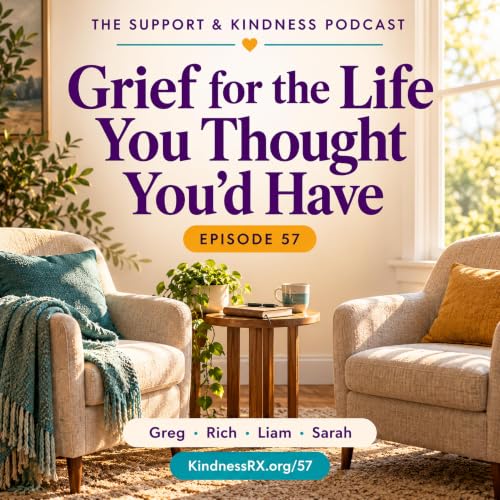
  • Episode 57: Grief for the Life You Thought You’d Have
    Oct 23 2026
    Maybe you thought life would look different by now. A different career. A closer family. Better health. More time with someone you love.Rich, Liam, Sarah, and I talk about grief for the life we expected, and the life we thought we had. We share personal experiences of brain injury, disability, recovery, caregiving, money worries, and regret. There are difficult moments, some laughs, and room for feelings that don’t fit neatly together.Kindo’s Kindness Challenge: “What Changed, What I Need”Finish: “What I miss is…” and “What would help me this week is…”Keep it small and private if you like. Supporting someone? Ask what others find hardest to understand. Listen, offer specific help, and allow a no. Respect requests for space.Listen/share: https://kindnessrx.org/57Free peer groups/current calendar: https://kindnessrx.org/groupsFollow: https://kindnessrx.org/listenCHAPTERS00:00 Intro and welcome01:44 The future you expected and the life you thought you had07:50 Grief for a life that changed16:12 Identity, lost roles, and the masks we wear24:48 Regret and responsibility27:21 When money changes your plans35:39 Grief while life is still changing40:25 Family expectations and comparison50:53 Listening when a loss is hard to see52:47 Making plans again without rushing grief58:04 What’s on your heart this week?1:02:47 Closing thoughts and practical support1:04:13 Kindo’s Kindness Challenge: What Changed, What I Need1:05:35 Sharing the episode, groups, and support resourcesLINKS WE PROMISEDThe poem Greg called “The Mask”: “Please Hear What I’m Not Saying” — Charles C. Finn:https://poetrybycharlescfinn.com/pages/please-hear-what-im-not-sayingTED talks for further listening:Nora McInerny — We don’t “move on” from grief. We move forward with it. A personal perspective on bereavement.https://www.ted.com/talks/nora_mcinerny_we_don_t_move_on_from_grief_we_move_forward_with_itKathryn Schulz — Don’t regret regret.https://www.ted.com/talks/kathryn_schulz_don_t_regret_regretAlexandra Sacks — A new way to think about the transition to motherhood.https://www.ted.com/talks/alexandra_sacks_a_new_way_to_think_about_the_transition_to_motherhoodResearch and information mentioned in the introduction:NHS — Grief after bereavement or loss:https://www.nhs.uk/mental-health/feelings-symptoms-behaviours/feelings-and-symptoms/grief-bereavement-loss/Studies of grief following bereavement, divorce and unemployment — Papa et al. (2014) and Klurfeld et al. (2020):https://pubmed.ncbi.nlm.nih.gov/24751321/https://pubmed.ncbi.nlm.nih.gov/32663941/APA’s 2023 stress survey (stress, not a measure of parental regret or grief):https://www.apa.org/news/press/releases/2023/11/psychological-impacts-collective-traumaFederal Reserve — 2025 household survey, published 2026; $400 emergency expense:https://www.federalreserve.gov/publications/2026-economic-well-being-of-us-households-in-2025-savings-investments.htmJuliana G. Breines and Serena Chen (2012) — Self-compassion and self-improvement motivation. The study measured motivation to make amends, not long-term behaviour change:https://pubmed.ncbi.nlm.nih.gov/22645164/Content note: Bereavement, dementia, family conflict, disability, addiction, substance use, and regret. Take a break if you need one. This is peer conversation, not medical advice or crisis care.Support: U.S. and territories, call/text 988 or visit https://988lifeline.orgOther countries: https://findahelpline.comImmediate danger: call your local emergency number.
    Show More Show Less
    1 hr and 8 mins
  • Episode 56: When You Can't Make Yourself Do Basic Things
    Oct 16 2026

    When You Can't Make Yourself Do Basic Things

    You need a shower. There's food to make and a letter you haven't opened. You know what needs doing, but getting started feels like too much. Then someone says, "It only takes five minutes."

    This week, Rich, Liam, Sarah, and I talk about the everyday tasks we struggle with and the shame that can come with them. We share what it's like when pain, brain injury, low energy, or trouble remembering things turns one job into a long list of steps.

    We talk about:

    • Why calling something "basic" can make it harder to admit you're struggling.

    • Showers, meals, medication routines, laundry, and unopened mail.

    • Breaking a job into smaller parts and choosing what needs attention first.

    • Reminders, asking for help, and having someone alongside you.

    • Offering support without taking over or making someone feel judged.

    • When changes in everyday life deserve a conversation with a health professional.

    In "What's on Your Heart This Week?", we talk about caregiving, sobriety, family, needing some peace, and feeling lonely.

    This week's kindness challenge: One Need, One Kind Step

    If you're struggling, choose one thing you need today. Make the next step clear or ask someone to help with one job.

    You could say: "I'm having a hard time with everyday things. Could you help me with one job?"

    If you're supporting someone, offer a choice: "Would it help if I brought you something to eat or sat with you while you open the mail?" Ask before moving their things or looking at anything private. Give them room to say no.

    If food, fluids, medication, or safety are already a concern, ask for help promptly. The challenge can wait.

    Listen and stay connected

    Follow The Support & Kindness Podcast and share this episode with someone you'd like to help understand.

    More episodes: https://kindnessrx.org/listen

    Free online peer-led support groups and current meeting times: https://kindnessrx.org/groups

    A note about this conversation

    We're sharing lived experience, not personal medical advice. Our peer support groups don't replace medical care, therapy, or crisis support. Speak with your clinician or pharmacist about medication concerns; don't change doses based on something heard in the episode.

    In the United States, call or text 988 for crisis support: https://988lifeline.org

    For immediate, life-threatening danger, call 911. Outside the United States, use your local emergency service or find support at https://findahelpline.com

    Content note: candid discussion of mental health, difficulty with personal care, alcohol recovery, and occasional strong language.

    Show More Show Less
    54 mins
  • The Anxiety of Checking Your Phone | Episode 55
    Oct 10 2026

    You care about people. So why can opening their messages feel so hard?

    An unread text. A missed call. A voicemail you keep putting off. Sometimes a phone notification feels like one more demand before you even know what it says.

    Greg, Rich, Liam, and Sarah talk honestly about phone anxiety, the pressure to reply straight away, and how avoidance can make a message feel bigger. We share different experiences, a few laughs, and small ways to make communication easier.

    In this episode:

    • Why a message can feel like a whole list of jobs

    • Reply guilt, limited energy, and the fear of bad news

    • Notification boundaries and deciding what is truly urgent

    • Short replies you can borrow when you feel overwhelmed

    • How to support someone without adding pressure

    • The one-message reset and our weekly Kindo challenge

    This week's challenge: One Message, One Boundary.

    If messages feel overwhelming, choose one safe, manageable message and one small boundary. If you're supporting someone, send a kind message that lowers the pressure, then give them room.

    Listen and share Episode 55: https://kindnessrx.org/55

    Free online peer support groups: https://kindnessrx.org/groups

    More episodes: https://kindnessrx.org/listen

    Article mentioned in the episode:

    TechRadar, every phone ping takes 7 seconds of your attention:

    https://www.techradar.com/phones/every-phone-ping-takes-7-seconds-of-your-attention-heres-how-to-get-it-back

    Research and practical resources:

    The original 2026 notification study: https://doi.org/10.1016/j.chb.2026.108926

    Notifications and attention, 2015 study: https://doi.org/10.1037/xhp0000100

    Understanding the anxiety cycle: https://www.cci.health.wa.gov.au/Resources/For-Clinicians/Panic

    Android notification settings: https://support.google.com/android/answer/9079661?hl=en

    iPhone Focus settings: https://support.apple.com/guide/iphone/allow-or-silence-notifications-for-a-focus-iph21d43af5b/ios

    The seven-second figure describes temporary slowing on a laboratory task, not a universal rule for every notification.

    This is a peer conversation, not a diagnosis or treatment advice. Keep urgent medical, safety, financial, and caregiver messages in your contact plan. In the U.S., call or text 988 for crisis support: https://988lifeline.org/. For immediate danger, call emergency services.

    You do not have to be available every minute to be a caring person.

    Show More Show Less
    53 mins
  • Episode 54: Are Influencers Ruining Kindness?
    Sep 30 2026

    Episode 54: Are Influencers Ruining Kindness?

    Someone pays for a stranger's groceries. The help is real. But did the person want their difficult moment shared with millions of people?

    Greg Shaw, Rich, Liam, and Sarah talk about kindness videos, money, consent, and what happens when someone's private struggle becomes online content.

    We leave room for different answers, including why these videos can move us and why some make us uncomfortable.

    We discuss:

    • Whether someone who needs help can freely say no to being filmed.

    • Why receiving help shouldn't come with a test of gratitude.

    • What changes when creators, brands, or television shows earn money from a good deed.

    • How to share kindness while protecting someone's privacy.

    • Sarah's family tradition of leaving dollar bills at hospital vending machines.

    • Small ways to help without asking for a public reaction.

    In What's on Your Heart, we talk about time with loved ones, challenging racism and homophobia, receiving unexpected kindness, and living with pain.

    This week's challenge

    Send a private thank-you to someone whose support mattered to you.

    Or offer a small act of help and let the other person choose what they share.

    If you want to tell their story online, make sure they can say no without losing the help.

    One question to take away: What rule would you want every kindness creator to follow?

    Listen to Episode 54: https://kindnessrx.org/54

    More episodes: https://kindnessrx.org/listen

    Free online peer support groups: https://kindnessrx.org/groups

    Brain injury: Mondays.

    Chronic pain: Tuesdays.

    Mental health: Wednesdays.

    Research mentioned in the episode

    American Psychiatric Association, 2023 Healthy Minds Poll:

    https://www.psychiatry.org/news-room/news-releases/new-poll-small-acts-of-kindness-benefits

    Among 2,210 U.S. adults surveyed, 90% said receiving kindness made them feel at least a little better.

    This was a self-report poll, not a study of being filmed or of kindness videos.

    Further reading, added after recording

    Elizabeth Dunn's TED Talk on helping and happiness:

    https://www.ted.com/talks/elizabeth_dunn_helping_others_makes_us_happier_but_it_matters_how_we_do_it

    UNICEF's ethical reporting guidance, including children's privacy and dignity:

    https://www.unicef.org/media/reporting-guidelines

    A clarification about recording

    • Our discussion includes broad comments about filming people in public.
    • Recording and publication rules vary by location and circumstances.
    • Being in public doesn't settle every question about audio consent, privacy, or commercial use.


    A useful U.S. starting point is the Reporters Committee's state-by-state guide:

    https://www.rcfp.org/reporters-recording-guide/

    Content note: Financial hardship, homelessness, vulnerability, caregiving, racism, homophobia, and occasional strong language.

    This is a peer conversation.

    Our groups and podcast do not replace therapy, medical care, or professional advice.

    Show More Show Less
    48 mins
  • Episode 53: Politics at the Kitchen Table: Can We Love People We Deeply Disagree With?
    Sep 24 2026

    What happens when someone you love sees an important issue in a completely different way?

    A conversation at the kitchen table can turn tense quickly, especially when politics, values, and family history are all tangled together.

    I’m joined by Rich, Liam, and Sarah for a candid conversation about what happens inside us when we disagree, why it can hurt more with family, and how to listen without pretending we agree.

    We talk about news fatigue, taking a pause, and setting boundaries when a conversation stops helping. We also share what gives us hope that people can still connect across differences.

    This is a conversation among friends. We don’t have perfect answers, and kindness does not require anyone to accept insults, threats, or harm.

    In this episode:

    • Why disagreements with loved ones can feel so personal.
    • Listening to understand without giving up your own views.
    • How to say, “I care about you, but I need to pause this conversation.”
    • The effect of headlines, feeds, and repeated arguments on how we see one another.
    • Two small challenges: pause before sharing a story or set one news boundary.

    This week’s question: How do you stay connected to people you love when you see important issues in different ways?

    Listen and share: https://KindnessRX.org/listen

    Our free online support groups: https://KindnessRX.org/groups

    Support: If you’re in the U.S. and need immediate emotional or suicide crisis support, call or text 988 or visit https://988lifeline.org/.

    Outside the U.S., look for local support at https://findahelpline.com/.

    If you’re in immediate danger, contact local emergency services.

    Further reading: American Psychological Association, Stress in America 2024: https://www.apa.org/pubs/reports/stress-in-america/2024/

    Pew Research Center, Americans’ feelings about politics and political discourse:

    https://www.pewresearch.org/politics/2023/09/19/americans-feelings-about-politics-polarization-and-the-tone-of-political-discourse/

    This podcast offers peer conversation, not therapy or crisis care.

    Show More Show Less
    55 mins