• Running Self-Hosted Models with Ruby and Chris Hasinski
    Dec 2 2025

    In this episode of the Ruby AI Podcast, hosts Valentino Stoll and Joe Leo
    welcome AI and Ruby expert Chris Hasinski. They delve into the benefits and
    challenges of self-hosting AI models, including control over model updates, cost
    considerations, and the ability to fine-tune models. Chris shares his journey
    from machine learning at UC Davis to his extensive work in AI and Ruby, touching
    upon his contributions to open source projects and the Ruby AI community. The
    discussion also covers the limitations of current LLMs (Large Language Models)
    in generating Ruby code, the importance of high-quality data for effective AI,
    and the potential for Ruby to become a strong contender in AI development.
    Whether you're a Ruby enthusiast or interested in the intersection of AI and
    software development, this episode offers valuable insights and practical
    advice.

    00:00 Introduction and Guest Welcome
    00:31 Why Self-Host Models?
    01:28 Challenges and Benefits of Self-Hosting
    03:14 Chris's Background in Machine Learning
    04:13 Applications Beyond Text
    06:39 Fine-Tuning Models
    12:27 Ruby in Machine Learning
    16:06 Distributed Training and Model Porting
    18:22 Choosing and Deploying Models
    25:19 Testing and Data Engineering in Ruby
    27:56 Database Naming Conventions in Different Languages
    28:19 Importance of Data Quality for AI
    18:03 Monitoring Locally Hosted AI Models
    29:37 Challenges with LLMs and Performance Tracking
    31:09 Improving Developer Experience in Ruby
    31:45 Ruby's Ecosystem for Machine Learning
    32:43 The Need for Investment in Ruby's AI Tools
    38:25 Challenges with AI Code Generation in Ruby
    43:35 Future Prospects for Ruby in AI
    51:26 Conclusion and Final Thoughts

    Show More Show Less
    54 mins
  • The Latent Spark: Carmine Paolino on Ruby’s AI Reboot
    Nov 18 2025

    In this episode of the Ruby AI Podcast, hosts Joe Leo and his co-host interview Carmine Paolino, the developer behind Ruby LLM. The discussion covers the significant strides and rapid adoption of Ruby LLM since its release, rooted in Paolino's philosophy of building simple, effective, and adaptable tools. The podcast delves into the nuances of upgrading Ruby LLM, its ever-expanding functionality, and the core principles driving its design. Paolino reflects on the personal motivations and community-driven contributions that have propelled the project to over 3.6 million downloads. Key topics include the philosophy of progressive disclosure, the challenges of multi-agent systems in AI, and innovative ways to manage contexts in LLMs. The episode also touches on improving Ruby’s concurrency handling using Async and Rectors, the future of AI app development in Ruby, and practical advice for developers leveraging AI in their applications.

    00:00 Introduction and Guest Welcome
    00:39 Depend Bot Upgrade Concerns
    01:22 Ruby LLM's Success and Philosophy
    05:03 Progressive Disclosure and Model Registry
    08:32 Challenges with Provider Mechanisms
    16:55 Multi-Agent AI Assisted Development
    27:09 Understanding Context Limitations in LLMs
    28:20 Exploring Context Engineering in Ruby LLM
    29:27 Benchmarking and Evaluation in Ruby LLM
    30:34 The Role of Agents in Ruby LLM
    39:09 The Future of AI Apps with Ruby
    39:58 Async and Ruby: Enhancing Performance
    45:12 Practical Applications and Challenges
    49:01 Conclusion and Final Thoughts

    Show More Show Less
    52 mins
  • Building Futures: AI, Careers & the Rails Ahead with Avi Flombaum
    Nov 4 2025

    In this episode of the Ruby AI Podcast, hosts Valentino Stoll and Joe Leo are joined by Avi Flombaum, the founder of Flatiron School. Avi talks about the origins of Flatiron, the success it achieved, and the educational methods used to teach programming, emphasizing on the importance of understanding code deeply and leveraging AI efficiently. He discusses the challenges and changes in the industry, particularly with the rise of AI, and provides insight into modern workflows and product development. The conversation also touches on the necessity of integrating product thinking into engineering and how automated workflows can improve consistency and efficiency in software creation.

    00:00 Introduction and Welcoming Avi Flombaum
    00:55 Avi's Journey to Founding Flatiron School
    02:22 The Impact and Growth of Flatiron School
    04:40 Challenges and Evolution in the Bootcamp Industry
    05:39 Transitioning from Education to AI
    06:39 The Role of AI in Modern Development
    08:14 Effective AI Workflows for Developers
    16:08 Teaching and Learning with AI
    20:47 Product Management and Engineering Collaboration
    27:31 Leveraging AI in Product Development
    28:35 Exploring AI-Driven Product Development
    29:42 Teaching Product Management Skills
    30:49 Innovative Solutions in Product Design
    32:25 Understanding User Needs and Problem Solving
    35:33 Learning Through Code and AI Tools
    42:38 The Future of Software Engineering

    Show More Show Less
    52 mins
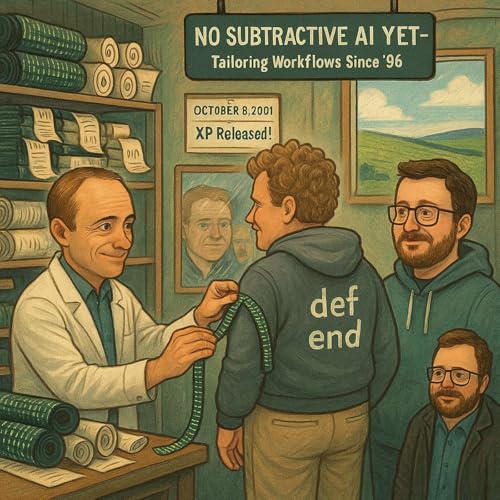
  • The TLDR of AI Dev: Real Workflows with Justin Searls
    Oct 21 2025

    In this episode of the Ruby AI Podcast, co-hosts Valentino Stoll and Joe Leo engage in a lively discussion with guest Justin Searls. They explore the evolving landscape of software development with agentic AI tools, comparing traditional agile methodologies with emerging AI-driven practices. Justin Searls his experiences with refactoring and the challenges of integrating AI tools into development workflows. The conversation touches on the suitability of AI in coding, philosophical perspectives on reinforcing proper software practices, and the future potential of these technologies. Justin also provides valuable insights on configuring AI tools for better productivity and discusses his personal coping strategies with the frustrations of modern AI capabilities.


    00:00 Introduction and Hosts Banter

    00:30 Guest Introduction: Justin Searls

    03:13 Justin's Career and Conference Talks

    07:52 The Evolution of Agile and Development Practices

    16:07 Challenges with AI and Iterative Development

    27:47 Recalibrating Development Processes

    28:00 Adoption of Pivotal Labs' Methods

    28:28 Continuous Integration and Testing

    29:21 AI in Development: Current State and Challenges

    30:16 The Role of AI Agents in Development

    32:17 Frustrations with AI Tools

    35:03 Philosophical Reflections on AI in Development

    36:16 Generative vs. Subtractive AI

    37:06 The Future of AI in Software Development

    39:27 Balancing Coding Enjoyment and Productivity

    44:02 Capability vs. Suitability in AI Tools

    46:35 Prompt Engineering Tips and Tricks

    52:39 Closing Thoughts and Plugs

    Show More Show Less
    55 mins
  • Real-World Ruby AI: Practical Systems That Work
    Oct 7 2025

    In this episode of the Ruby AI Podcast, co-hosts Joe Leo and Valentino Stoll, alongside guest Amanda Bizzinotto from Ombu Labs, delve into the ongoing controversy within the Ruby community involving Ruby Central, Shopify, and Bundler/Ruby Gems. While both Valentino and Amanda share their perspectives on the situation, the conversation swiftly transitions into Amanda's journey and current work in AI and machine learning at Ombu Labs. The episode highlights various AI initiatives, including the creation of an AI bot to streamline internal processes, automated Rails upgrade roadmaps, and multi-agent architectures aimed at enhancing efficiency in Rails projects. Amanda also discusses the challenges of integrating AI in consultancy services and shares some insights on the tools and strategies used at Ombu Labs. The podcast concludes with exciting updates about Amanda's recent work, Joe's announcements on upcoming projects including Phoenix's public release, and Valentino's discovery of a new user interface for Claude Swarm.


    00:00 Introduction and Welcome

    00:26 Ruby Community Controversy

    04:37 Amanda's AI Journey

    08:45 AI in Business and Consultancy

    16:24 AI-Powered Tools and Applications

    23:09 Managing Knowledge Base Updates

    24:42 Prompting Strategies and Agentic Workflows

    26:02 Understanding Workflows vs. Agents

    28:37 Observability in AI Systems

    29:06 Advanced Prompting Techniques

    31:08 Multi-Agent Architectures

    34:32 Ruby AI Gems and Libraries

    37:09 Exciting Announcements and Future Plans

    41:44 Conclusion and Final Thoughts

    Mentioned In The Show:

    • AI for Rails upgrades: FastRuby automated roadmap
    • PGVector and Neighbor gem
    • Guardrails.ai for hallucination control (https://www.guardrailsai.com)
    • Microsoft Presidio for PII stripping
    • Observability with LangFuse (https://www.langfuse.com)
    • Prompting engineering techniques
    • Chain-of-Thought, ReAct pattern article
    • ActiveAgent
    • LangChain.rb
    • DSPy.rb
    • Phoenix AI upgrade assistant public beta Oct 15 event
    • Ombu Labs roadmap tool live now
    • Swarm UI for Claude Swarm by Parruda
    • Ombu Labs – https://ombulabs.com
    • Artificial Ruby NYC meetup – https://artificialruby.ai
    • Shopify Claude Swarm project – https://github.com/shopify/claude-swarm
    Show More Show Less
    42 mins
  • Contracts and Code: The Realities of AI Development
    Sep 23 2025

    In this episode, Valentino Stoll and Joe Leo unpack the widening gap between headline-grabbing AI salaries and the day-to-day realities of building sustainable AI products. From sports-style contracts stuffed with equity to the true cost of running large models, they explore why incremental gains often matter more than hype. The conversation dives into the messy art of benchmarking LLMs, the fresh evaluation tools emerging in the Ruby ecosystem, and new OpenAI features that change how prompts, tools, and reasoning tokens are handled. Along the way, they weigh the business math of switching models, debate standardisation versus playful experimentation in Ruby, and highlight frameworks like RubyLLM, Phoenix, and Leva that are reshaping how developers ship AI features.

    Takeaways

    • The importance of marketing oneself in the tech industry.
    • Disparity in AI salaries reflects market demand and hype.
    • AI contracts often include equity, complicating true value assessment.
    • The AI race lacks clear winners, with incremental improvements across models.
    • User experience often outweighs model efficacy in AI products.
    • Prompt engineering is crucial for optimizing model performance.
    • Benchmarking AI models is complex and requires tailored evaluation sets.
    • Existing tools for AI evaluation are often insufficient for specific needs.
    • Cost analysis is critical when choosing AI models for business.
    • Incremental improvements in AI models may not meet user expectations. You can constrain tool outputs to specific grammars for flexibility.
    • Asking models to think out loud can enhance tool calls.
    • Reasoning tokens can be reused in subsequent AI calls.
    • Evaluating AI frameworks is crucial for business decisions.
    • Ruby's integration in AI is becoming more prominent.
    • The AI landscape is rapidly evolving, requiring adaptability.
    • Hype cycles can mislead developers about tool longevity.
    • Ruby offers a unique user experience for developers.
    • Tinkering with code fosters creativity and innovation.
    • The playful nature of Ruby can lead to unexpected insights.


    Show More Show Less
    48 mins
  • Rails After the Robots: Chad Fowler on AI as the Next Abstraction
    Sep 9 2025

    Veteran Rubyist and investor Chad Fowler sits down with hosts Valentino Stoll and Joe Leo to unpack why generative AI is less a magic trick and more the next big layer of abstraction. From his days rewriting Wunderlist in multiple languages to today’s LLM-driven code generation, Chad explains how small, well-typed modules, strong conventions and agent-based workflows could let humans design systems while machines write the code. The trio debate Python vs. Ruby, micro-services vs. monoliths, cognitive load, runtime performance (hello Haskell & Rust) and what it will take for legacy Rails apps—and our careers—to thrive in an AI-first future.

    Mentioned In the Show:

    • MountainWest Ruby Conference — Early Ruby conference where Chad delivered a keynote in 2007 about the future of Ruby.
    • TLA+ — Formal specification language for verifying distributed systems, discussed in relation to formal verification.
    • Quint Language — Open-source formal specification language resembling Ruby/JavaScript.
    • OWL (Web Ontology Language) — Semantic Web language for defining ontologies, cited as inspiration for constraints.
    • Extreme Programming Immersion (Object Mentor) — XP training course Chad attended, pairing with Kent Beck.
    • Immutable Infrastructure — Concept Chad advocated, paired with his idea of "disposable code."
    • Snyk — Security company that auto-generates PRs for dependency and vulnerability fixes, discussed as a precursor to agent workflows.
    • Specification-Driven Development — You described industry momentum toward specification-driven code assistants.
    • Claude on Rails — Obie's exploration of using Anthropic's Claude with Ruby on Rails.
    • ESP32 Dev Kit — IoT hardware Chad experimented with, used in AI-assisted electronics projects.
    • 3D Printing with ChatGPT — General reference to AI-assisted 3D design and printing workflows.
    Show More Show Less
    54 mins
  • Evaluating LLMs with Leva
    Aug 26 2025

    In this episode of the Ruby AI Podcast, host Valentino Stoll talks with special guest Kieran, a prominent figure in the Ruby AI space. Kieran recently gave a talk at the San Francisco Ruby Meetup about his new gem, Leva, which focuses on LLM evaluations in Ruby. Kieran discusses his background, his passion for AI and Ruby, as well as his journey in building AI products, including his tool Cora, which helps manage email inboxes by categorizing and summarizing emails using AI. Together, Valentino and Kieran explore the process, challenges, and best practices of creating AI-driven gems and tools in Ruby, the importance of evaluations, and the fun and creative aspects of integrating AI into Ruby on Rails projects.

    Mentioned in the show:

    • Kieran Klaassen – Ruby developer, creator of Cora and Leva.
    • Leva gem – Kieran's LLM evaluation framework for Rails.
    • Jumpstart Pro – “is the best Ruby on Rails SaaS template out there”.
    • Stepper / Stepper Motor (workflow engine) – a “journey” with steps for background jobs.
    • Jaccard Index – A metric for set similarity (|A∩B|/|A∪B|).
    • LangSmith – a platform for building production-grade LLM applications.
    • Morph LLM – The Fastest Way to Apply AI Edits (4500+ tokens/sec).
    • Friday AI Agent – An AI-powered coding agent that handles PRs from start to finish.
    • DSPy.rb – Framework for building AI agents and optimizing prompts.

    Highlights:

    00:00 Introduction and Guest Welcome

    00:53 Kieran's Background and AI Journey

    01:20 Building AI Tools and the Leva Gem

    03:47 Challenges and Best Practices in AI Development

    07:16 Evaluations and Real-World Applications

    07:36 Community Recognition and Adoption

    12:37 Prompt Engineering and Model Testing

    22:06 Leveraging AI for Workflow Optimization

    28:35 Visualizing Workflows and Tools

    31:44 Exploring Hybrid Orchestration Layers

    33:15 Debating Deterministic Workflows vs. Agent Flows

    34:28 The Fun of Experimenting with AI and Ruby

    34:55 Building Gems and Learning Through Creation

    40:03 The Value of Rails in AI Development

    46:28 Evaluating AI Outputs and Metrics

    50:40 Annotation and Continuous Improvement

    53:50 Future of AI and Rails Integration

    54:54 Closing Thoughts and Recommendations


    Show More Show Less
    1 hr