• Greenhushing, Communication, and Stakeholder Engagement for Endowments with Lane Jost
    Dec 17 2025

    In this crossover episode of The Future of Finance and Beyond Carbon, hosts Georges Dyer and Chris Ito sit down with Lane Jost, Head of Sustainability & Governance Advisory at Edelman Smithfield, for a candid conversation about the evolving ESG and sustainable investing landscape. Lane traces the arc of ESG from its “1.0” early days to today’s politically charged environment, unpacking the dynamics of greenwashing, greenhushing, regulatory risk, and the often-confusing language that shapes public perception.

    Together, the group explores whether the rise of greenhushing may actually signal a maturing field—one that demands more rigor, transparency, and alignment between claims and investment processes. They explore what this moment means for endowments, asset managers, and campus stakeholders, and discuss the new offering from Edelman Smithfield and FFI Solutions working directly with endowments on strategic communications strategies. The conversation also highlights the opportunity for higher education institutions to turn sustainable investing into a powerful learning laboratory for students, future leaders, and informed citizens.

    Ultimately, the episode balances realism about political headwinds with optimism about market innovation, improved governance, and the long-term trajectory toward resilience and value creation.

    This episode is brought to you by Metis Global Partners.

    Keywords: ESG evolution, greenhushing, greenwashing, sustainable investing, fiduciary duty, strategic communications, endowments, resilience, stakeholder engagement

    Show More Show Less
    52 mins
  • Breaking Barriers: Diversity, Wall Street, and Inclusive Capitalism with Dorien Nunez
    Dec 10 2025

    In this wide-ranging conversation, Georges Dyer sits down with Dorien Nunez — longtime investment professional, community advocate, senior fellow with the Intentional Endowments Network, and founder of Omni Research. Dorien reflects on his unlikely path into finance, beginning with a life-changing scholarship to St. Paul’s School and early Wall Street internships that opened doors most young people never get access to. He shares how experiences with redlining, the anti-apartheid divestment movement at Harvard, and later discrimination in the finance industry shaped his lifelong commitment to expanding diversity, equity, and inclusion in investing.

    Dorien traces the evolution of DEI and ESG efforts across decades, from early activism to today’s backlash, offering historical context, practical insights, and optimism grounded in real industry progress — from changing licensing barriers to CFA Institute guidelines to the growing ecosystem of mentorship programs. He discusses his work at Omni Research, including research on closing the racial wealth gap, the backlash aiming to politicize “woke capitalism,” mentorship initiatives, and tools empowering consumers and investors to align investing with their values.

    This episode offers inspiration, candor, and a clear-eyed look at how structural barriers shape opportunities (or lack thereof) in finance — and how to create a more inclusive industry for the next generation.

    This episode is brought to you by Metis Global Partners.

    Keywords: Diversity in finance, racial wealth gap, ESG & DEI, mentorship, emerging managers, inclusive capitalism, financial education, Wall Street careers, systemic change, responsible investing

    Show More Show Less
    55 mins
  • Beyond Modern Portfolio Theory with Jon Lukomnik
    Dec 3 2025

    In this episode of The Future of Finance, host Georges Dyer sits down with Jon Lukomnik — investor, author, corporate governance pioneer, and one of the main architects of system-level investing. Drawing on his experience managing New York City’s pension funds in the 1990s, Jon recounts the moment he realized that traditional Modern Portfolio Theory (MPT) was no longer sufficient for investors responsible for real-world liabilities. The conversation traces his decades-long journey toward developing “beyond MPT” thinking, culminating in his influential book Moving Beyond Modern Portfolio Theory and the forthcoming System-Level Investing Handbook.

    Jon explains why the majority of investors’ returns are shaped not by stock picking, but by overall market performance — and why investors must understand, steward, and take action to support the health of social and environmental systems to manage systemic risk. He highlights real examples from global pension funds, insurers, and asset managers who are leading this shift, and discusses tools such as collaborative engagement, policy advocacy, and rethinking investment beliefs. Jon also tackles critiques of systemic stewardship, the politicization of ESG, the role of academia, and how system-level thinking can shape the future of finance.

    The episode closes with rapid-fire questions covering food, music, teaching at Columbia, AI governance, and Jon’s vision for a financial system that supports — rather than undermines — a thriving real economy.

    This episode is brought to you by Metis Global Partners.

    Keywords: System-level investing, Modern Portfolio Theory, beta activism, universal ownership, systemic risk, institutional investors, collaborative engagement, policy advocacy, sustainability and finance, investment beliefs

    Show More Show Less
    1 hr and 6 mins
  • From the Corporation to the System: Fixing the Rules of Markets with Rick Alexander
    Nov 26 2025

    In this episode of the Future of Finance podcast, Georges Dyer sits down with Rick Alexander, CEO of The Shareholder Commons and a leading voice in system-level investing and system stewardship. Rick shares his journey from decades as a Delaware corporate lawyer to becoming one of the foremost advocates for rethinking the purpose of corporations and the role of investors in shaping sustainable markets.

    They explore the core idea of universal ownership—the recognition that diversified institutional investors ultimately own the economy as a whole, not just individual companies. When a company boosts profits by externalizing costs onto society, the environment, or the broader market, it may harm the long-term returns of its shareholders’ entire portfolios. Rick explains why investors must move beyond traditional ESG arguments about company-level financial performance and instead use their “superpowers” as owners to steward economic systems, protect common goods, and reshape business culture.

    The conversation spans externalities, climate risk, inequality, antimicrobial resistance, mining tailings, fiduciary duty, antitrust concerns, and the cultural shift needed to escape the “prisoner’s dilemma” of profit maximization at all costs. Rick also discusses emerging academic research, investor collaboration efforts, and the growing global movement toward system stewardship.

    This episode is brought to you by Metis Global Partners

    Keywords: System stewardship, universal ownership, externalities, fiduciary duty, sustainable investing, portfolio-level returns, corporate governance, climate risk, antitrust and investor collaboration, system-level investing

    Show More Show Less
    59 mins
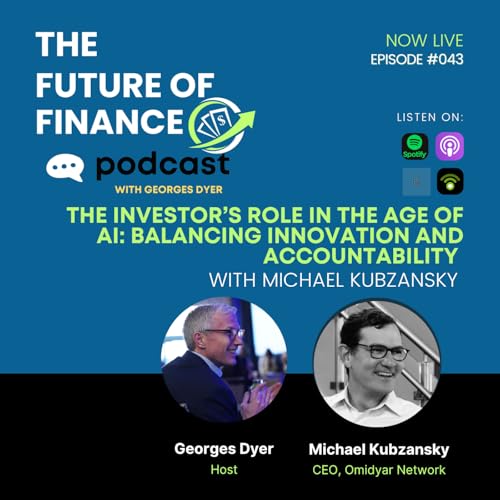
  • The Investor’s Role in the Age of AI: Balancing Innovation and Accountability with Mike Kubzansky
    Nov 19 2025

    In this episode of Future of Finance, Georges Dyer introduces a presentation from Mike Kubzansky, CEO of the Omidyar Network, delivered at the Intentional Endowments Network’s 2025 Virtual Forum. Kubzansky explores the transformative power and systemic risks of artificial intelligence—ranging from job displacement and economic inequality to the rise of monopolies and threats to democracy. Drawing parallels between AI and past technological revolutions like the automobile, he underscores that effective governance and regulation are not barriers to innovation but essential enablers of sustainable progress. Kubzansky lays out five key actions for investors to advance responsible AI:

    1. Cut through the hype and understand the real implications.
    2. Adapt the climate engagement playbook to AI governance.
    3. Integrate responsible AI policies into investment decision-making.
    4. Invest in AI safety technologies such as watermarking and deepfake detection.
    5. Build shared standards and collective investor action on responsible tech.

    He calls on investors to lead in shaping AI’s future, arguing that “safe tech is better tech” and that now is the critical moment to put guardrails in place for a sustainable, equitable digital economy.

    Keywords: Responsible AI, Omidyar Network, impact investing, regulation and innovation, AI governance, investor stewardship, technological disruption, job displacement, ethical technology, sustainable finance

    Show More Show Less
    24 mins
  • Climate Change, Capital, and Fiduciary Duty with Kirsten Spalding, John Adler and Machel Allen
    Nov 12 2025

    In this episode of The Future of Finance, host Georges Dyer shares a dynamic conversation from the Intentional Endowments Network’s Virtual Forum on Climate, Capital, and Fiduciary Duty. Guests Kirsten Spalding (Ceres), John Adler (NYC Retirement Systems), and Machel Allen (Metis Global Partners) explore how institutional investors consider climate risk as part of their fiduciary responsibilities.

    Kirsten discusses how investors are reframing net-zero portfolio strategies amid political backlash, focusing on material financial risks and adaptation. John details how New York City’s pension funds are embedding climate risk management into their investment process as part of their fiduciary duty—requiring all asset managers to have decarbonization plans by 2025 and prioritizing real-world impact over cosmetic portfolio shifts. Machel adds the asset manager perspective, explaining how investors can align climate goals with strong financial performance through customized passive strategies and stewardship.

    Together, they paint a picture of an evolving investment landscape—where integrating considering climate change is essential to fiduciary duty and financial performance.

    Keywords: Climate finance, fiduciary duty, net zero, institutional investors, ESG investing, decarbonization, stewardship, pension funds, climate risk, sustainable investing

    Show More Show Less
    27 mins
  • Why Indigenous Finance Is the Key to a Sustainable Future with Rebecca Adamson
    Nov 5 2025
    In this episode, host Georges Dyer sits down with Rebecca Adamson, founder of First Peoples Worldwide, to explore Indigenous finance and its vital role in navigating the global energy transition. A pioneer in social investing, Adamson reflects on her trailblazing work in creating the first U.S. microloan fund and developing the first investment screen for Indigenous peoples’ rights.

    Together, they unpack the new report Sustainable Indigenous Finance: Navigating the Energy Transition, a collaboration between First Peoples Worldwide, the US SIF, and ImpactARC. Adamson explains why over half of the world’s critical minerals for the energy transition are on Indigenous lands—and how investors can avoid repeating extractive patterns of the past.

    Through stories, data, and deep wisdom, she makes a compelling case that Indigenous peoples are not a “risk to be managed,” but essential partners in managing risk and building a sustainable, values-driven economy. The conversation weaves together system-level investing, fiduciary duty, and ancient principles of balance and “enoughness” to explore a vision for the future of finance.

    This episode is brought to you by Metis Global Partners.

    Resources:

    • "Enoughness" film: https://www.youtube.com/watch?v=RxPVrr44KHI

    Keywords: Indigenous finance, energy transition, sustainable investing, fiduciary duty, systems-level investing, first peoples worldwide, social impact investing, responsible mining, values-based finance, enoughness

    Show More Show Less
    1 hr
  • From Alpha to Systems: Rethinking System Stewardship with Sara Murphy
    Oct 29 2025

    In this episode of The Future of Finance, Sara Murphy — former Chief Strategy Officer at The Shareholder Commons and now Director of System-Level Investing at the Sierra Club Foundation — shares how investors can play a transformative role in addressing global sustainability challenges through system-level investing and system stewardship.

    Sara challenges the traditional “alpha-first” mindset that rewards individual company performance at the expense of long-term market health. Drawing from the Freshfields Legal Framework for Impact and PRI’s Active Ownership 2.0, she explains why investors must manage not only company-specific risks but also the broader social and environmental systems that underpin portfolio value.

    She unpacks the conflicts of interest embedded in the financial system, the dangers of externalized costs like carbon emissions and inequality, and how “guardrails” — clear, expert-defined parameters for company behavior — can help institutional investors align stewardship with portfolio-wide sustainability.

    Keywords: System-level investing, system stewardship, fiduciary duty, externalities, universal ownership, ESG integration, portfolio-first voting, shareholder commons, guardrails, sustainable finance

    Show More Show Less
    30 mins