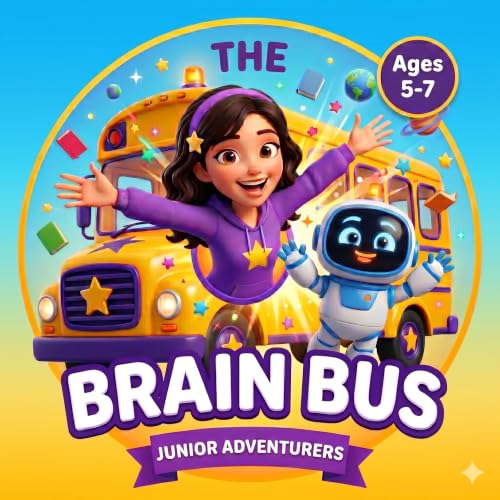
The Brain Bus: Junior Adventurers cover art

The Brain Bus: Junior Adventurers

The Brain Bus: Junior Adventurers

By: The Brain Bus
Listen for free

This Season's Biggest Deal | $0.99/mo for 3 months + $20 Audible bonus

Auto-renews at $8.99/mo. after 3 months - terms apply.
Summary
The screen-free road trip podcast for kids ages 5–7. Stories, science surprises, brain games & family quizzes — perfect for curious young minds in the back seat. Junior Adventurers is the Little Kids feed from The Brain Bus — the educational podcast purpose-built for road trips and screen-free family time. Nova (your endlessly enthusiastic host) and sidekick Cosmo (the lovably, confidently wrong sidekick) take kids on wild audio adventures through science, nature, history, and the world's most mind-blowing facts. No screens needed. Everything works through audio alone. What kids aged 5–7 will love: - Interactive "pause and guess" puzzles - Amazing science facts about dinosaurs, space, and the ocean - Stories from world cultures and mythology - Cosmo's hilarious wrong answers — and Nova setting the record straight - Vocabulary-building disguised as a really good time What parents will love: - Screen-free entertainment for school runs and long drives - Age-appropriate for 5–7 (vocabulary, topics, energy, pace) - Educational topics: science, history, animals, geography, and more - Episodes run 15–20 minutes — right for real road trips - Part of a whole-family listening ecosystem that grows with your child New episodes weekly. Topics include: dinosaurs, space, ocean creatures, Australian wildlife, ancient Egypt, world foods, volcanoes, weather, human body, and much more. Part of The Brain Bus family. Also look for: Tiny Explorers (ages 2–4), Brain Busters (ages 8–10), and Mind Blowers (ages 11–13). Making drive time discovery time.© 2026 Literature & Fiction
Episodes
  • Space Food: Eating and Drinking in Zero Gravity
    Nov 17 2026

    In this episode of The Brain Bus: Junior Adventurers, your 5-to-7-year-old discovers why astronauts eat tortillas instead of bread, how they catch floating balls of water with their mouths, and what happens to a fizzy drink in zero gravity. It's about 15 minutes - just right for a stretch of road trip where you want something genuinely interesting playing.

    Nova and Cosmo take Explorers on board the International Space Station to investigate what mealtime looks like with almost no gravity. Kids find out that bread crumbs float dangerously around the cabin, salt must be used as liquid drops, and hot sauce is a favourite because astronauts' noses get partly blocked in space - dulling their sense of taste. The episode is a great screen-free car ride activity that naturally answers the questions young kids already ask about space. As a kids podcast for ages 5-7, it wraps the science in a road-trip-friendly quiz, a crumb-patrol game, and Cosmo's repeated insistence that freeze-dried gift-shop ice cream is real astronaut food - until Nova sets the record straight.

    What You'll Discover:
    • Water floats in wobbly balls in space and astronauts catch them in their mouths
    • Bread crumbs drift dangerously in zero gravity, so tortillas are used instead
    • Fizzy drinks are avoided because burps come out wet and bubbly in microgravity
    • Body fluids float upward in space and block astronauts' noses, making food taste bland - which is why hot sauce is so popular
    • Scientists have grown and eaten fresh red lettuce on the space station as part of research for future long-distance missions

    All content is pitched warmly and gently for 5-to-7-year-olds - the weirder facts, like recycled water and wet burps, are framed with humour rather than alarm, and there is nothing in this episode that requires a parent to be present to manage.

    The Crumb Patrol game - where kids shout 'CRUMB TROUBLE' or 'FLOAT-FRIENDLY' at foods Nova names - works perfectly in a moving car and needs zero equipment.

    Chapters
    • (00:00:00) - Welcome
    • (00:00:55) - Topic Reveal
    • (00:01:48) - Main Content
    • (00:08:39) - Quiz Break
    • (00:10:21) - Fun Fact Blast
    • (00:11:32) - Road Challenge
    • (00:13:19) - Next-Stop Riddle
    • (00:14:11) - Sign-Off
    Show More Show Less
    15 mins
  • Animal Records: Fastest, Largest & Smallest Creatures
    Nov 10 2026

    In this episode of The Brain Bus: Junior Adventurers, children ages 5–7 discover that the blue whale's tongue alone weighs as much as an elephant - and that this ocean giant is larger than any dinosaur that ever lived. It's about 15 minutes of curious, screen-free listening that pairs beautifully with a long drive.

    Nova and Cosmo race through the animal kingdom's record-holders - from a peregrine falcon diving at over 300 kilometres an hour to a frog small enough to sit on a fingernail. Kids hear why the blue whale can grow larger than any land animal ever could, learn a Māori story about an ancestor carried to Aotearoa on a whale's back, and find out the truth behind the famous (and completely false) ostrich head-in-sand myth. As a screen-free car ride activity, this episode keeps young passengers active with a movement challenge - fluttering fingers like a hummingbird and reaching in slow motion like a sloth - making it a natural fit as a podcast for a 6-year-old road trip or any family journey with kids ages 5–7.

    What You'll Discover:
    • The peregrine falcon dives faster than 300 kilometres an hour by tucking its wings in tight like a folded paper plane
    • The blue whale is the largest animal that has ever lived - its tongue alone weighs as much as an elephant - and the ocean's buoyancy is what makes that size possible
    • The bee hummingbird's egg is about the size of a pea, and hummingbirds are the only birds that can fly backwards
    • A Māori story from the Ngāti Porou people tells how an ancestor named Paikea was carried safely to Aotearoa on a whale's back, making whales taonga - a treasure - to Māori
    • Ostriches do not bury their heads in sand - when frightened they flatten and stretch their neck along the ground, and their powerful legs let them outrun most predators

    All animals and topics are presented with warmth and wonder - nothing is scary or graphic - and the episode is completely suitable for unsupervised car listening with children ages 5–7.

    The Road Challenge segment has kids flutter their fingers at hummingbird speed, then reach in slow-motion sloth style, then pinch their fingers tiny as the world's smallest frog - a perfect burst of movement for small passengers who need a wiggle on a long drive.

    Chapters
    • (00:00:00) - Welcome
    • (00:00:55) - Topic Reveal
    • (00:01:39) - Main Content
    • (00:08:16) - Quiz Break
    • (00:10:02) - Fun Fact Blast
    • (00:11:07) - Road Challenge
    • (00:12:29) - Next-Stop Riddle
    • (00:13:30) - Sign-Off
    Show More Show Less
    14 mins
  • Rainbows, Prisms & Lasers: How Light Hides Color
    Nov 3 2026

    Your child will discover that white sunlight secretly contains every color of the rainbow blended together, and that a single raindrop can spread them all apart - which is why you can never walk to the end of a rainbow. This episode of The Brain Bus Junior Adventurers is made for ages 5–7 and runs about 14 minutes, just right for a stretch of highway.

    In this episode, kids explore why rainbows are actually full circles (the ground hides the bottom half), how prisms and raindrops bend light to reveal hidden colors, and why bees can see an ultraviolet layer of the world that humans cannot. Nova and Cosmo also cover how scientists bounced a laser beam off the Moon using mirrors left there by astronauts. Whether you're looking for screen-free car ride activities or a podcast for a 6 year old road trip, this episode gives children something genuinely surprising to think and talk about - no screen required. A shouted Road Challenge and a three-question quiz keep kids actively involved for the whole ride.

    What You'll Discover:
    • Every rainbow is a full circle - the ground hides the lower half, but from an aeroplane you can sometimes see the whole glowing ring
    • White light holds every color blended together, and a raindrop or prism bends each color a slightly different amount to reveal them all
    • A rainbow always moves with your eyes and can never be reached, no matter how far you walk toward it
    • Scientists bounced a laser beam off the Moon using mirror-like reflectors left on the surface by astronauts
    • Bees can see a color called ultraviolet that human eyes cannot detect, revealing secret patterns painted on flowers

    All content is age-appropriate for 5–7 year olds - the laser safety note is handled simply and matter-of-factly, and there are no scary or intense themes, making this easy listening on any family drive without supervision.

    The Road Challenge gets everyone in the car shouting a rainbow of things - red foods, orange animals, green anything - so the back seat becomes part of the episode.

    Chapters
    • (00:00:00) - Welcome
    • (00:00:55) - Topic Reveal
    • (00:01:53) - Main Content
    • (00:07:54) - Quiz Break
    • (00:09:24) - Fun Fact Blast
    • (00:10:33) - Road Challenge
    • (00:11:38) - Next-Stop Riddle
    • (00:12:34) - Sign-Off
    Show More Show Less
    13 mins
No reviews yet
In the spirit of reconciliation, Audible acknowledges the Traditional Custodians of country throughout Australia and their connections to land, sea and community. We pay our respect to their elders past and present and extend that respect to all Aboriginal and Torres Strait Islander peoples today.