Episodes

  • From Emerging Markets to Leading Journals: Entrepreneurship Research That Matters
    Nov 15 2026

    Got something to say to this podcast? Send a voicemail, and you might hear yourself on the next episode!

    Beyond Research | Professor Paul Jones: Entrepreneurship, AI and the Future of Academic Publishing

    What makes entrepreneurship research truly impactful? Can emerging economies contribute new perspectives to global scholarship? And three years after the arrival of ChatGPT, how should academic publishing respond to artificial intelligence?

    In this episode of Beyond Research, Dr. Samar Aad and Dr. Moustafa Haj Youssef welcome Professor Paul Jones, Professor of Entrepreneurship and Innovation at Swansea University and Editor-in-Chief of the International Journal of Entrepreneurial Behavior & Research.

    The conversation explores entrepreneurship in emerging economies, the challenges facing small businesses, and how researchers can turn local realities into internationally relevant contributions.

    We also go behind the scenes of academic publishing. Professor Jones shares his perspective on what makes a manuscript stand out, why papers get rejected, and how researchers can strengthen their chances of publication.

    A particularly timely discussion revisits his contribution to the 2023 paper “So What If ChatGPT Wrote It?”, exploring how generative AI is changing academic writing, authorship, peer review, and research integrity.

    In this episode, we explore:

    • Entrepreneurship and innovation in emerging economies.
    • How researchers from Lebanon and the MENA region can contribute to international scholarship.
    • What editors look for in a strong research manuscript.
    • Common reasons for desk rejection and how to respond to reviewers.
    • The opportunities and challenges of using AI in academic research.
    • Practical advice for early-career researchers seeking to publish internationally.

    Three key themes:

    1. Local contexts can generate global insights. Research conducted in emerging economies can contribute to theory when it addresses meaningful questions.
    2. A strong research contribution matters more than methodological complexity. Successful manuscripts need a clear argument, rigorous evidence, and a convincing explanation of what they add to existing knowledge.
    3. AI is reshaping academic publishing. Researchers and editors must reconsider authorship, transparency, and responsibility as generative AI becomes part of research workflows.

    Guest: Professor Paul Jones, Swansea University.

    Hosts: Dr. Samar Aad and Dr. Moustafa Haj Youssef.

    Beyond Research connects academic ideas with the real-world challenges facing businesses, universities, and society.

    Show More Show Less
    50 mins
  • Can Entrepreneurship Still Be Taught? AI, the Future of Universities, and the Research Behind It
    Oct 29 2026

    Got something to say to this podcast? Send a voicemail, and you might hear yourself on the next episode!

    Can Entrepreneurship Still Be Taught? AI, the Future of Universities, and the Research Behind It, with Prof. Laura Galloway

    Prof. Laura Galloway (Heriot-Watt University; IJEI) on what entrepreneurship education really achieves, how AI changes teaching and assessment, and what editors look for in publishable research.

    Can entrepreneurship be taught, and how do we know our teaching makes a difference? AI can now produce a business plan or a market analysis in minutes. So what should an entrepreneurship classroom look like today?

    In this episode, Dr. Samar Aad and co-host Dr. Moustafa Haj Youssef talk with Professor Laura Galloway. She is Professor of Business and Enterprise at Edinburgh Business School, Heriot-Watt University, and Joint Editor-in-Chief of The International Journal of Entrepreneurship and Innovation. She has also led a university business incubator.

    In this episode:

    • What entrepreneurship education can achieve, and how to measure real outcomes beyond intentions
    • The teaching approaches that make the most difference
    • What students still need to learn for themselves when AI can produce the outputs
    • Redesigning courses and assessment for the age of AI
    • Whether AI will widen access to entrepreneurship or deepen inequalities
    • Where entrepreneurship research is heading and which questions have become repetitive
    • What editors look for, why manuscripts get desk-rejected, and advice for scholars in Lebanon and the MENA region

    Key takeaways

    1. Entrepreneurship education should focus on what students can do.
    2. AI is forcing us to rethink teaching and assessment.
    3. Strong research starts with a question that matters.
    Show More Show Less
    40 mins
  • From ideas to impact: Entrepreneurship and Innovation
    Oct 9 2026

    Got something to say to this podcast? Send a voicemail, and you might hear yourself on the next episode!

    Beyond Research | Professor Shaker Zahra: Rethinking Entrepreneurship Research — From Local Context to Global Impact

    What makes entrepreneurship research truly impactful? And how can researchers in the Middle East contribute original knowledge to global academic debates?

    In this episode of Beyond Research, Dr. Samar Aad and Dr. Moustafa Haj Youssef welcome Professor Shaker A. Zahra, a leading scholar in entrepreneurship, strategy, and international business at the University of Minnesota.

    Drawing on decades of research and academic experience, Professor Zahra reflects on how entrepreneurship scholarship has evolved, why context matters in developing new theories, and the opportunities for researchers working in emerging economies.

    The conversation also explores the challenges facing scholars in the MENA region, including limited access to data, research collaboration, and mentorship. Professor Zahra shares practical advice for early-career researchers and discusses how artificial intelligence could reshape entrepreneurship, academic research, and economic development.

    In this episode, we explore:

    • Why local contexts can generate globally relevant research.
    • The difference between replication and meaningful theoretical contribution.
    • Which entrepreneurship research topics deserve renewed attention.
    • How collaboration and mentorship can strengthen research in the MENA region.
    • The opportunities and challenges AI presents for researchers and entrepreneurs.

    Three key takeaways:

    1. Context matters. Research rooted in local realities can challenge existing assumptions and contribute to new theory.
    2. Study problems that matter. Meaningful research begins with important questions that have relevance beyond academic publications.
    3. Collaborate to create impact. Sharing knowledge, resources, and expertise can help researchers overcome constraints and produce stronger scholarship.

    About the guest: Professor Shaker A. Zahra is a distinguished scholar whose work has contributed extensively to entrepreneurship, strategic management, and international business.

    Hosted by: Dr. Samar Aad and Dr. Moustafa Haj Youssef.

    Beyond Research brings academic ideas into conversations that connect research with real-world challenges, opportunities, and impact.

    Show More Show Less
    1 hr and 1 min
  • The Freedom Myth: What Really Makes Entrepreneurs Happy?
    Jul 25 2026

    Got something to say to this podcast? Send a voicemail, and you might hear yourself on the next episode!

    The Freedom Myth: What Really Makes Entrepreneurs Happy?

    Ask any entrepreneur why they left a stable job, and you'll hear the same word: freedom.

    But what if freedom isn't what makes entrepreneurs happy?

    A study of nearly 4,000 entrepreneurs across six countries — Egypt, Jordan, Lebanon, Saudi Arabia, Tunisia and the UAE — found something surprising. Autonomy wasn't essential in a single pathway to satisfaction. Not one. What mattered most was far more personal: who is standing beside you.

    In this pilot episode of Research to Impact, Dr. Samar Aad sits down with Dr. Moustafa Haj Youssef to unpack what actually makes entrepreneurial life satisfying — and why the answer looks different for women and men.

    ABOUT THE GUEST

    Dr. Moustafa Haj Youssef is Associate Professor at the Adnan Kassar School of Business, Lebanese American University. He researches strategic leadership, managerial discretion and gender-focused entrepreneurship, and is Principal Investigator of a Templeton-funded project mapping entrepreneurship across the MENA region — one of the largest datasets of its kind.

    WHAT WE COVER

    • Why the team studied satisfaction instead of revenue and growth
    • Running face-to-face fieldwork with 3,757 entrepreneurs across six countries
    • Why autonomy — the classic promise of entrepreneurship — turned out to be essential in no pathway at all
    • What a partner actually provides: emotional support, shared labour, legitimacy, or something else
    • Why women showed three routes to satisfaction and men only two
    • Why women could reach high satisfaction even with heavy parental responsibilities, as long as partnership support was there
    • Reading the findings against economic crisis and regional upheaval in 2023–24
    • What a policymaker in Beirut, Amman or Riyadh should do the morning after reading the paper

    THREE TAKEAWAYS

    1. There is no single recipe for entrepreneurial satisfaction. It comes from combinations of personal traits, family roles and work conditions — and several different combinations work. Stop hunting for the one secret and build the mix that fits your life.
    2. Who stands beside you matters more than how much control you have. Partnership support was the one constant in every pathway. Invest in your relationships as deliberately as you invest in your business.
    3. Support for entrepreneurs must be gender-sensitive and family-inclusive. Men's and women's routes differ. Incubators, accelerators and policymakers should design with the whole household in mind — partner-inclusive programmes, childcare support, and training that builds entrepreneurial orientation alongside resilience.THE RESEARCH Haj Youssef, Wahidi, Cheng & Kallmuenzer (2026). "Configuring entrepreneurial job satisfaction: a gendered analysis of personal, relational, and work factors across the MENA region." International Journal of Entrepreneurial Behavior & Research, 32(6). Survey of 3,757 entrepreneurs across six MENA countries, analysed using fuzzy-set qualitative comparative analysis.Research to Impact bridges academic research and industry, turning complex ideas into practical insights and real-world solutions.If this episode changed how you think about entrepreneurial success, share it with an entrepreneur in your life.
    Show More Show Less
    27 mins
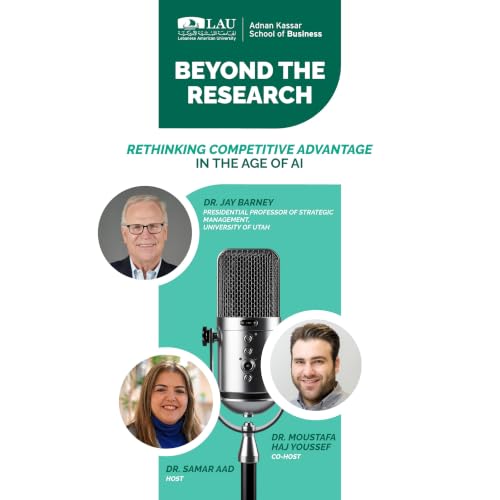
  • Competitive advantage in the age of AI with Prof Jay Barney
    Sep 25 2026

    Got something to say to this podcast? Send a voicemail, and you might hear yourself on the next episode!

    Dr. Samar Aad and Dr Moustafa Haj Youssef speak with Professor Jay Barney about competitive advantage in the age of AI.

    How might AI change the resources organizations rely on, and what does that mean for strategy research and practice?

    Show More Show Less
    45 mins