• #153 Building Frameworks, One Principle at a Time
    Oct 22 2026

    What does it take to build your own process framework? Are there common pieces to a framework, the must haves that make it all click? Even if you could build one, do you know why you’re doing it, and if you should?

    In this episode, Jim, Sander, and Rich explore the nature of frameworks, innovation, and effective collaboration in organizations. They discuss how frameworks serve as scaffolding, the role of informal conversations in fostering change, the importance of adaptable, purpose-driven processes, and the pitfalls of rigid standardization. Along the way, they find many core concepts for when you’re considering how to approach your work and the people you’re doing it with.

    Some core concepts we identified were:

    • Solved Problems
    • Collaboration
    • The Level of Work Management
    • See the Whole System
    • Rules of Ownership
    • Validate Results
    • Make Definitions Clear and Specific
    • Consistency, Not Standardization
    • Allow Process Changes
    • Measurement Against Goals


    Chapters:

    00:00 Introduction

    06:29 Importing frameworks and scaffolding

    10:18 Focusing on solving problems, not parts

    13:27 AI and the importance of collaboration and subject matter experts

    17:21 Understanding the whole system

    20:46 Frameworks as constraints, not strict processes

    24:24 Balancing process and human behavior

    28:32 The cafeteria approach to frameworks

    36:35 Standardization versus consistency in complex work

    39:43 The role of incentives in behavior change

    44:20 Creative problem solving

    45:32 Principles of effective frameworks

    49:26 Starting simple and evolving your framework

    52:11 Conclusion: frameworks as living, adaptable systems

    Books mentioned:

    A technique for producing ideas - https://a.co/d/0a5fJ0VA

    The Anatomy of a Product - https://productfields.com/product/the-anatomy-of-a-product

    Connect with Product Fields:

    📢 Follow the podcast for more inspiring stories
    💬 Join the conversation on LinkedIn - https://linkedin.com/company/mastering-agility

    📩 Contact us for trades or sponsorships

    👉 If you enjoyed this episode, leave a review and share it with someone who needs to hear it!

    Check out our sponsors:

    https://www.xebia.com

    https://www.wiserbees.com

    https://www.jointinsights.com

    https://www.productfields.com

    Show More Show Less
    53 mins
  • #152 "I Make", Take and Collaborate with Jimmy DiResta
    Sep 11 2026

    Jimmy DiResta has spent decades building things other people only imagine. Furniture. TV shows. A life that doesn't sit still. In this episode, we get past the shop tour and into what actually shaped him.

    We talk New York, the city that built his eye for craft and his tolerance for hustle. We talk Hollywood, and what it's like to make things for an industry built on illusion. We talk about how he approaches a problem, any problem, whether it's a broken hinge or a broken plan. And we get into the parts of his life that don't show up in a highlight reel: his hobbies, friends, family, and picking up pottery as a beginner all over again.

    This one isn't about tools. It's about how a maker keeps making, decade after decade, without losing the parts of himself that got him here. Most people stop learning new crafts once they've mastered one. Jimmy hasn't. This conversation is a case study in staying a beginner on purpose.

    What we get into

    • Growing up in and around New York, and how the city and early years shaped his work ethic
    • Hollywood: building for the screen, and what the industry taught him about craft
    • His approach to problem-solving, on set and in the shop
    • Starting pottery as a total beginner, and what it's like to be bad at something new again

    00:00 Introduction to Jimmy DiResta

    02:34 The Art of Making and Teaching

    04:52 Crafts and Changing Times

    07:40 Timeless Design Elements

    10:32 Manufacturing History and Local Craftsmanship

    13:21 Reflections on High School and Early Influences

    19:14 From High School to Making Toys

    22:04 From Art School to Graphic Design

    23:03 Early Experiences in Advertising

    23:28 Learning the Craft from Family

    24:27 Transitioning to Toy Design

    25:47 The Evolution of Problem Solving

    28:01 Understanding the Nature of Props and Products

    29:59 The Balance of Temporary and Permanent Creations

    31:46 The Pressure of Client Work

    33:46 Confidence in Problem Solving

    37:00 The Joy of Troubleshooting

    38:48 Memorable Moments with Howard Stern

    41:20 Maker Style F-Marry-Kill

    43:31 Collaboration in the Maker Community

    46:16 Exploring Pottery as a New Medium

    47:22 Embracing Mistakes in Craftsmanship

    51:05 The Zen of Pottery and Creative Space

    53:23 Gifts from You, Gifts to Me

    54:17 The Value of Content as a Legacy

    58:16 Interacting with Fans and Community Influence

    01:07:24 Parting Thoughts on Positivity and Gratitude

    Connect with Product Fields:

    📢 Follow the podcast for more inspiring stories
    💬 Join the conversation on LinkedIn - https://linkedin.com/company/mastering-agility

    📩 Contact us for trades or sponsorships

    👉 If you enjoyed this episode, leave a review and share it with someone who needs to hear it!

    Connect with our guest: Jimmy DiResta

    https://www.youtube.com/user/jimmydiresta/

    https://www.instagram.com/jimmydiresta/

    https://www.instagram.com/makingfunshow/

    https://www.joinmakersmob.com/diresta/

    https://jimmydiresta.com/

    https://imakeny.com/

    https://direstaedc.com/

    Check out our sponsors:

    https://www.xebia.com

    https://www.wiserbees.com

    https://www.jointinsights.com

    https://www.productfields.com

    Show More Show Less
    1 hr and 11 mins
  • #151 Product Economics
    Aug 3 2026
    Summary

    In this episode, Rich Visotcky and Jim Sammons explore the nuances of decision-making, the importance of understanding opportunity costs, and how to effectively manage product development and organizational priorities through early learning, strategic experimentation, and the economics of product development. They discuss strategies for quantifying costs, the impact of delays, and practical approaches to focus and efficiency. Jim and Rich wrap things up with how to make smarter decisions with limited resources, the value of testing assumptions, and the impact of human behavior on business success.

    Takeaways
    • The cost of delay can significantly erode value if not managed properly.
    • Prioritization should be based on economic impact and opportunity cost.
    • Simplicity and focusing on what matters most can improve organizational agility.
    • Understanding team costs and resource allocation helps in better planning.
    • Early validation and quick learning are crucial to avoid sunk cost fallacies. Early learning and iteration can significantly reduce risk and improve outcomes.
    • Understanding human behavior helps in designing better products and services.
    • Buying time through strategic decisions can lead to better resource allocation.
    • Asking the right questions reveals hidden opportunities and customer needs.
    • Simple frameworks and mental models can make complex decisions more manageable.
    Show More Show Less
    1 hr and 35 mins
  • #150 YouTube, Products, and Tacos with David Picciuto from Make Something
    Jun 24 2026

    In this engaging conversation, Jim Sammons interviews David Picciuto, a content creator and artist with a background in tech. They explore topics like audience building, product creation, the impact of social media, and the future of content in the age of AI, offering valuable insights for creators and entrepreneurs.

    David's Site - https://makesomething.com/

    David's YouTube Channel - https://www.youtube.com/@MakeSomething
    David's art exhibition link - https://www.facebook.com/events/824417793474488/824417800141154/?active_tab=about&rdid=LhU2vlGENfrG7IEA
    Giant Cassette Tape - https://youtu.be/jExRIl7WBPs?si=NNiHBl_RiLA-c89D

    Show More Show Less
    1 hr and 23 mins
  • #148 It's You, Not Me...Right?
    Feb 4 2026

    In this conversation, Jim Sammons and Rich Visotcky discuss various aspects of team dynamics, particularly focusing on Scrum Masters and the importance of engagement and interest in work. We explore the expectations placed on Scrum Masters, the significance of caring about the work being done, and how to navigate conflicts within teams around their work, tool choice, communication patterns, and more.

    Key highlights include:

    • Interest in work drives better performance and outcomes.
    • Navigating conflict requires understanding the context.
    • Caring about the work leads to better results.
    • Frustrations in work often stem from organizational decisions.
    • Shifting mindsets from tool dependency to problem-solving is crucial.
    • Different teams require different types of support and skills.

    Chapters

    00:00 Intro

    00:16 Should Scrum Masters Be Interested?

    01:23 Do Process People Need to Grasp The Backlog?

    04:48 Do Care and Interest Go Hand in Hand?

    08:14 Marker 4

    08:14 Did the Creators of Agility Expect People to Care?

    10:56 Do You Need to Know How the Sausage is Made?

    13:41 The Legend of "Json the Troublemaker"

    18:25 It's Not Them, It's You

    21:39 The Way of Working

    26:30 What Gets You Riled Up?

    29:49 It Makes Sense, and it Makes Me Angry

    34:52 The "User" Will See You Now

    37:03 What Riles Rich Up?

    42:35 Part of the Solution?

    46:29 On the Next Episode...

    Connect with Product Fields:

    📢 Follow the podcast for more inspiring stories
    💬 Join the conversation on LinkedIn - https://linkedin.com/company/mastering-agility

    📩 Contact us for trades or sponsorships

    👉 If you enjoyed this episode, leave a review and share it with someone who needs to hear it!

    Connect with our hosts:

    https://www.linkedin.com/in/jamessammons/

    https://www.linkedin.com/in/richvisotcky/


    Check out our sponsors:

    https://www.xebia.com

    https://www.wiserbees.com

    https://www.jointinsights.com

    https://www.productfields.com

    Show More Show Less
    49 mins
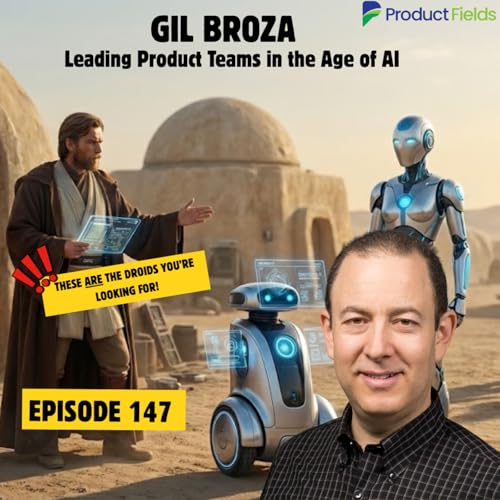
  • #147 Leading Product Teams in the Age of AI - With Gil Broza
    Jan 15 2026

    Gil Broza joins our hosts, Jim Sammons and Rich Visotcky, for the first episode of the Product Fields podcast in 2026! In this conversation, we discuss the evolving landscape of agility and product management in the age of AI. Together, we explore how AI has transformed product delivery, the importance of accountability, and the need for leaders to adapt their strategies to ensure effective team dynamics. Too often, we have seen companies go full-on into AI without any strategy or understanding of the consequences. Through our discussion, we dive into the balance between leveraging AI for efficiency while maintaining critical thinking and human oversight, and the need for a thoughtful approach to integrating AI into work processes.

    00:00:00 Intro

    00:02:04 Agility Beyond Tech: Adapting Principles for Non-Tech Teams

    00:03:44 The Relevance of the Agile Manifesto, Values, and Principles

    00:08:44 AI's Impact on Product Delivery and Management

    00:12:15 Going Back to Principles in the Age of AI

    00:16:52 Accountability in the Age of AI

    00:28:03 The AI Industrial Revolution: Trust and Human Connection

    00:33:58 The Atrophy of Skills in the Age of AI

    00:35:07 The Impact of AI on Communication and Authenticity

    00:45:38 The Dangers of Over-Reliance on AI

    00:47:27 Fundamentals in the Age of AI

    00:50:45 The Danger of Agency and AI

    00:53:01 The Future of Work and AI Integration

    00:57:46 Quantity vs. Impact

    01:01:20 Closing

    Connect with Product Fields:

    📢 Follow the podcast for more inspiring stories
    💬 Join the conversation on LinkedIn - https://linkedin.com/company/mastering-agility
    📩 Contact us for trades or sponsorships

    👉 If you enjoyed this episode, leave a review and share it with someone who needs to hear it!

    Connect with our guests:

    Gil Broza: https://www.linkedin.com/in/gilbroza

    Subscribe to Gil’s newsletter: https://3pvantage.com/subscribe-newsletter/

    Attend Gil’s course, “Leading AI-Enabled Product Teams”: https://3pvantage.com/leapt/

    Check out our sponsors:

    https://www.xebia.com

    https://www.wiserbees.com

    https://www.jointinsights.com

    https://www.productfields.com

    Show More Show Less
    1 hr and 5 mins
  • #146 Can Mindset be Quantified? - With Dr. Karen Eilers and Christiaan Verwijs
    Jan 6 2026

    Join hosts Rich Visotcky and Jim Sammons as they delve deep into the agile mindset and its significance in team dynamics from a research-backed perspective. Joining them in this episode are Dr. Karen Eilers and Christiaan Verwijs who are leading studies exploring the agile mindset from the individual and team level. Through their research and the help of Columinity, they describe how to factors like motivation, morale, collaborative exchange, value focus, and management support improve team effectiveness. Together, we discuss the development of reliable measurement scales, the importance of data in understanding team effectiveness in order to take action, and the challenges of selection bias and trust in survey data. We also dip our toes into the pools of dynamic reteaming and its effects on team cohesion and team outcomes.

    Whether you’re a manager looking to help your teams hit their stride, a team member trying to understand how to improve yourself to improve those around you, or a research and data junkie curious about people and teams, this episode has you covered!

    Want to learn more about your team and the research?

    Participate (and get immediate actionable feedback!): https://questionnaire.columinity.com/setup/model/agilemindset

    Preliminary findings: https://blog.columinity.com/how-a-team-level-agile-mindset-shapes-team-effectiveness/

    Scientific paper on Agile Mindset: https://www.sciencedirect.com/science/article/pii/S0040162522001822

    Contact Columinity: https://columinity.com/research

    Connect with our guests:

    Karen Eilers: linkedin.com/in/dr-karen-eilers/

    Christiaan Verwijs: linkedin.com/in/christiaanverwijs/

    Connect with Mastering Agility:

    📢 Follow the podcast for more inspiring stories
    💬 Join the conversation on LinkedIn - linkedin.com/company/mastering-agility
    📩 Contact us for trades or sponsorships

    👉 If you enjoyed this episode, leave a review and share it with someone who needs to hear it!

    Check out our sponsors:

    www.xebia.com

    www.wiserbees.com

    www.jointinsights.com

    www.productfields.com

    Find more at www.masteringagility.org

    Show More Show Less
    53 mins
  • S06 E12 Omnipresence and Needing to be Perfect
    Jan 2 2024

    Summary
    In this second part of the conversation, Jim and Sander discuss their holiday plans and reflect on the highlights of the podcast in 2023. They also share their dream guests for future episodes and discuss the importance of understanding root causes in problem-solving. They explore how Scrum Masters can help teams become more effective and the need to build environments for product success. They also discuss the challenges of avoiding reactive approaches and the importance of continuous improvement. Finally, they discuss the importance of recognizing blind spots and areas for improvement. In this conversation, Jim and Sander discuss various topics related to their professional lives and personal preferences. They explore the balance between quality and satisfaction, the importance of professional emotional regulation, and the need to bury unwanted concepts. They also touch on the issue of hate and ad hominem attacks on social media and the value of constructive feedback. The conversation concludes with a discussion about the misuse of the Shu-Ha-Ri model and the joy of holiday food traditions.


    Takeaways

    • Reflecting on the highlights of the past year can provide valuable insights and learning opportunities.

    • Understanding root causes is important for effective problem-solving and preventing recurring issues.

    • Scrum Masters can have a wider impact by building their skills and focusing on continuous improvement.

    • Creating environments for product success is crucial for long-term value creation.

    • Avoiding reactive approaches and focusing on proactive measures can lead to better outcomes.

    • Recognizing blind spots and areas for improvement is essential for personal and professional growth. Balancing quality and satisfaction is important in professional work.

    • Professional emotional regulation is crucial for maintaining composure and being a calming influence.

    • It's okay to have strengths and weaknesses, and not everyone has to be good at everything.

    • Unwanted concepts and practices should be buried to make room for more effective approaches.

    • Hate and ad hominem attacks on social media should be replaced with constructive feedback.

    • Being candid is important, but it's essential to avoid being an asshole.

    • Teaching should be focused on practical application rather than just theoretical knowledge.

    • Being a little like Mr. Miyagi and withholding certain information can be beneficial in facilitating learning.

    • Helping others should not be driven by selfish motives.

    • Identifying as a teacher or educator depends on the specific context and knowledge.

    • Food and holiday traditions bring joy and create memorable experiences.

    Don't forget to check out our sponsor: https://scrummatch.com/en


    Hosted on Ausha. See ausha.co/privacy-policy for more information.

    Show More Show Less
    41 mins