• How To Design a Life Aligned With Your Values: A Conversation With Amy Mullen
    Mar 7 2026

    In this episode, Laura welcomes Amy Mullen, President of Money Quotient, for a powerful conversation about why financial literacy alone rarely leads to lasting behavior change.

    Amy shares the origin story behind Money Quotient, beginning with her mother Carol Anderson. After going through a divorce that left her uncertain about her financial future, Carol transitioned from preschool teacher to financial literacy advocate. That experience ultimately sparked the creation of Money Quotient and deeply shaped Amy’s perspective on the connection between money and life design.

    Growing up with parents who had completely opposite money personalities, a saver mother and a spender father, Amy learned early how deeply our financial behaviors are shaped by our experiences. Those contrasting influences helped her recognize the importance of self-awareness when making financial decisions, rather than simply repeating inherited patterns.

    Amy also shares fascinating research on financial behavior. Many people seek financial education when they feel anxious or fearful about money. But once they learn something new, that anxiety decreases even if no real action has been taken. Without that emotional urgency, motivation often disappears. Sustainable behavior change, she explains, comes not from fear but from positive emotions like excitement about goals and clarity around what truly matters.

    The conversation offers practical tools for women navigating financial decisions and life transitions. One powerful exercise Amy shares is the Wheel of Life, which helps break down overwhelming questions about life satisfaction into manageable areas. By identifying what brings genuine joy, purpose, and fulfillment, people can begin using those values as a guide for financial decisions instead of comparing themselves to others.

    Key Takeaways

    💡 Positive emotions drive sustainable change. Fear may push people to seek information, but lasting transformation happens when people feel excited about a vision for their future.

    💡 Childhood money stories shape adult behavior. Amy grew up with a saver mom and a spender dad, which created conflicting spending habits. Understanding those patterns helped her make more intentional financial choices aligned with her own values.

    💡 True fulfillment comes from alignment. When you align your time, energy, and money with what brings intrinsic reward, you create a deeper sense of life satisfaction.

    Guest

    Amy Mullen, CFP® is President of Money Quotient, Inc., an organization founded in 2001 that teaches financial professionals how to bring science to the art of relationship. In this role, Amy conducts training, provides individualized consulting, and frequently presents at national financial industry conferences on the benefits and effectiveness of a values-based approach to financial planning, understanding clients' financial motivations and how to guide them through change to create long-lasting client-planner relationships.

    Resources
    • Investing Your Time and Energy
    • Wheel of Life Exercise
    • Directory of Money Quotient Advisors
    • Facebook
    • LinkedIn
    • Website
    Show More Show Less
    56 mins
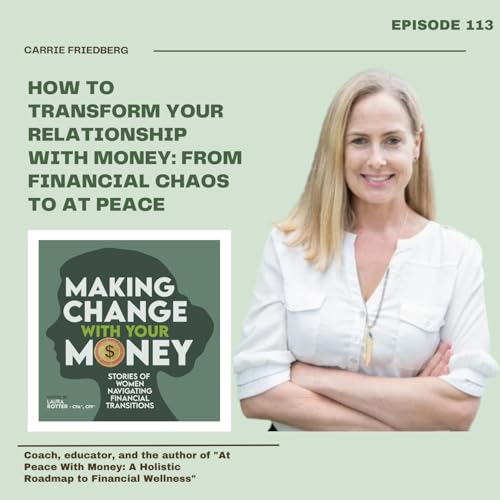
  • How To Transform Your Relationship With Money with Carrie Friedberg
    Feb 21 2026

    What happens when someone who grew up witnessing financial conflict decides to transform their relationship with money? Laura sits down with Carrie Friedberg, author of the book "At Peace With Money: A Holistic Roadmap to Financial Wellness," to explore how she moved from credit card debt and constant anxiety to becoming a money coach who helps others find their own financial peace.

    Carrie grew up in a household where money was a source of tension and secrecy. Despite enjoying financial security on the surface, the misalignment between her parents around spending created an atmosphere of stress that Carrie carried into her young adult life. Living on a teacher's salary while maintaining an active social life, she found herself trapped in a cycle of credit card debt, emotional spending and profound anxiety about money.

    The turning point came through an unexpected source: her yoga practice. The physical, emotional, and spiritual transformation Carrie experienced on the mat gave her the courage to seek help with her finances. After trying various approaches on her own, she discovered the power of working with a money coach who provided both practical tools and emotional support. This two-year journey didn't just change her bank account; it transformed her self-esteem, her relationships, and ultimately her career path.

    Now a money coach herself, Carrie shares the essential steps for building financial wellness, from tracking your spending for at least 90 days to creating a realistic spending plan that honors both your current lifestyle and your future goals. She emphasizes that financial health isn't about deprivation or quick fixes but rather a sustainable practice that requires consistent attention and self-compassion.

    💡 Money patterns often begin in childhood.
    Growing up with parents who held opposing views on spending left Carrie anxious around money. She observed secrecy, conflict, and tension during everyday financial moments, which her body absorbed long before she could articulate it. Understanding these early imprints is a critical step in reshaping adult money habits.

    💡 Financial wellness is a long-term practice.
    Just as physical or emotional health doesn’t change overnight, neither does financial health. Carrie’s transformation unfolded over years. The reward was improved self-esteem, healthier relationships, and peace of mind.

    💡 Tracking spending creates awareness and change.
    The most powerful tool in Carrie’s journey was tracking every dollar she spent for at least 90 days. This practice helped her see her real habits instead of assumptions. Whether done by hand, through apps, or with a bookkeeper, the key is awareness rather than avoidance.

    💡 A spending plan doesn’t require sacrificing joy.
    Carrie learned that financial health doesn’t mean cutting out everything you love. By identifying non-negotiable self-care and intentionally spacing out other expenses, she shifted away from feast or famine spending.

    Facebook LinkedIn Instagram Website

    Book

    Show More Show Less
    48 mins
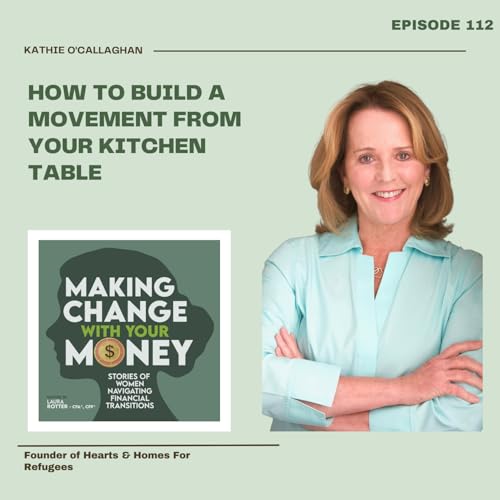
  • How to Build a Movement from Your Kitchen Table: with Kathie O'Callaghan
    Feb 7 2026

    What happens when you combine childhood memories of your mother opening your home to refugees, a crisis playing out on television screens worldwide, and the belief that ordinary people can make extraordinary change? You get Hearts and Homes for Refugees—a movement that has helped resettle and support over 1,000 refugees in the Lower Hudson Valley and inspired a national shift in how America welcomes those fleeing persecution.

    In this conversation, Laura sits down with Kathie O'Callaghan, founder of Hearts & Homes for Refugees. Kathie shares her journey from breaking barriers as the eldest daughter in a large Catholic family in Louisville, to working on Capitol Hill and in New York corporate PR, to stepping back to raise four teenagers, to founding an organization that would change the refugee resettlement landscape in America.

    When the Syrian refugee crisis erupted in 2015, Kathie remembered the Vietnamese family her mother helped resettle in the 1970s through their parish. She knew there was a model that worked—faith communities and neighbors providing extended support beyond what government-funded resettlement agencies could offer. So she gathered people around her kitchen table in Pelham Manor and said: We can do this. And they did. Now, the community sponsorship model Hearts & Homes pioneered has spread nationwide, with millions of Americans stepping up to welcome Afghan and Ukrainian refugees.

    This episode is essential for anyone who's ever thought "someone should do something" about an issue they care deeply about, for women wondering if they can make a difference after stepping back from careers, and for anyone seeking inspiration about what's possible when you trust your gut, mobilize your community, and refuse to accept that the way things are is the way things have to be.

    Key takeaways:

    💡 Your childhood experiences can become your life's mission—decades later: Kathie's mother opened their Louisville home as a "revolving door" to Vietnamese refugees, homeless people, and anyone needing help in the 1970s. Forty years later, watching the Syrian crisis, those childhood memories became the blueprint for Hearts & Homes for Refugees.

    💡 The best solutions often come from models that already worked: Kathie didn't invent refugee sponsorship—she remembered it from her childhood and adapted it for 2016. Sometimes innovation isn't creating something new; it's recognizing what worked before and bringing it back when it's needed again.

    💡 You don't need permission or a roadmap to start something important: In 2016, resettlement agencies said community sponsorship wouldn't work. Kathie said "watch us" and gathered people around her kitchen table. That model reshaped refugee resettlement nationwide. Sometimes you just have to build it and trust they'll come.

    💡Success isn't about money—it's about impact, one family at a time: Kathie defines success as seeing her vision come to life, bringing diverse communities together, and knowing that every single volunteer—whether leading a cohort or driving once a month—feels they're doing the most important work they've ever done.

    Connect with Kathie: Facebook LinkedIn Instagram X Website Advocacy Toolkit

    Show More Show Less
    48 mins
  • How to Lead Yourself First: The CORE Framework for Intentional Living with Miki Feldman Simon
    Jan 24 2026

    What if the most important leadership role you'll ever have isn't managing a team, but leading yourself? In this conversation, Laura Rotter sits down with Miki Feldman Simon—executive coach and author—who shares her journey to discovering her true calling: helping people live with intention, authenticity, and purpose.

    Miki's path wasn't linear. From fashion design to psychology to HR to operations to marketing, she explored diverse fields while developing a consistent through-line: curiosity about people and the ability to create psychological safety that gets others to open up. After moving from Israel to Australia to the United States, taking forced career breaks due to visa restrictions, and taking care of aging parents, Miki found herself asking the fundamental question that drives her work today: Who do you want to be?

    Her answer became the CORE framework—a four-step process detailed in her book Core Leadership. CORE stands for Clarify, Operationalize, Reflect and Evaluate. This isn't just a leadership model for executives—it's a framework for anyone who wants to stop being managed by other people's priorities and start showing up as the person they truly want to be.

    This episode is essential listening for anyone feeling pulled along by life rather than intentionally choosing it, for parents trying to model values for their children, for professionals wondering if their credit card statement reflects what they say matters most, and for anyone ready to ask: In this moment, who do I want to be?

    Key Takeaways

    💡 Leadership starts with leading yourself—it happens everywhere: You don't need a management title to be a leader. Leadership shows up in your kitchen, with your family, in how you respond to stress. If you're not intentional about leading yourself, you'll be managed by other people's priorities and habits, pulled along without direction.

    💡 Ask others about your strengths—you can't see them clearly yourself: Miki asked her teenage daughter "What are my strengths?" and received a life-changing answer: "You have simple solutions to complex situations." We dismiss compliments or assume everyone has our gifts. Ask at least three people who know you well what your strengths are—the answers will surprise and empower you.

    💡 Clarify who you want to BE, not just what you want to DO: We spend enormous energy on what we want to accomplish but rarely ask who we want to be. When your values, priorities, and vision of yourself are clear, decisions become easier—even painful ones—because you have a compass guiding you.

    💡 Your credit card statement reveals your true priorities: Say family is your priority? Check your calendar and bank statement. We rationalize that we'll "someday" focus on what matters, but operationalizing your values means your actions actually align with what you say is important.

    Resources: Core Leadership

    The 6 Types of Working Genius

    Show More Show Less
    45 mins
  • How to Take a Power Pause in Your Career Without Losing Your Ambition with Lisa Cassidy
    Jan 10 2026

    What does it take to walk away from 15 years at a prestigious company like IBM when you're ambitious, driven, and have two young children at home? In this deeply practical conversation, Laura Rotter sits down with Lisa Cassidy—former IBM consultant and organizational change specialist—who shares her journey of taking what she calls a "power pause" to recenter herself and her family after feeling stretched too thin.

    Lisa grew up in a log cabin in rural Maryland, where her parents made intentional choices about money—no mortgage, modest vacations, but heavy investment in education. Those early lessons about values over lifestyle gave her the foundation to make bold decisions decades later. After spending her twenties exploring three different industries in three different cities, earning her MBA, and building a successful 15-year consulting career, Lisa heard a quiet voice saying "you're doing too much." With the support of her husband David, she made the intentional decision to resign—but not before taking a leave of absence to ensure she was making the choice from a place of calm, not chaos.

    This episode is essential listening for any woman who feels like she's barely keeping her head above water, any parent trying to balance career and family, or anyone wondering if it's possible to pause without losing momentum. Lisa shares the financial preparation that made her pause possible, the questions she and her husband answered together to align on money values, and why success is really about the ability to choose how you spend your time.

    💡 Education as generational wealth can enable life choices: Lisa's parents lived in a small home without a mortgage and skipped fancy vacations to invest heavily in their daughters' education—including boarding school and college. This pattern, passed down from her grandfather paying for her father's law school, gave Lisa the foundation to later afford her own power pause.

    💡 Know yourself before you know your next role: Through exploring three different industries in three different cities in her twenties, Lisa learned that relationships and variety were more important to her than any specific field. Knowing what motivates you—not just what sounds impressive—is critical to long-term career satisfaction.

    💡 One in three working women will pause in the next two years: According to The Power Pause by Neha Ruch, one in three women currently working will pause their careers in the next two years, and 90% will return. You're not alone if you're considering this.

    💡 Make the decision from calm, not chaos: Lisa took a leave of absence before resigning to ensure she was making the choice from a centered place, not from burnout. She worked with a coach, journaled extensively, and had deep conversations with her husband about money values before taking the leap.

    💡 Success is the ability to choose how you spend your time: By buying a small house in Maine where cost of living is lower, sending kids to public school, and being intentional about expenses, Lisa and her husband created the financial flexibility to have choices. Money enables choice, but choice is the real measure of success.

    Connect with Lisa:

    LinkedIn

    Resources:

    The Power Pause

    Suzy Welch Podcast

    Show More Show Less
    39 mins
  • How to Build Wealth and Legacy with Lauri Kibby, Managing Partner at Seleen Brighthouse
    Dec 27 2025

    What happens when a seasoned finance professional with an MBA and 26 years in construction loses nearly $2 million to a Ponzi scheme? In this candid and empowering conversation, Laura Rotter sits down with Lauri Kibby—Managing Partner at Seleen Brighthouse real estate investment fund—who turned one of her most devastating financial mistakes into a mission to educate and empower women investors.

    Lauri's journey from growing up with money as a "weapon" (despite living an upper-middle-class life) to becoming a successful entrepreneur and developer reveals powerful lessons about financial resilience, self-trust, and the importance of knowing your complete financial picture. After discovering she'd been caught in a Ponzi scheme in 2023—lured by greed and the failure to trust her own gut instincts—Lauri didn't hide in shame. Instead, she founded Seleen Brighthouse to provide women access to real estate investment opportunities typically reserved for the ultra-wealthy, along with the education and community they need to become sophisticated investors.

    This episode is essential listening for any woman who wants to take full ownership of her financial life, whether you're preparing for the great wealth transfer, managing an inheritance, or simply ready to stop outsourcing your financial decisions. Lauri shares why women need to look beyond the two-year horizon, how to build fundamental self-trust that creates wealth, and why knowing your net worth is one of the most empowering things you can do for yourself.

    Key Takeaways

    💡 Even finance professionals fall for scams—and that's the point: Lauri, with her MBA and decades of investment experience, lost $2 million to a Ponzi scheme because greed overrode her gut instincts. If it can happen to her, it can happen to anyone. The antidote is education, community, due diligence, and trusting the "pit in your stomach" when something feels off.

    💡 Most women don't know their true net worth—and that's disempowering: Women often can't name all their assets, forget about old 401(k)s, and don't have a consolidated view of their financial picture. Knowing your complete balance sheet—assets and liabilities—is incredibly empowering and usually reveals you're worth more than you think.

    💡 True financial success comes from daily impact, not account balances: After comparing herself to ultra-wealthy family members for years, Lauri redefined success as the impact she makes in relationships every day. Better relationships lead to better decisions, which lead to better financial outcomes—not the other way around. And fundamentally, most people have always been okay, which should give us power to do big things without fear.

    Connect with Lauri:

    Website

    LinkedIn

    Stay connected:

    Connect with Laura on LinkedIn

    @Rotters5 on X

    Connect with Laura on Facebook

    Subscribe to my YouTube channel

    Subscribe to my newsletter

    Disclaimer: Please remember that the information shared on this podcast does not constitute accounting, legal, tax, investment or financial advice. It’s for informational purposes only.

    Show More Show Less
    45 mins
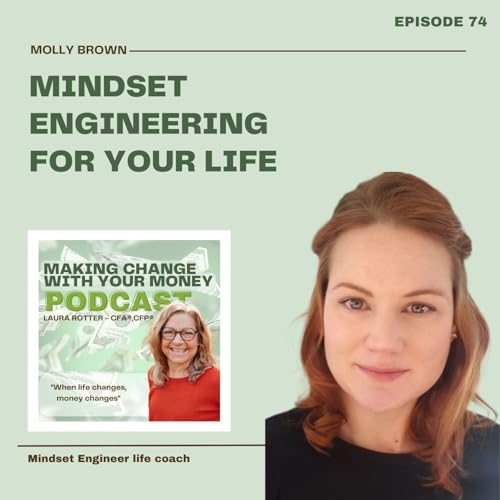
  • Mindset Engineering For Your Life: An Interview With Molly Brown, Mindset Engineer Life Coach
    Aug 24 2024
    Molly Brown is a Mindset Engineer life coach. Molly started her career in the army as an intelligence analyst and moved on to the corporate world as an engineer at a large aerospace company. Fast forward to her work today as a life coach: Molly believes that making any change in one's life follows an engineering design process that starts on a blank sheet of paper. She leads people in this process of radical transformation and self-discovery, in which they shift their experience of life to be how they most love to live it. Growing up in a religious household where money discussions were off-limits, Molly always felt a burning desire to break free and achieve financial independence. Her determination to earn what she calls "man money" led her to exceptional academic achievements and career milestones, despite the societal and familial limitations she faced. She talks about the shortcomings of chasing metrics like money and KPIs. She opens up about the disillusionment with these conventional markers and the deeper, intrinsic needs that often go unaddressed, such as security, freedom, and a sense of belonging. Through her intellectual and emotional journey, Molly underscores the importance of understanding the motivations behind our pursuit of success and how these realizations guided her towards a more authentic and fulfilling life.“It's not the money that's keeping you safe. The money is fantastic and when you feel safe, it's really easy to make money. When you feel safe, it's really easy to grow money. When you feel safe, it's really enjoyable to spend the money going out and doing things that you don't feel like you have to hold it in. Your experiences around everything: money, education, food, other people, travel, the world, it completely changes when you understand inherent safety, when you embody your own safety.” - Molly BrownKey takeaways: - Anything measurable, like money, is adjacent to and not actually what we want to have. Molly notes that we actually want security and safety and belonging and freedom, the ability to express ourselves fully. Yet we can't measure any of those things, so we use money, which we can measure, as the substitute metric.- Be open to your curiosity transforming you. Molly felt drawn to explore consciousness, which, through her own transformational work with a coach, eventually led her to become a life coach. She’s an introvert, and would prefer to be behind a screen, but her passion and curiosity for the work she is doing has led her to be a teacher and speaker. - When you’re called to make a change, take practical steps. Molly knew that she needed to leave the corporate world and eventually, transition from two incomes to one income. So she sold her house, and bought a multi-family house that generated rental income that covered her housing bills, so she no longer felt beholden to her job. She felt financially safe, because she had taken steps and done the work. About the guest: Hi, I’m Molly, the Mindset Engineer life coach. I started my career in the Army as an intelligence analyst and moved on to the corporate world as an engineer at a large aerospace company. I've always had a passion for patterns especially in music and movement, it's what attracted me to physics, chemistry and mechanical engineering in college. So in my career as an engineer I was drawn to data of all sorts, anything I could get my hands on. I was looking for patterns to understand what was going on that we couldn't see or measure directly. After years of working with data with all sorts of teams, technical and non technical, I finally saw that all we were doing with data is drawing the target around the arrow. You've probably heard of confirmation bias but that is just the tip of the iceberg. I dove into this with a fascinated curiosity. As the company was pushing a data driven decision making initiative, I was coming to realize that data driven decision making is a total myth. We can only ever find in data what we are already looking for, whether we are conscious of what we are looking for or not. And this is not a problem at all! But it is important that we understand what is going on in our thinking as we interact with data (data meaning any and all information about yourself and the world). This became the foundation of my life coaching. The data is helpful, it is a reflection of what we are already believing. If we are looking for the data to give us something different to belief however, we'll never find the evidence we need to change. If however we use the data to inform us of what we are truly believing, that we weren't already aware of, then it is useful. From there, making any change in your life follows an engineering design process that starts on a blank sheet of paper. I lead people in this process of radical transformation and self discovery in which they shift their experience of life to be how they most love to live it.Website: ...
    Show More Show Less
    50 mins
  • From Credit Analyst to Corporate Boardrooms; The Power of Schmoozing: an interview with Shelly Lombard
    Jul 8 2023
    Shelly had a 30+ year career on Wall Street valuing and investing in public and private companies. Her finance specialties include evaluating companies' financials in order to assess financial health, balance sheet management, and leveraging the capital markets and investor relations to maximize value for stakeholders. She serves on the boards of public companies including Bed Bath & Beyond, and has a LinkedIn newsletter called Schmooze, which talks about business relationships for women.Shelly shared that money was tight while growing up. Both her parents were school teachers and so had a pretty comfortable income, but it was tight for their family of six. In Shelly's words, she had everything she needed but not everything she wanted. Shelly remembers appreciating having her first job, at age 15, which gave her the freedom of summer spending money and financial cushion.Shelly was a gifted student. She started college when she was 16 years old, and attended Columbia Business School on scholarship. She had worked as a journalist before deciding to get an MBA, after coming to the realization that she was never going to get ahead financially on a journalist's salary!Shelly's first job out of business school was doing leveraged finance first at Citibank, then at Drexel, Burnham Lambert. She loved the drama and relevancy of working on deals that were on the cover of the Wall Street Journal the next morning! Later on in her career, she became a frequent guest on CNBC, talking about the auto industry during the financial crisis. She was downsized when the auto industry righted itself, leading to a long period of exploring how her skillset could be used in new roles."I started Schmooze, the LinkedIn newsletter, not because I have great tips on networking, but because I wanted to interview amazing women doing amazing things who had a perspective on business relationships and how you leverage them and how you make them work for you." - Shelly LombardKey takeaways:- Have an emergency fund. Shelly went through a difficult period financially when she lost her job in the aftermath of the financial crisis, while her kids were in college. Thankfully, she had a large emergency fund, knowing as she did the inherent volatility of the financial industry. - Focus on building your network when you’re exploring what to do next. Women often have difficulty with transactional, business relationships. As a generalization, women tend to build relationships based upon shared interests, while men make friends based on what they can do for each other. Shelly started her LinkedIn newsletter, On the Schmooze, so she could learn from women who have a perspective on how to build robust business relationships.- Understand how your skill set may extend to new opportunities. Shelly had defined herself narrowly as a “distressed debt investor,” until she realized that her analytical skills could extend to new roles. She is now exploring venture capital investing, and is a limited partner in a venture capital fund that invests in beauty brands that have been launched by people of color. About the guest:Shelly spent 30+ years on Wall Street valuing and investing in companies. Since then, she has served on the boards of several public companies, most recently Bed Bath & Beyond. Recently, she also launched a LinkedIn newsletter for women about business relationships called Schmooze. Linkedin:- https://www.linkedin.com/in/shellylombard/Webinar: Intro to Distressed Debt Investing Interested in booking a free consultation? Schedule a call.Stay connected:Connect with Laura on LinkedIn@Rotters5 on TwitterConnect with Laura on FacebookSubscribe to my YouTube channelSubscribe to my newsletterGet your free copy of Unlock Your Money Blocks Workbook : Your step-by-step guide to unlocking your blocks to financial freedom.Disclaimer: Please remember that the information shared on this podcast does not constitute accounting, legal, tax, investment or financial advice. It’s for informational purposes only. You should seek appropriate professional advice for your specific information.
    Show More Show Less
    50 mins