Making Change with your Money cover art

Making Change with your Money

Making Change with your Money

By: Laura Rotter CFA CFP® | Financial Advisor for Women in Midlife Transitions
Listen for free

About this listen

Making Change with Your Money is the go-to podcast for women in midlife experiencing major life transitions and ready to transform their relationship with money.

Hosted by Laura Rotter, CFA, CFP®—a financial advisor and Founder of True Abundance Advisors—this podcast features intimate conversations with women who have successfully navigated career changes, divorce and financial independence, retirement planning, entrepreneurship, and complete life reinvention.

Every episode explores both the practical side of financial planning for women and the deeper inner work around money mindset, worthiness, and values-based living. From healing financial trauma to building sustainable businesses, from leaving corporate careers to investing with confidence, these stories provide both inspiration and actionable financial guidance.

Whether you're contemplating a career pivot, managing an inheritance, recovering from divorce, or simply feeling that there must be more to life than the relentless pursuit of more—this podcast will help you use your resources (money, time, energy, and talent) to create a life of meaning and purpose.

Laura brings her Wall Street experience, mindfulness practice, and financial life planning expertise to help listeners understand that true abundance isn't about the numbers in your account—it's about the freedom to live authentically.

Perfect for: Women over 40, midlife career changers, recent divorcées, pre-retirees, women entrepreneurs, and anyone questioning whether they're worthy of pursuing their heart's desires.

Topics include: Financial planning, money mindset, career transitions, retirement alternatives, divorce and money, women's financial empowerment, entrepreneurship, investing, financial therapy, values-based financial planning, and life reinvention.

2025 Laura Rotter, CFA, CFP® | Financial Advisor for Women in Midlife Transitions
Economics Spirituality
Episodes
  • How To Design a Life Aligned With Your Values: A Conversation With Amy Mullen
    Mar 7 2026

    In this episode, Laura welcomes Amy Mullen, President of Money Quotient, for a powerful conversation about why financial literacy alone rarely leads to lasting behavior change.

    Amy shares the origin story behind Money Quotient, beginning with her mother Carol Anderson. After going through a divorce that left her uncertain about her financial future, Carol transitioned from preschool teacher to financial literacy advocate. That experience ultimately sparked the creation of Money Quotient and deeply shaped Amy’s perspective on the connection between money and life design.

    Growing up with parents who had completely opposite money personalities, a saver mother and a spender father, Amy learned early how deeply our financial behaviors are shaped by our experiences. Those contrasting influences helped her recognize the importance of self-awareness when making financial decisions, rather than simply repeating inherited patterns.

    Amy also shares fascinating research on financial behavior. Many people seek financial education when they feel anxious or fearful about money. But once they learn something new, that anxiety decreases even if no real action has been taken. Without that emotional urgency, motivation often disappears. Sustainable behavior change, she explains, comes not from fear but from positive emotions like excitement about goals and clarity around what truly matters.

    The conversation offers practical tools for women navigating financial decisions and life transitions. One powerful exercise Amy shares is the Wheel of Life, which helps break down overwhelming questions about life satisfaction into manageable areas. By identifying what brings genuine joy, purpose, and fulfillment, people can begin using those values as a guide for financial decisions instead of comparing themselves to others.

    Key Takeaways

    💡 Positive emotions drive sustainable change. Fear may push people to seek information, but lasting transformation happens when people feel excited about a vision for their future.

    💡 Childhood money stories shape adult behavior. Amy grew up with a saver mom and a spender dad, which created conflicting spending habits. Understanding those patterns helped her make more intentional financial choices aligned with her own values.

    💡 True fulfillment comes from alignment. When you align your time, energy, and money with what brings intrinsic reward, you create a deeper sense of life satisfaction.

    Guest

    Amy Mullen, CFP® is President of Money Quotient, Inc., an organization founded in 2001 that teaches financial professionals how to bring science to the art of relationship. In this role, Amy conducts training, provides individualized consulting, and frequently presents at national financial industry conferences on the benefits and effectiveness of a values-based approach to financial planning, understanding clients' financial motivations and how to guide them through change to create long-lasting client-planner relationships.

    Resources
    • Investing Your Time and Energy
    • Wheel of Life Exercise
    • Directory of Money Quotient Advisors
    • Facebook
    • LinkedIn
    • Website
    Show More Show Less
    56 mins
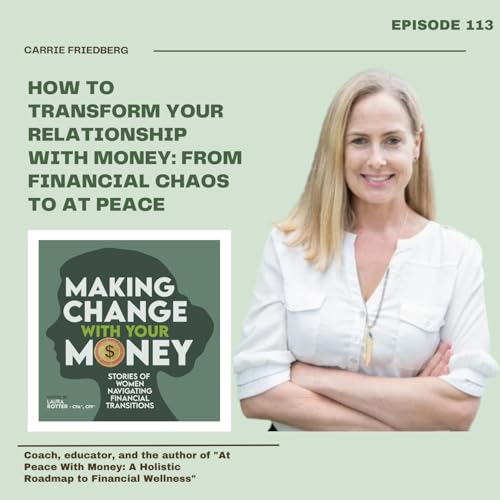
  • How To Transform Your Relationship With Money with Carrie Friedberg
    Feb 21 2026

    What happens when someone who grew up witnessing financial conflict decides to transform their relationship with money? Laura sits down with Carrie Friedberg, author of the book "At Peace With Money: A Holistic Roadmap to Financial Wellness," to explore how she moved from credit card debt and constant anxiety to becoming a money coach who helps others find their own financial peace.

    Carrie grew up in a household where money was a source of tension and secrecy. Despite enjoying financial security on the surface, the misalignment between her parents around spending created an atmosphere of stress that Carrie carried into her young adult life. Living on a teacher's salary while maintaining an active social life, she found herself trapped in a cycle of credit card debt, emotional spending and profound anxiety about money.

    The turning point came through an unexpected source: her yoga practice. The physical, emotional, and spiritual transformation Carrie experienced on the mat gave her the courage to seek help with her finances. After trying various approaches on her own, she discovered the power of working with a money coach who provided both practical tools and emotional support. This two-year journey didn't just change her bank account; it transformed her self-esteem, her relationships, and ultimately her career path.

    Now a money coach herself, Carrie shares the essential steps for building financial wellness, from tracking your spending for at least 90 days to creating a realistic spending plan that honors both your current lifestyle and your future goals. She emphasizes that financial health isn't about deprivation or quick fixes but rather a sustainable practice that requires consistent attention and self-compassion.

    💡 Money patterns often begin in childhood.
    Growing up with parents who held opposing views on spending left Carrie anxious around money. She observed secrecy, conflict, and tension during everyday financial moments, which her body absorbed long before she could articulate it. Understanding these early imprints is a critical step in reshaping adult money habits.

    💡 Financial wellness is a long-term practice.
    Just as physical or emotional health doesn’t change overnight, neither does financial health. Carrie’s transformation unfolded over years. The reward was improved self-esteem, healthier relationships, and peace of mind.

    💡 Tracking spending creates awareness and change.
    The most powerful tool in Carrie’s journey was tracking every dollar she spent for at least 90 days. This practice helped her see her real habits instead of assumptions. Whether done by hand, through apps, or with a bookkeeper, the key is awareness rather than avoidance.

    💡 A spending plan doesn’t require sacrificing joy.
    Carrie learned that financial health doesn’t mean cutting out everything you love. By identifying non-negotiable self-care and intentionally spacing out other expenses, she shifted away from feast or famine spending.

    Facebook LinkedIn Instagram Website

    Book

    Show More Show Less
    48 mins
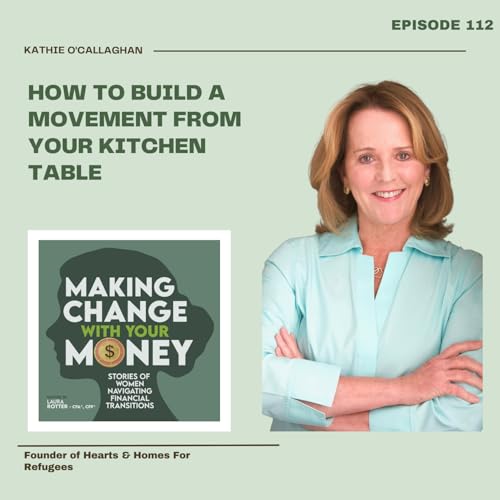
  • How to Build a Movement from Your Kitchen Table: with Kathie O'Callaghan
    Feb 7 2026

    What happens when you combine childhood memories of your mother opening your home to refugees, a crisis playing out on television screens worldwide, and the belief that ordinary people can make extraordinary change? You get Hearts and Homes for Refugees—a movement that has helped resettle and support over 1,000 refugees in the Lower Hudson Valley and inspired a national shift in how America welcomes those fleeing persecution.

    In this conversation, Laura sits down with Kathie O'Callaghan, founder of Hearts & Homes for Refugees. Kathie shares her journey from breaking barriers as the eldest daughter in a large Catholic family in Louisville, to working on Capitol Hill and in New York corporate PR, to stepping back to raise four teenagers, to founding an organization that would change the refugee resettlement landscape in America.

    When the Syrian refugee crisis erupted in 2015, Kathie remembered the Vietnamese family her mother helped resettle in the 1970s through their parish. She knew there was a model that worked—faith communities and neighbors providing extended support beyond what government-funded resettlement agencies could offer. So she gathered people around her kitchen table in Pelham Manor and said: We can do this. And they did. Now, the community sponsorship model Hearts & Homes pioneered has spread nationwide, with millions of Americans stepping up to welcome Afghan and Ukrainian refugees.

    This episode is essential for anyone who's ever thought "someone should do something" about an issue they care deeply about, for women wondering if they can make a difference after stepping back from careers, and for anyone seeking inspiration about what's possible when you trust your gut, mobilize your community, and refuse to accept that the way things are is the way things have to be.

    Key takeaways:

    💡 Your childhood experiences can become your life's mission—decades later: Kathie's mother opened their Louisville home as a "revolving door" to Vietnamese refugees, homeless people, and anyone needing help in the 1970s. Forty years later, watching the Syrian crisis, those childhood memories became the blueprint for Hearts & Homes for Refugees.

    💡 The best solutions often come from models that already worked: Kathie didn't invent refugee sponsorship—she remembered it from her childhood and adapted it for 2016. Sometimes innovation isn't creating something new; it's recognizing what worked before and bringing it back when it's needed again.

    💡 You don't need permission or a roadmap to start something important: In 2016, resettlement agencies said community sponsorship wouldn't work. Kathie said "watch us" and gathered people around her kitchen table. That model reshaped refugee resettlement nationwide. Sometimes you just have to build it and trust they'll come.

    💡Success isn't about money—it's about impact, one family at a time: Kathie defines success as seeing her vision come to life, bringing diverse communities together, and knowing that every single volunteer—whether leading a cohort or driving once a month—feels they're doing the most important work they've ever done.

    Connect with Kathie: Facebook LinkedIn Instagram X Website Advocacy Toolkit

    Show More Show Less
    48 mins
No reviews yet
In the spirit of reconciliation, Audible acknowledges the Traditional Custodians of country throughout Australia and their connections to land, sea and community. We pay our respect to their elders past and present and extend that respect to all Aboriginal and Torres Strait Islander peoples today.