• EP 23. Educating for Peace (Qamaruzzaman)
    Nov 29 2025

    We talk about finding peace and peace building, as individuals and as a planet. What does peace really mean? What are the conditions that it may arise?

    In this episode we go on a long walk and a yarn about Peace from many dimensions: inner, social, and global, and the role of education in fostering it.

    Q has been an educator, a ‘physics geek’, and guitarist for many decades specialising in educating for peace. He works with schools and organizations across Asia and globally, including communities navigating violence and trauma, helping learners explore fundamental questions of identity, planetary well-being, and what it means to be human in the 21st century.

    In this conversation he opens up on his own journey, growing up as a Malay Singaporean, moving to Canada for High School and experiencing the power of education to bridge worlds, helping young Burmese navigate violence in their upbringing, and navigating a mental breakdown in his 40s, all which contributed to a deeper knowing of how we may create conditions for peace it to arise in our world.


    We recorded this together at Light Forest Studios in Chiang Mai. Thank you for listening!


    Projects and Resources Mentioned

    - CASEL (Collaborative for Academic, Social, and Emotional Learning)- Organization focused on social and emotional learning frameworks

    - **United World Colleges (UWC) - International network of schools promoting peace through education

    - UNESCO - United Nations Educational, Scientific and Cultural Organization


    Books and Frameworks Referenced

    - Integral Theory by Ken Wilber

    - Johan Galtung’s peace theory
    - Myth of Normal by Gabor Mate

    Show More Show Less
    1 hr and 21 mins
  • EP 22. The Power of Metaphor to Transform our Future (Sohail Inayatullah)
    Nov 14 2025

    What if we understood the future as an open space, co-created by us in this moment.

    A reality that we actively shape, but driven by myths and metaphors we unconsciously hold about ourselves and the world.
    To live your authentic future, to help guide policy change, uncover the existing story and metaphor, and find a new one.
    From Dark Forest to Light Forest.
    We are joined by Sohail Inayatullah, a futures studies pioneer who has spent decades helping students, world leaders, and organizations navigate complexity and actively transform their futures, integrating Eastern and Western approaches.

    Sohail is co-founder of metafutures, educational think tank which explores futures-oriented issues, co-founder of the Asia-Pacific Futures Network, is the inaugural UNESCO Chair in Futures Studies, and holds several roles with universities around the globe, including Tamkang University (Taiwan).

    • 00:00:00 Introduction to Future Studies
    • 00:03:15 The Six Pillars Framework
    • 00:10:45 Causal Layered Analysis (CLA)
    • 00:18:30 Personal CLA and Metaphors
    • 00:25:00 Spirituality and Future Studies
    • 00:32:00 Health and Microvita
    • 00:40:00 Concluding Thoughts on Future Studies


    Show More Show Less
    55 mins
  • EP 21. Redesigning Money and Moving Away from GDP growth as Paths to a Regenerative World (Stephen DeMeulenaere)
    Nov 1 2025

    We’ve been told a story that human society evolved from primitive barter to superior modern money.

    That linear story flattens thousands of years of value exchanged through reciprocity, mutual aid, and gift economies. Systems that nourished people and ecological relationships.

    Modern (fiat) money and its associated systems have a valuable role to play but it has become a de-stabalising force in our culture, one that is at the root of all our planetary challenges today. Redesigning money is a core pathway away from GDP growth to a more regenerative, Light Forest World.


    Today, we’re joined by Stephen DeMeulenaere, who has spent over 35 years helping communities design financial tools that strengthen local economies, support small businesses, and build resilience in times of crisis.

    Stephen lives in Bali and is the co-author (with Scott Morris) of a recent book Pathways to Regeneration: Hope and Resilience Through Anticipatory Design

    His life’s focus has been on using local currencies, digital payments, and regenerative economic models to help communities thrive—whether in rural villages, urban neighborhoods, or entire regions. He has worked with community currencies, emergency currencies, and credit unions during the Asian Monetary Crisis in Japan, Hong Kong, Thailand, Indonesia, and East Timor after their independence. He led Indonesia’s first non-profit stablecoin and continues to bridge the worlds of community currencies and blockchain technology, collaborating with commons-centric communities to ground crypto in real-world regeneration.chain technology, collaborating with commons-centric communities, to ground crypto in real world regeneration.

    In this walk through the forest, Stephen takes us down many paths:

    • The history of money, economy, and anthropology to explain how our current system is on the verge of collapse.

    • A range of approaches from his book, drawing on leading thinkers, such as Kate Raworth and John Fullerton, and EF Schumacher, to redesign currency and economies.

    • His first-hand experience working with communities in Thailand and Indonesia designing community currencies in the late 90s

      A sharp assessment of the potential of blockchain to enable decentralised forms of currencies, and the practical challenges working with crypto space and the technology and rooting them in local communities.


    • Chapters

      02:16 Introduction to Stephen DeMeulenaere

      04:39 The Problematic Design of Economic Systems

      08:49 Extractive Economies and GDP Critique

      14:37 Anticipatory Design Framework

      19:10 Understanding Currency and Community Currencies

      33:49 Practical Applications of Community Currencies

      36:41 Designing Local Economies: Lessons from Indonesia

      39:34 The Role of Credit Unions in Community Economies

      40:40 Rethinking Money: From Barter to Relationships

      44:09 Crisis as a Catalyst for Monetary Innovation

      45:00 Community Resilience in Times of Crisis

      47:32 Exploring Forms of Capital in Local Communities

      49:29 Blockchain and Community Currencies: A New Frontier

      52:38 Bridging Community Currencies and Blockchain

      01:04:31 The Future of Community Currencies and Blockchain Integration

      01:07:56 Building Trust in Governance

      01:11:13 The Role of Blockchain in Community Governance

      01:15:24 Local Communities and Collaborative Economies

      01:20:03 Future Pathways and Financial Crises

      01:30:32 Taking Action and Building Resilience


      Visit https://lightforestworld.substack.com/for book references & connect with Stephen.

    Show More Show Less
    1 hr and 20 mins
  • EP 20. Regenerating Soil & Food in Thailand (with Avika & Abhi)
    Oct 18 2025

    60+ years of industrial farming has left us with degraded soil, farmers on the brink of ruin, nutritionally hollow food, and a disconnection from how our food arrives to our homes.

    Here lie the roots of the health crises we experience today.

    In this conversation we get a root-level understanding of this picture from Avika & Abhi, co-founders of Living Roots, on a mission to help regenerate the soil and food production in Thailand.

    Avika Nerula and Abhi Agarwal are co-founders of Living Roots, an agricultural technology company building climate-resilient futures through biological innovation. Based in Thailand, they’re working with farmers across Southeast Asia to revolutionize food production by prioritizing soil health, farmer profitability, and improving crop yields.

    Before becoming farmers and entrepreneurs, Avika and Abhi were software engineers working in New York. They left their tech jobs, moved back to Thailand where they grew up, and started a farm, Sunshine Permaculture.

    Today they open up on their journey.

    Chapters

    04:54 The State of Soil in Thailand

    09:41 The Impact of Chemical Fertilizers

    14:56 The Nutritional Deficiency Crisis

    19:40 The Disconnect Between Farmers and Consumers

    24:51 The Role of Living Roots in Regenerative Agriculture

    29:30 Innovations in Soil Health and Farmer Profitability

    34:27 The Future of Food Systems and Consumer Choices

    01:03:09 Building Trust in Agriculture

    01:06:07 Navigating Business Challenges in Regenerative Farming

    01:09:12 The Shift Towards Regenerative Practices

    01:16:40 Personal Journeys and Life Perspectives

    01:21:02 The Reality of Farming and Its Challenges

    01:27:57 Community and Connection in Agriculture

    01:36:14 Envisioning a Regenerative Future

    01:40:09 Practical Steps for Consumers

    01:43:40 Resources for Understanding Regenerative Agriculture

    01:48:03 Understanding Crop Burning and Its Implications


    Resources:

    • Dirt: The Erosion of Civilizations by David Montgomery

    • Braiding Sweetgrass by Robin Wall Kimmerer

    • For the Love of Soil by Nicole Masters

    • Will Harris - White Oak Pastures Farm (regenerative agriculture authors)

    Connect with Avika & Abhi

    • Spend a night at their Farm stay

    • Panya Seeds - buy heirloom Seeds & organic compost for your garden

    • Living Roots

    • Abhi LinkedIn

    • Avika LinkedIn


    Show More Show Less
    1 hr and 46 mins
  • EP 19. Reimagining Citizenship (Lauren Razavi)
    Oct 4 2025

    Your passport determines where you can live, work, and travel—based purely on where you were born. The document is only 100 years old, and someone’s actually redesigning it from the root up. Lauren Razavi is working with tech companies and Web3, UN, and governments worldwide to build alternatives to the passport, and in this conversation, she reveals how it’s happening.

    Lauren is the Executive Director of Plumia, a global network rethinking migration, citizenship, and borders for the 21st century.

    Lauren is also the author of a book called Global Natives about the digital nomad subculture and the rise of borderless work, and she writes the Substack newsletter Borderless. She is an investor in new media platforms, and has her finger on the pulse of one of the most fast-growing cultures changing our relationship with work and place.

    Why you should listen

    • Learn about Lauren’s Plumia vision for the future of mobility and identity and how she’s actually building a re-designed passport from the ground up.

    • Put you finger on the pulse of the future trends of digital nomadism, travel, digital culture, and how you can actively engage with these movements.

    • Hear Lauren's experience bridge building between cutting edge tech & nomad movements and national governments, trying to create something fundamentally new.

    Chapters

    00:45 Passport Discrimination

    06:42 Experiencing Inequality as a Digital Nomad

    11:26 Bridging Old and New Systems

    17:40 Communicating Across Cultures

    25:03 Engaging with Ascending Nations

    29:14 Building a New Digital Nomad Identity

    29:14 The Genesis of Plumia

    35:21 Plumia’s Ongoing Initiatives

    41:08 Rethinking Citizenship and Identity

    46:13 The Future of Governance and Community Engagement

    Connect with Lauren

    • Borderless Substack
    • Lauren’s website

    • Plumia

    • Global Natives


    Show More Show Less
    1 hr
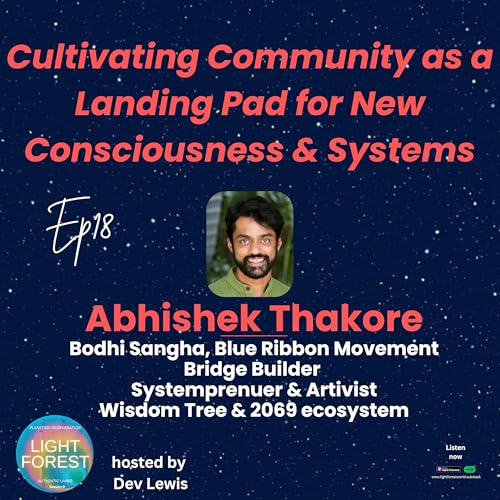
  • EP 18. Weaving an Indic Response to the Meta Crisis (with Abhishek Thakore)
    Sep 20 2025
    The meta-crises is a concept that is growing in usage around the worldIt is developed in the western context with a Global North audience in mind, although in sync with Asian & indigenous wisdom traditions. The ingredients are coherent. But for an Asian audience it can seem dry, bland, and not very relatable. Like it’s missing a burst of flavour that animates your being. So it was really refreshing and uplifting to sit down with Abhishek to learn what an Indic perspective and response to the Metacrises looks like based on 20+ years of lived experience of movement building in India. Abhishek Thakore is the co-author of the soon to be released report "Bodhi Sangha: An Indian Response to the Meta Crisis" - a collection of 15 voices offering indigenous wisdom for our times. With over 20 years of facilitation experience across 50+ organizations globally, Abhishek is founder of the Blue Ribbon Movement and co-founder of WisdomTree and the Bodhisangha ecosystem - one of India's most innovative mycelium-like networks. His own work is inspired and informed by elders such as Vinoba Bhave, and which spans initiatives across levels—from hyperlocal to global—and approaches, including policy, programs, and practice.Understanding the Meta Crisis Through Indic EyesThe Indic mind sees our current crises — financial, Climate, social, health, etc. — as manifestations of inner spiritual decline. Therefore the root of the response must also begin here. Seeing our present moment within the context of cycles (yug). This opens us up to ancestral wisdom, and codified messages passed on to us from religious texts and wisdom traditions. Amidst the confusion and chaos of our time, rather than try to answer the question “what do I want”, we learn to find the Yugdharma, the calling of our times."The Indic mind at its surface level is able to hold paradoxes, deal with ambiguity, deal with chaos and so on. And I think the deeper layers of that mind are that the collective mind has had a long time to evolve."Abhishek has helped build a sophisticated set of social technologies for movement building, social change rooted in relationships, and working with our egos. Relational fields: the emergent power of high-frequency relationships between groups of people that can become space for a new consciousness to land and for new ideas that will be intuited through a web of relationships. The ‘inner’-net: The power of relationships within community gatherings as a practise to better see our own egos at play and tune our inner-nets, and bring our spirituality from the temple into the muck of everyday life. Forest-like Fundraising: An approach to fundraising relying on diverse sources of revenue going beyond the donor-recipient model that he’s honed from his experience with Blue Ribbon Movement and Bodhisangha ecosystem.Chapters00:00 Grounding and Intention Setting01:55 Exploring the Meta-Crisis06:47 The Indic Response to Crisis12:24 The Indic Mind and Its Paradoxes17:40 Cycles of Time and the Kali Yuga23:21 Finding Hope in Crisis26:51 Theory of Change and Relational Fields28:09 The Ego Function and Its Impact29:30 Relationships as a Testing Ground31:18 Creating a Landing Pad for Consciousness32:51 The Theory of Change through Relational Fields35:28 Building Generosity in Ecosystems41:09 Resourcing Ecology vs. Traditional Fundraising45:09 The Power of Artivist Ashrams47:37 Rediscovering Indic Roots and Personal Journey54:56 The Journey of Self-Discovery58:20 From Self to Society: A Shift in Perspective01:01:07 Honing the Instrument of Change01:03:46 The State of India: Youth and Challenges01:09:56 Building Alliances for Change01:12:59 Community as a Catalyst for TransformationConnect with AbhishekBodhi Sangha LinkedInBlue Ribbon Movement
    Show More Show Less
    1 hr and 19 mins
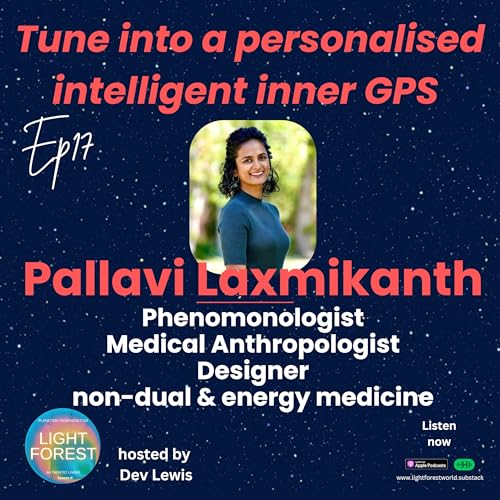
  • EP 17. Living in 'Guidance' for health and peace (with Pallavi Laxmikanth)
    Sep 6 2025

    Over the course of Season 0 we've heard about intuition and the intuitive mind, inner wisdom, sixth sense, inner voice, and authentic selves. Many words, all pointing in a similar direction.
    This is a big part of what I mean by Light in Light Forest. We yearn for it. But we don't always know what it really is, and how to form a stable connection to it.
    Today we're going to take a long walk deep in this direction through a new word: Guidance.

    Joining us to take us on this journey is Pallavi Laxmikanth.

    Pallavi works as a researcher, designer, and educator, roles she carries in the outer world as an academic and former startup leader, as well as in the inner worlds of truth and spirit.
    Her spiritual curiosity about who and what we are, how we function, and how we must live has taken her through formal training in biotechnology, medical anthropology and cybernetics, as well as through spiritual commitment via inquiry-based non-duality practices, Vedic astrology, yoga and energy medicine.
    We will journey with her as she intersects and intertwines these worlds, offering perspectives on how to bring spirit and spirituality into everyday life, health, work and more.

    Pallavi's deepest desire is to help us remember who we truly are, and she does this by choosing to access and embody the part of us that has never forgotten. The ways in which her research and teaching serve this purpose are continually evolving as she engages in conversation with that part called guidance, which we shall learn about today.


    Chapters

    • What is Guidance (3:36)

    • The difference between Guidance and Intuition (10:58)

    • Building a Relationship with Guidance (18:58)

    • Self-Inquiry & Belief Systems (27:53)

    • Distinguishing between Ego & Guidance (41:34)

    • Working Smarter, Not Harder (51:15)

    • Healing from Chronic Disease (1:04:15)

    • Guidance-based healthcare (1:16:01)

    • Guidance vs AI (1:32:10)


      Book mentioned

      The Course in Miracles


      • Website

      • IG @inner.educator

    Show More Show Less
    1 hr and 43 mins
  • EP 16. Stories and Guidance from an Elder to help us live with more Light
    Aug 23 2025

    How do we pretend not to be whole people? How can we learn to embrace the full spectrum of our emotions, intellect, and intuition, to be fully embodied in the present moment?

    In this episode, we journey deep into the Light Forest with William Wait, a musician, psychologist, and psychedelic elder, who shares many stories, insight, and techniques from his long life that started in California in 1941, and now in Bangkok.


    Introducing William Wait and his journey…

    • from the segregated 1950s playing trumpet in blues black bars in California and experiencing a moment of oneness on stage

    • to dropping acid with 18,000 people and psychedelics pioneers like Timothy Leary during the “Summer of Love” in 1967 San Francisco,

    • decades as a psychologist, and practitioner of Taiqi and Qigong, and meditation, spending time with Osho in Pune in the 1980s and 33+ years living in Thailand.

    As a therapist, he developed his own approach which he calls Life Streams, integrating Eastern and Western techniques and philosophies, to help people do the inner work and experience wholeness of life that is our true nature.

    William experienced a stroke earlier this year and in his words can feel death is imminent and is in his final chapter. He wants to share and pass on his knowledge and experience. and i’m super grateful to have the chance to bring this conversation to the podcast.


    Chapters

    • 00:00 - Introduction and Welcome

    • 05:38 - The Four Life Streams: A Framework for Wholeness

    • 08:15 - Stream One: Embodiment and Sensation vs mindfulness

    • 10:36 - Stream Two: Emotionality and the Full Spectrum of Feelings

    • 14:11 - Programming from Conception: Birth Trauma to Social Conditioning

    • 17:00 - Stream Three: Mind as Tool vs Identity

    • 18:34 - Stream Four: Intuition and Expanded Awareness

    • 19:00 - Mind vs intuition

    • 23:20 - Growing Up in 1950s California: Music as Gateway

    • 26:46 - Stream 5: environment

    • 29:07 - working with emotions

    • 35:07 - pretending to not be whole

    • 41:15 - The Mystical Experience: Merging with Music and Unity Consciousness

    • 49:45 - Summer of Love 1967: Psychedelics

    • 55:42 - The Shadow of the Psychedelic Movement

    • 59:30 - From Musician to Psychologist: Spirituality and Eastern Practices: Transcendal Meditation, Tai Chi, and Buddhism

    • 61:30 - AI and Technology:

    • 69:30 - remixing wisdom for the modern mind

    • 77:11 - Living in Bangkok: Choosing Life Over Monastic

    • 82:45 - Death

    • 84:15 - Marriage and the Yoga of Relationship

    • 98:30 - Thailand as Teacher

      103:45 - Facing Death: Life in the Final Chapter


    • References

      • The Psychedelic Experience: A Manual Based on The Tibetan Book of the Dead by Timothy Leary, Ralph Metzner and Richard Alpert

      • Doors of Perception by Aldous Huxley - About his mescaline experience

      • Gestalt Therapy - The therapeutic approach William used extensively

      • Stanislaw Grof - Psychedelic researcher and birth trauma work

      • Ram Dass - "Be Here Now"

      • The Power of Now (by Eckhart Tolle)

      • Brave New World (by Aldous Huxley

      • 1984 (by George Orwell)

      • The Trauma of Birth by Otto Rank - A book from the 1930s by a psychoanalyst about birth trauma

        The Tao Te Ching


    • Connect with William

      You can email William at wmwait@yahoo.com. He is available to do 1 on 1 sessions, couple’s work, or speak to other podcasters that might like to have a conversation with him. I highly recommend you take the opportunity while you can !

    Show More Show Less
    1 hr and 35 mins