Hidden in Plain Sight - ADHD, ASD, and OCD - The Often Missed Diagnoses Driving Overthinking, People Pleasing, Perfectionism, Self-Doubt, and Burnout cover art

Hidden in Plain Sight - ADHD, ASD, and OCD - The Often Missed Diagnoses Driving Overthinking, People Pleasing, Perfectionism, Self-Doubt, and Burnout

Hidden in Plain Sight - ADHD, ASD, and OCD - The Often Missed Diagnoses Driving Overthinking, People Pleasing, Perfectionism, Self-Doubt, and Burnout

By: Dr. Lauren Schaefer
Listen for free

About this listen

You’re overwhelmed and tired, mentally, emotionally, maybe even physically. You overthink everything, feel like you're never doing enough, and constantly worry about what others think of you. You're stuck in cycles of procrastination, perfectionism, or people-pleasing. Social situations can feel draining, and even rest doesn’t feel restful.


You’re the one who holds it together. You care deeply and try so hard to be good and helpful, while quietly unraveling inside. You get things done, but you never feel done. You never feel rested. You never feel right.


You find yourself endlessly doom-scrolling, withdrawing from others into books or your phone, and struggling to feel motivated. If this sounds familiar and nothing seems to be helping, you’re not alone. You’ve just been hidden in plain sight.


Hidden in Plain Sight is a podcast for people-pleasing, perfectionistic, over-giving women who can't seem to find relief. Hosted by psychologist Dr. Lauren Schaefer, this show explores the hidden diagnoses behind lifelong anxiety, depression, self-doubt, shame, and burnout among women whose symptoms have been written off as "just anxiety and/or depression." This is a podcast for deep-feeling, overthinking women who’ve been called too sensitive, too anxious, too intense, or too much, when really, they’ve just been misunderstood.


We’ll talk about the perfectionism you've developed to hide your ADHD; the obsessive-compulsive personality traits, driven by anxiety, to overcompensate for neurodivergent executive dysfunction; your ability to camouflage in relationships and not knowing who you are outside of your relationships due to years of people-pleasing and masking. We'll explore how emotional intelligence, people pleasing, and hypervigilant masking can hide neurodivergent wiring, leading to late diagnosis and poor self-image.


Here you’ll find language for your exhaustion, compassion for your coping, and a mirror that finally reflects the truth: You were never too much. You were just unseen. This is a place to unmask, unravel, and understand the real reasons it’s always felt harder than it looked.

© 2025 Dr. Lauren Schaefer
Hygiene & Healthy Living Personal Development Personal Success Psychology Psychology & Mental Health Science Social Sciences
Episodes
  • Learn to Breathe With Me - Guided Practice for Anxious Minds and Bodies
    Dec 24 2025

    If breathing exercises have ever felt uncomfortable, overwhelming, or hard to follow, you’re not alone. We’ll keep this simple, slow, and flexible. This practice includes tactile and visual strategies to help you better engage the diaphragm and, in turn, activate the vagus nerve and signal safety to the body.

    As we go, you may notice thoughts, distractions, or a desire to do it correctly. That’s okay. Nothing needs to be fixed or pushed away. You can come back to the sound of my voice whenever it feels helpful.

    This practice is for general wellness and education, not medical or mental health treatment. If you have a medical condition that affects your breathing, or if anything here feels uncomfortable, you can pause or stop at any time. You’re always in control of how you participate.

    Here is a written tutorial for future practice:

    Step 1. Set your position

    You can do this sitting upright, reclining, or lying on your side. Choose a position where your ribs and belly can move freely. There is no single correct posture.

    Step 2. Begin with a soft nasal inhale

    Breathe in through your nose for a slow count of three. The inhale should feel soft and gentle, not deep or forced. Imagine someone handing you flowers. You pause, notice them, and gently smell them. Repeat this a few times until the inhale feels easy and unstrained.

    Step 3. Add the diaphragm and belly

    Once the gentle inhale feels comfortable, begin picturing a flower blooming as you breathe in. As the flower opens, imagine the air traveling down into your belly and lower ribs. The image helps cue your diaphragm to move downward, allowing space for the lungs to fill without lifting your shoulders or tightening your chest.

    Step 4. Slow, controlled exhale through the mouth

    Exhale through pursed lips with slow, steady pressure. This should not be forced. Imagine blowing gently on hot coffee so it cools without splashing, or blowing bubbles through a wand. The exhale is calm, quiet, and controlled.

    Aim for the exhale to be about twice as long as the inhale. If you inhaled for three, exhale for six. If six feels like too much at first, shorten it. This improves with practice.

    Step 5. Use your hands to guide the breath

    Hands provide feedback to help your brain understand where the breath is going. This allows us to practice rib expansion: forwards, backwards, and to the sides.

    First placement

    Place both hands on your left side ribs. Breathe for about 30 seconds, directing the air into your hands. Your job is simply to raise your hands with the breath. It is okay if other areas move too.

    Second placement

    Move both hands to the center front of your ribs and upper belly. Repeat the same gentle breathing, allowing the ribs and belly to expand forward.

    Third placement

    Move both hands to the right side ribs and repeat.

    Fourth placement

    Place your hands on your back ribs. Many people find this easiest while lying on their side or bending slightly forward while seated. Focus on sending the breath outward into your hands, as if gently inflating the back of the ribcage.

    Step 6. Timing and practice

    Practice this breathing for short periods rather than long sessions. Even one to two minutes is effective.

    Helpful times to practice include before eating, before bed, or during transitions when your body tends to hold tension.

    Important reminders

    This skill takes time. Most people do not “get it” right away. That is normal.

    If you feel lightheaded, retur

    Recommendations, Feedback, Comments? I’d love to hear from you!

    Support the show

    With Care,

    Dr. Lauren Schaefer - Hidden in Plain Sight Podcast

    Show More Show Less
    14 mins
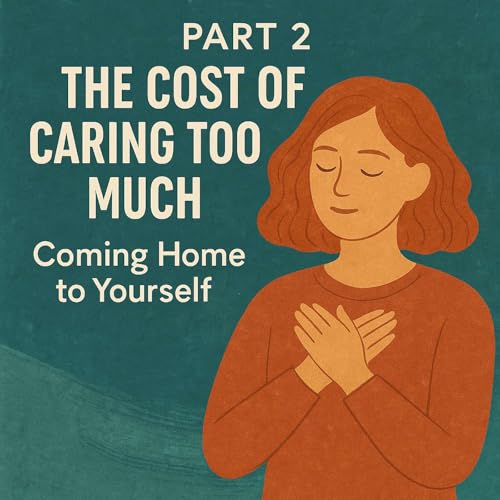
  • Part Two: The Cost of Caring Too Much - Coming Home to Yourself
    Nov 27 2025

    TL/DR Episode Summary: This episode explores the tender line between empathy and emotional fusion, and why so many sensitive, overgiving women lose themselves while trying to care for others. If you’ve ever felt responsible for someone else’s feelings, this one will feel like coming home to yourself.

    Welcome Back!

    In this second part of the series, we step into one of the most tender, defining truths of the overgiving pattern: the difference between empathy and fusion. This is the moment in therapy where clients usually go quiet, or cry, or exhale in that way that tells me something finally landed.

    Because most people who care “too much” aren’t struggling with empathy at all. They’re struggling with over-identification. Emotional merging. Becoming a one-person sponge for everyone else’s feelings while slowly disappearing inside their own life.

    In this episode, we explore how fusion feels in the body, why it masquerades as kindness, and how it forms in childhood, long before you had words for any of this.

    We look at the nervous system mechanics behind over-attunement, the praise that rewarded your self-erasure, and the subtle ways fusion shapes your posture, your breath, your sense of self, and your relationships.

    You’ll hear real-world examples that make the pattern unmistakable, the heavy-text spiral, the relationship “pause,” the emotional weather system that turns someone else’s storm into your climate. And you’ll learn why this reflex isn’t a flaw; it’s a survival strategy your body learned to keep you safe.

    Most importantly, we talk about what healthy empathy actually looks like, and the sentence that becomes a turning point for so many sensitive, intuitive women:

    You can care… without carrying.

    If you’ve ever felt like you know everyone else’s feelings but not your own, if you’ve ever lost yourself in someone’s silence, if you’ve ever confused hyper-attunement with love, this episode is a homecoming.

    Let’s walk it slowly, together.

    Recommendations, Feedback, Comments? I’d love to hear from you!

    Support the show

    With warmth,

    Dr. Lauren Schaefer

    Show More Show Less
    36 mins
  • Part 1: The Cost of Caring Too Much - When Caring Turns Into Self-Abandonment
    Nov 19 2025

    Dr. Lauren Schaefer unpacks the psychology of overgiving and explores the quiet slide from compassion into self-erasure. We explore when empathy becomes vigilance, when connection becomes labor, and when our nervous system mistakes intensity for intimacy. Through attachment, trauma bonding, and neurodivergent wiring, we’ll look at why these patterns form and the addictive push-pull that keeps so many deep feelers stuck in relationships that drain them.

    We’ll learn why “caring harder” becomes a reflex, and why certain patterns feel magnetic even when they’re painful. A validating exploration of overgiving, for anyone who feels like they’re always managing the emotional weather around them.

    Recommendations, Feedback, Comments? I’d love to hear from you!

    Support the show

    With warmth,

    Dr. Lauren Schaefer

    Show More Show Less
    33 mins
No reviews yet
In the spirit of reconciliation, Audible acknowledges the Traditional Custodians of country throughout Australia and their connections to land, sea and community. We pay our respect to their elders past and present and extend that respect to all Aboriginal and Torres Strait Islander peoples today.