DNA Today: A Genetics Podcast cover art

DNA Today: A Genetics Podcast

DNA Today: A Genetics Podcast

By: Kira Dineen Gene Pool Media
Listen for free

This Season's Biggest Deal | $0.99/mo for 3 months + $20 Audible bonus

Auto-renews at $8.99/mo. after 3 months - terms apply.
Summary

Discover New Advances in the world of genetics, from technology like CRISPR to rare diseases to new research. For 14 years, multi-award winning podcast ”DNA Today” has brought you the voices of leaders in genetics. Host Kira Dineen brings her genetics expertise to interview geneticists, genetic counselors, patient advocates, biotech leaders, researchers, and more.

***Best Science and Medicine Podcast Award Winner (2020, 2021 and 2022)***

Learn more (and stream all 400+ episodes) at DNAtoday.com. You can contact the show at info@DNAtoday.com.


This show is part of "Gene Pool Media: The Science Podcast Network" head to GenePoolMedia.com to explore all our science themed shows.

DNA Today, LLC 2012-2026
Biological Sciences Science
Episodes
  • #421 Bridging Genetic Testing and Patient Advocacy: From Diagnosis to Support
    Nov 20 2026
    A genetic diagnosis can provide long-awaited answers, but for patients and families, it often marks the beginning of a new journey. From understanding test results and connecting with others who share a diagnosis to navigating research opportunities and accessing care, support beyond the genetics clinic is essential. In this episode of DNA Today, host Kira Dineen is joined by two fellow genetic counselors, Jessica Shiles Hess, Associate Director of Patient Advocacy and Engagement at GeneDx, and Karmen Trzupek, Senior Director of Scientific Programs at Global Genes, to explore how partnerships between genetic testing laboratories and patient advocacy organizations can better support the rare disease community. Together, they discuss how advocacy has evolved from providing community support to actively advancing research and therapeutic development. They also examine persistent barriers to genetic testing, the challenges of interpreting uncertain results, and how laboratories and advocacy organizations are collaborating to improve education, expand access, and connect families with meaningful resources. From GeneDx's patient support services and data-sharing initiatives to Global Genes' Rare Concierge program and efforts to reach underserved communities, this conversation highlights how collaboration can help bridge the gap between receiving a diagnosis and knowing what comes next. Episode Discussion Topics The evolving role of patient advocacy: How patients, caregivers, genetic counselors, and advocacy organizations are driving education, research, policy, and therapeutic development.Global Genes and the rare disease community: How the organization supports condition-specific advocacy groups through education, mentorship, research infrastructure, and community resources.Laboratory and advocacy partnerships: How GeneDx collaborates with Global Genes and other organizations to develop genetic testing education, support research, and help families navigate the diagnostic journey.Data sharing and gene discovery: The importance of ClinVar, GeneMatcher, and collaborative research in improving variant interpretation and advancing rare disease diagnosis.Barriers to genetic testing: Geographic disparities, limited access to specialists, insurance coverage, financial challenges, health literacy, and underrepresentation in genomic databases.Supporting genetic counselors and healthcare providers: GeneDx's genetic counseling services, educational resources, financial assistance programs, sponsored testing pathways, and condition-specific report resources.Navigating variants of uncertain significance (VUS): Why clinical context matters, when connecting families with advocacy organizations may be helpful, and how reinterpretation can provide new insights over time.Connecting families with rare disease resources: How Global Genes' Rare Concierge program supports patients, caregivers, and healthcare professionals seeking guidance.Expanding testing access in underserved communities: A collaboration involving Global Genes and GeneSprout, including a pilot initiative focused on rural Tennessee communities.The future of rare disease advocacy: Why collaboration among laboratories, healthcare providers, researchers, and patient organizations is essential for improving access to diagnosis and advancing research. About the Guests Jessica Shiles Hess, MSc GC, CPC, is the Associate Director of Patient Advocacy and Engagement at GeneDx. A genetic counselor with a career focused on rare disease, Jessica works to strengthen partnerships between genetic testing laboratories and patient advocacy organizations. Her work emphasizes genetic testing education, access to diagnostic services, patient support resources, and collaboration that helps families navigate the genetic testing journey and connect with research opportunities. Karmen Trzupek, MS, CGC, is the Senior Director of Scientific Programs at Global Genes. With a background in rare disease genetics, genetic counseling, and telehealth services, Karmen focuses on helping patient advocacy organizations develop the scientific knowledge, research infrastructure, and partnerships needed to advance rare disease research. Her work supports advocacy leaders working to move their communities toward better diagnostics, treatments, and ultimately improved outcomes. Resources & Links Patient Advocacy and Support GeneDx – Genetic testing, patient education, genetic counseling support, and resources for healthcare providers.GeneDx Advocacy – Learn how GeneDx supports advocacy organizationsGlobal Genes – Resources, education, research programs, and support for rare disease advocacy organizations, patients, and families.Global Genes Rare Concierge – A resource for individuals, families, and healthcare professionals seeking guidance and connections within the rare disease community.Courageous Parents Network – Educational resources and support for families caring for children with...
    Show More Show Less
    38 mins
  • #420 NSGC 2026: Ambry's Whole Genome Sequencing and BillionToOne's Unity Confirm
    Nov 14 2026
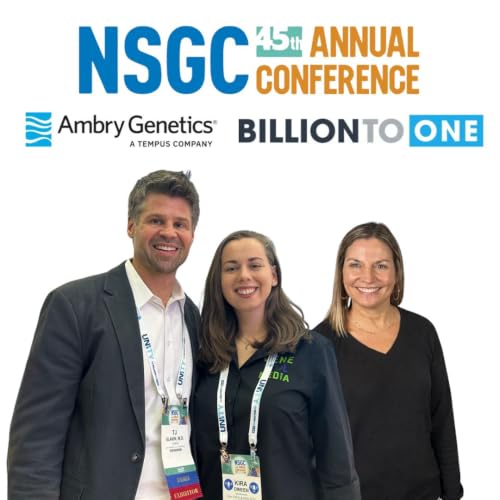
    In this episode, we're coming to you from Baltimore for the National Society of Genetic Counselors (NSGC) 2026 Annual Conference! From new approaches to whole genome sequencing to the ability to analyze intact fetal cells through a pregnant person’s blood sample, we're exploring two exciting advances in genetic testing that could change how patients receive answers. Host Kira Dineen sits down with experts from Ambry Genetics and BillionToOne to discuss new technologies unveiled at the conference, their clinical applications, and how they could improve diagnostic accuracy and accessibility. We also celebrate Genetic Counselor Appreciation Day, highlight memorable moments from NSGC 2026, and share a special thank-you following Kira's recognition with the NSGC Leader in Community Engagement Award! Featured Guests Thomas "TJ" Slavin Jr., MD, is the Chief Medical Officer of Ambry Genetics and a medical geneticist. He joins us to discuss Ambry Genetics' newly launched whole genome sequencing offerings, GenomeNext and GenomeReveal, and how integrating RNA analysis, pangenome references, and proactive reanalysis could help end the diagnostic odyssey for more families. Jennifer "Jen" Hoskovec, MS, CGC, is Vice President of Medical Affairs at BillionToOne and a past president of NSGC (2014). She returns to DNA Today to introduce Unity Confirm, a new prenatal testing option that isolates and sequences intact circulating placental cells from a pregnant person’s blood to provide additional information following high-risk NIPT results. In This Episode We Discuss Ambry Genetics: Whole Genome Sequencing, RNA Analysis, and the Pangenome How Tempus' acquisition of Ambry Genetics brings together tumor sequencing and germline testing capabilities.Why Ambry chose 2026 to launch GenomeNext and GenomeReveal and how whole genome sequencing is changing rare disease diagnostics.How RNA analysis can help clarify variants of uncertain significance (VUS), particularly variants that may affect RNA splicing.Why incorporating a human pangenome reference can improve variant detection across diverse ancestral populations and help address disparities in genetic testing.How Ambry's Patient for Life program proactively reanalyzes genetic data and contacts providers when new evidence leads to clinically meaningful changes.Why identifying dual genetic diagnoses is increasingly important and how ongoing reanalysis can reveal additional explanations for a patient's symptoms. Clarification - Dr. Salvin mentioned Tempus is "the largest tumor sequencing company", it’s important to note that this is in the context of comprehensive genomic profiling (CGP). BillionToOne: Unity Confirm and Cell-Based Prenatal Testing How Unity Confirm differs from traditional cell-free DNA screening by isolating intact circulating extravillous trophoblasts from a pregnant person’s blood.How sequencing individual placental cells can provide additional information following a high-risk NIPT result.Why Unity Confirm is positioned as an additional testing option rather than a replacement for diagnostic procedures such as chorionic villus sampling (CVS) or amniocentesis.How this technology could help patients who decline invasive testing or face geographic, financial, or gestational-age barriers to accessing diagnostic procedures.The limitations of analyzing a small number of cells, particularly when considering placental mosaicism and conditions such as Turner syndrome.How staining techniques and genetic comparisons help distinguish placental trophoblasts from maternal white blood cells.How genetic counselors can integrate another source of prenatal information into patient-centered conversations about screening, diagnosis, and reproductive decision-making. Resources & Links NSGC Annual Conference National Society of Genetic Counselors (NSGC) – Learn more about NSGC, its annual conference, and resources for genetic counseling professionals. Ambry Genetics and Whole Genome Sequencing Ambry Genetics – Explore Ambry's clinical genetic testing services and resources. GenomeNext and GenomeReveal Launch Announcement – Learn how Ambry integrates whole genome sequencing, RNA analysis, pangenome references, and ongoing reanalysis to improve rare disease diagnosis. GenomeNext and GenomeReveal – Explore the technologies and clinical capabilities behind Ambry's new whole genome sequencing offerings. Patient for Life White Paper – Learn how Ambry's proactive reanalysis program identifies new diagnostic findings as genetic knowledge evolves. Tempus AI – Learn about Ambry's parent company and its work in precision medicine. Fact Check: Kira misspoke when she said Ambry has been analyzing RNA as part of clinical testing for 15 years, she was thinking of Ambry offering the first clinical exome as that was launched in 2011. BillionToOne and Prenatal Testing BillionToOne – Explore the company's prenatal genetic testing technologies. Unity Confirm ...
    Show More Show Less
    31 mins
  • #419 Optical Genome Mapping and Long-Read Sequencing: Unlocking Rare Diagnoses
    Nov 6 2026
    What happens when traditional genetic testing leaves patients and families without answers? Emerging technologies like optical genome mapping (OGM) and long-read sequencing are expanding what laboratories can detect, from complex structural variants to difficult-to-analyze repetitive regions of the genome. These advances are already changing clinical testing strategies and helping uncover diagnoses that previously remained out of reach. In this episode, we welcome back Dr. Nikhil Sahajpal, Assistant Laboratory Director at Greenwood Genetic Center (GGC), who previously joined us in Episode 362 to introduce optical genome mapping. Now, nearly two years after GGC began offering OGM clinically, Dr. Sahajpal shares how the technology is being integrated into rare disease diagnostics, including additional diagnostic findings in at least 5% of previously unsolved cases. The conversation takes a closer look at facioscapulohumeral muscular dystrophy (FSHD), a genetically complex condition involving D4Z4 repeat contractions, epigenetic changes, and inappropriate DUX4 expression. Dr. Sahajpal explains how OGM and short-read sequencing can work together to distinguish FSHD1 from FSHD2, and why the laboratory is evaluating long-read sequencing as a potential way to streamline this testing. We also explore targeted applications of OGM and long-read sequencing, including clarifying DMD duplications, mapping structural variant breakpoints, and determining whether variants are in cis or trans. Finally, Dr. Sahajpal discusses where long-read genome sequencing fits into the rare disease diagnostic workflow and whether a more comprehensive, unified genetic test could eventually reduce the need for multiple testing platforms. Episode Discussion Topics How optical genome mapping compares with karyotyping, FISH, and chromosomal microarrayGreenwood Genetic Center's clinical experience with OGM and its additional diagnostic yield in previously unsolved rare disease casesWhen OGM may serve as a reflex test following negative genome sequencingThe genetics of FSHD1, including D4Z4 repeat contractions, permissive haplotypes, and DUX4 expressionWhy chromosome 4 and chromosome 10 repeat regions complicate FSHD testingHow OGM and short-read sequencing contribute to distinguishing FSHD1 and FSHD2The potential for long-read sequencing to assess repeat size, sequence variants, and DNA methylationWhen long-read genome sequencing may be appropriate for patients with broad or nonspecific phenotypesHow targeted OGM can clarify DMD duplications and change carrier screening interpretationUsing targeted long-read sequencing to phase variants in recessive conditions without parental samplesThe limitations of phenotype-driven variant analysis and the future of comprehensive genomic testing Resources & Links Greenwood Genetic Center OGM CompleteOGM Targeted Facioscapulohumeral Muscular Dystrophy Type 2 (FSHD2) NGS PanelFSHD1Long-read Sequencing-Trio Analysis Long-read Sequencing-Targeted Analysis Sahajpal Completes Laboratory Fellowship at GGC and Joins FacultySahajpal NS, Mondal AK, Singh H, Vashisht A, Ananth S, Saul D, Hastie AR, Hilton B, DuPont BR, Savage NM, Kota V, Chaubey A, Cortes JE, Kolhe R. Clinical Utility of Optical Genome Mapping and 523-Gene Next Generation Sequencing Panel for Comprehensive Evaluation of Myeloid Cancers. Cancers (Basel). 2023 Jun 16;15(12):3214. doi: 10.3390/cancers15123214. PMID: 37370824; PMCID: PMC10296552. Relevant DNA Today Podcast Episode #362 Optical Genome Mapping: Detecting Structural Variants Missed by Traditional Tests (with guest Dr. Nikhil Sahajpal)#279 Reflecting on 50 Years of Greenwood Genetic Center#183 Dr. Miga and Dr. Phillippy on the Telomere to Telomere Consortium#182 Eric Green on the Complete Human Genome Project #145 Greenwood Genetic Center on Epigenetics Connect with DNA Today: You never have to wait long for a new episode of DNA Today, we release episodes every Friday! In the meantime, explore our library of over 400 episodes on Apple Podcasts, Spotify, DNAToday.com, or wherever you listen to podcasts. Just search “DNA Today.” Prefer to watch? The video version of this episode is available on our YouTube channel and DNAToday.com. Select episodes are filmed in person, including some at the iconic NBCUniversal studios. Discover more podcasts exploring genetics, genomics, medicine, and science from our network, Gene Pool Media: The Science Podcast Network. DNA Today is hosted and executive produced by Kira Dineen, MS, LCGC, CG(ASCP)CM. Liv Davidson is our Social Media Lead and Eric Knaus is our Digital Marketing and Automation Lead. Follow us at @DNATodayPodcast on all platforms including Instagram, X, BluSky, Threads, LinkedIn, Facebook, YouTube and our website, DNAToday.com. Questions, partnership inquiries, and guest pitches can be sent to info@DNAToday.com.
    Show More Show Less
    39 mins
No reviews yet
In the spirit of reconciliation, Audible acknowledges the Traditional Custodians of country throughout Australia and their connections to land, sea and community. We pay our respect to their elders past and present and extend that respect to all Aboriginal and Torres Strait Islander peoples today.