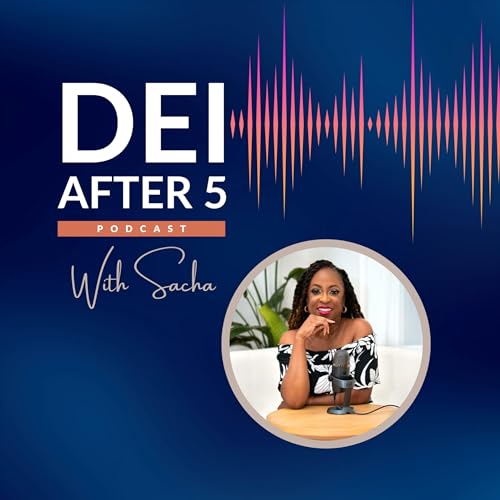
DEI After 5 with Sacha cover art

DEI After 5 with Sacha

DEI After 5 with Sacha

By: The work doesn’t end at 5pm—and neither do we.
Listen for free

About this listen

DEI After 5 is where inclusion meets real life. Hosted by Sacha Thompson, this weekly podcast explores how current events shape our workplaces and communities—with practical insights and honest reflection.

deiafter5.substack.comSacha Thompson
Economics Management Management & Leadership Social Sciences
Episodes
  • Unlocking the Power of Coaching and Mindset
    Nov 25 2025
    When I think about the leaders, teams, and individuals I’ve supported over the years, one truth keeps showing up: mindset is the gateway to transformation. Whether we’re talking about happiness, resilience, purpose, or even navigating workplace stress, the way we frame our experiences shapes the way we move through them. Coaching becomes the vehicle—not because it provides all the answers, but because it gives us the space to ask better questions, build awareness, and shift how we see ourselves and the world around us.Positive psychology gives us a grounding point. At its core, it’s the study of how humans thrive—how joy, connection, meaning, and accomplishment support well-being. What I appreciate most is how it pushes us away from the idea that happiness lives in external markers: the job title, the car, the “perfect” life. It pushes us back toward ourselves. Toward intrinsic motivation. Toward values. Toward the understanding that we create peace from the inside out, not the outside in.And peace isn’t perfection—it’s honest alignment.It’s the moment you realize you can’t keep performing your way into happiness. It’s when you stop arranging your life around the expectations of others and start tuning into who you are, what you need, and what truly matters. That’s where mindset shifts become powerful. A growth-oriented mindset doesn’t ask you to ignore the hard stuff; it asks you to meet it with curiosity instead of fear. It reminds you that setbacks aren’t stop signs—they’re information.So much of the work I do—especially with leaders navigating complex or uncertain environments—comes back to this idea of intentionally cultivating positive emotions. In one of my conversations on the podcast, we talked about the ten positive emotions highlighted in positive psychology: love, joy, serenity, awe, hope, amusement, and others. These emotions aren’t trivial. They’re not fluffy. They’re “peace builders.” They fuel resilience, deepen relationships, and help us shift out of survival mode.Many people are surprised when I say your peace is a skill you can practice.Your joy is a skill.Your optimism and purpose? Skills too.That’s where coaching sits at the intersection of science and lived experience. I often ask clients to identify their joy triggers—small, accessible moments that reset their emotional baseline. A few minutes of anticipation about something exciting. A memory that brings a smile. The comfort of a pet. A moment of gratitude. These tiny shifts matter because they interrupt stress patterns and create room for us to breathe again.This is especially important during tough seasons. I think about a client struggling through a toxic return-to-office mandate. Their stress levels were sky-high. Instead of pushing them to “push through,” we centered on finding small ways to reclaim joy. For them, it was their dogs. That tiny moment of lightness became an anchor in the chaos—proof that even in hard situations, access to joy is still possible.But access to joy isn’t the same for everyone.In fact, it’s not evenly distributed.When I talk to people navigating workplace inequities—especially Black women, women of color, and people whose identities are marginalized—I hear the same themes over and over: exhaustion, suppression of emotion, carrying “strength” as a requirement, not a choice. Generational trauma plays a role here too. Many of us were raised in families where pain was minimized, emotions were tucked away, and pushing through was considered a virtue. That survival mindset served its purpose, but it can keep us from healing.And healing is essential.Not optional. Not indulgent. Essential.Resilience isn’t built from pretending we’re not hurting. It grows when we acknowledge our wounds, seek support, and allow ourselves to process what we’ve been carrying. Coaching helps with the “what’s next”—the forward movement. Counseling helps with the “what happened”—the deeper unpacking. Both matter. Both create room for joy, peace, and clarity to take root.I’ve seen the power of healing and mindset shifts change how people show up in their work and their leadership. When we stop compartmentalizing—when we admit that the personal impacts the professional—everything shifts. Leaders become more human-centered. Teams become more connected. People feel safer to speak, contribute, and grow.Purpose ties it all together.Purpose isn’t a destination; it’s a continual unfolding. It requires presence, emotional honesty, and the willingness to dance in the rain instead of waiting for the storm to pass. Mindset gives us the tools to do that—tools that help us recognize meaning in the midst of uncertainty, and joy in the midst of change.Every conversation I have—whether I’m coaching a leader through a career pivot, talking with a parent trying to support their child, or reflecting on my own journey—comes back to the same ...
    Show More Show Less
    40 mins
  • Developing Your Empathy Muscle as a Leader
    Nov 18 2025
    If there’s one leadership skill that keeps coming up in every conversation I have—with clients, podcast guests, and leaders navigating the post-pandemic workplace—it’s empathy. Not the “I feel sorry for you” kind. Not sympathy. Real empathy. The kind that helps you actually feel with people, not just observe their struggle from the outside.This skill isn’t soft. It isn’t optional. And it definitely isn’t something you can toggle on only when it’s convenient. Empathy is a leadership muscle. And like any muscle, if you don’t build it intentionally, it won’t be there when you need it.Empathy Isn’t About Fixing—It’s About ConnectingIn my conversation with consultant and engineer Erin Thorpe on DEI After 5, she described the trap so many leaders fall into: problem-solving their way through people issues.Think of it like having a hammer. It’s useful for certain tasks. But if everything is treated like a nail, you’re going to do more harm than good.No one wants to be “fixed.”People want to be understood.Empathy is the tool leaders often overlook in their toolbox—the one that helps you slow down, get curious, and genuinely connect with the human in front of you. It asks you to step into their world long enough to understand what’s happening beneath the surface.The First Step: Build Your Emotional CapacityBefore leaders can extend empathy to others, they have to be willing to feel their own emotions. And let’s be honest: many of us were taught to leave feelings at the door and “be professional.”But today’s workplace doesn’t reward emotional disconnection. It demands emotional capacity.Start small. Erin talked about using the shower as a safe place to acknowledge your emotions—no emails, no team requests, no interruptions. Just you and whatever’s bubbling up. Practicing this regularly makes it easier to hold space when your team brings their emotions to you.Because here’s the truth:You can’t support what you don’t understand.And you can’t understand what you refuse to feel.Name the Emotion Before You Respond to ItMost people can identify four emotions: happy, sad, angry, frustrated. But there are layers beneath each one. Tools like the “emotion wheel” can help you name what’s actually going on—disappointment, overwhelm, shame, discouragement, excitement, anticipation.Being able to name an emotion helps you regulate it. And if you can regulate yours, you’ll be far better equipped to support someone else.This is why emotional intelligence is so tied to effective leadership. It’s not about perfect composure—it’s about honest awareness.Your Body Already Knows What’s Going OnVerbal communication only tells part of the story. The rest shows up in body language—crossed arms, fidgeting, leaning away from the screen, avoiding eye contact, a quick smirk that flashes and disappears. Most leaders notice these cues without knowing what to do with them.Here’s where empathy comes in.Instead of assuming, lead with curiosity:* “I’m picking up something—what’s coming up for you right now?”* “I noticed you leaned back when that topic came up. Tell me more.”When you see a cue, don’t ignore it. Check it, explore it, understand it.This attention doesn’t slow down productivity. It accelerates it. People work better when they feel seen.Emotions Are a Part of InclusionEveryone expresses emotions differently. Some people shut down. Some people get loud. Some tear up. Some fling a hammer across the room (yes, that actually happens on job sites).What matters is this:Emotions are human.And inclusion is not possible without making room for that humanity.Too often, tears get labeled as “unprofessional,” especially for women. Anger gets labeled as “aggressive,” especially for women of color. Both interpretations are rooted in bias, not truth.You can’t build an inclusive workplace while demanding emotional sameness.True inclusion means creating space for people to show up as they are—and not punishing them for it.People Need to Feel Valued, Seen, Heard, and ConnectedIf one of these is missing, belonging breaks down:* Valued – “I matter to this team.”* Seen – “You notice and respect who I am.”* Heard – “My voice isn’t dismissed.”* Connected – “I’m part of something here.”Leaders who get this right don’t just improve culture—they increase retention, commitment, innovation, and trust. The emotional connection people feel at work directly impacts how they show up.And part of that connection comes from modeling it yourself. You can’t pour from an empty cup. You have to know what you need, too.Empathy Starts Small—but Consistency MattersBuilding this muscle doesn’t require grand gestures. Start with manageable habits:* Check in with your own emotions daily.* When irritation rises, pause for 30 seconds instead of responding immediately.* Take a sip of water or walk for two minutes when overwhelmed.* ...
    Show More Show Less
    41 mins
  • Building Trust and Accountability: The Key to Effective Leadership
    Nov 11 2025
    Leadership today demands more than vision or authority—it requires trust. In workplaces where uncertainty and change are constant, the leaders who succeed are those who create environments where people feel safe, supported, and empowered to deliver their best work. As Damian Goldvarg shared in our recent conversation, effective leadership is not about control—it’s about cultivating trust and accountability so that teams can thrive without micromanagement.Trust is not a soft skill—it’s a strategic one. When leaders trust their teams, they create the conditions for psychological safety, innovation, and shared ownership. When that trust is missing, fear fills the void. Micromanagement takes over, creativity stalls, and engagement plummets.The foundation of effective leadership lies in understanding that trust enables accountability without micromanagement. Teams that operate from a place of trust know what’s expected of them and have the confidence to deliver. They hold themselves accountable not because they’re being watched, but because they’re invested in the outcome.Trust Is a Choice We MakeTrust doesn’t happen by default—it’s a choice, an intentional decision we make every day in our interactions. Some people give it freely; others hold it close, shaped by past experiences or team dynamics. For leaders, understanding their own relationship with trust is the first step toward building it.When leaders choose to trust, they communicate belief in their team’s competence and integrity. When they don’t, that skepticism often gets mirrored back. The energy of distrust—whether it shows up in tone, body language, or behavior—can create a cycle of fear and disengagement.That’s why the most effective leaders cultivate self-awareness and curiosity. Instead of asking, “Why did this go wrong?” they ask, “What’s behind this?” or “What support might be needed here?” This shift from judgment to inquiry transforms how teams operate.Embrace Discomfort to Build TrustBuilding trust often means stepping into uncomfortable territory. Whether it’s addressing performance issues, navigating layoffs, or discussing mental health, leaders must be willing to engage in conversations that stretch them.Avoiding discomfort may protect leaders from awkward moments—but it prevents growth. In contrast, embracing discomfort builds credibility. When leaders demonstrate that they’re willing to have hard conversations with honesty and care, they model the very accountability they expect from others.As Damian noted, discomfort is not a signal to retreat—it’s an invitation to deepen trust. Asking questions like “What’s the worst that can happen?” or “What do you need from me right now?” helps to reframe fear into opportunity.Developing Your Inner Coaching VoiceLeadership requires a new kind of fluency—one rooted in self-reflection and emotional intelligence. The inner coaching voice is that quiet guide that helps leaders pause, assess, and respond rather than react.When we work with external coaches, over time we begin to internalize their guidance. That becomes our inner coach—the voice that reminds us to breathe before responding, to question assumptions, to align actions with values. Developing this inner voice helps leaders model what self-accountability looks like.It also helps leaders navigate emotional triggers and stay grounded when challenges arise. Leaders who can name their emotions, understand their impact, and stay centered during conflict create stability for others. They embody psychological safety in action.Human-Centered Leadership Is the FutureThe traditional command-and-control models of leadership no longer work in a world where people crave meaning, connection, and trust. Human-centered leadership focuses on people first—recognizing that performance follows well-being.This kind of leadership blends empathy, coaching, and emotional intelligence with clarity and accountability. It’s not about being “soft”; it’s about being real. It’s about knowing when to step in and when to step back. It’s about trusting your people enough to let them lead, and supporting them when they stumble.When leaders model trust, they give their teams permission to take risks, share ideas, and own outcomes. The result? Stronger performance, higher engagement, and cultures where accountability is shared, not enforced.The Bottom LineBuilding trust and accountability isn’t a one-time initiative—it’s an ongoing practice. It requires courage, curiosity, and compassion. It asks leaders to look inward before pointing outward.When we choose trust, we create psychological safety. When we embrace discomfort, we strengthen relationships. And when we lead with humanity, we build organizations where people—and results—thrive.If you’re ready to explore what it looks like to build a Culture of Care in your organization—and the role the leader-as-coach plays in making ...
    Show More Show Less
    21 mins
No reviews yet
In the spirit of reconciliation, Audible acknowledges the Traditional Custodians of country throughout Australia and their connections to land, sea and community. We pay our respect to their elders past and present and extend that respect to all Aboriginal and Torres Strait Islander peoples today.