Collaborators UNITE Podcast cover art

Collaborators UNITE Podcast

Collaborators UNITE Podcast

By: Chuck Anderson
Listen for free

Season's Savings | $0.99/mo for 3 months

Auto-renews at $8.99/mo. after 3 months - terms apply.
Let's face it, achieving great business results as an entrepreneur is rarely accomplished alone. There is always someone out there that can solve problems faster and easier than you can. What if you could leverage a strategic partnership or creative collaboration to accelerate the growth of your business? This show is all about how Chuck Anderson and his entrepreneur friends have leveraged partnerships and collaborations to increase our business results and make a BIG positive impact on others. Each week, Chuck interviews guests that share their best collaboration & partnership stories and how it has transformed their business and their lives. What is your story?Copyright 2022 Fincastle Media Inc Economics Leadership Management & Leadership Marketing Marketing & Sales Personal Finance
Episodes
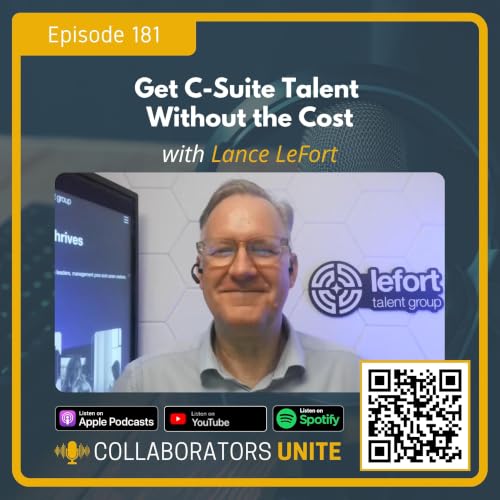
  • Get C-Suite Talent Without the Cost with Lance LeFort
    Oct 14 2026
    If your business has outgrown what you can do alone but you can't yet afford a full-time senior hire, fractional experts could be the strategic solution you've been missing. In this episode of the Collaborators UNITE Podcast, host Chuck Anderson sits down with recruiting specialist Lance LeFort to unpack the fractional hiring model — a smarter, budget-friendly way for small businesses and startups to access CMO, CFO, and CTO-level talent. Lance explains how experienced executives are actively seeking part-time roles that fit around their lifestyle, making it possible for growth-stage businesses to access decades of strategic experience at a fraction of the cost. You'll learn how to identify when you're ready for a fractional hire, how to find the right person, and how this approach reduces risk for both employer and expert. Perfect for coaches, consultants, and B2B service providers ready to scale without overextending their budget.Q&A SECTION:Q: What is a fractional expert and how is it different from a contractor or VA?A: A fractional expert is a senior-level professional — think CMO, CFO, or CTO — who works part-time (two to three days a week) for your business. Unlike a VA who handles tasks, a fractional expert brings high-level strategy and decades of experience without requiring a full-time salary.Q: Can a small business actually afford a fractional CMO or CFO?A: Yes. Because fractional executives only want part-time work — often due to lifestyle priorities like family or semi-retirement — you access their full expertise at a fraction of the cost. You pay for the days they work, not a full-time package, making senior talent genuinely accessible for growth-stage businesses.Q: How do I know when my business is ready for a fractional hire?A: You're likely ready when VAs and task-based workers can no longer solve your growth problems. If you're hitting strategic ceilings — in marketing, finance, or operations — and need someone who can build infrastructure and lead decisions, it's time to consider a fractional expert.Q: What happens if the fractional arrangement outgrows itself?A: Many fractional relationships naturally evolve. As your business scales — especially after a funding round or revenue milestone — you can increase the person's hours or convert them to a full-time role if both parties want it. Lance calls it the "date before the marriage."Q: What types of roles can be filled fractionally?A: Almost any senior function can be filled fractionally — marketing (CMO), finance (CFO), technology (CTO/CIO), operations, and executive production. The model works anywhere you need strategic leadership but aren't yet at the stage to justify a full-time hire.Q: How is the current job market making fractional hiring more appealing?A: With a cautious hiring market, many businesses are hesitant to commit to full-time executive salaries. At the same time, experienced professionals prefer the flexibility of part-time work. Fractional hiring meets both needs — lower commitment for the business, better lifestyle for the expert.Q: How do I find the right fractional expert for my business?A: Work with a specialist recruiter like Lance LeFort who understands both the business need and the talent pool. The right match isn't just about skills — it's about energy, cultural fit, and threading the person's specific expertise into your exact gaps.QUOTES:"You could get a very senior person with a great resume who doesn't want the five-day-a-week hustle — and you're not having to pay the full freight charge on that salary." — Lance LeFort"Think of it as the date before the marriage. They work together for six months, the business starts to ramp up, and then it potentially becomes a full-time gig — if both sides want it." — Lance LeFort"I'm like a doctor and someone says, here's the ailment — I've got this solution, or this solution, or let's try this. I'm matchmaking to solve their problem." — Lance LeFort"It mitigates the risk on both sides. Do I really want to go back full time? No. Does this person really have the money to hire someone full time? No. So let's do this little dance for a bit and let it evolve." — Lance LeFortLINKS:https://calendly.com/lance-ltg/podcast-fridayhttp://www.leforttalentgroup.com/ ­ Was this episode helpful?Please leave us a review and subscribe to the show to be notified of future episodes.Until next time, keep moving forward!Chuck Anderson,Affiliate Management Expert + Investor + Mentorhttps://AffiliateManagementExpert.com/
    Show More Show Less
    30 mins
  • Practical Steps to Connect with Your Inner Power with Dr Elizabeth Locey
    Oct 6 2026
    If you've built a successful career but feel quietly trapped by it, this episode is your permission slip to pay attention to what's beneath the surface. Dr. Elizabeth Locey — former tenured French professor, department chair, and New York Times-cited scholar — shares how a single Akashic Records session cracked open her carefully constructed life and set her on a path of soul-aligned impact.This episode speaks directly to high-achieving experts experiencing a career pivot, spiritual awakening, or the unsettling feeling that outward success isn't enough. Dr. Locey walks through the practical and spiritual steps she took to connect with her inner power, trust a radical life transition, and step into her identity as what the Records called a 'truth teller.'If you're searching for how to reconnect with your purpose after burnout, how to trust a major career change, or what self-discovery actually looks like in practice — this honest, grounded conversation with Chuck Anderson delivers real insight without bypassing the hard parts.Q&A SECTION:Q: Why do high achievers feel unfulfilled even after reaching major career milestones?A: Outward success can mask a misalignment between your role and your soul-level identity. Dr. Locey describes repeatedly blowing past ceilings in academia — tenure, NYT recognition, international leadership — and still feeling empty. Achievement without authentic purpose creates what she calls a 'life sentence,' not a life.Q: What are Akashic Records and how can they help with a career transition?A: The Akashic Records are a spiritual framework for accessing soul-level information about your identity and purpose. For Dr. Locey, one session surfaced a message — 'you are a truth teller' — that reoriented her entire sense of self and ultimately catalysed her decision to leave a tenured academic career within 20 months.Q: How do you know when it's time to leave a successful career rather than just push through?A: The signal is often cumulative: years of subtle misalignment, followed by a sharp moment of clarity. For Dr. Locey it was a New Year's Day after a blood moon eclipse — not a single crisis, but the final crack in a wall that had been weakening for years. Your body and inner life usually know before your logic does.Q: What does connecting with your inner power actually look like in practice?A: It starts with asking the right questions about yourself — not 'what should I do?' but 'who am I at a soul level?' Dr. Locey began with a clipboard of handwritten questions in a parked car, creating private space for honest inner inquiry. Stillness, journaling, and accessing tools like the Akashic Records were her entry points.Q: Can spirituality and professional ambition coexist for impact-driven entrepreneurs?A: Yes — and Dr. Locey argues they amplify each other. Impact without inner alignment produces burnout. But when your work is rooted in soul-level truth, the drive to create impact becomes sustainable and magnetic. Her post-academic work is entirely built on this integration.Q: How do you handle the fear of walking away from a legacy career or identity?A: Dr. Locey's tenure was a legacy position — both her parents had been French professors before her. Leaving it was a revolutionary act. She reframes the fear: what feels like loss is often the universe clearing space. The 20-month unravelling after her first Akashic Records session wasn't random — it was orchestrated alignment.Q: What should I do if I feel blocked or stuck despite working hard toward my goals?A: Stop adding more effort and start asking deeper questions. Blocks are often signals, not obstacles. Dr. Locey's approach is to look beneath the visible career or business layer and examine what the soul is actually asking for — often using tools like the Akashic Records, journaling, or working with a spiritual mentor who knows you well.QUOTES:"You are a truth teller — and when you sing your truth song, imprisoned angels are set free." — Dr. Elizabeth LoceyThe Akashic Records message that dismantled her tenured academic career and launched her soul-aligned work."Tenure started to feel like a life sentence. I kept blowing past the ceilings and still not being fulfilled." — Dr. Elizabeth LoceyOn why external achievement without internal alignment is the most invisible form of being stuck."Within 20 months of that first message in a car on a cell phone, I quit my tenured position — a legacy position both my parents had held before me." — Dr. Elizabeth LoceyOn how quickly life can reorganise itself once you ask the right soul-level questions."Money is great, but impact is where the magic is." — Dr. Elizabeth LoceyThe operating principle behind her pivot from academia to transformational work."I am a topic that is interesting to me." — Dr. Elizabeth LoceyOn why self-inquiry is not navel-gazing — it's the most rigorous research a leader can do.LINKS:https://www.elizabethlocey.com/Was this ...
    Show More Show Less
    35 mins
  • Avoid Stripe Shutdowns and Chargebacks with Rey Pasinli
    Sep 29 2026
    If you're a coach, consultant, or high-ticket seller who relies on Stripe or PayPal to collect payments — you may be one bad month away from a frozen account and held funds. In this episode, 27-year payment processing veteran Rey Pasinli joins host Chuck Anderson to explain exactly why platforms like Stripe were not built for high-ticket or high-volume coaching businesses, what triggers their automated shutdown systems, and how to protect your revenue before disaster strikes. Rey breaks down the difference between aggregated payment platforms and traditional merchant accounts, explains what chargeback ratios and refund thresholds actually mean for your account health, and outlines when and how to make the move to a more stable, scalable payment infrastructure. Whether you're searching for high-risk merchant account solutions, trying to understand how to prevent chargebacks, or wondering if your business qualifies as high risk, this episode gives you clear, actionable answers from someone who has helped thousands of merchants find safe, long-term payment processing homes.Q&A SECTION:Q: Why did Stripe freeze my account and hold my money?A: Stripe's automated algorithm flags accounts that spike outside normal patterns — large transactions, sudden volume increases, or high refund and chargeback ratios. When triggered, your account is frozen and funds held while you attempt to resolve the issue, often with a chatbot rather than a real person.Q: What is considered a high-risk merchant account in payment processing?A: High-risk accounts typically involve large ticket sizes (over $500), continuity or subscription billing, coaching or consulting services, or businesses with revenue spikes from live events or webinars. Less than 10% of all merchants fall into this category, but they're the ones most likely to encounter Stripe or PayPal shutdowns.Q: When should I stop using Stripe and get a traditional merchant account?A: Consider switching when you're consistently processing over $25,000/month, selling packages above $500, running subscription billing, or experiencing revenue spikes from launches or webinars. These patterns trigger Stripe's risk algorithm and make a traditional underwritten merchant account far more stable.Q: What is the difference between Stripe and a traditional merchant account?A: Stripe is an aggregated platform — fast to set up but governed by automated AI risk systems with limited human support. A traditional merchant account involves manual underwriting, a real relationship with a bank, and more stability for businesses with higher volume, larger tickets, or non-standard business models.Q: How do chargebacks affect my payment processing account?A: Chargebacks raise your chargeback ratio, which payment processors monitor closely. If your ratio exceeds acceptable thresholds, your account can be flagged, frozen, or terminated. For high-ticket businesses, even a small number of chargebacks can push you into the danger zone quickly.Q: Can coaches and online course creators get a high-risk merchant account?A: Yes. Working with a payment specialist who understands your business model and has relationships with multiple banks gives you access to merchant accounts specifically structured for coaching, consulting, and online education — with far more protection and longevity than Stripe alone.Q: Is PayPal safer than Stripe for high-ticket coaching businesses?A: Not significantly. PayPal operates similarly to Stripe as an aggregated platform with automated risk systems. Both can freeze funds without warning. For businesses processing large-ticket or high-volume sales, a dedicated merchant account provides more reliable, long-term payment infrastructure.QUOTES:"Anything under twenty-five thousand dollars, especially if your transaction sizes are well below five hundred dollars — I call that the safe zone." — Rey Pasinli"When you start dealing with continuity subscriptions and bigger ticket packages, you're really outside of what Stripe was built for. It'll be much more reliable to be structured in a traditional merchant account." — Rey Pasinli"I see problems and I can't stop until I fix and solve them. Once you remove friction from the engine, clients typically grow ten, twenty, thirty percent." — Rey Pasinli"Less than ten percent of clients encounter a problem with Stripe — but less than ten percent of all merchants would be considered high risk or medium risk. The overlap is almost everyone in the coaching space." — Rey PasinliLINKS:Free 30 Minute Consultation and EvaluationHow do you know your business is fully optimized? I'm happy to share the mistakes made, lessons learned and secrets of success gained from interacting with 85,000 ecommerce merchants.https://www.total-apps.com/contact-us/Was this episode helpful?Please leave us a review and subscribe to the show to be notified of future episodes.Until next time, keep moving forward!Chuck Anderson,Affiliate Management Expert +...
    Show More Show Less
    34 mins
adbl_web_anon_alc_button_suppression_t1
No reviews yet
In the spirit of reconciliation, Audible acknowledges the Traditional Custodians of country throughout Australia and their connections to land, sea and community. We pay our respect to their elders past and present and extend that respect to all Aboriginal and Torres Strait Islander peoples today.