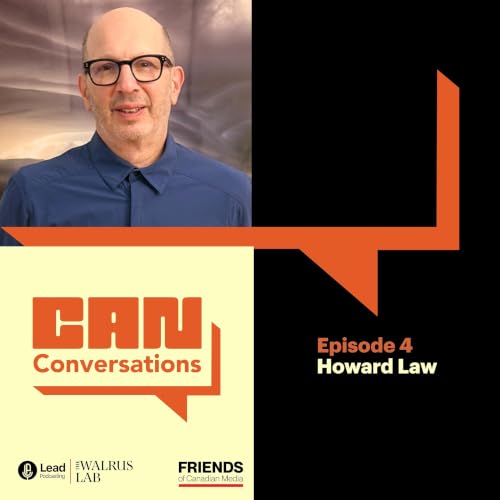
CanConversations cover art

CanConversations

CanConversations

By: The Walrus Lab
Listen for free

This Season's Biggest Deal | $0.99/mo for 3 months + $20 Audible bonus

Auto-renews at $8.99/mo. after 3 months - terms apply.
Summary

CanConversations explores the big questions shaping Canada's media landscape, from Canadian storytelling and local journalism to public broadcasting, online platforms, and the policies that determine what Canadians see, hear, and trust.


From Friends of Canadian Media, in partnership with The Walrus Lab.

Hosted on Acast. See acast.com/privacy for more information.

The Walrus Lab
Political Science Politics & Government Social Sciences
Episodes
  • What makes a story Canadian?
    Nov 12 2026
    What makes a piece of content “Canadian”? In an era where broadcasting is being reshaped by global streamers, that question has never mattered more. In this episode, Raj Shoan sits down with Tandy Yull, who has worked decades in Canadian broadcasting and cultural policy, to discuss what “Canadian” means and who gets to make that decision.Raj and Tandy walk us through the machinery of CanCon, highlight why Canadian ownership and creative control are so important, why production in Canada is not the same thing as Canadian content, and why Canadian news programming is foundational to nation building in Canada.About Tandy Yull:Tandy Yull is the Vice President, Policy and Regulatory Affairs at the Canadian Broadcasters Association. She has spent decades working in Canadian broadcasting and cultural policy, including 23 years at the CRTC.3 REASONS TO LISTEN TO THIS EPISODEUnderstand how Canadian content is defined, including the point system for Canadian TV, the MAPL system for music, and why some Canadian artists’ songs still don’t count as “CanCon”.Hear a clear explanation of the issues at the heart of Canadian broadcasting and how the mass migration of audiences to streaming has affected Canadian entertainment and news programming.Get a sense of what success for Canadian media can look like in an era of algorithms and streamers.CLARIFICATIONS[12:48] Tandy mentions that recent numbers shared by CRTC show “50% of Canadians aren't in this closed system anymore”. Per the CRTC statistics, 33% of households subscribe only to streaming services (i.e., have left the closed distribution system).Source: Annual highlights of the broadcasting sectorRESOURCESCRTC (Canadian Radio-television and Telecommunications Commission)Broadcasting ActOnline Streaming Act (Bill C-11)MAPL system — how Canadian content is certified in musicAnne with an E poster controversyFriends of Canadian MediaHIGHLIGHTS[17:27] The regulatory quid pro quo: how Canadian programming gets paid for“The regulatory quid pro quo is I'll give you a license, but in return, you're going to give me 30% of your revenue on Canadian programming for television for over-the-air television stations. 50% of their time still has to be devoted to Canadian programming. That's sort of the cost for doing business in Canada. And it's been in place since … at least 1968 when the CRTC was created.”[25:20] Canadian ownership and creative control“I don't know what's Canadian, but I'll know it when I see it. That's sort of the ethos of Canada... I think the stories are going to resonate more with Canadians if they're made by Canadians. And therefore, we go back to the idea of creative control. I think creative control is an important principle. And it comes in part from ownership. Plus, by the way, the first provision of the Canadian Broadcasting Act says predominantly owned and controlled by Canadians. It's the law.”[22:27] The importance of news programming and streamers’ obligations“It's critical to democracy and sovereignty... The streamers have appealed the CRTC's decision and there's a group of streamers that only appealed the obligation to contribute to news. Their logic is "We don't do news, why would we contribute to the news?" And that's what we would say is, "Well, you don't do news, therefore you need to spend on news," and help make up the gap that they created in the system.”Thanks for listening to CanConversations, a podcast from Friends of Canadian Media in collaboration with The Walrus Lab.Everything we do at Friends of Canada Media is supported by people who believe in strong journalism, public broadcasting, and stories that reflect who we are as Canadians.And we do it without government funding, political ties, or corporate support. If that matters to you too, you can support us at friends.ca.If you enjoyed this episode, leave a review and share with a friend!Thank you for listening. Hosted on Acast. See acast.com/privacy for more information.
    Show More Show Less
    29 mins
  • What does the future of the CBC look like?
    Nov 2 2026
    The first of two special episodes marking the 90th anniversary of the CBC.On November 2nd, 1936, the CBC aired for the first time. 90 years later, CanConversations looks back at the history of Canada’s national public broadcaster and how it has grown with shifting media technologies.In this 90th anniversary episode, host Raj Shoan sits down with media policy analyst and author Howard Law to discuss the evolution of the CBC, where it stands today, and what it might look like tomorrow. They delve into the CBC’s fundamental purpose, its representations and criticisms, the challenges it faces in a crumbling media landscape dominated by global tech companies, and the importance of investing in Canadian public broadcasting.About Howard Law:Howard Law is the founder of MediaPolicy.ca. He is a media analyst, author, and former Director of Media at Unifor, representing thousands of journalists and media workers across Canada.3 reasons to listen:Learn about the history of the CBC and how it has evolved in its 90 years.Hear about the CBC’s mandate to represent Canada’s diversity and contribute to a unified national identity amid increasingly polarized times.Explore the future of public broadcasting in an era of algorithms, oversaturation of platforms, underfunding, and fragmentation.ResourcesCBCMediaPolicy.caBroadcasting ActFreedom Convoy 2022Friends of Canadian MediaHighlights[03:22] Reconciling diversity and shared national identity"Canada is a dance between that unity and that diversity, and always has been. I think when you combine the idea of a national passion and the diversity of the country in terms of what you're delivering, the reason you're doing that is because Canadians have a foot in each community at the same time. They have a foot in Canada and they have a foot in whatever community they are in Canada. I think that what the CBC tries to do is try to share experiences of Canadians from different regions, communities, etc., with the other Canadians. And that's just part of our national life."[13:37] Creating trust in a public broadcaster in a fragmented Canada"You need to be able to cover all corners of the country so everybody feels like they're part of the coverage of CBC. And I think the other thing is you need to be bold, you need to be intellectually curious, that engages people. You need to be unafraid of political criticism, which is never gonna end."[22:50] The importance of Canadian public broadcasting in the face of global tech companies"U.S. tech companies and U.S. streamers have made it pretty clear that they will be dragged, screaming and kicking, into the era of making Canadian content prominent on their internet services. And until that attitude changes and changes for good, relying on them to deliver Canadian content to Canadians is fraught. It's very, very difficult."Thanks for listening to CanConversations, a podcast from Friends of Canadian Media in collaboration with The Walrus Lab.Everything we do at Friends of Canada Media is supported by people who believe in strong journalism, public broadcasting, and stories that reflect who we are as Canadians.And we do it without government funding, political ties, or corporate support. If that matters to you too, you can support us at friends.ca.If you enjoyed this episode, leave a review and share with a friend!Thank you for listening. Hosted on Acast. See acast.com/privacy for more information.
    Show More Show Less
    27 mins
  • Does the digital age have to be dangerous?
    Oct 15 2026
    How can we protect Canadians from online harms? Online harassment doesn’t just affect the individual—it can have systemic effects on our institutional trust, our right to free expression, and even our democracy itself.In the latest episode of CanConversations, host Raj Shoan talks to Rachel Gilmore, an independent journalist covering extremism and disinformation, about how Canadians can build a better Internet and protect our communities—and our sovereignty—from the greed and apathy of tech companies. Rachel has been at the forefront of reporting on online harms in Canada, and has firsthand experience of the real-world consequences of digital harassment.In the episode, Rachel and Raj discuss how harassment risks silencing journalists, the problems with age-related social media bans, and what we can do to hold platforms accountable for their algorithmic actions.About Rachel Gilmore:Rachel Gilmore is an independent journalist who operates her own media company, Bubble Pop Media. She previously reported for CTV and Global News, and has written for publications including The Tyee and the National Observer. Rachel’s work focuses on human rights, disinformation and extremist movements.Clarification:[28:48] - Rachel says "The Arab Spring happened because of the internet."There is quite a lot of debate around this idea, however many scholars do support this sentiment.More on this topic: University of Washington | Al Jazeera | India QuarterlyResources:Bubble Pop with Rachel GilmoreRachel Gilmore on TikTokBill C-34: The Safe Social Media ActImpact of online violence on women journalistsFriends of Canadian MediaThe Walrus LabThree reasons you should listen to this episode:Learn why protecting Canada’s digital sovereignty is essential to our democratic freedomHear about how age-related social media bans avoid holding tech companies accountable for the damage they causeDiscover how adding ‘friction’ to platforms can improve social media for everyoneEpisode highlights:04:52 How harassment can risk silencing journalistsRachel discusses how online harassment disproportionately impacts marginalized journalists, particularly women and racialized journalists. She shares how efforts to protect journalists from harassment may risk shutting down their work instead, and discusses her fear that online harms might lead to self-censorship.12:46 Learn how social media platforms reward anger and disinformationRachel explains how social media platforms reward anger and disinformation. She discusses how anger and conflict drive social media engagement, and thus potentially increase profits for tech companies.14:52 Pros and cons of Canada’s Bill C-34: The Safe Social Media ActRaj and Rachel outline the benefits and potential issues of Canada’s “latest attempt to create a comprehensive framework for online safety.” In particular, they discuss why age verification raises serious privacy concerns and may allow social media companies to sidestep taking responsibility for their algorithms.20:50 A safer Internet doesn’t need to harm our freedom to expressionRachel and Raj explain how we can protect individuals from harassment and discrimination, while protecting Canadians’ right to free expression. Rachel describes the distinction between “freedoms from” and “freedoms to,” noting that government regulation to protect our citizens doesn’t have to come at the expense of our freedoms.Thanks for listening to CanConversations, a podcast from Friends of Canadian Media in collaboration with The Walrus Lab.Everything we do at Friends of Canada Media is supported by people who believe in strong journalism, public broadcasting, and stories that reflect who we are as Canadians.And we do it without government funding, political ties, or corporate support. If that matters to you too, you can support us at friends.ca.If you enjoyed this episode, leave a review and share with a friend!Thank you for listening. Hosted on Acast. See acast.com/privacy for more information.
    Show More Show Less
    30 mins
No reviews yet
In the spirit of reconciliation, Audible acknowledges the Traditional Custodians of country throughout Australia and their connections to land, sea and community. We pay our respect to their elders past and present and extend that respect to all Aboriginal and Torres Strait Islander peoples today.