• The Billing Line: How Cost Allocation Shapes Tech Decisions
    Feb 8 2026
    In most organizations the engineering ticket, the cloud bill, and the product roadmap converge at a single, underappreciated place: the billing line. Who sees and pays which costs shapes technical trade-offs, influences product choices, and quietly decides which risks are acceptable. In this episode Mirko Peters walks both sides of that aisle: the business view (budget ownership, predictability, and accountability) and the IT view (cost drivers, measurement, and operational consequences). Using a concise generalized vignette—an analytics pipeline that ballooned because costs were invisible—Mirko shows how cost signals distort decisions and create perverse incentives. Listeners get a practical Cost-Responsibility Matrix to map who feels which charges, simple heuristics to pick showback versus chargeback, and three lightweight actions teams can try this week to turn cost visibility into better decisions, not blame. Clear, non-technical, and immediately useful, the episode helps leaders treat money as signal, not sword. If this episode helps, leave a review and follow Mirko on LinkedIn.

    To continue the conversation, follow Mirko Peters on LinkedIn, where more insights and real-world examples are shared from both business and IT perspectives.
    Show More Show Less
    7 mins
  • Organizational APIs: Making Invisible Interfaces Explicit
    Feb 7 2026
    Teams don’t just hand off code or documents; they hand off expectations: who answers questions after launch, what ‘done’ means, how data is interpreted, and which escalation path to use. These invisible interfaces — meeting rituals, implicit data formats, timing assumptions, and informal ownership norms — behave like undocumented APIs that leak cost and slow decisions. In this episode Mirko Peters examines these organizational APIs from the business view (clarity, velocity, outcome ownership) and the IT view (coupling, monitoring, implicit contracts). He uses a concise generalized vignette where timing assumptions between product, analytics, and ops turned a weekly report into a months-long firefight. Listeners get a practical pattern to identify, name, and version their organizational APIs: a lightweight contract template (responsibility, expectations, data contract, SLAs, rollback triggers) and three small rituals teams can adopt this week to make invisible interfaces explicit. If helpful, leave a review and follow Mirko on LinkedIn for the contract template.

    To continue the conversation, follow Mirko Peters on LinkedIn, where more insights and real-world examples are shared from both business and IT perspectives.
    Show More Show Less
    8 mins
  • After the Launch: Who Really Owns the Problem?
    Feb 5 2026
    Too often 'we launched it' becomes shorthand for 'someone else will fix it later.' That gap between delivery and durable ownership creates operational drag: incidents sit unresolved, product changes stall, data quality erodes, and hidden costs compound. In this episode Mirko Peters examines the mismatch from both sides—why business treats features as product milestones while IT hears 'support it forever'—and shows the common failure modes of handoffs, escalation chains, and assumed responsibilities. Using a generalized consulting vignette, he surfaces where organizations lose accountability and how that amplifies risk and cost. Listeners walk away with a compact Ownership Matrix (roles, decision rights, handback triggers), practical runbook governance rules, and three quick steps to make the next launch actually stay launched. If this episode helps, leave a review and follow Mirko on LinkedIn for the downloadable matrix and templates.

    To continue the conversation, follow Mirko Peters on LinkedIn, where more insights and real-world examples are shared from both business and IT perspectives.
    Show More Show Less
    9 mins
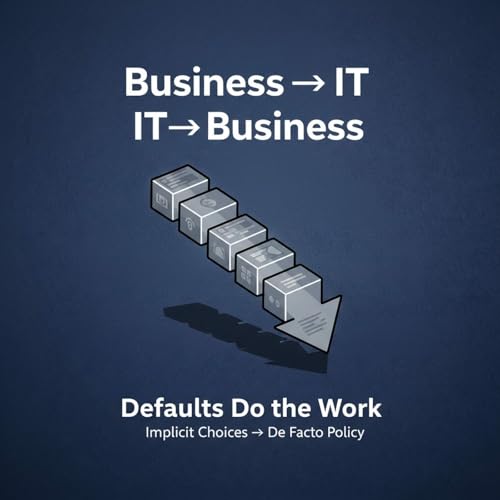
  • Defaults Do the Work: How Implicit Choices Become Policy
    Feb 4 2026
    Organizations make thousands of quiet decisions every week: a config left as-is, a contract clause copied from a template, a deployment cadence nobody questioned. These implicit defaults end up governing behavior, locking in costs, and creating surprise constraints when business priorities change. In this episode Mirko Peters frames the problem from both sides: why business teams treat defaults as neutral conveniences and why IT inherits long-term operational burden. Using generalized consulting examples (no client names), he explains common patterns where defaults produce hidden coupling, governance gaps, and runaway support costs. Listeners get a practical, repeatable checklist to audit defaults, questions to surface when a choice becomes policy, and simple governance habits to prevent accidental lock-in. The episode is direct, actionable, and built for leaders and practitioners who want to reduce surprise costs without bureaucratic overhead.

    To continue the conversation, follow Mirko Peters on LinkedIn, where more insights and real-world examples are shared from both business and IT perspectives.
    Show More Show Less
    10 mins
  • When KPIs Become Requirements: The Hidden Engineering Tax of Metrics
    Feb 3 2026
    Business metrics are meant to guide decisions, not dictate architecture — but they often do both. In this episode Mirko Peters walks listeners through the common, avoidable path where a headline KPI morphs into a brittle system requirement: dashboards spawn batch jobs, SLAs create unnecessary real-time coupling, and product vanity numbers drive feature work that multiplies operational load. Mirko describes the problem from the business perspective (clarity, accountability, urgency), then the IT perspective (data plumbing, latency, monitoring, cost), and pinpoints the translation failures that cause the tax. Using a generalized consulting example, he shows how simple metric design choices ripple into months of work and recurring operational burden. The episode concludes with a short, practical metric-to-requirement checklist and three rules teams can apply this week to keep KPIs useful — not expensive.

    To continue the conversation, follow Mirko Peters on LinkedIn, where more insights and real-world examples are shared from both business and IT perspectives.
    Show More Show Less
    9 mins
  • When 'Just One More' Rewrites Strategy
    Feb 2 2026
    (00:00:00) Bridging the IT-Business Gap
    (00:00:43) The Hidden Costs of Small Changes
    (00:03:09) The Engineering Perspective on Scope Creep
    (00:04:47) The Decision Litmus Test
    (00:06:33) Practical Habits for Better Decision-Making
    (00:07:05) Implementing Decision Hygiene
    (00:08:33) Closing Thoughts and Call to Action
    (00:09:24) LinkedIn Follow and Review Request

    A single late-stage 'small' change — a UI tweak pushed in at sign-off — sometimes becomes the hill that breaks the roadmap: in one generalized example a late tweak consumed ~160 developer-hours, added six weeks to launch, and ~ $24k in execution cost. Mirko Peters opens with that micro-story and uses it as a springboard for a fresh framing: decision hygiene. He introduces a three-question "decision litmus" that quickly sorts fixes, scoped features, and strategic rewrites; presents a short guest clip from a product/IT lead who lived the consequence; and translates incentives into measurable signals leaders can track. The episode balances the business and engineering perspectives, offers lightweight costing heuristics, and delivers a one-page Decision Litmus checklist listeners can download and use immediately. Practical, number-backed steps, templates, and governance habits make this more than another scope-creep lecture — it’s a field guide for stopping 'just one more' before it becomes debt.

    To continue the conversation, follow Mirko Peters on LinkedIn, where more insights and real-world examples are shared from both business and IT perspectives.
    Show More Show Less
    10 mins