Blue Collar White Coat Podcast cover art

Blue Collar White Coat Podcast

Blue Collar White Coat Podcast

By: Amy Weldon
Listen for free

About this listen

Blue Collar White Coat is a podcast bringing to life the human side of STEM, one unglamorous but essential job at a time. Whether you're science-curious, career-curious, or just love a good story, this is the show for you. So get your safety glasses on and keep your mind open, it's time to meet the people powering science.2025 Career Success Economics Science
Episodes
  • Before Silicon Valley: How Guild Halls and Skilled Trades Drove Innovation
    Dec 21 2025
    Special crossover episode with Seemingly Unrelated

    What do medieval guild halls and the first mechanized loom have to do with modern science?

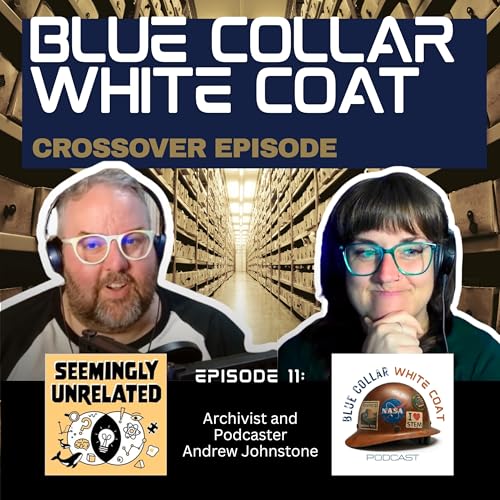
    In this special crossover episode, Blue Collar | White Coat teams up with Seemingly Unrelated host Andrew Johnstone to explore how knowledge has always been built, shared, and preserved through skilled, often invisible labor. From guild halls and tradespeople to archives and technicians, this conversation traces the human infrastructure that makes discovery — and history — possible.

    Andrew brings his archivist's perspective (and a talent for sneaking history lessons into great stories) to a wide-ranging conversation about how ideas move through time, who decides what gets preserved, and why so much of the work that underpins science and culture goes unseen.

    If you've ever wondered how history survives, how trust in institutions is built, or why blue collar work has always been essential to progress — this one's for you.

    This episode is a crossover with Seemingly Unrelated, hosted by Andrew Johnstone.

    Seemingly Unrelated explores surprising connections between history, culture, and the present day — often starting from one small question and spiraling into something much bigger. Andrew is also an archivist, bringing deep firsthand experience with the behind-the-scenes work of preserving history.

    Andrew also provided historical research support and fact-checking for this episode.

    Check out Seemingly Unrelated:

    • Podcast: https://shows.acast.com/seemingly-unrelated

    • YouTube: https://www.youtube.com/channel/UC9Qm06cYYzYJ4xzHTfqrryQ

    • Patreon: https://www.patreon.com/cw/SeeminglyUnrelated

    • Social media: @seeminglyunrelatedpod

    Blue Collar | White Coat tells the stories of the everyday people whose work makes science, technology, and discovery possible — especially the skilled and often invisible labor behind the scenes.

    Watch full video episodes on YouTube:
    https://www.youtube.com/@BlueCollarWhiteCoat

    Follow us on social at @bluecollarwhitecoatpod or email guest ideas and feedback to
    bluecollarwhitecoatpod@gmail.com

    Season 2 drops late March.

    Blue Collar | White Coat is hosted, produced, and edited by Amy Weldon.
    Social media content support by Kiera Gower.
    Historical research support and fact-checking for this episode by Andrew Johnstone, host of Seemingly Unrelated.

    Show More Show Less
    1 hr and 16 mins
  • Firefighter to R&D Machinist: Kyle Luker's Blue Collar STEM Career
    Dec 7 2025

    at does science look like when you strip away the lab coats and take a peek behind the equipment? In this episode of Blue Collar | White Coat, we meet Kyle Luker — a machinist, welder, former firefighter, and self-taught problem-solver whose hands quietly keep research moving forward. From wildland firefighting to managing an R&D machine shop at a major university, Kyle's winding path into the world of academic science is a reminder that discovery depends on far more than degrees and data.

    Kyle shares how he learned to weld in the field, why TIG welding feels like meditation, and how he eventually became the person scientists call when their experiments require something that has never been made before. Along the way, he breaks down the often unseen relationship between engineers and tradespeople, the hidden labor behind every experiment, and why practical experience is just as essential to innovation as theory.

    If you've ever wondered who actually builds the equipment that makes scientific breakthroughs possible — or if you're curious about unconventional paths into STEM — this episode will change the way you see scientific work.

    Show More Show Less
    1 hr and 16 mins
  • From Lab to Legislation: Training Scientists to Influence Policy
    Nov 16 2025
    In Episode 9 of Blue Collar | White Coat, Amy sits down with Robin Garcia, a former federal worker and now a professional science communications trainer with Compass Science Communication. Robin's career has taken her from marine biology labs to NOAA to Capitol Hill workshops — and in this episode, she breaks down exactly why communicating science effectively to Congress, policymakers, and everyday non-experts is more crucial than ever. We cover everything from shrimp-on-a-treadmill headlines to the realities of federal budgets, policy briefings, fellowships, science education, burnout in research, and why scientists so often struggle to translate their work outside of academia. Robin also shares a behind-the-scenes look at how she prepares scientists to speak with members of Congress and what policymakers actually need from experts when making funding decisions. If you've ever wondered how science moves from the lab bench to the halls of Congress — or why it sometimes doesn't — this episode is for you. What We Talk About in This Episode: How Robin went from marine biology to science communication Life as an aquarium intern, REU fellow, and grad student Crabs on treadmills, blue crabs, and climate impacts on marine species Why many scientists struggle with teaching and communication Working at NOAA, federal contracting, and "the power of the purse" How congressional staffers process scientific information Why scientists need simpler messages — not "dumbed down," just translated How Compass trains researchers to work with policymakers Why people assume science communication equals "media training" The rise of science communication careers in the U.S. Structural barriers to entering science (money, access, equity) Why the loudest anti-science group is not actually the largest What gives Robin hope for the future of science and policy Chapters / Timestamps 00:00 — Intro Amy sets the scene: what Congress funds, why science communication matters, and who actually understands scientific concepts on Capitol Hill. 03:42 — Reconnecting After 10+ Years Robin and Amy share the backstory of how they first met at the National Aquarium. 04:30 — "Shamu Showed Me the Light" Robin explains her early love for the ocean and the path to marine science. 06:30 — College, Chemistry, and Choosing Marine Biology Studying at the University of Miami, double-majoring, and surviving organic chemistry. 07:54 — REUs, Crabs on Treadmills, and Real Field Work A deep dive into research internships, metabolic studies, and why crustaceans need treadmills. 10:47 — Climate, Oxygen, and Estuary Life How environmental change impacts blue crabs, clams, oysters, and coastal ecosystems. 12:12 — The Hardest Job in Science: Teaching Why teaching assistantships are challenging and the difference between "knowing" and "teaching." 14:56 — From Educator to Environmental Research Robin's time teaching beach ecology and working in animal husbandry at NIH. 19:13 — Burnout in Research & Rethinking the Path Why the "aha moments" in science are so rare — and why she pivoted away from research. 20:58 — Discovering Science Communication Volunteering, building a portfolio, and learning how to translate research for non-experts. 23:47 — Joining Sea Grant & NOAA Federal contracting, budget stress, agency priorities, and working with coral reef programs. 26:28 — Palau, Coral Reefs & International Science Policy Behind the scenes of NOAA travel, jurisdictional meetings, and multi-agency collaboration. 27:51 — Who Really Works for the Government (And Why They Stay) IT staff, biologists, and federal workers choosing mission over money. 31:10 — What Compass Science Communication Does Training scientists, preparing fellows, and the key differences between experts and non-experts. 33:26 — Communicating With Policymakers How congressional offices operate, what staffers need, and why one-pagers matter. 36:12 — Bringing the Hill to the Classroom Compass' unique model of bringing in actual policy experts for workshops. 39:23 — How Policy Meetings Really Work Who to email, why contact forms go nowhere, and how to find the right staffer. 41:08 — Flip the Script: Start With the Result Why scientists must reverse the structure of academic papers when addressing the public. 43:52 — Simple, Not Simplistic Using a different "language" instead of dumbing down science. 47:37 — The Reality of Literacy Levels in America Understanding why plain language is essential — without judgment. 49:18 — Fellowships, Science Policy Careers & Early Training How fellowships bridge academia and policy, what they offer, and why they're growing. 55:22 — How Science Communication Has Changed From obscure niche to essential skill — and why communication must be baked into research. 59:08 — The Hidden Financial Barriers to Science Why research often requires unpaid labor and how that shapes who gets to become a scientist. 1:03:13...
    Show More Show Less
    1 hr and 11 mins
No reviews yet
In the spirit of reconciliation, Audible acknowledges the Traditional Custodians of country throughout Australia and their connections to land, sea and community. We pay our respect to their elders past and present and extend that respect to all Aboriginal and Torres Strait Islander peoples today.