• Bioprocess and Biomanufacturing Intelligence Bulletin: February 2026 Edition
    Feb 27 2026

    This bioprocess and biomanufacturing report from February 2026 highlights a shift toward industrial maturity through significant technical and economic breakthroughs. Key scientific advancements include a highly accurate scale-up framework and engineered yeast strains designed to overcome production barriers for GLP-1 drugs. The text also tracks the integration of AI-driven sensors and real-time monitoring tools that improve manufacturing efficiency and regulatory compliance. Furthermore, the discussion details a resurgence of capital investment and the opening of new shared-access infrastructure in the United States and India. These developments aim to bridge the "valley of death" by providing startups with the facilities needed for large-scale fermentation. Overall, the document illustrates an industry transitioning from experimental research to reliable, high-volume production.


    #BTEC, #BioMADE, #Glatt, #Aragen, #Verley, #USFDA

    #Bioprocess, #Biomanufacturing, #FermentationTechnology, #ScaleUp, #IndustrialBiotech, #PrecisionFermentation, #MetabolicEngineering #CDMO,#Biologics, #MonoclonalAntibodies, #GLP1, #BioBasedChemicals, #Putrescine, #Chromatography, #ProcessAnalyticalTechnology, #RamanSpectroscopy

    #AISoftSensors, #DigitalBioprocessing, #ContinuousManufacturing, #SharedInfrastructure, #RegulatoryScience, #FDA, #AIinBiotech

    Show More Show Less
    22 mins
  • Control Strategy, Lifecycle, and AI-Enabled QbD (QbD Part-4)
    Feb 26 2026

    This part outlines a sophisticated framework for bioprocessing lifecycle management by integrating Quality by Design (QbD) principles with advanced digital tools. It details how a robust control strategy links process parameters to product quality through real-time monitoring and hybrid feedback mechanisms. The sources describe a multi-stage validation lifecycle that transitions from initial design to continuous commercial verification and knowledge management. Furthermore, the discussionexplores the complexities of continuous bioprocessing andhow artificial intelligence, machine learning, and digital twins enhance process predictability. Ultimately, theseelements combine to transform biomanufacturing into a dynamic, data-driven system capable of constant improvement and regulatory compliance.#Control Strategy, Lifecycle, and AI-Enabled QbD (QbD Part-4)#Bioprocess #ScaleUp and #TechTransfer,#Industrial #Microbiology,#MetabolicEngineering and #SystemsBiology,#Bioprocessing,#MicrobialFermentation,#Bio-manufacturing,#Industrial #Biotechnology,#Fermentation Engineering,#ProcessDevelopment,#Microbiology,#Biochemistry,#Biochemical Engineering, #Applied #MicrobialPhysiology, #Microbial #ProcessEngineering, #Upstream #BioprocessDevelopment, #Downstream Processing and #Purification,#CellCulture and #MicrobialSystems Engineering, #Bioreaction #Enzymes, #Biocatalyst #scientific #Scientist #Research

    Show More Show Less
    17 mins
  • Execution Discipline, PAT, and Robustness Across Scale (QbD Part-3)
    Feb 25 2026

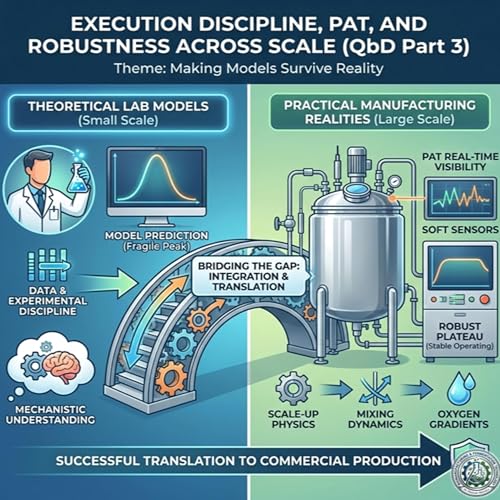
    This part outlines how to bridge the gap between theoretical bioprocess models and the practical realities of large-scale manufacturing. It emphasizes that high-quality data and experimental discipline are the foundation of reliable models, particularly when transitioning from small shake flasks to complex bioreactors. The author explains how Process Analytical Technology (PAT) and soft sensors provide the real-time visibility necessary to maintain process control and ensure product quality. Furthermore, the expert advocates for robustness testing to identify stable operating plateaus rather than fragile performance peaks. By embedding scale-up physics and mixing dynamics into early development, engineer scan create processes that remain resilient against physical gradients and oxygen limitations. Ultimately, the text argues that integrating mechanistic understanding with rigorous execution ensures that optimized laboratory conditions translate successfully to commercial production.

    #Execution Discipline, PAT, and Robustness Across Scale (QbD Part-3)

    #Bioprocess #ScaleUp and #TechTransfer,#Industrial #Microbiology,#MetabolicEngineering and #SystemsBiology,#Bioprocessing,#MicrobialFermentation,#Bio-manufacturing,#Industrial #Biotechnology,#Fermentation Engineering,#ProcessDevelopment,#Microbiology,#Biochemistry,#Biochemical Engineering, #Applied #MicrobialPhysiology, #Microbial #ProcessEngineering, #Upstream #BioprocessDevelopment, #Downstream Processing and #Purification,#CellCulture and #MicrobialSystems Engineering, #Bioreaction #Enzymes, #Biocatalyst #scientific #Scientist #Research

    Show More Show Less
    22 mins
  • Defining and Mapping the Process CPPs, DoE, and Design Space (QbD Part-2)
    Feb 24 2026

    This part outlines a systematic framework for applying Quality by Design (QbD) principles to bioprocessing, specifically within fermentation. It describes how to transform biological hypotheses into quantitative process maps by identifying Critical Process Parameters (CPPs) through both mechanistic understanding and statistical modeling. The discussion emphasizes the use of Design of Experiments (DoE) to efficiently explore interactions between variableslike temperature, pH, and oxygen transfer. These methodologies help define a multivariate design space where product quality is consistently maintained.Ultimately, the source advocates for prioritizing robust operating windows over fragile optima to ensure process reliability during scale-up. This structured approach ensures that biomanufacturing stays within regulatory and scientificboundaries throughout a product's lifecycle.#Defining and Mapping the Process CPPs, DoE, and Design Space (QbD Part-2)

    #Bioprocess #ScaleUp and #TechTransfer,#Industrial #Microbiology,#MetabolicEngineering and #SystemsBiology,#Bioprocessing,#MicrobialFermentation,#Bio-manufacturing,#Industrial #Biotechnology,#Fermentation Engineering,#ProcessDevelopment,#Microbiology,#Biochemistry,#Biochemical Engineering, #Applied #MicrobialPhysiology, #Microbial #ProcessEngineering, #Upstream #BioprocessDevelopment, #Downstream Processing and #Purification,#CellCulture and #MicrobialSystems Engineering, #Bioreaction #Enzymes, #Biocatalyst #scientific #Scientist #Research

    Show More Show Less
    19 mins
  • Foundations of QbD in Living Systems (QbD Part-1)
    Feb 23 2026

    This part explores the application of Quality by Design (QbD) principles to microbial fermentation, moving away from traditional reactive testing toward a proactive, science-based development framework. It highlights how the inherent variability of living systems—driven by genetic drift, nonlinear metabolic shifts, and environmental interactions—requires a more sophisticated approach than simple one-factor-at-a-time experimentation. By utilizing ICH regulatory guidelines, manufacturers can link a product’s clinical intent to critical quality attributes and specific process parameters. The discussion emphasize using structuredrisk management tools, such as FMEA, to identify how upstream biological fluctuations propagate through themanufacturing lifecycle. Ultimately, the material frames QbD as a disciplined strategy for navigating biological complexity to ensure consistent product safety and efficacy.

    #Foundations of QbD in Living Systems (QbD Part-1)#Bioprocess #ScaleUp and #TechTransfer,#Industrial #Microbiology,#MetabolicEngineering and #SystemsBiology,#Bioprocessing,#MicrobialFermentation,#Bio-manufacturing,#Industrial #Biotechnology,#Fermentation Engineering,#ProcessDevelopment,#Microbiology,#Biochemistry,#Biochemical Engineering, #Applied #MicrobialPhysiology, #Microbial #ProcessEngineering, #Upstream #BioprocessDevelopment, #Downstream Processing and #Purification,#CellCulture and #MicrobialSystems Engineering, #Bioreaction #Enzymes, #Biocatalyst #scientific #Scientist #Research

    Show More Show Less
    17 mins
  • BIOMANUFACTURING AND FERMENTATION TECHNOLOGY, The Bioprocess Pulse – (13–19 Feb 2026).
    Feb 20 2026

    This week discussion summarizes a bioprocessing industry report highlighting significant technical and economic shiftsoccurring in early 2026. Researchers have successfully engineered yeast to overcome production barriers for industrial chemicals, while artificial intelligence is now being used to optimize genetic coding and streamline complex regulatory compliance. The report forecasts substantial market growth in hardware and infrastructure, driven by international investments and new government manufacturing initiatives in China. However, thesource also offers a critical reality check regarding the economic limitations of precision fermentation for low-value goods. Industry founders and engineers are encouraged to prioritize scalable technology and rigorous cost-benefit analyses to ensure long-term viability. Ultimately, these updates illustrate a transition toward data-driven biology and intensified manufacturing processes within the global bioeconomy.


    #Bioprocess #ScaleUp and #TechTransfer,#Industrial #Microbiology,#MetabolicEngineering and #SystemsBiology,#Bioprocessing,#MicrobialFermentation,#Bio-manufacturing,#Industrial #Biotechnology,#Fermentation Engineering,#ProcessDevelopment,#Microbiology,#Biochemistry,#Biochemical Engineering, #Applied #MicrobialPhysiology, #Microbial #ProcessEngineering, #Upstream #BioprocessDevelopment, #Downstream Processing and #Purification,#CellCulture and #MicrobialSystems Engineering, #Bioreaction #Enzymes, #Biocatalyst #scientific #Scientist #Research

    Show More Show Less
    21 mins
  • Mechanistic Modeling and Mitigation of Fouling in Fermentation TFF
    Feb 19 2026

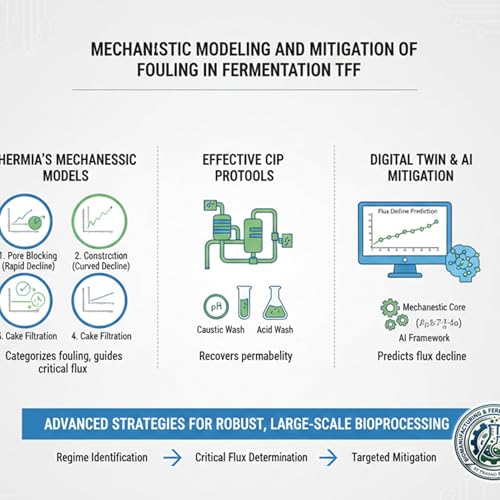
    Hermia’s models categorize TFF fouling into four mechanisms, guiding regime identification and critical flux determination. Effective CIP protocols use caustic/acid washes to recover permeability. Digital twins combine mechanistic cores with AI to predict flux decline.

    How to use the result to minimize fouling in production TFF

    • Set your operating flux below the measured critical flux (often with a safety factor) to avoid sustained resistance growth.

    • If you observe a TMP “jump” pattern above certain fluxes, treat that as entering a new fouling regime and back off; TMP-jump behavior above critical/threshold flux is discussed as a characteristic signature in constant‑flux fouling studies.

    • Re-measure critical flux when any major variable changes (broth solids/viscosity, temperature, membrane lot, crossflow/channel geometry), because critical flux is not a membrane constant; it is an operating‑condition-dependent boundary.


    #Bioprocess #ScaleUp and #TechTransfer,#Industrial #Microbiology,#MetabolicEngineering and #SystemsBiology,#Bioprocessing,#MicrobialFermentation,#Bio-manufacturing,#Industrial #Biotechnology,#Fermentation Engineering,#ProcessDevelopment,#Microbiology,#Biochemistry,#Biochemical Engineering, #Applied #MicrobialPhysiology, #Microbial #ProcessEngineering, #Upstream #BioprocessDevelopment, #Downstream Processing and #Purification,#CellCulture and #MicrobialSystems Engineering, #Bioreaction #Enzymes, #Biocatalyst #scientific #Scientist #Research


    Show More Show Less
    15 mins
  • Programming the Cell Factory: Aligning Cellular Decision-Making and Control
    Feb 18 2026

    This episode outlines a shift in bioprocessing strategy from maintaining static setpoints to designing dynamic environmental trajectories that align with internal cellular decision-making. Rather than treating microbes as passive catalysts, the author argues that scientists should use benchtop bioreactors to program specific patterns of stress, growth rates, and nutrient feeds. By treating variables like dissolved oxygen dips and temperature shifts as intentional design tools, researchers can better predict how populations will behave at an industrial scale. This discussion focuses on managing phenotypic subpopulations and metabolic burdens to ensure cells prioritize product synthesis over repair. Ultimately, the source provides a framework for using timed perturbations and phased growth strategies to achieve higher yields and more reproducible fermentation outcomes.


    #Bioprocess #ScaleUp and #TechTransfer,#Industrial #Microbiology,#MetabolicEngineering and #SystemsBiology,#Bioprocessing,#MicrobialFermentation,#Bio-manufacturing,#Industrial #Biotechnology,#Fermentation Engineering,#ProcessDevelopment,#Microbiology,#Biochemistry,#Biochemical Engineering, #Applied #MicrobialPhysiology, #Microbial #ProcessEngineering, #Upstream #BioprocessDevelopment, #Downstream Processing and #Purification,#CellCulture and #MicrobialSystems Engineering, #Bioreaction #Enzymes, #Biocatalyst #scientific #Scientist #Research

    Show More Show Less
    22 mins