

Mechanistic Modeling and Mitigation of Fouling in Fermentation TFF
Failed to add items
Add to basket failed.
Add to Wish List failed.
Remove from Wish List failed.
Follow podcast failed
Unfollow podcast failed

Mechanistic Modeling and Mitigation of Fouling in Fermentation TFF
-
Narrated by:
-
By:
About this listen
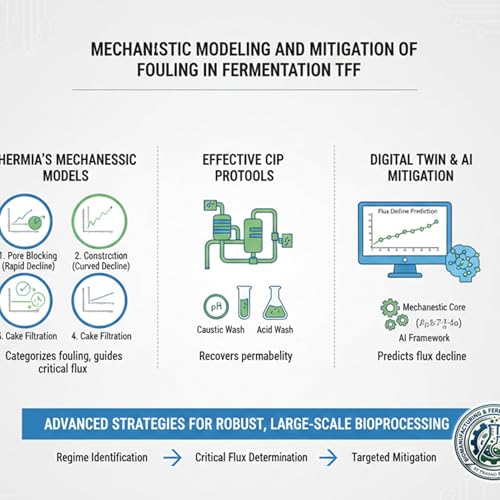
Hermia’s models categorize TFF fouling into four mechanisms, guiding regime identification and critical flux determination. Effective CIP protocols use caustic/acid washes to recover permeability. Digital twins combine mechanistic cores with AI to predict flux decline.
How to use the result to minimize fouling in production TFF
• Set your operating flux below the measured critical flux (often with a safety factor) to avoid sustained resistance growth.
• If you observe a TMP “jump” pattern above certain fluxes, treat that as entering a new fouling regime and back off; TMP-jump behavior above critical/threshold flux is discussed as a characteristic signature in constant‑flux fouling studies.
• Re-measure critical flux when any major variable changes (broth solids/viscosity, temperature, membrane lot, crossflow/channel geometry), because critical flux is not a membrane constant; it is an operating‑condition-dependent boundary.
#Bioprocess #ScaleUp and #TechTransfer,#Industrial #Microbiology,#MetabolicEngineering and #SystemsBiology,#Bioprocessing,#MicrobialFermentation,#Bio-manufacturing,#Industrial #Biotechnology,#Fermentation Engineering,#ProcessDevelopment,#Microbiology,#Biochemistry,#Biochemical Engineering, #Applied #MicrobialPhysiology, #Microbial #ProcessEngineering, #Upstream #BioprocessDevelopment, #Downstream Processing and #Purification,#CellCulture and #MicrobialSystems Engineering, #Bioreaction #Enzymes, #Biocatalyst #scientific #Scientist #Research