

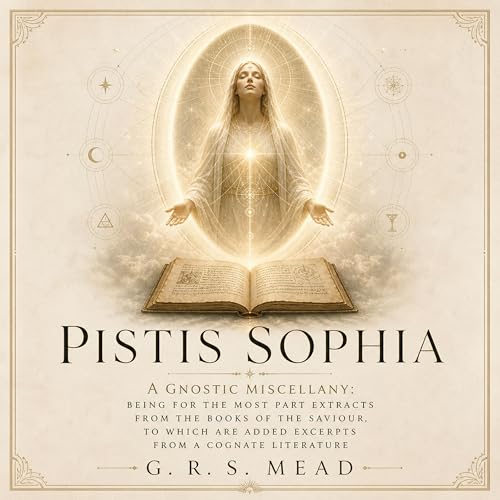
Pistis Sophia
A Gnostic Miscellany: Being for the Most Part Extracts from the Books of the Saviour, to Which Are Added Excerpts from a Cognate Literature
Failed to add items
Add to basket failed.
Add to Wish List failed.
Remove from Wish List failed.
Follow podcast failed
Unfollow podcast failed
$0.99/mo for 3 months + $20 Audible bonus voucher

Pistis Sophia
Buy Now for $27.38
-
Narrated by:
-
Matthew Schmitz
-
By:
-
G.R.S. Mead
Brought to you by Altrusian Grace Media (altrusiangrace.com) and human-narrated by Matthew Schmitz.
Pistis Sophia is a Gnostic text discovered in 1773, possibly written between the 3rd and 4th centuries AD. The existing manuscript, which some scholars place in the late 4th century, relates one Gnostic group's teachings of the transfigured Jesus to the assembled disciples, including his mother Mary, Mary Magdalene, and Martha.
This is G.R.S. Mead's translation of the Pistis Sophia, the most extensive Gnostic scripture available until the discovery of Nag Hammadi texts in 1945.
The Pistis Sophia is a startling blend of primitive Christianity and Hellenic Paganism, with other elements such as reincarnation, Astrology, Mystery religion and Hermetic magic. The Goddess makes an appearance in the guise of Sophia, a fallen angel.
The text is notable because the female disciples of Jesus are treated as active participants in the discourse, in a way that would be unimaginable in later Christianity. Tensions between the men and women disciples are not glossed over.
©2023 Matthew Schmitz (P)2023 Matthew Schmitz