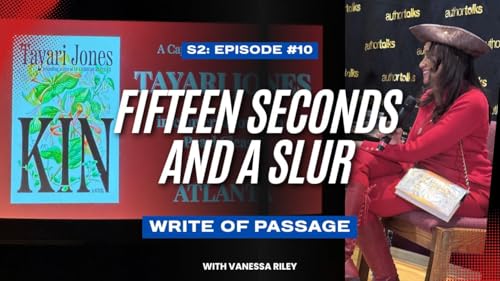
• Fifteen Seconds and a Slur
    Feb 24 2026
    For any writer or creator, the edit is your best tool or best weapon. Every paragraph, article, headline, every broadcast, even every post is a choice—what stays in, what gets cut, who gets protected, and who gets exposed are choices. If you have the power to edit, you have the power to do better. Let’s talk about the superpower that comes with great responsibility.Fifteen Seconds and a SlurThe edit is intentional.The greatest tool any author carries is not talent, not inspiration, not even discipline. It is the edit. The edit is where intention meets responsibility. It is where raw creation becomes art.No one—no one—sits down and instantly produces a masterpiece. Manuscripts are not born polished. They are wrestled into being. They are drafted in confusion, in bursts of brilliance, in gaps of missing facts and half-remembered details. I cannot tell you how many times I’ve left myself placeholders—XXX—so I can go back and hunt down what I actually meant: the correct monetary value of a tavern meal in pirate haven Port Royal, the historical cut of a waistcoat or falls of breaches, the name of a street or rue in Hispaniola. It’s never right on the first go.Returning to it on the next pass, the next edit—that’s where the magic happens. The edit is the intentional power to clarify what you meant. The power to fix what you missed. The power to elevate what almost worked into what truly does.I’ve worked with brilliant editors and those who gave me brilliant headaches. I even hire my own. A good editor helps me see what I cannot see. They bring perspective, distance, and rigor. But even then, I choose. I decide what advice to accept, what to reconsider, and what to reshape. Editing is collaboration—but it is also stewardship. Before any manuscript moves to the next level—before submission or publication—it carries the weight of my choices. Another set of eyes will add more to the manuscript. Every perspective reveals something new. That’s how diligent writers reach the best version of a book earthly possible.Writers are not the only ones who wield this magic tool.Video editing is editing. What you choose to upload to your social feeds—what you trim, what you blur, what you cut out—matters. I am more conscious of accidentally revealing mailing addresses in the background of one of my post office runs. Everyone should hide vulnerable information that should not be public, and watch for angles that misrepresent.The edit shapes our experience. On TikTok, Threads, Bluesky, Instagram—even if you wander back to Twitter—you should be curating what we see. That curation, that social edit is power.Journalists edit, too. They decide:* Whose names appear?* Which details matter?* Which context is included?* And which bits of info are left out?That is why it unsettles me when journalists act as if they are powerless—when they behave as though they must show everything, or they both-sides-things normalizing crazy, and seem to be okay with pieces that distort or wound.When civil rights leader and Rainbow Coalition founder Jesse Jackson died peacefully at 84 on February 17, 2026, after long battles with Parkinson’s disease, the headline was clear: a giant of the civil rights movement had passed, noting Jackson was:* A key figure in the struggle after Martin Luther King Jr.* A two-time presidential candidate.* A successful hostage negotiator (over 100 returned to the US).* A man whose life reshaped American political possibility.Yet in a brief radio mention—a mere fifteen-second clip to commemorate his death—the spot highlighted not only Jackson’s death but his son’s past troubles. Fifteen seconds. In a moment meant for legacy, painful and tangential details were inserted. That is an edit. That is a choice.Editing is not neutral.The same lesson unfolded at the BAFTA Film Awards. During a broadcast on BBC, Tourette syndrome campaigner John Davidson shouted a racial slur while actors Delroy Lindo and Michael B. Jordan stood on stage presenting an award. Both men—accomplished, respected, peers among peers—were subjected to one of the most dehumanizing words in the English language, the N-word. The live moment was shocking enough. But the editing was worse.The slur remained in the BBC broadcast and was replayed worldwide three hours later. The corporation later apologized, saying producers in the truck had not heard it. Meanwhile, other moments—such as calls of “Free Palestine”—were edited out of the rebroadcast. Actor Alan Cumming, hosting the ceremony, initially offered an explanation centered on Tourette syndrome and apologized “if you are offended.” Later reactions grew sharper. Producer Hannah Beachler criticized what she described as a throwaway apology.Editing is a choice.The decision to leave a racial epithet while removing a political statement is not accidental neutrality. It reveals priority. It reveals what is deemed urgent to correct and what is allowed...
    Show More Show Less
    14 mins
  • P&P – Persecution and Paranoid
    Feb 17 2026
    Have you ever felt like the walls were closing in — like doors were shutting and you couldn’t figure out why?Today’s essay is about that season. The P & P season.Persecution… and the paranoia that follows.If you’ve ever wondered whether you deserved the storm you were in, this one is for you.Persecution is an odd thing.When everything starts going wrong, I feel myself shrink. I feel extremely small. Then every slight becomes magnified. A look. A tone. An unanswered email. And suddenly we’re dangerously close to the other P word — paranoia.Your once-hopeful persona begins to fade. You start waiting for the next blow.As a type A person, an engineer at heart, I look for cause and effect. I try to pinpoint the moment I FAed and FOed. While I search, I double down on hope, prayer, and producing. I can be one productive fool when I feel the walls closing in.Still, I will lie awake trying to figure out what I did to deserve this.And for the whole of last year, I couldn’t find the culprit. Did I cross a line? I would like to know. Did I cut somebody? Did I punch somebody really, really hard? Did I steal your chair or your parking space?No.I didn’t take anybody’s anything. Nope. I have my own.In our twisted parasocial world, I will wonder if I liked the wrong posts, which now give you beef.You can see how the paranoia can ramp. Deep down, I think many of us want to feel like we deserve this punishment. If I earned it, at least there’s logic. At least there’s control.But the painful lesson I’ve had to grapple with is this:Other than being overly eager and overly enthusiastic, I didn’t do anything wrong. Persecution is not necessarily earned.Somewhere in the strange karma of the cosmic universe, you were chosen. And we all want to be chosen, right? But just not like this.Congratulations, you were chosen to have doors slammed in your face. Sometimes your hand was still on the seal — so you get that extra sting. You were chosen to lose. You were chosen to have your integrity questioned. You were chosen to decide whether you were going to grow up, go high… or sink low. If you’ve contemplated being the villain and getting revenge, put it in the comments.Now I’ve said before — and if you’ve read Fire Sword and Sea, you know — I believe in something called holy anger. There is a righteous anger. As a woman, I was urged to hold it in. To not sin in my anger. Yet, you can be angry and still be whole.Nonetheless, that is the struggle. How do we keep ourselves together as we wait for relief?I won’t pretend I’ve mastered survival. I haven’t. But I can say I didn’t curse anybody out — at least not where it could be recorded. I kept my cool for the most part. And when it came time to fight the battle, I didn’t yell. I let other people stand in the gap. I brought my hurt to those who could counsel me. I found fellowship. I found sisterhood. I saw rapiers lifted to defeat an armada.I found in real time who was on your team, my crew, and who wasn’t.My blessed crew found the time to encourage me, and gave me grace to rise above every point of contention. The P&P season, it’s very shocking. It’s hurtful.When you find you’re in the P&P-season, hold yourself together even when you find traitors in your midst.Persecution shows you who’s pulling for you. You find out who will show up, and the ones who have your back, even when it costs them something.It’s priceless the perspective I now have. And let me say this clearly: persecution is momentary. It may feel fresh, but there is an expiration date.Despite the pain, I am grateful for the experience.Why?Because it has made me more appreciative of those who advocate for me. It has made me more discerning about praise and opportunity. It has made me double down on what connects me most to you.This podcast--I do this podcast every week because it allows me to express what I’m going through — not just as an author, but as a human being. And in putting a voice to thoughts and sharing, I feel closer to you. My books may move you, yes. But when I talk about the shared experiences we are all living through — just in different forms — something deeper happens.We bond. We may commiserate. And maybe I’ve given voice to shared pain, shared struggle.When I started writing weekly essays, I was angry at the world. Frankly, I was pissed off. Somewhere along the way, this became therapeutic. I often write about the past. This podcast became a bridge to our shared present. It’s our bridge. And this bridge energizes every facet of my heart and mind.Every week, I look forward to this space, to sharing a revelation. A story. Something that made me angry. Something that brought me joy. Something that might shift your perspective.Listen to me. I know some of you are hurting. Some of you are still in the storm. I wish you comfort and safety. When you get close to the other side of through, I want you to see the sunlight breaking ...
    Show More Show Less
    16 mins
  • Hands. Hands. Hands.
    Feb 10 2026
    Hands. Dozens—reaching up, hands high, reaching together—midair, mid-trust, mid-hope.At the Super Bowl, it wasn’t about the score. It wasn’t the teams. It was a moment during the halftime show when Bad Bunny turned his back, leapt into the unknown, and believed—without hesitation—that someone would catch him. I don’t have the faith that. Somehow, I’d love to find it again.Hands. Hands. HandsLike many of you, I got ready for Super Bowl Sunday. I wasn’t particularly invested in either team—though, fine, go Seattle. Super Bowl LX, played on February 8, 2026, at Levi’s Stadium in Santa Clara, gave us a familiar matchup: a rematch of Super Bowl XLIX between the Seattle Seahawks and the New England Patriots. The Seahawks won decisively, 29–13. But I’m not here for the game.I’m here for the halftime show.In a previous essay, I talked about what I half-jokingly call the Kendrick Bowl (and the Beyoncé Bowl)—those halftime performances that feel less like entertainment and more like cultural moments, collective storytelling events we prepare ourselves to receive. We tune in expecting meaning. We expect to be told something about who we are.Bad Bunny delivered exactly that.As the solo headliner of the Super Bowl LX halftime show, Benito Antonio Martínez Ocasio made history with an almost entirely Spanish-language set—the first of its kind on this stage. The 13-minute performance was unapologetically Latin, deeply Puerto Rican, and expansively American. With guest appearances from artists like Lady Gaga, Ricky Martin, Karol G, and Cardi B, the show pulsed with energy and intention. It honored elders and entrepreneurs, community and culture, sugarcane and sweat—the histories on which this nation, and particularly the Caribbean, were built. The theme might as well have been spelled out in lights: Together We Are America.But that’s not why I’m writing today.I’m writing because of a single image—a still photograph taken during the performance—that I will not soon forget.At one point, Bad Bunny turns his back to the stage and vaults into the air, committing fully to a trust fall. There is no visible harness. No safety net. Just the assumption—no, the certainty—that he will be caught. The photograph captures him midair, body arched, while dozens of hands reach up toward him. Many hands. Many skin tones. All extended in the same direction, united by purpose: we will not let you fall.It is a breathtaking image.Ishika Samant’s Getty photograph freezes that moment of collective trust and shared responsibility. It is not about celebrity. It is about belief. And when I saw it, I felt something click into place.At first, I thought of 2020—the flood of performative black squares, the hollow gestures of solidarity that required nothing and risked nothing. But no, this image goes further back. Much further.It took me to November 4, 2008.The New York Times ran a photograph by Doug Mills of supporters of Senator Barack Obama cheering at a rally in Chicago as news broke that he had won Pennsylvania. Hands raised. Faces lit with hope. That night, as Adam Nagourney wrote, Barack Hussein Obama was elected the 44th president of the United States, “sweeping away the last racial barrier in American politics.”Welp. That didn’t last.Yet, the photo still exists. The image of hands raised high—reaching, open, expectant. It’s hopeful.Hope, that’s what the Bad Bunny photograph reminded me of: that version of America, diverse and unfinished, but leaning forward together.That moment in 2008, or 2026, seems a distant dream.Leaders chuckle at racist cartoons. Organizations kill Americans because they dared to protect a brother or a sister. Young folks question the American dream and if they’ll be able to afford half the things their parents did. Millions of people don’t know if they will ever be able to retire, because the economy many voted for has stripped them of their dignity and security, and quietly tells us what many of us already suspected—that in the eyes of the state, you are disposable, especially if you are not part of the vaulted class chosen to run industries, sit on boards, or make lists.I don’t like that picture of America. It’s hollow. It’s performative. It’s as empty as a black square aka 2020 on Instagram.I want a hopeful America again. I want the shining city on a hill—not the slogan, but the promise behind it. I want to believe that yes we can find unity and forgive division.Lately, when I talk about Fire Sword and Sea, I use the metaphor of a pirate ship as a meritocracy. Stay with me. Yes, pirates stole other people’s things, and by today’s standards that’s somewhat illegal. In the 1600s, it was disturbingly legal.A pirate crew survived because . everyone worked toward a common goal. Picture it: Africans, Europeans, Indigenous people, people from across the Caribbean—the very nations Bad Bunny called out in his performance—thrown ...
    Show More Show Less
    13 mins
  • Block. Blockety Block.
    Feb 3 2026
    As we head into February, Black History Month, remember that this month is short, intentional, and earned—created because Black contributions were systematically erased from American history. My that sort of sounds familiar. Like what’s happening now. Welp, for my part, I’m making a block list. That’s right for all asking performative questions, those too lazy to Google asking for labor or lists. So, if you show up confused, unprepared, or intentionally obtuse, don’t worry—you won’t be staying for long.Blocking SeasonAs we enter Black History Month, I find myself both excited and annoyed.I actually love this month. I hate that it’s only twenty-eight days—unless we luck into a leap year. February is the month my father was born, which establishes my own Black American cred: Caribbean immigrant roots on one side, and on the other, my mother’s people—Igbo transported, South Carolina born and bred. The family name Riley traces Irish roots, because everyone, at some point, was complicit in colonization and enslavement.But I digress. That’s not the purpose of this essay.Black History Month did not simply appear—it was fought for. In 1926, historian Carter G. Woodson established what was then called Negro History Week. His aim was simple and radical: to force a nation that had erased Black contributions from its textbooks and public memory to pause and acknowledge the truth. He deliberately chose February to coincide with the birthdays of Abraham Lincoln (February 12) and Frederick Douglass (February 14), dates many Black communities were already honoring.It was radical to demand national attention on Black contributions. Woodson understood something America still resists: history does not correct itself, nor does it acknowledge wrongdoing, unless it is confronted.Eventually, that week became a month. A complicated, necessary space to recognize Black history in America—and across the world.I remember the irony well: focusing the shortest month of the year on Black history, while the other eleven months continue doing what they always do—centering dominant or majority cultures.Still, I look forward to it. To revel in Blackness. To listen to our music. To laugh at our inside jokes. To not explain ourselves. To exist without translation.It’s my history month. It’s actually everyone’s history—but truth deniers don’t have the bandwidth for that.Which is why I am not doing this thing we do every year.If you have never thought about reading anything by a Black author before, do not log onto social media and ask those performative, empty questions. I saw one just yesterday: “I want to read about Black people, but I don’t want to read about slavery.”Here’s the thing: Black authors write about everything—just like everybody else. Romance. Science fiction. High-tech thrillers. Family sagas. Hollywood celebrity culture. I guarantee someone is writing about the Epstein saga as we speak.What we are not going to do is pretend Google or ChatGPT doesn’t exist.What we are not going to do is pretend libraries are inaccessible or that librarians are scary.What we are not going to do is ask for free labor from people you have spent your entire big age ignoring.If you have gotten this far in life without caring to learn about anyone who doesn’t look like you, stay in your lane. You simply don’t need to know. You lack the empathy gene—and that is information we need to know. In pirate terms, you are the person we watch closely when swords are handed out, because history suggests you’ll stab someone in the back.So go ahead. Self-identify.Ignore the culture. Remain blissfully clueless. No cookout invitations were coming anyway. You’ve missed nothing.But if you wander into my lane with lazy, antagonistic nonsense, I will block you. No explanation. No debate. You will simply find yourself gone.Let me say this clearly: do not play the few Black people who tolerate you with your performative curiosity. Do not ask questions designed to provoke eye-rolling. Do not demand emotional labor disguised as “learning.”Frankly, I assume half of these posts are bots engineered to raise my blood pressure. But just in case they aren’t—just in case a real person is typing these things—stay home. Stay in your zone. Keep your sheets on. Dust off the cone hats. We do not need you.Now, for those of us who are actually curious about culture: we read widely. We write widely. Yes, enslavement is a pervasive story—because colonization is a pervasive story. Across history, there has always been a dominant culture with better weapons and a willingness to exploit others for economic gain.Notice I did not say white people.Enslavement is humanity’s recurring sin.One of the most heartbreaking things I researched for Fire Sword and Sea was learning how French governors in the Caribbean actively stole poor French women from the streets of Paris—enslaving them and selling them as wives or ...
    Show More Show Less
    12 mins
  • Revenge, Regret, and a Lick
    Jan 27 2026
    Revenge isn’t justice—it’s a dopamine hit with consequences.We love the fantasy of the lick back: the receipts, the public shaming, the Waiting to Exhale moment.But what happens after the fire dies out and you’re the one standing in the smoke? This essay asks an uncomfortable question: Is revenge power, or is it professional and spiritual suicide?Revenge, Regret, and a Lick Back I saw a viral clip from Oprah’s podcast about the science of revenge, and it mesmerized me. It’s a thought or a topic that I deal with when I write. Pro-tip: Real deep emotions that your characters embody resonate with readers.But back to Oprah.A woman in the podcast audience recounts a moment when she lost control. Consumed by suspicion, she triangulated her lover’s whereabouts using technology: combing through his laptop, pulling Uber receipts, matching dates to her calendar, and Googling addresses. The trail led straight to his ex-girlfriend. Proof in hand, she didn’t confront him quietly. She burned his clothes—Waiting to Exhale–style—posted flyers in the neighborhood with his photo stamped CHEATER, and I caught the vibe that maybe there was more she wouldn’t say on television.The anger was palatable. Right, in the United States, anger is rampant. We have more acts of government-sanctioned brutality and murder. Officials are lying. Some folks seeme outraged. Others are looking away, hoping for a reasonable explanation of murder. While the ones once told to be silent are questioning whether all lives really do matter.Back to Oprah again.Oprah responded with compassion and hard-earned wisdom. She admitted she’d had a similar moment in her twenties—and learned that instead of tracking someone down, sometimes the bravest act is to stop, to cool down, to get help, and to reclaim yourself before you do something that costs you far more than it costs them.Have you ever been there?So angry at how someone wronged you that you feel yourself tipping into something unrecognizable?I’ve written that moment. In Fire Sword and Sea, Jacquotte experiences a rage so pure and sharp it feels righteous. The pirate crew she serves is a meritocracy: everyone is equal as long as they do their job. But one pirate, eaten alive by jealousy, sabotages battle instructions and leaves the entire crew in mortal danger. I won’t spoil what happens—but terrible things follow.Jacquotte wants to kill him. Not metaphorically. She wants to drive her rapier through his heart, drag it up to his gullet and down into his gut. Based on what happens, her anger is justified. It’s righteous anger.And yet—she does nothing.She has to consider the crew. Her leadership. The sacrifices, she’s already made. The futures she fought for can be destroyed with one wrong move. In choosing restraint, something else breaks inside her. She almost loses her sanity.Revenge might have felt freeing, but it wouldn’t have solved the problem or undone the harm caused by one ignorant, jealous fool.James Kimmel Jr., author of The Science of Revenge, tells Oprah that revenge is a core emotion—an addictive one—that drives wars and conflicts. Or, as we say in the neighborhood: you can’t help but want to get your lick back.But revenge is often also professional suicide.Even when everything and a court of law is on your side, the world gets very small very fast. When word spreads about your clever act of vengeance, who will really trust you? You’re now the person who “crashed out.” Your stability and dependability are questioned. Team chemistry evaporates like smoke.I’ve had friends who didn’t care. For ten glorious minutes—right up until security escorted them out—they had their revenge.Before restraining orders are needed, I think we owe ourselves one hard question:Is it worth burning down your world just to set fire to theirs?The best villains say yes. But is that you? No? So, I’m advocating to turn the other cheek. Forgive. But I don’t know about that forgetting part. We’re not angels. We’re definitely not Christ. Forgetting that someone harmed you can put you right back in danger. They already stole your trust and your time—things you can’t get back.Yes, second-chance romances exist. But infidelity is a hard one to forgive, but so is belittling your dreams or gaslighting your pain. Refusing to admit wrongdoing while demanding your faith is wrong. When someone cannot acknowledge harm but insists they have your best interests at heart—that’s not a lesson to learn twice. That’s a situation to run from.So what is the ultimate revenge?Physical harm is wrong. Social harm is fleeting. The endorphin rush fades. The pain remains. And now you might also have a criminal record for trespassing. No thank you.At this stage of my life, I don’t actually want revenge.I want regret.I want a soul-stirring, chest-tightening, sleepless regret. I want them to know—deeply—that if they had only lived up to the values they preached, ...
    Show More Show Less
    12 mins
  • The Scars We Carry
    Jan 20 2026
    Betrayal leaves no visible wound, only a hardened place in the heart—scabbed, protected, and difficult to penetrate. The question becomes, do we want to heal, or can we linger in hate and fire?Betrayal is one of the most disorienting experiences a person can endure. It does not arrive all at once; it sweeps through you in stages, much like grief. First comes shock, then self-doubt. Was I naïve? Was I fooled? Were there signs I ignored because I wanted to believe? You replay conversations, gestures, moments of connection, wondering which parts were real and which were carefully constructed illusions. There is a particular cruelty in realizing you were allowed—invited—into a false sense of security.What makes betrayal hurt the most is not just the deception, but the bond you believed you shared. Often, trust is built. Often values are mirrored: bonding on marginalization, feminism, activism, or other deeply held beliefs. You thought we saw the world the same way.And with this bond, one can say, I’m not alone, not alone in the mission, not alone in the place and time. Basically, I’m not alone or lonely anymore.Finding a like-minded person can feel like hope in an isolating world. And when that bond proves false, it shakes more than the relationship—it shakes your foundation, your sense of reality. You begin to question everything. What was authentic? What was performative? And inevitably, the most haunting question surfaces: If I can be misled, how do I trust again?This question lives at the heart of Fire Sword and Sea. Jacquotte Delahaye wrestles with trust at every stage of her life. As a cook in a tavern, she must decide who entering the building is safe, and who is not.When Jacquotte becomes a pirate, she’s surrounded by a crew whose survival depends on loyalty; that question becomes life-or-death. In love, it becomes even more perilous: who deserves her heart, and who should she flee from? We all recognize the trope of the “bad boy, bad girl”—and even then, there’s an understanding of risk.Hoping to expand our happiness, and unfortunately, to our detriment, we try. Then we fail, and every reason that seemed right masked all those wrong reasons.In Jacquotte’s story, betrayal cuts sharply when it comes from a friend, someone she would die for. The wound left behind is unforgettable. Her heart leans to be more guarded. As readers follow her journey, I wish for them to reflect on their own lives: and asking the tough questions:Where are they most vulnerable?Where does trust feel most fragile?How do they respond when someone they love or admire proves to be painfully human—or worse, willfully harmful?Recovery from betrayal is difficult, especially when it comes from someone you love. It hurts down deep when your admiration was for naught.Yet living with a grudge is harder. Holding on to ill will and being unable to forgive is terrible. These conditions are like living behind armor so heavy it prevents connection altogether. No one wants to become the person who’s constantly looking over their shoulder, questioning every kindness, every soft word. And yet, as a member of a marginalized community, I can say that this struggle is familiar. Betrayal is not theoretical; it is lived.President Reagan famously said, “Trust, but verify,” when referencing his mortal enemies. The word enemy implies intention, while mortal suggests an endgame. Jacquotte survives betrayal.Mostly.She carries with her a scar—a hardened scab over part of her heart.The scab is protective. It’s tender. Difficult to penetrate.One of the most personal and honest aspects of Jacquotte Delahaye’s character is how she navigates betrayal while balancing mercy, forgiveness, awareness, and pain. She is not idolized. She is real. A crew member betrays her profoundly, and yet she must decide how to move forward, because leadership demands clarity. If you are on her crew, she must be prepared to sacrifice everything for you.I’m not suggesting anyone make unwise sacrifices for those who’ve harmed them. Some acts are unforgivable.But we live in a moment that demands deeper conversations about accountability, justice, and grace. There’s a growing urge to harden our hearts—to refuse forgiveness entirely—especially when apologies arrive only after consequences. And yet, we must weigh these decisions carefully, as captains of our own ships.I do not claim to have the right answers. The Jacquotte I wrote doesn’t. She is flawed. She walks a delicate balance between forgiveness and holy anger.So I think about Jacquotte. As I went on a release week tour, she was on my heart. She lived an experience that left marks, taught her caution, and forced us to decide who she’d become in the aftermath.In life, the question is not whether we will be wounded, but when to choose healing—and what parts of ourselves we are willing to risk again.This week’s booklist:A book on recovering from betrayal:Waking the Tiger: ...
    Show More Show Less
    11 mins
  • Fire Sword and the Crime of Womanhood
    Jan 13 2026
    By the time you hear this, my twenty-ninth book will no longer be hidden, filtered, or quietly passed around behind publishing gates.It took two and a half years, a global history we were never taught, censorship, delays, stolen copies—yes, pirates—to bring this book into the world.Fire Sword and Sea is about women who refused to disappear, in a time when choosing your own life could get you exiled—or killed.And now, their story is yours.By the time you hear this, my twenty-ninth book will be live—released into the world, no longer hidden behind NetGalley or Edelweis or advanced reader copy structures.It took two and a half years of research, writing, revising, questioning myself, starting over, and fine-tuning every voice until each character could stand on their own feet and speak without apology. Fire Sword and Sea is now available everywhere books are sold—and, I hope, in your libraries. And if it’s not there yet, ask for it. Librarians listen.This book represents not just years of labor, but the weight of them—the questions I’ve been circling, the history I’ve been chasing, the fire I’ve been quietly tending while drumming up attention and conversations, wondering how the world would react when they finally got to see the finished product.And now, you can too.In Fire Sword and Sea, you’ll meet Jacquotte Delahaye—a Black woman of mixed heritage, French and African, who refuses to bend to authority that demands obedience. She wants freedom: the freedom to earn money and spend it as she chooses, the freedom to love whom she wants, not the man her father selects, or the love society deems “appropriate.” Jacquotte resists not because she is reckless, but because she understands that such rigid constructs for women have always been a cage.You’ll meet Bahati, a Black pirate of African descent, who resists every force that tries to dictate how she should labor, whom she should serve, and what she should endure. She chooses piracy not for glory, but for survival—for legacy. She wants a world where her nieces will never know poverty, never know enslavement, never have their lives narrowed by someone else’s greed.You’ll come to know Lizzôa, a spy in Petit-Goâve. If you have ever dreamed against the odds—if you’ve ever needed a guide who knows how to move quietly, how to gather information, how to turn whispers into strategy—Lizzôa is the person who will help you build what you were thought was impossible, what you were even told could never happen. Lizzôa doesn’t follow the orders of men or kings. No Lizzôa bends and reshapes everything with fire. Dreaming is living fire.And you’ll meet Sarah Sayon, a woman willing to do anything to escape a brutal relationship. Her resistance is not gentle. She uses fire to destroy evil and to cleanse the world that tried to break her.There are so many more on the crew in Fire Sword and Sea. You will find yourself and your role.This novel takes you back to a time to the 1600s, when women were given only two roles: wife or wench. Or as a friend said, a heaux or a housewife. This is the original respectability politics, where you fit in or were exiled or killed. Choice was a luxury that women were not meant to have.You may be thinking how can this be? My history books… Le Sigh. This was a time when the world had two true global powers—and they are not who you’ve been taught to expect. The gold belonged to Spain and to the Muslim Mughal Empire. That is why piracy was legal. Every European nation wanted what those empires possessed, and piracy became a sanctioned tool—a way to steal wealth while keeping hands clean and the crimes off your shores.Fire Sword and Sea is a muscular read.It’s a diverse read.It’s a powerful read.These stories and histories have been buried for far too long. With all that’s going one, reading about women who resisted, women who chose, women who refused to disappear quietly, is the book we need.And I’m taking this book on the road.I’ll be heading to Washington, D.C., Petersburg, Virginia, Severna Park, Maryland, St. Louis, Missouri, Austin, Texas, and several stops in Georgia, at Woodstock and Perimeter.Come out and join the tour. I would love to see you. I would love to talk with you about this book.We just kicked things off at the Gwinnett Library—and you readers and podcast listeners, you showed up. Registration sold out. The energy in that room was electric. My moderator, Jasmine Sinkfield, was amazing.And when you work this hard on a book—when you’ve shared many of the battles publicly, as I have—these moments matter.Fire Sword and Sea’s journey hasn’t been easy.There was censorship.Delays in shipping.Publishing slowdowns.Pirates stealing ARCs—yes, really. That happened.And a million other battles that drove me to my knees, again and again, in prayer.But we are here.I’m so excited for you to meet these women. To sit with their choices. To imagine what it meant, ...
    Show More Show Less
    10 mins
  • Between the Book and Me
    Jan 6 2026
    Someone said, “Reading is elitism,” and I knew immediately—we’re in trouble.When people start calling books the problem, it’s never about books.It’s about control.A mind that doesn’t read is easier to steer.Easier to distract.Easier to convince that vibes are enough and history is optional.But reading—especially our reading—was once illegal.Punishable by death.So no—reading isn’t elitism.It’s survival.I saw a screed on Threads that made me stop and stare.“Reading is elitism,” the post declared.It left me scratching my head.Why now?Why is this sentiment surfacing at a moment when people are desperate to escape the hellscape we’re living in—when they’re trying to learn, to grow, to imagine ways to resist?Is it something more sinister?Because an algorithm shaped by bots and billionaires has no interest in a smart, savvy, or hopeful electorate. It wants control. A mind that doesn’t read—one that lives on vibes alone—is easy to steer. It will thrive on chaos. It shall be misled, distracted, and ultimately enslaved.That post made me angry. The kind of angry that pulls my inner poet out of hiding.Yes, Vanessa Riley has been known to write poetry. If you’ve read Island Queen, Sister Mother Warrior, The Bewildered Bride, and others, you’ve already seen my poetic bent threaded through the prose.And don’t you have a new book out? Fire Sword and Sea, next week, Jan. 13? Ain’t nobody have time for all this.No. Nobody does, but I made time. For I got big mad.I reached for the pen—or rather, the keyboard.What came out was a poem I now call Between the Book and Me.Between the Book and MeReading is a privilege, a refuge, a right sorely won.So miss me with the BS, the apathy.Because I Know Why the Caged Bird Sings (Maya Angelou).Maybe it’s my generation.For we came from a time when we were raised as Beloved (Toni Morrison),and hoped for Something Like Love (Beverly Jenkins),Only to learn we were an Invisible Man (Ralph Ellison),Never a Native Son (Richard Wright).We sought out books to find The Souls of Black Folk (W.E.B. Du Bois),but kept our gaze fixed on librarians and mentors,for Their Eyes Were Watching God (Zora Neale Hurston).And they knew what books to pick for our good.They understood which passage would give us hope.When we learned that life—she—was No Crystal Stair (Eva Rutland),They gave us books that fed a Hunger (Roxane Gay),Because they knew we would ache when Things Fall Apart (Chinua Achebe).They understood that verses on a page, in a hymnal, on a screen,would become Kindred (Octavia E. Butler)—Something to remember, to retain, to hug.That touch, that warm embrace, when nouns and verbs paint pictures,Keeps the flames of imagination burning.It will stoke The Fire Next Time (James Baldwin).Reading makes a difference.When peaceful with a psalm or enraged and ready to fight Fire Sword and Sea (Vanessa Riley),Try opening a book—keep going—Fill your soul with words and dreams.Get so full you must Go Tell It on the Mountain (James Baldwin).So it makes me sad when some insistOur whole story lives only in the Narrative of the Life… an American Slave (Frederick Douglass),or the Incidents in the Life of a Slave Girl (Harriet Jacobs).No. Black Boy (Richard Wright).No—Black girl.No bright child misled into craving The Bluest Eye (Toni Morrison).Rise up from The Street (Ann Petry).Savor words as if they are rare,Growing sweeter when harvested in the mind like A Raisin in the Sun (Lorraine Hansberry).If you read, you will learn this:That you are more than Sister Outsider (Audre Lorde).You are The Black Jacobins (C.L.R. James).You are an Island Queen (Vanessa Riley),Swaying to a Harlem Rhapsody (Victoria Christopher Murray).You see, Between the World and Me (Ta-Nehisi Coates)—Between a book and you—AreA mother’s prayer,A grandmother’s wisdom,An ancestor’s war song.So don’t turn your back on reading.Don’t dismiss the act our forefathers and foremothers chose, even under the penalty of death.Reading isn’t elitism.It’s essential to survival.It’s defiance, spelled out.It’s the way to live.This week’s book list is in my poem. Go to the show notes. Get the full list. I’m supporting Novel Neighbor through their website and Bookshop.org.We are less than a week away from the release of Fire Sword and Sea. She comes out on January 13th, 2026. Caribbean women pirates—That’s Black pirates, integrated crews, and secrets—of those who sailed the seas for adventure, a better life, or because they darn well felt like it. Read their truth. Get folks talking about this book.Consider purchasing Fire Sword and Sea from Novel Neighbor or one of my partners in the fight, bookstores large and small who are with me.Come on, my readers, my beautiful listeners. Let’s get everyone excited to read Fire Sword and Sea.Show notes include the poem mentioned in this broadcast.You can find my notes on Substack or on my website, VanessaRiley.com , under ...
    Show More Show Less
    9 mins