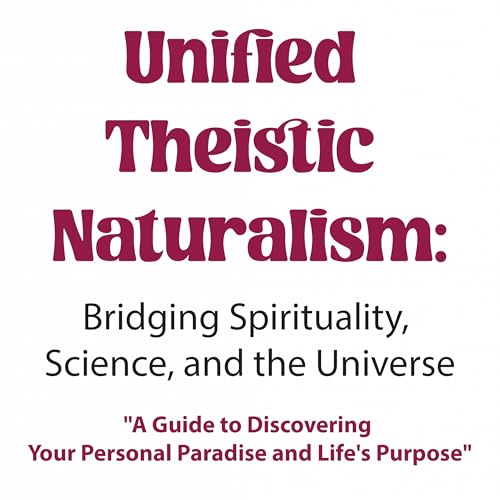
Unified Theistic Naturalism (UTN) cover art

Unified Theistic Naturalism (UTN)

Unified Theistic Naturalism (UTN)

By: Patrick Carodine
Listen for free

About this listen

Unified Theistic Naturalism is a podcast for those who sense that something fundamental has been missing from humanity’s spiritual, psychological, and scientific conversations. Rather than offering beliefs to adopt or practices to follow, this show explores a single question: What happens when we see clearly? Through the framework of Unified Theistic Naturalism (UTN), each episode examines the human condition—conflict, suffering, identity, love, fear, aging, and meaning—through the meeting point of biology, neuroscience, natural law, and communion with the Divine.Patrick Carodine Spirituality
Episodes
  • Why You’re Not an Individual —The Tyrant in Your Head
    Dec 21 2025

    Why You’re Not an Individual — The Tyrant in Your Head
    Unified Theistic Naturalism (UTN)

    The modern world assures you that you are an individual.
    Your name, your opinions, your preferences, your freedoms all seem to confirm it.

    Yet neuroscience, behavioral biology, and psychology quietly reveal something unsettling: most human thought, emotion, and decision-making is pattern-driven, not authored. The brain conserves energy by repeating inherited and conditioned neural pathways. Social mirroring, predictive processing, and survival-based learning ensure that what feels personal is often collective memory running efficiently.

    In this episode, we explore how the material mind hijacks center frame, speaking with your voice while drawing from somogenic transmission, social conditioning, and inherited stress responses. This is not pathology—it is biology doing what it evolved to do.

    The tyrant in your head is not evil.
    It is efficient.

    But efficiency is not individuality.

    Modern science confirms that chronic identification with patterned thought correlates with elevated cortisol, systemic inflammation, cardiovascular strain, immune suppression, anxiety disorders, depression, and shortened telomere length. The body pays a measurable cost when life is lived in oscillation—constantly anticipating, defending, comparing, and correcting.

    When communion replaces oscillation, something verifiable happens:
    • the nervous system shifts from sympathetic dominance to parasympathetic regulation
    • heart rate variability increases, signaling resilience and coherence
    • inflammatory markers decrease
    • cognition becomes quieter, more adaptive, less reactive
    • action emerges without internal conflict or rehearsal

    This is not self-improvement.
    It is center frame being restored.

    True individuality does not arise from effort, identity construction, or differentiation from others. It emerges only when nothing occupies center frame until presence calls. In that stillness, the material mind returns to its rightful place as tool, and the present self—the image of the Divine—moves in resonance.

    What follows is not belief, but observation:
    • why most “self-expression” is repetition
    • how the collective masquerades as personality
    • why perfect action cannot be planned
    • and how something genuinely new enters the world only when pattern falls silent

    This episode is not asking you to become someone else.
    It invites you to notice what happens when no one false is speaking.

    🔹 The Four Pillars of UTN
    A living architecture revealing how Truth, Observation, Perfect Action, and Movement arise naturally when presence governs action.
    🔗 https://doi.org/10.5281/zenodo.16989975

    Reflect:
    • What stabilizes when effort ends?
    • Can clarity exist without control?
    • What moves when nothing is forcing movement?

    🔹 The Death of the Image
    An unflinching examination of how self-image sustains suffering—and how its dissolution restores health without loss.
    🔗 https://doi.org/10.5281/zenodo.17009966

    Reflect:
    • Who remains when no image is defended?
    • What stress disappears with comparison?
    • Is relief the absence of something imagined?

    🔹 The Day God Forgot to Create Sin
    A compassionate re-reading of creation that reveals conflict as oscillation, not condemnation—and restores neutrality to human experience.
    🔗 https://doi.org/10.5281/zenodo.17172235

    Reflect:
    • What if nothing was ever wrong?
    • How does guilt survive without separation?
    • What heals when neutrality is seen clearly?

    There is no correct order.
    There is no superior doorway.
    There is only resonance.

    So now—let us walk together as friends, without urgency and without effort, and see what unfolds as this journey opens fully into Why You’re Not an Individual — The Tyrant in Your Head.

    I’m Patrick Carodine,
    and this is Unified Theistic Naturalism.

    Show More Show Less
    15 mins
  • The Day God Forgot to Create Sin
    Dec 19 2025

    The Day God Forgot to Create Sin is not an accusation.
    It is a question whispered through creation itself.

    What if sin was never formed?
    What if separation was never authored by the Divine—but emerged later, through memory, perception, and survival patterns inherited by matter long before humanity arrived?

    In this journey, we step gently into Genesis—not to dismantle it, but to see it clearly. We return to the six days of creation and notice something startling: again and again, the text declares “and God saw that it was good.” There is light and darkness, land and sea, predator and prey—but no sin. No moral fracture. No cosmic enemy.

    The ancients did not yet have language for oscillation—the movement away from presence that produces distortion, fear, and conflict. They could only describe what they observed: suffering when relationship was absent. So they assumed a cause. A fall. A battle. A breach.

    Unified Theistic Naturalism offers a quieter revelation:
    the image of the Divine was placed into matter already carrying memory—predator and prey, win and loss, survival and threat. What later became called “sin” was not rebellion, but misalignment. Not evil, but inherited motion without presence.

    Adam and Eve were not cursed for curiosity.
    They were clothed in memory that interpreted neutrality as danger.
    The serpent did not introduce evil—it reflected existing oscillation.
    And shame did not come from God—it emerged from perception.

    This episode unfolds as a love story, not a condemnation. A deliverance, not a doctrine. A return to the truth that God created good, and never paused to invent its opposite.

    Along the way, we explore:
    • Why trauma and conflict arise naturally when presence is lost
    • How somagenic transmission carries survival memory across generations
    • Why calling life “sinful” contradicts the Divine’s own declaration
    • How judgment replaced observation—and how it can dissolve again

    And when the story completes, three doorways quietly appear—each offering deeper clarity, not answers to accept, but truth to see.


    🌿 Doorway One — When the Framework Becomes Too Tight

    🔗 https://doi.org/10.5281/zenodo.17537467
    What happens when even sacred systems begin to strain against truth? This journey reveals how the Divine continues whispering—not against frameworks, but through their limitations.

    Reflect:
    • Where have I mistaken structure for truth?
    • What feels tight, defended, or rigid in my beliefs?
    • What loosens when presence leads instead of certainty?


    🌊 Doorway Two — Why You’re Not an Individual

    🔗 https://doi.org/10.5281/zenodo.17575688
    A quiet dismantling of the myth of separateness. Here we see how identity forms, fractures, and dissolves when the center frame returns to presence.

    Reflect:
    • Who am I without the story I repeat?
    • What remains when separation is not assumed?
    • Could unity be observed—not believed?


    🌹 Doorway Three — The Real Reason Love Doesn’t Last

    🔗 https://doi.org/10.5281/zenodo.17172235
    Not a failure of affection, but a misunderstanding of presence. This doorway reveals why love fades when oscillation replaces communion—and how it can remain whole.

    Reflect:
    • Where do I ask love to compensate for fear?
    • What happens when love is no longer negotiated?
    • Can love remain when nothing is being protected?

    There is no correct order.
    There is no preferred doorway.
    There is only resonance.

    So now, let us continue gently—
    and discover what lies ahead in The Day God Forgot to Create Sin.

    🌿 Doorway One — When the Framework Becomes Too Tight🌊 Doorway Two — Why You’re Not an Individual🌹 Doorway Three — The Real Reason Love Doesn’t Last

    Show More Show Less
    19 mins
  • Principia Communio: Axioms and Laws of Unified Theistic Naturalism
    Dec 18 2025

    Principia Communio is not a teaching to adopt, a belief to defend, or a system to follow.
    It is the living foundation of Unified Theistic Naturalism—the axioms and laws that describe how suffering arises, how freedom dissolves it, and how communion with the Divine operates without intermediaries.

    In this episode, you are invited into the heart of UTN—not through persuasion, but through observation. What unfolds here is not myth or metaphor alone, but an articulation of reality that can be tested, lived, and seen for yourself. These laws do not ask for agreement. They operate whether named or ignored.

    The ancients pointed to these truths with the language available to them—through parable, poetry, symbol, and story. We honor that lineage deeply. But matter has continued to learn. Science has revealed new mechanics. Psychology has mapped conditioning. Physics has shown us that observation changes outcomes. And so consciousness, too, must be allowed to move forward.

    Principia Communio does not replace religion, philosophy, or science.
    It reveals what has always been beneath them.

    This episode is dense because truth is simple—but its implications are vast. It is not meant to be heard once. It is meant to be returned to. Read. Lived beside. Watched in motion. The laws described here do not belong to UTN. UTN belongs to them.

    If something in you stirred—resistance, relief, awe, stillness—that is not confusion. That is resonance meeting habit.

    And when you feel ready to continue the walk, these next doorways remain open—not as steps to climb, but as landscapes to explore together.


    🌿 1. The End of Conflict: Presence as the Final Mirror
    https://doi.org/10.5281/zenodo.17537467
    A precise and disarming exploration of conflict—not as an enemy to defeat, but as a signal of movement away from presence. This journey reveals how conflict dissolves naturally when observation replaces opposition.

    Reflective invitations:
    • Where does conflict vanish when no position is being protected?
    • What remains when there is nothing left to resist?
    • Is peace something you achieve—or something you stop interrupting?


    🌀 2. There Is No Ego — Only Movement Away from Presence
    https://doi.org/10.5281/zenodo.17575688
    This work dismantles the modern obsession with the “ego” and replaces it with an observable truth: suffering does not come from an entity, but from misalignment. Nothing to conquer. Nothing to improve. Only return.

    Reflective invitations:
    • What changes when you stop trying to fix something that was never there?
    • Can suffering survive without a story to sustain it?
    • Who are you when the center frame is empty?


    3. Touching the Hem of the Divine: Virtue Dispatched, Communion Awaiting
    https://doi.org/10.5281/zenodo.17172235
    A return to immediacy—where virtue is not earned, delayed, or mediated. This journey explores how communion releases what traditions once attributed to worthiness, ritual, or permission.

    Reflective invitations:
    • What if nothing stands between you and the Divine?
    • How often are you waiting for permission that was never required?
    • What becomes possible when stillness is trusted?


    There is no hierarchy here.
    No final step.
    No destination to reach.

    Only observation.
    Only presence.
    Only the quiet recognition of what has always been whole.

    I’m Patrick Carodine,
    and this is Unified Theistic Naturalism.


    Now let us walk together as friends, gently entering Principia Communio: Axioms and Laws of Unified Theistic Naturalism, and see —without effort—what unfolds before us.

    Show More Show Less
    50 mins
No reviews yet
In the spirit of reconciliation, Audible acknowledges the Traditional Custodians of country throughout Australia and their connections to land, sea and community. We pay our respect to their elders past and present and extend that respect to all Aboriginal and Torres Strait Islander peoples today.