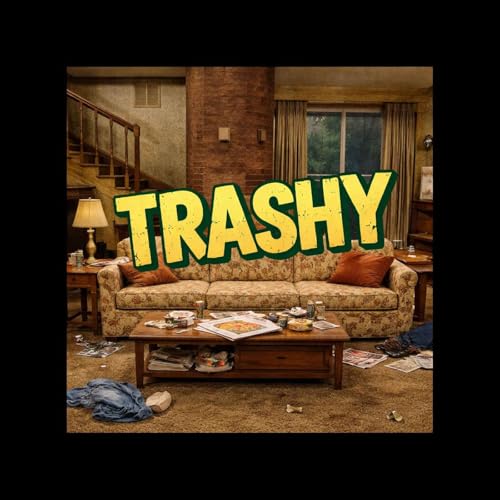
Trashy cover art

Trashy

Trashy

By: Chris Garcia
Listen for free

About this listen

Trashy is a podcast about the culture that worked because it wasn’t supposed to matter. The shows, scandals, stunts, and spectacles people watched obsessively and then pretended not to care about. Not misunderstood art. Not guilty pleasures. Just things built to grab attention, burn hot, and leave a mess behind. Each episode digs into the moments when embarrassment became entertainment, outrage became currency, and humiliation turned into a business model. If it was disposable, undeniable, and impossible to look away from, it belongs here. Art Social Sciences
Episodes
  • Episode 6 - Leisure Suit Larry
    Feb 12 2026

    Leisure Suit Larry: When Horny Point-and-Click Ruled the 80s

    In this episode of Trashy, we dig into Leisure Suit Larry, the shockingly successful, deeply uncomfortable, and historically important adult comedy game series that somehow became a cornerstone of mainstream PC gaming. Created by Al Lowe and released by Sierra On-Line in 1987, Leisure Suit Larry in the Land of the Lounge Lizards dropped players into the polyester-soaked world of Larry Laffer, a balding, socially maladjusted man in search of sex, love, and validation, usually failing at all three.

    At a time when video games were still associated with children and arcades, Leisure Suit Larry arrived as a full-on rebuttal: bawdy humor, sexual innuendo, profanity, sex workers, and jokes that now feel wildly outdated. Sierra tried to soften the blow with an “age-verification” trivia quiz, but the game’s reputation spread fast, making it both notorious and irresistible. Against all odds, it sold extremely well.

    The series ran through the late 80s and 90s, evolving alongside PC technology, shifting from text parser to point-and-click, from EGA to VGA, and from sleazy parody to self-aware farce. Some entries sharpened the satire, others leaned into juvenile humor, and at least one nearly killed the franchise outright. Along the way, Larry became a strange cultural artifact: part sex comedy, part commentary on masculinity, part relic of an era when “edgy” meant punching every possible boundary.

    In this episode, we talk censorship, corporate risk, gamer panic, moral outrage, declining comedy standards, and why Leisure Suit Larry still matters as a marker of how “trashy” media keeps forcing itself into the mainstream, whether anyone is comfortable with it or not.

    If you hate yourself for loving it, it’s probably Trashy.

    Links & Further Reading

    https://en.wikipedia.org/wiki/Leisure_Suit_Larry

    https://www.mobygames.com/game-group/leisure-suit-larry-series

    https://archive.org/details/LeisureSuitLarry1DOS

    https://www.sierragamers.com

    https://www.al-lowe.com

    This podcast is powered by Pinecast.

    Show More Show Less
    17 mins
  • Episode 5 - Harlequin Romances
    Feb 5 2026
    Episode Description This episode of Trashy takes a deep, unsentimental look at Harlequin romance novels, the most industrialized, rule-bound, and commercially successful form of popular fiction of the last seventy-five years. What began in postwar Canada as a modest paperback reprint operation became a global publishing machine that trained readers to expect very specific emotional rhythms, moral frameworks, and romantic outcomes, delivered on a strict monthly schedule. We trace the history of Harlequin Enterprises, founded in Winnipeg in 1949, and its pivotal 1957 distribution deal with Britain’s Mills & Boon. That partnership locked Harlequin into a highly controlled romance format built around short novels, consistent word counts, conservative sexual politics, and a belief that readers wanted familiarity more than surprise. By the 1970s and 1980s, Harlequin was selling well over 100 million books a year worldwide, largely through supermarkets, drugstores, and subscription programs. The episode explains how Harlequin’s category romance system worked in practice. Editors enforced detailed guidelines governing plot, tone, character behavior, and even acceptable professions for heroes and heroines. Lines such as Harlequin Presents and Harlequin Romance functioned almost like television genres, training readers to know exactly what kind of story they were buying before opening the cover. Doctors, tycoons, ranchers, and emotionally unavailable men were not accidents but structural requirements. We also look at the writers who thrived inside this system and those who used it as a stepping stone. Figures like Barbara Cartland, Penny Jordan, Debbie Macomber, and Nora Roberts built massive readerships by mastering the form, while the rise of longer, more explicit romances in the 1970s began to strain Harlequin’s carefully policed boundaries. The episode closes by examining Harlequin’s reputation as a “guilty pleasure,” the gendered contempt directed at its readers, and why these books mattered culturally even when critics refused to take them seriously. Topics Covered The founding of Harlequin in 1949 The Mills & Boon partnership and British influence Category romance and enforced narrative formulas Harlequin Presents vs. Harlequin Romance Author guidelines, word counts, and editorial control Supermarket distribution and subscription readers Feminist critiques and reader loyalty Harlequin’s move into ebooks and digital platforms Key Books & Turning Points The Flame and the Flower by Kathleen Woodiwiss , and the shift toward longer, more sexually explicit romance The late-1970s softening of Harlequin’s “no sex” rules The rise of branded romance lines as consumer signals Links & Further Reading Harlequin official sitehttps://www.harlequin.com Harlequin corporate historyhttps://www.harlequin.com/about-us Mills & Boon historyhttps://www.millsandboon.co.uk/about-us/our-history/ Smithsonian Magazine – history of Harlequin romancehttps://www.smithsonianmag.com/arts-culture/the-history-of-the-harlequin-romance-180975015/ New York Times – Harlequin and the romance businesshttps://www.nytimes.com/2019/06/15/books/romance-novels-harlequin.html The Atlantic – in defense of romance novelshttps://www.theatlantic.com/entertainment/archive/2014/12/in-defense-of-romance-novels/383212/ Nora Roberts official sitehttps://noraroberts.com Debbie Macomber official sitehttps://www.debbiemacomber.com Why This Is Trashy Identical covers. Mandatory happy endings. Emotional satisfaction engineered at scale. Harlequin romance didn’t just sell love stories. It sold predictability, comfort, and fantasy by the millions, and that makes it pure Trashy. This podcast is powered by Pinecast.
    Show More Show Less
    22 mins
  • Episode 4 - XPW
    Jan 29 2026
    Episode Description

    This episode of Trashy dives into XPW, one of the most infamous, short-lived, and aggressively controversial professional wrestling promotions of the early 2000s. Founded in 1999 in Southern California, Xtreme Pro Wrestling set out to be the most violent, explicit, and transgressive alternative to mainstream wrestling, pushing hardcore aesthetics far past what even ECW had normalized. Blood, sexual shock value, real injuries, and deliberately offensive storylines were not accidents. They were the point.

    XPW was created and financed by Rob Black, owner of the adult company Extreme Associates, and the promotion reflected that origin openly. Shows regularly featured graphic weapons use, sexualized angles, and unfiltered crowd hostility, often staged in Southern California venues like the Grand Olympic Auditorium and the Los Angeles Sports Arena. The company leaned heavily into the post-ECW vacuum after ECW’s bankruptcy in early 2001, marketing itself as the true heir to extreme wrestling just as the national wrestling boom began to collapse.

    The episode examines XPW’s most notorious stars, including New Jack, Supreme, Sabu, and Vampiro, and how the promotion blurred the line between worked violence and genuine danger. We also break down XPW’s infamously unsafe working conditions, lack of medical oversight, and the culture that encouraged performers to escalate risk in front of increasingly desensitized audiences.

    Finally, we cover the collapse. In 2002, Rob Black and Extreme Associates became the target of a high-profile federal obscenity prosecution that effectively destroyed XPW’s financial backing. The promotion shut down soon after, leaving behind a legacy of injured wrestlers, banned footage, and a reputation as one of the most reckless experiments in wrestling history. XPW would later be revived in the 2020s in a far tamer form, trading notoriety for nostalgia.

    Topics Covered
    • The founding of Xtreme Pro Wrestling in Los Angeles

    • Rob Black, adult film money, and wrestling as shock spectacle

    • Life after ECW and the extreme wrestling vacuum of 2001

    • Notorious XPW matches, weapons, and bloodshed

    • Performer injuries and lack of safety standards

    • The federal obscenity case against Extreme Associates

    • XPW’s shutdown and later revival

    Key Names & Figures
    • Rob Black

    • New Jack

    • Supreme

    • Sabu

    • Vampiro

    Links & Further Reading

    XPW official site (revival era)https://xpwrestling.com

    XPW profile at Cagematchhttps://www.cagematch.net/?id=8\&nr=11

    Wrestling Observer on XPW history and collapsehttps://www.f4wonline.com

    Dark Side of the Ring episode guide (XPW context)https://www.vicetv.com/en_us/show/dark-side-of-the-ring

    Federal obscenity case background on Extreme Associateshttps://www.justice.gov/archive/criminal/ceos/cases/extreme-associates.html

    Los Angeles Times on extreme wrestling in Californiahttps://www.latimes.com/archives

    New Jack career overviewhttps://www.cagematch.net/?id=2\&nr=99

    Why This Is Trashy

    Real blood. Real injuries. Porn money. No safety net. XPW wasn’t just wrestling gone wrong. It was a promotion built to see how far “too far” could go before the whole thing collapsed. That’s not just trashy. That’s legendary.

    This podcast is powered by Pinecast.

    Show More Show Less
    22 mins
No reviews yet
In the spirit of reconciliation, Audible acknowledges the Traditional Custodians of country throughout Australia and their connections to land, sea and community. We pay our respect to their elders past and present and extend that respect to all Aboriginal and Torres Strait Islander peoples today.