• THE DEEPEST VOICE IN THE WORLD?! | Ep. 28 This is the Legend of Eric Hollaway
    Dec 5 2025

    He first sang in his church’s children choir. Then, he sang in the U.S. Army. Then he was discovered for having the deepesthuman vocal range, the basso profondo.

    He did not even have his first singing lesson until he was 25 years old!

    Oktavists are vocalists who sing in the basso profondo range. Oktavists are EXTREMELY rare: at one point, there were only 12 in the entire world! He is one of them.

    Meet Eric Hollaway, aka thatbassvoice, an oktavist, YouTuber with over 726,000 subscribers, and voice actor whose has been featured in numerous films and video games, including the award winning “DOOM Eternal”.

    Join Amos Vang and Eric Hollaway as they share Eric’s legendary adventures, from serving in the U.S. Army as a nuclear warhead technician while entertaining and singing in an a cappella group for German audiences, to returning back to the U.S. and being discovered by two music professors for his voice, to learning and training in the different operatic styles and traditions, and to working with the legendary Mick Gordon on providing his voice to “DOOM Eternal’s” unforgettable music. Amos and Ericalso discuss musicality, the unique characteristics of the basso profondo range, and the most important lessons that Eric has learned from his career.

    Eric’s Instagram: @thatbassvoice

    Eric’s YouTube channel:@thatbassvoice

    Tomorrow by Scott Buckley – released under CC-BY 4.0. www.scottbuckley.com.au


    -- CHAPTERS --

    0:00 – Introduction

    4:00 – What inspired Eric Hollaway to pursue music?

    8:30 – Eric Hollaway explains his childhood musicalcommunity environment!

    10:31 – What were the most important lessons that EricHollaway learned from his childhood musical community environment?

    12:51 – When did Eric Hollaway discover that he could reachthe male bass vocal range?

    17:13 – Eric Hollaway served in the U.S. Army and was partof an Army a cappella group!

    25:07 – Eric Hollaway studied opera in college, competed inbass voice competitions, and received a voice scholarship immediately!

    26:58 – Up until age 25, Eric Hollaway NEVER HAD A VOICELESSON BEFORE!

    33:35 – Imperfections are beautiful!

    34:04 – How did Eric Hollaway discover that he can reach thebasso profondo range?

    37:44 – “I found my people”

    38:59 – Discovering oktavism and Glenn Miller helped EricHollaway discover his true identity in voice!

    40:08 – “Eric, come up!”

    42:55 – How rare is oktavism and the basso profondo range?

    45:52 – What inspired Eric Hollaway to pursue voice actingand singing full time, and to create thatbassvoice?

    48:08 – Doom Eternal: Eric Hollaway was in it! How did Eric Hollaway work with Mick Gordon?

    55:22 – Eric Hollaway sings that song from Doom Eternal!

    56:55 – What is musicality to Eric Hollaway?

    1:06:17 – If Eric Hollaway was immersed heavily into theworld of professional music making in his childhood, then he would not haveenjoyed music as much as he does now.

    1:11:25 – What is the basso profondo? Is it even possible to train to become anoktavist?

    1:19:31 – What are the greatest misconceptions of singingand oktavism that Eric Hollaway has seen?

    1:21:24 – One must have vocal training and healthy lifestylehabits, no matter how talented they are!

    1:22:55 – Chocolate and bass voices: good or bad?!

    1:27:02 – Luciano Pavarotti influenced Eric Hollaway!

    1:28:59 – Mario Lanza, Placido Domingo, and Thomas Hampson

    1:32:42 – What are the most important lessons that EricHollaway has learned from his career?

    1:34:50 – What are the most rewarding things that EricHollaway has experienced from his career? What advice would he give to people who want to pursue this career?

    Show More Show Less
    1 hr and 42 mins
  • ATHENA DENG RETURNS from the CHOPIN Competition! Ep. 27
    Nov 21 2025

    She just competed at the Olympics of Piano, the 2025 International Chopin Competition. Athena Deng returns to the show to share her experiences!

    Join Amos Vang and Athena Deng as they revisit Athena’s Road to Warsaw, from her performance at the preliminaries to her 1st round performance, as well as her preparation and mindset going into and after the Competition. Athena also shares the most important lessons that she learned from this experience, and the unique emotions she experienced from performing on the greatest stage of piano.

    See Athena's first appearance on the show: https://www.youtube.com/watch?v=ttpWfb1L1Z8

    #chopin #chopinpiano #chopin2025 #piano #chopincompetition #argerich #athenadeng #dengsisters #canadianchopinsociety #royalconservatoryofmusic #rcm #chopininstitute #classicalmusic

    -- CHAPTERS --

    0:00 – Introduction

    0:59 – Athena Deng describes her experience at the International Chopin Competition!

    1:56 – Athena Deng at the Preliminaries

    3:27 – How did Athena Deng prepare for the main International Chopin Competition?

    6:03 – Athena Deng balanced a Masters of Music at the New England Conservatory with her preparation for the International Chopin Competition!

    11:30 – Pianists have to learn and master massive amounts of music in a matter of weeks or even days!

    15:02 – Athena Deng tried to use muscle memory to compete in the 1st round, which did not ultimately work out for her.

    18:38 – Athena Deng talks about her experiences hearing different interpretations of the same Chopin repertoire at the Competition!

    23:57 – Athena Deng felt like she was floating during her performance of Chopin’s Nocturne in G Major at the International Chopin Competition!

    29:33 – Why did Athena Deng select the Yamaha for the prelims and the Kawai for the main rounds of the International Chopin Competition?

    35:08 – The Shigeru Kawai piano was the 2nd most popular piano at the 2025 International Chopin Competition!

    37:22 – Shigeru Kawai pianos are DIFFERENT from the K. Kawai pianos! It is good to practice on heavier pianos.

    40:06 – What was Athena Deng thinking and feeling when she stepped onto the world stage and performed her 1st round programme at the International Chopin Competition?

    45:27 – The competitors were very friendly and excited to be at the Chopin Competition!

    46:51 – What were Athena Deng’s favorite experiences in Warsaw?

    48:30 – Athena Deng thinks that the Warsaw Philharmonia felt SMALLER than Koerner Hall in Toronto, Canada!

    54:23 – Pianists must know how to project to the back of the concert hall in their performances!

    57:43 – Athena Deng visited Zelazowa Wola, Chopin’s birthplace!

    59:51 – Dang Thai Son grew up listening to Chopin in the outdoors!

    1:02:54 – Nature and wilderness focused CDs in the 2000s and early 2010s

    1:05:28 – What were the most important lessons that Athena Deng has learned from the International Chopin Competition?

    1:07:28 – How has the International Chopin Competition changed or help evolve Athena Deng’s understanding of Fryderyk Chopin?

    1:11:14 – Justice Rosalie Abella took inspiration from Fryderyk Chopin?!

    1:16:35 – Sports announcing and piano have A LOT in common. Amos Vang, who’s done both, explains why!

    1:18:12 – Will Athena Deng compete in the 2030 International Chopin Competition?

    1:22:39 – Athena Deng addresses her fans!

    Show More Show Less
    1 hr and 26 mins
  • He's a JUNO AWARD NOMINEE! | Ep. 26: This is the Legend Of Iman Habibi
    Nov 7 2025

    He almost got kicked out of school in Iran for playing piano. Then, he and his family fled Iran because of war. After years of tribulation and difficulties, he would become a world-renowned, award-winning composer, with a JUNO Award nomination in 2024.This is the legend of Iman Habibi, an Iranian-Canadian composer who served as the commissioned composer for the recently concluded 2025 Honens International Piano Competition. Even though Honens has concluded, it’s still a great time to hone in on Iman’s career and newest composition, “Fracture”. Join Amos Vang and Iman Habibi as they discuss the unique experiences and challenges of musicianship during Iman’s early life in Iran, the most important lessons that Iman learned from all of his composition teachers, the direct connections between “Fracture”, current events, and the metacrisis, and the importance of musicality in defining culture.#honens #honens2025 #neurorecital #verbier #chopincompetition #imanhabibi #classicfm #neuroscience #cliburn #piano #janinafialkowska #classicalmusicIman’s website: https://www.imanhabibi.com/Iman’s Instagram: @iman.habibi.composerTomorrow by Scott Buckley – released under CC-BY 4.0. www.scottbuckley.com.au

    Other music composed by Amos Vang, with a special excerpt of “Fracture” by Iman Habibi-- CHAPTERS --0:00 – Introduction3:27 – What inspired Iman Habibi to pursue music?8:31 – Tehran, Iran was very influential to Iman Habibi’s early artistic pursuits, in polarising ways that showed the power of music10:00 – Iman Habibi was almost expelled from school for playing piano in Iran!12:47 – In Iran, classical music was viewed ENTIRELY DIFFERENTLY compared to Canada, the U.S., and the West!15:43 – Iman Habibi describes the most important lessons that he learned from his early teachers!22:15 – Performing and sharing music with an audience is a unique experience.24:01 – Chopin’s music really speaks to people, especially in times of conflict.27:00 – What inspired Iman Habibi to become a composer?28:53 – What were the most important lessons that Iman Habibi learned from his composition teachers?38:07 – Every performer and composer has their own signature: they imbue a bit of themselves into their performances and compositions.39:17 – Chopin, Iman, and every other composer is a product of their own time. Authenticity is important in music!40:49 – What is a commissioned composition?42:07 – What is Iman Habibi’s planning process for each commissioned composition?46:23 – What is “Fracture”, Iman Habibi’s commissioned composition for the 2025 Honens International Competition?49:59 – Iman mentions the Metacrisis, which is coincidentally related to some of Amos’s work at Stanford University’s MAHB!53:57 – There is a cultural problem that is preventing humanity from understanding the problems that affect it.59:30 – How should pianists approach “Fracture” by Iman Habibi?1:05:55 – What is musicality to Iman Habibi?1:10:31 – What is the Complete Artist to Iman Habibi?1:17:23 – Music appreciation is losing ground in Canada and the U.S. This is isolating people.1:28:21 – How can people enjoy music competitions such as Honens?1:31:33 – What is Iman Habibi’s advice to those who want to pursue a career in music?

    Show More Show Less
    1 hr and 37 mins
  • Meet the CEO and President of Honens | Ep. 25: This is the Legend Of Amanda Smith
    Oct 15 2025

    The semi-finals of the 2025 Honens International Piano Competition begins tomorrow, and as we hone in on the competition, it's time to get the organizational and professional perspectives on the success of Honens!

    Meet Amanda Smith, CEO and President of Honens! Join Amos Vang as he features Amanda's career and pathway to Honens, along with behind-the-scenes organizational elements of the competition and festival, Honens's unique perspective on musicality and artistry, and the ways in which you can enjoy Honens this year!

    Honens's competition website: https://www.honens.com/competition/

    Tomorrow by Scott Buckley – released under CC-BY 4.0. www.scottbuckley.com.au Other music composed by: Amos Vang

    -- CHAPTERS --

    0:00 – Introduction

    2:41 – What inspired Amanda Smith to pursue music?

    4:18 – Amanda did her music degree at Queens University in Kingston, Ontario, Canada.

    5:40 – Amanda took marketing courses, which would inspire her to pursue an MBA with a specialization in charitable organizations at Trinity Western University.

    7:09 – How has Amanda’s music training prepared her for the transition into the corporate world and on her perspective of business management?

    11:38 – People have many professional interests in the present day!

    13:30 – How have each of Amanda’s professional chapters prepared her for Honens?

    14:45 – What inspired Amanda to Hone In on Honens? I.e. What inspired her to join Honens?

    17:53 – Trust and healthy communities have been sadly lacking in much of the world today.

    19:30 – A day in the life of Honens CEO and President Amanda Smith 21:58 – How has the pandemic changed Honens?

    25:20 – What is musicality to Amanda Smith?

    26:12 – How does Honens market musicality?

    27:35 – Storytelling is important. Amos Vang himself tackles the issue of storytelling in many different areas of work.

    29:51 – In music, particularly piano, storytelling is shown through the pianist’s hands.

    32:22 – Ryan Wang: a pianist is at their best when they are at their most vulnerable.

    33:27 – How does Amanda support Jon Kimura Parker’s artistic vision at Honens?

    38:34 – Amos Vang calls Honens the Canadian Grand Slam of international piano competitions!

    40:54 – How does the Honens organisation differ between a competition year and a non-competition year?

    43:21 – Amanda: the largest gaps in Canadian musical education are largely cultural.

    45:55 – Dang Thai Son’s lifelong devotion to music is legendary.

    47:32 – Canadians are to hockey as the Chinese are to piano!

    49:10 – What is Honens’s “Keys for Newcomers” programme?

    51:42 – What is Honens’s “Artistic Development” programme? What makes this programme unique from other competitions’ programmes?

    54:00 – What are the similarities and differences in managing the post-Honens early careers of Illia Ovcharenko and Nicolas Namoradze?

    59:27 – What are the most rewarding things that Amanda has experienced at Honens?

    1:01:23 – How can people watch and enjoy Honens?

    1:03:40 – What is Amanda’s advice to former musicians who have decided to change career paths?


    #honens #honens2025 #illiaovcharenko #nicolasnamoradze #neurorecital #jonkimuraparker #virtuosity #cliburn #chopin #chopin2025

    Show More Show Less
    1 hr and 8 mins
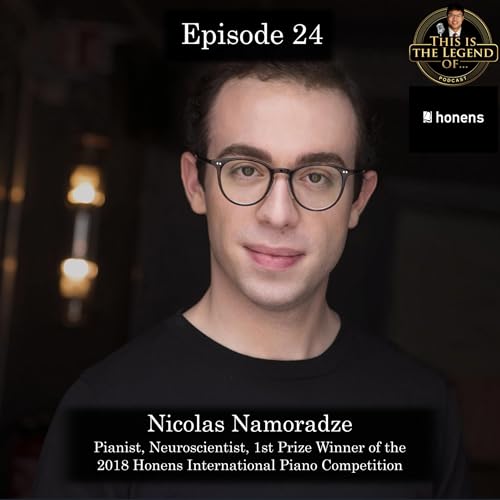
  • HE SHOWED HIS BRAIN ON MUSIC | Ep. 24 - This is the Legend Of Nicolas Namoradze
    Sep 26 2025
    The finest instrument is the mind. He showed exactly why, by recording his own brain on music! Meet Nicolas Namoradze (known as “Nico” to friends and colleagues), a pianist, award-winning neuroscientist, and 1st prize winner of the 2018 Honens International Piano Competition. In this episode of This is the Legend Of…, Amos features Nicolas’s unique career, pathway to Honens, and fascinating research after Honens. His most recent research, the “Neurorecital”, records the neural activity of a musician’s brain while the musician is performing music. Nicolas just debuted the “Neurorecital” at the world-renowned Verbier Festival in Switzerland, and by using the University of California – San Francisco’s revolutionary “Glass Brain” technology, Nicolas has broken new ground into musical performance’s musical, neurological, and psychological effects on both the performer and the audience! Looking forward to featuring Nicolas’s research updates in the future! Nicolas's Instagram: @nicolasnamoradze Nicolas’s website – https://nicolasnamoradze.com/ #honens#honens2025 #chopin #chopincompetition#nicolasnamoradze#cliburn #cliburncompetition#vancliburn #piano #janinafialkowska #fialkowska #carnegie #classicalmusicTomorrow by Scott Buckley – released under CC-BY 4.0. www.scottbuckley.com.auOther music composed by: Amos Vang-- CHAPTERS --0:00 – Introduction4:16 – What inspired Nicolas Namoradze to pursue piano?6:58 – What is the music culture like in Tbilisi andBudapest?11:01 – North America has growing centres of rich pianoculture.11:25 – Nicolas made his solo debut at 10 yearsold and his orchestral debut at 12 years old!12:49 – How have the music cultures of Budapest, Vienna, andFlorence shaped Nicolas Namoradze’s musical style and philosophy?16:27 – It is important to consider both musical ANDnon-musical influences on a composer’s style!20:48 – Chinese music has A LOT of rich cultural references! Amos Vang explains the Cantonese and Mandarinlinguistic influences on music!24:04 – There are parallels between musicianship and acting! Tony Leung Chiu-wai is a great example of that.27:37 – Nicolas brings a scientific perspectiveinto piano performance!28:44 – Music teachers would benefit greatly fromunderstanding the scientific perspectives behind piano performance.35:47 – Bruce Lee’s Jeet Kune Do can be applied into musicalperformance!36:55 – Is there a kinesiological explanation for good armmovement in piano performance?42:23 – Michael Phelps spent more time on mental practicethan on swimming! Could musicians learnfrom that?51:34 – What inspired Nicolas Namoradze to compete inHonens?57:48 – Honens has a unique scoring system.1:02:29 – Music does NOT operate in a vacuum. There must be dialogue and adaptation.1:05:41 – Justice Rosalie Abella, a former judge of theSupreme Court of Canada, was a performing pianist.1:14:52 – Music and law have one thing in common: theirstudents learn about THEORY and THEME!1:15:10 – Justice Rosalie Abella actually read Amos Vang’sfinal law school paper about her!1:15:47 – What is musicality to Nicolas Namoradze?1:19:32 – Can there be objectivity/universality in beauty(and by extension, in musicality)?1:24:28 – What is the Neurorecital? What are the most important research findingsthat Nicolas Namoradze has found in the Neurorecital?1:28:16 – How can the Neurorecital contribute to our current knowledge of effective musical performance?1:30:31 – Amos Vang describes his own experience withobserving musical therapy in senior patients with dementia.1:34:52 – The gradual decrease of music education in Canada’spublic education systems1:40:01 – Look at the brain on music! There are NO BAD SIDE EFFECTS!1:40:55 – What is the Complete Artist to Nicolas?1:42:36 – How do new audience members watch and enjoy Honens?1:45:48 – What are the most rewarding aspects of NicolasNamoradze’s career?
    Show More Show Less
    1 hr and 51 mins
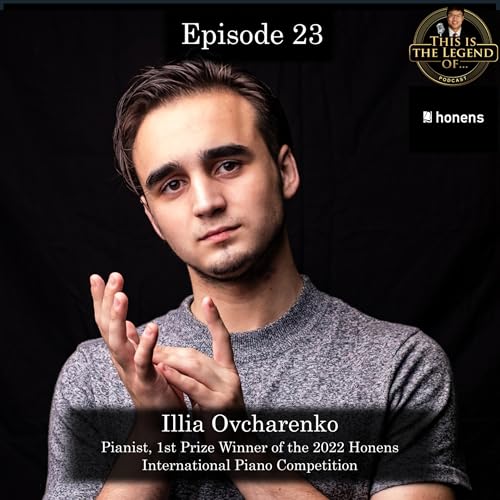
  • At age 21, he won HONENS | Ep. 23: This is the Legend of Illia Ovcharenko
    Aug 29 2025

    In 2022, at age 21, he became the first Ukrainian pianist and the youngest person to win Honens, aka Canada’s Grand Slam of international piano competitions, in the most cathartic year of recent history.But it almost did not happen.This is the Legend of Illia Ovcharenko.Join Amos Vang as he features the legendary path of Illia Ovcharenko’s piano career, Ukraine’s rich music traditions, Ukraine’s strong educational foundations in music and culture, Illia’s path to winning the Busoni International Piano Competition and the Honens International Piano Competition, and the impact that all of Illia’s cultural influences had on him.Illia’s YouTube channel: https://www.youtube.com/@UCU7_grgiVXQeNV4C8aNG2EQ Illia's Instagram: https://www.instagram.com/illiaovcharenko_pianist/?hl=enTomorrow by Scott Buckley – released under CC-BY 4.0. www.scottbuckley.com.auOther music composed by: Amos Vang-- CHAPTERS --0:00 – Introduction3:18 – What inspired Illia Ovcharenko to pursue piano?6:56 – What were Illia Ovcharenko’s early musical stylistic influences?10:13 – What were the greatest challenges that Illia Ovcharenko faced early on in his life?13:15 – What is the curriculum at the Kyiv Lysenko State Music Lyceum?16:52 – Unlike Canada, Ukraine builds a strong musical foundation into its educational programs, regardless of whether one chooses to pursue a musical career.18:36 – Ukraine has central music academies across the country. Canada has hockey academies across the country.20:33 – Practising…so important, but it can get monotonous…21:05 – This is what Illia Ovcharenko does BEFORE he starts practising.21:48 – Illia Ovcharenko’s practise strategy is very community-oriented, which is different from many pianists’ individualistic practising routine.25:19 – Music is supposed to be FUN! Life experience defines the musical performance.27:10 – Illia Ovcharenko made his performing debut at 12 years old!29:01 – Arie Vardi is Illia’s teacher, mentor, and inspiration.37:10 – What was Illia Ovcharenko’s preparation experiences for the 2021 Busoni International Piano Competition?42:12 – What inspired Illia Ovcharenko to HONE IN ON HONENS?!45:36 – Illia Ovcharenko ALMOST DID NOT COMPETE IN HONENS!!!!!47:33 – Illia Ovcharenko went from almost not making the competition to WINNING HONENS, in the most CATHARTIC YEAR OF 2022!!!!!53:16 – Amos Vang and Illia Ovcharenko discuss Illia’s Honens performance of Liszt’s Sonata in B minor.59:03 – Amos Vang describes his experience performing Liszt’s Dante Sonata.1:00:28 – How do Illia’s performative work and educational work with Honens influence each other?1:03:13 – What is musicality to Illia Ovcharenko?1:06:49 – What is the Complete Artist to Illia Ovcharenko?1:10:52 – How do new audiences watch and enjoy piano competitions such as Honens?1:15:23 – Amos Vang calls Honens the “Canadian Grand Slam of International Piano Competitions”!!!!!1:16:44 – What are the greatest misconceptions that Illia Ovcharenko has seen about classical music?1:20:05 – Did O Canada copy Mozart?

    #honens #chopin #chopincompetition #illiaovcharenko#cliburn#cliburncompetition#vancliburn#piano#janinafialkowska#fialkowska#carnegie #classicalmusic


    Show More Show Less
    1 hr and 24 mins
  • He won the Leeds International Piano Competition - Ep. 22: This is the Legend Of Jon Kimura Parker
    Aug 2 2025

    In 1984, he was the first Canadian to win the LeedsInternational Piano Competition. That same year, he performed for Queen Elizabeth II.

    8 years later, he judged the inaugural edition of the Honens International Piano Competition, Canada’s Grand Slam of international piano competitions.

    Meet Jon Kimura Parker (known as “Jackie” to friends new and old), an award-winning pianist who also serves as the Artistic Director of Honens.

    In this episode, Jackie and Amos discuss Jackie’s trailblazing career throughout Juilliard, throughout the 1984 Leeds Competition, Britain’s Grand Slam of international piano competitions, and beyond.

    2025 is also a special year, as the newest edition of the Honens International Piano Competition will take place in October. Jackie explains the philosophy of the “Complete Artist” at Honens, as well as the innovations that have come out of such a philosophy in judging, in competition organisation, and in music education.

    Jackie’s website: https://www.jonkimuraparker.com/

    Honens’ website: https://www.honens.com/


    Tomorrow by Scott Buckley – released under CC-BY 4.0. www.scottbuckley.com.auOther music composed by: Amos Vang


    - CHAPTERS -

    0:00 – Introduction

    3:28 – HONE IN ON HONENS!

    3:43 – What inspired Jon Kimura Parker to pursue piano?

    6:31 – What were the most profound lessons that Jon KimuraParker learned from each of his piano teachers?

    17:19 – When did Jon Kimura Parker feel that he was readyfor Leeds?

    21:08 – How did Jon Kimura Parker prepare for Leeds?

    24:12 – Many musicians still work regularly with coacheseven after going professional. Pianists, on the other hand, do not really do this.

    25:29 – A pianist’s mindset tends to be very independent andeven isolated.

    29:01 – Jon Kimura Parker describes every single round ofthe Leeds International Piano Competition!

    33:41 – Jon Kimura Parker actually had a MEMORY SLIP at Leeds!

    35:15 – Jon Kimura Parker performed the Barber Sonata atLeeds, with a BROKEN SOSTENUTO PEDAL!

    38:35 – Jon Kimura Parker performed the Brahms PianoConcerto No. 1 at the finals of Leeds.

    41:13 – Jon Kimura Parker won 1st prize, but something HILARIOUS happened!

    44:10 – Queen Elizabeth II commissioned Jon Kimura Parker toperform for her. This was her reaction.

    47:08 – Queen Elizabeth II and Prince Philip were genuinelykind, caring people.

    49:16 – Amos performed Liszt’s Dante Sonata in thepast. This is how he handled the difficult technical parts.

    50:23 – Liszt, Beethoven, and Romantic era composers hadSIGNIFICANTLY lighter pianos. Modern pianos are very heavy.

    53:17 – Heavier pianos actually give good experience forpianists by training up the stability of their technique.

    55:23 – Jon Kimura Parker appeared on a children’s TV show,“Under the Umbrella Tree”.

    1:02:16 – Amos Vang uses sports analogies and terminologiesto explain classical music competitions and festivals.

    1:03:33 – Jon Kimura Parker has the difficult job of deciding who wins Honens.

    1:04:05 – What is musicality to Jon Kimura Parker?

    1:07:39 – Who is Esther Honens? This is her legend.

    1:13:46 – A day in the life of Honens Artistic Director JonKimura Parker

    1:17:02 – In 2018, one of the jury members cancelled!

    1:20:00 – Curation of Honens content during the pandemic

    1:22:34 – Managing Nicolas Namoradze’s and Illia Ovcharenko’s careers during the pandemic

    1:24:14 – What is the Complete Artist to Jon Kimura Parker?

    1:34:27 – Nicolas Namoradze got a degree in neuroscienceduring the pandemic.

    1:36:09 – How does Honens define the CompleteArtist?

    1:42:37 – Honens’s approach challenges many misconceptionsof classical music

    1:43:04 – How can new audiences watch and enjoy Honens andother piano competitions?

    1:44:50 – Jon Kimura Parker explains Honens’s judgingprocess in FULL DETAIL.

    1:50:57 – Canada has the potential to become a majorclassical music centre on the world stage!

    1:54:52 – What is Jon Kimura Parker’s advice to those whowant to pursue a career in classical music, especially piano?

    Show More Show Less
    2 hrs and 1 min
  • At age 5, he debuted at CARNEGIE HALL - Ep 21 - This is the Legend Of Ryan Wang
    Jun 27 2025

    At age 5,he made his professional piano performing debut at Carnegie Hall. Yes, 5 YEARS OLD.

    At age 11, he performed for a Canadian prime minister.

    At age 14, he won his first international piano competition.

    By the age of 16, he won at least 5 internationalpiano competitions, and was the youngest winner of Le Prix Cortot in world history.

    How old is he right now? 17 YEARS OLD!

    Not only that, but he will represent Canada on his Road to Warsaw, at the Olympics of piano, the International ChopinCompetition in Warsaw, Poland on October 2025. Simultaneously, he will begin his academic pursuits at HarvardUniversity and New England Conservatory, still at 17 YEARS OLD.

    Join Amos Vang as he features the living legend of Ryan Wang, virtuoso pianist and 2024 BBC Young Musician of theYear, on his meteoric rise from prodigy to seasoned performer. Ryan discusses his inspirations of becoming a pianist, his deep connection with musicality, his experiences at winningcompetitions such as the 2025 Canadian Chopin Competition, and the unbelievable potential that he holds as a pianist.

    If you thought you knew legendary, wait till you tune into this story!

    Ryan's Instagram - @ryanwangpianist

    Ryan's YouTube channel - https://www.youtube.com/@ryanwangpianist8416

    Ryan's website: https://ryanwangpiano.com/

    Tomorrow by Scott Buckley – released under CC-BY 4.0. www.scottbuckley.com.au

    Other music composed by: Amos Vang, Fryderyk Chopin, andtheir respective composers


    -- CHAPTERS --

    0:00 – Introduction

    5:37 – Reminiscing on the Canadian Chopin Competition

    6:59 – What inspired Ryan Wang to pursue piano?

    8:46 – Learning a musical instrument is very common in Asianfamilies.

    9:43 – Ryan Wang’s first piano teachers shaped his musicaland even life skill foundations.

    12:36 – What does Ryan Wang remember about his Carnegie Hall debut at 5 YEARS OLD?!

    14:18 – How does Ryan prepare for piano competitions?

    16:20 – Are the Chopin and Cliburn Competitions MOREDIFFICULT than the Olympics?!

    20:24 – How does Ryan Wang adapt to different pianos andconcert venues?

    24:05 – Ryan Wang did not actually know what the CanadianChopin Competition concert venue looked like!

    26:08 – Ryan Wang performed alongside Bruce Liu and Yunchan Lim in 2023.

    28:10 – What sparked Ryan's Road to Warsaw?

    30:50 – Ryan Wang won the International YOUTH ChopinCompetition. What were the most important lessons that he learned from there?

    32:05 – A pianist is at their best when they are performingtheir heart out.

    32:52 – Ryan Wang takes us through his adventure at the2025 Canadian Chopin Competition.

    34:33 – Amos Vang CRIED when seeing Ryan Wang’s performance of Chopin’s Concerto in E Minor at the 2025 Canadian Chopin Competition!

    37:41 – Chopin’s Concerto in E Minor, especially the 2ndmovement, is beautiful. Here’s why.

    38:54 – What is musicality to Ryan Wang?

    40:07 – Who is Fryderyk Chopin to Ryan Wang?

    42:17 – Musicians are humans, too. People tend to focus too much on the celebrity aspect of artists.

    44:28 – What surprised Ryan Wang the most about Chopin?

    49:59 – What are some fun, unconventional methods of pianopractice that Ryan Wang uses?

    51:42 – How does Ryan Wang master the art of bel cantosinging in piano performance?

    54:53 – Pausing in music has the same emphatic effect aspausing in speech, especially when it comes to lawyering or announcing sports.

    55:49 – To what extent does Ryan Wang balance his ownmusical philosophy with the composer’s musical philosophy?

    57:54 – How does Ryan Wang develop and evolve his musicalstyle? (Hint: there’s a bit of Descartes influence here!)

    1:00:51 – What are the largest misconceptions that Ryan Wanghas personally seen about classical music?

    1:11:15 – What are the most rewarding things that Ryan Wanghas experienced in his career?

    1:13:03 – What is Ryan Wang’s mindset and game plan goinginto the main rounds of the 2025 International Chopin Competition?

    Show More Show Less
    1 hr and 17 mins