The VTM Podcast by Dr. Ralph Clayton cover art

The VTM Podcast by Dr. Ralph Clayton

The VTM Podcast by Dr. Ralph Clayton

By: Dr. Ralph Clayton
Listen for free

About this listen

🎙 The VTM Podcast


What if the future isn’t approaching you… but already exists?

The VTM Podcast explores the cutting edge of science and the architecture of tomorrow — from theoretical physics and complexity science to artificial intelligence, information theory, and the Volumetric Time Model.

In this series, we examine a bold idea: that time may not be a river flowing forward, but a structure — a vast geometric landscape where past, present, and future coexist. Not destiny. Not superstition. But physics.

If modern science suggests that spacetime is a four-dimensional object, what does that mean for free will? For causality? For the strange sensation that certain events feel inevitable long before they occur?

Each episode pushes into the frontier where cosmology meets computation, where prediction collides with agency, and where humanity confronts the possibility that the universe is far more structured than we imagined.

We’ll explore:

  • The science behind time as a dimension
  • How advanced systems reshape human decision-making
  • Why prediction can survive even when control disappears
  • What emerging technologies reveal about the geometry of reality
  • And how the Volumetric Time Model fits into a future shaped by AI, quantum theory, and complex networks

This is a podcast about big ideas — the kind that challenge how you see the universe and your place within it.

Because if time has a shape…


All rights reserved. 2026. Ralph Clayton
Astronomy Astronomy & Space Science Philosophy Physics Science Social Sciences
Episodes
  • VTM Podcast - Episode 10 - Life goes through a pipeline.
    Apr 5 2026


    In episode ten of the Volumetric Time Model series, Ralph Clayton takes the next step beyond the distinction between the world and the record by introducing one of the central ideas in the framework: the observer as pipeline. This episode explores how reality does not arrive as raw, immediate truth, but through a chain of delivery — events become traces, traces become signals, signals become records, and records become belief. Along the way, Ralph shows how perception is always filtered, delayed, compressed, and interpreted, whether through light crossing cosmic distances, instruments extracting signals from noise, or the human mind reconstructing experience from incomplete inputs.

    The episode also breaks down the major limits every pipeline faces — bandwidth, noise, and latency — and explains how these shape uncertainty, disagreement, and the felt experience of temporal flow. Ralph argues that what we call “the present” is often just the moving boundary of what our pipeline has managed to deliver, not a universal slice of reality. From there, he connects the idea to modern life, scientific measurement, human perception, and the difference between clean stories and robust access. The episode closes by opening the next major question in the series: why seeing clearly does not necessarily mean being able to steer outcomes, and how this sets up a more operational theory of influence

    Show More Show Less
    38 mins
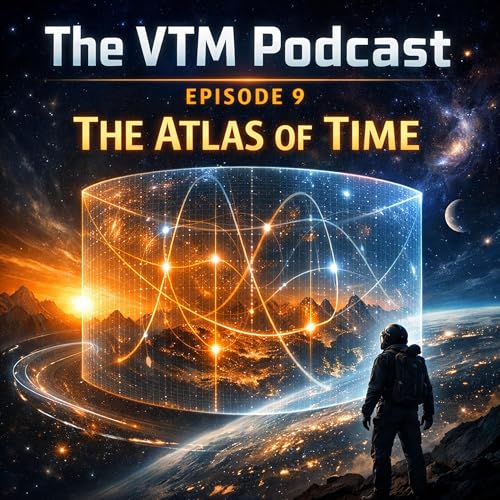
  • The VTM Podcast - Episode 9 - The Atlas of Time
    Mar 29 2026

    Episode Description

    In episode nine of the Volumetric Time Model series, Ralph Clayton moves beneath the familiar questions of prediction, control, and Agency Horizons to examine the deeper picture of reality that makes those ideas possible. Instead of treating time as a simple stream of moments arriving one after another, this episode introduces a different framework: a bounded region of spacetime containing a set of complete, law-abiding “admissible histories,” shaped by physical law and boundary constraints. Ralph calls this set the atlas, and uses it to reframe some of the most difficult questions about uncertainty, knowledge, and the future.

    From there, the episode explores one of the central distinctions in the VTM framework: the difference between the world itself and the record available to an observer embedded inside it. An observer does not stand outside the atlas with total access. Instead, they move through life with a growing, delayed, noisy, and incomplete record composed of signals, measurements, memories, and other limited traces. On this view, uncertainty is often not a sign that reality itself is undecided, but a sign that access is partial. Learning, then, becomes the narrowing of possible histories as evidence accumulates, while the felt flow of time emerges from the one-way growth of the observer’s record.

    Along the way, Ralph connects these ideas to relativity, modeling practice, forecasting, hindsight, and human experience. He explains why the future can be highly constrained without being fully accessible, why prediction does not require mysticism, why warnings do not always translate into power, and why late clarity can feel so emotionally brutal. The result is a rich and careful episode that shows how the Volumetric Time Model can hold together physics, inference, and lived experience without collapsing into either mysticism or oversimplified determinism. It is an episode about the structure of reality, the limits of embedded knowledge, and the profound importance of distinguishing between the world and the record through which we encounter it

    Show More Show Less
    47 mins
  • The VTM Podcast - Episode 8 - When Warnings Become Receipts
    Mar 26 2026

    At 2:13 a.m. in a quiet hospital, a machine issues a warning: high risk of sepsis. The data is clear. The pattern is recognized. The future, in a sense, is already visible.

    And yet, nothing moves fast enough.

    In this episode, Ralph Clayton takes listeners inside a single night shift to expose one of the most unsettling truths of modern life: the gap between knowing and being able to act. Through the unfolding story of a patient, a nurse, and a physician, the episode reveals how even accurate, early warnings can fail to change outcomes when action is delayed by systems, friction, and timing.

    This is not a story about medicine. It’s a story about structure.

    Building on the Volumetric Time Model, Clayton explores the growing divide between forecasting and steering—between seeing what’s coming and having the power to alter it. As predictive systems become more advanced, the paradox deepens: we are better than ever at recognizing the future, and yet often unable to reach it in time to matter.

    Why does clarity arrive as control disappears?

    What happens when warnings become receipts?

    And where, exactly, does human agency begin to fade?

    Episode 8 pushes deeper into the mechanics behind the feeling that the future is already decided—not because of fate, but because access is delayed, and leverage runs out.

    Show More Show Less
    38 mins
No reviews yet
In the spirit of reconciliation, Audible acknowledges the Traditional Custodians of country throughout Australia and their connections to land, sea and community. We pay our respect to their elders past and present and extend that respect to all Aboriginal and Torres Strait Islander peoples today.