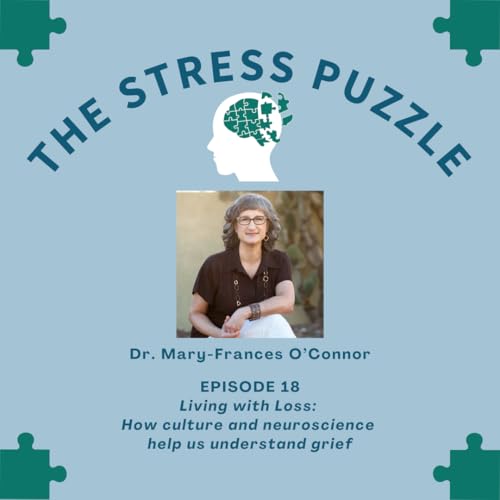
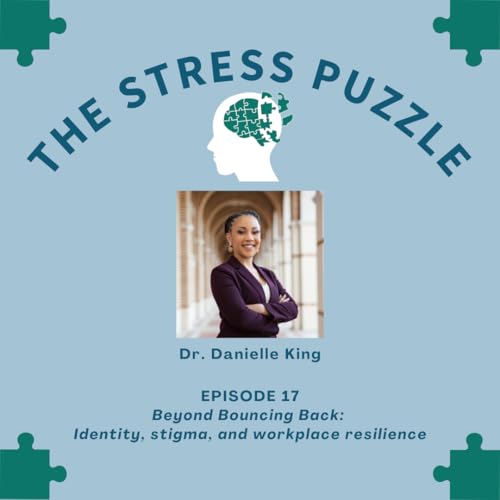
The Stress Puzzle cover art

The Stress Puzzle

The Stress Puzzle

By: Dr. Ryan L. Brown and the UCSF Stress Measurement Network
Listen for free

About this listen

The Stress Puzzle engages both researchers and the broader community in the cutting-edge field of stress science by promoting high-quality research that doesn't shy away from the nuances of the work.2024 Hygiene & Healthy Living Science Social Sciences
Episodes
  • Living with Loss: How culture and neuroscience help us understand grief with Dr. Mary-Frances O'Connor
    Jan 28 2026
    Death, dying, and grief are topics we often avoid but are central to our experience of being human. Today's guest, Dr. Mary-Frances O'Connor, studies the neurobiology behind how our brains grapple with the death of a loved one. Although grief isn't a light topic, Dr. O'Connor walks us through this research in a way that is absolutely captivating. Throughout this conversation, we talked about what her research can tell us about the process of learning to live with loss. We discussed the role of community, rituals, and tradition in grief across different cultures and religions. We also talked about the history and rationale behind prolonged grief disorder as a diagnosis, and how the death of a loved one is especially distinct from other kinds of stressors. Lastly, we touched on emerging ethical concerns around grief, loss, and AI chatbots. Dr. Mary-Frances O'Connor is a Professor of Clinical Psychology at the University of Arizona. Her research focuses on the physiological correlates of emotion, in particular the wide range of physical and emotional responses during bereavement, including yearning and isolation. In her research, she uses methods of psychoneuroimmunology, neuroimaging, autonomic physiology, and virtual reality. She takes a clinical science approach toward the experience and mechanisms of grieving to improve interventions for prolonged grief disorder. Dr. O'Connor also leads the Neurobiology of Grief International Network (NOGIN), which brings grief and loss researchers together to foster collaboration and translate research into clinical impact. If you're interested in learning more about the science of grief and loss, Dr. O'Connor has also written two books: "The Grieving Brain" and "The Grieving Body." Topics Discussed: Grief/Grief as a Form of LearningGrief ResponsesNeurobiologyAttachment/Attachment NeurobiologyGone-but-Everlasting TheoryNucleus AccumbensMental StriatumLoss-Related StressorsRestoration-Related StressorsDaily Diaries/Ecological Momentary Assessment Dual Process ModelResilienceGrief as a diagnosisProlonged Grief DisorderMeaning, adaptation, integrationAffective reactivityKulber-Ross 5 Stages of Grief ModelStigmaCultural Differences in Grief and Mourning Papers and Resources Discussed: O'Connor MF, Seeley SH. Grieving as a form of learning: Insights from neuroscience applied to grief and loss. Curr Opin Psychol. 2022 Feb;43:317-322. [PDF] Hofer, M. A. (1984). Relationships as regulators: A psychobiologic perspective on bereavement. Biopsychosocial Science and Medicine (formerly Psychosomatic Medicine), 46(3), 183–197. Evstigneev SR, O'Connor MF, Wilhelm FH, Blum D, Slavich GM, Seiler A. Grief and bereavement: A pre-registered systematic review of neuroimaging studies. Neurosci Biobehav Rev. 2026 Mar;182:106535Stroebe M, Schut H. The dual process model of coping with bereavement: rationale and description. Death Stud. 1999 Apr-May;23(3):197-224.Mostofsky E, Maclure M, Sherwood JB, Tofler GH, Muller JE, Mittleman MA. Risk of acute myocardial infarction after the death of a significant person in one's life: the Determinants of Myocardial Infarction Onset Study. Circulation. 2012 Jan 24;125(3):491-6.Bonanno GA, Wortman CB, Lehman DR, Tweed RG, Haring M, Sonnega J, Carr D, Nesse RM. Resilience to loss and chronic grief: a prospective study from preloss to 18-months postloss. J Pers Soc Psychol. 2002 Nov;83(5):1150-64.Moon JR, Kondo N, Glymour MM, Subramanian SV. Widowhood and mortality: a meta-analysis. PLoS One. 2011;6(8):e23465.Bonanno GA, Papa A, Lalande K, Zhang N, Noll JG. Grief processing and deliberate grief avoidance: a prospective comparison of bereaved spouses and parents in the United States and the People's Republic of China. J Consult Clin Psychol. 2005 Feb;73(1):86-98. Lewis TT, Van Dyke ME, Matthews KA, Barinas-Mitchell E. Race/Ethnicity, Cumulative Midlife Loss, and Carotid Atherosclerosis in Middle-Aged Women. Am J Epidemiol. 2021 Apr 6;190(4):576-587. Garcini LM, Galvan T, Brown R, Chen M, Klonoff EA, Ziauddin K, Fagundes CP. Miles over mind: Transnational death and its association with psychological distress among undocumented Mexican immigrants. Death Stud. 2020;44(6):357-365.Yang Hsu B, Palitsky R, Maintaining, Relinquishing, and Adapting Bonds in Bereavement: A Qualitative Study of Grave Sweeping in China, SSM - Mental Health, Volume 3, 2023, 100219, ISSN 2666-5603. -- The Stress Puzzle is hosted by Dr. Ryan L. Brown (https://www.ryanlinnbrown.com/) and supported by the UCSF Stress Measurement Network, an NIH/NIA funded network which aims to better understand the relationship between stress and health by improving the measurement of stress in research studies. Learn more about available resources to support stress research at: www.stressmeasurement.org. Have burning questions about stress? Email us at stresspuzzlepod@gmail.com and we may feature your question in a future episode!
    Show More Show Less
    54 mins
  • Beyond Bouncing Back: Identity, stigma, and workplace resilience with Dr. Danielle King
    Nov 25 2025
    In the midst of this season of gratitude, I feel especially grateful to be able to share this episode with you featuring Dr. Danielle King and focusing on the meaning and measurement of resilience. Our conversation focused primarily on resilience in the workplace and how stigma, chronic stress, and systemic factors shape the opportunity for resilience - drawing from her recent paper in American Psychologist outlining a stigma-conscious framework for resilience. Throughout this conversation, Dr. King also explained the limitations of trait-based definitions of resilience, emphasizing the importance of dynamic and context-sensitive measurement. Dr. Danielle King is an Associate Professor of Organizational Psychology and the Associate Dean of Graduate and Postdoctoral Studies at Rice University. She is the founder and principal investigator of the WorKing Resilience Research Laboratory. Her research and teaching portfolios focus on promoting motivation, leadership, resilience, thriving, voice, and belonging. Her research is frequently published in top journals like American Psychologist and popular media outlets including Harvard Business Review. Dr. King's research has been funded by the National Science Foundation, including a prestigious 5-year NSF Career Award, which is designated for scholars who serve as role models and leaders in research and education by advancing science for the betterment of society. She has also received some of the top awards in the field from both APA and APS. Topics Discussed: ResilienceEmployee ResilienceIdentityStigmaGoal PursuitPhysiological CostsMicroaggressions Papers and Resources Discussed: King, D. D., Lopiano, G., & Fattoracci, E. S. M. (2024). A stigma-conscious framework for resilience and posttraumatic change. American Psychologist, 79(8), 1155–1170.King, D. D., Newman, A., and Luthans, F. (2016) Not if, but when we need resilience in the workplace. J. Organiz. Behav., 37: 782–786.What Leaders Get Wrong About Resilience - Dr. King in the Harvard Business Review.Tugade MM, Fredrickson BL. Resilient individuals use positive emotions to bounce back from negative emotional experiences. J Pers Soc Psychol. 2004 Feb;86(2):320-33.King, D. D., Fattoracci, E. S. M., Hollingsworth, D. W., Stahr, E., & Nelson, M. (2023). When thriving requires effortful surviving: Delineating manifestations and resource expenditure outcomes of microaggressions for Black employees. The Journal of applied psychology, 108(2), 183–207. King, D.D., Hall, A.V., Johnson, L. et al. Research on Anti-Black Racism in Organizations: Insights, Ideas, and Considerations. J Bus Psychol 38, 145–162 (2023). King, D. D., Lyons, B., & Phetmisy, C. N. (2021). Perceived resiliency: The influence of resilience narratives on attribution processes in selection. Journal of Vocational Behavior, 131, 103653. Wilkerson, I. (2020). Caste: The origins of our discontents. Random House. Bennett, B. (2020) The Vanishing Half. Riverhead Books. King, D. D., DeShon, R. P., Phetmisy, C. N., & Burrows, D. (2022). What is resilience? Offering construct clarity to address "quicksand" and "shadow side" resilience concerns. In Examining the paradox of occupational stressors: Building resilience or creating depletion (Vol. 20, pp. 25-50). Emerald Publishing Limited. -- The Stress Puzzle is hosted by Dr. Ryan L. Brown (https://www.ryanlinnbrown.com/) and supported by the UCSF Stress Measurement Network, an NIH/NIA funded network which aims to better understand the relationship between stress and health by improving the measurement of stress in research studies. Learn more about available resources to support stress research at: www.stressmeasurement.org. Have burning questions about stress? Email us at stresspuzzlepod@gmail.com and we may feature your question in a future episode!
    Show More Show Less
    41 mins
  • Rising Economic Inequality: How social class shapes our lives with Dr. Michael Kraus
    Oct 28 2025
    For this episode, I spoke with Dr. Michael Kraus about the widening gap between the richest and the poorest in our society (aka rising economic inequality). We discussed how social class shapes every domain of our lives and how class segregation creates distinct cultural patterns and norms. Dr. Kraus also emphasized how quickly and acurately people can perceive social class, the psychological mechanisms that perpetuate inequality, and the profound ways economic inequality affects our social interactions and well-being on a daily basis. Dr. Michael Kraus is a Professor of Psychology at Northwestern University and Morton O. Schapiro Faculty Fellow at the Institute for Policy Research. Dr. Kraus is a social psychologist who studies how inequality fundamentally shapes the dynamics of human social interactions. Much of his research focuses on the behavioral and emotional states that maintain and perpetuate economic and racial inequality in society. His research is consistently published in top journals and has been highlighted by numerous media outlets including ABC World News, National Public Radio, and the Wall Street Journal. Topics Discussed: Social RankSocial HierarchiesSocial ClassRelative RankSocioeconomic (SES) StatusSocietal HealthEconomic InequalityPower/AgencySocial Mobility Perception/Status Signals Papers and Resources Discussed: Tan, J. J. X., Kraus, M. W., Carpenter, N. C., & Adler, N. E. (2020). The association between objective and subjective socioeconomic status and subjective well-being: A meta-analytic review. Psychological bulletin, 146(11), 970–1020. Kraus, M. W., Adler, N., & Chen, T. W. (2013). Is the association of subjective SES and self-rated health confounded by negative mood? An experimental approach. Health psychology : official journal of the Division of Health Psychology, American Psychological Association, 32(2), 138–145. Pew Research Center on Global Economic InequalityKraus, M. W., Piff, P. K., & Keltner, D. (2011). Social Class as Culture: The Convergence of Resources and Rank in the Social Realm. Current Directions in Psychological Science, 20(4), 246–250. Kraus, M. W., Park, J. W., & Tan, J. J. X. (2017). Signs of Social Class: The Experience of Economic Inequality in Everyday Life. Perspectives on Psychological Science, 12(3), 422–435. Kraus, M. W., & Tan, J. J. X. (2015). Americans overestimate social class mobility. Journal of Experimental Social Psychology, 58, 101–111. Carey, R. M., & Markus, H. R. (2017). Social class shapes the form and function of relationships and selves. Current Opinion in Psychology, 18, 123–130. Markus, H. R. (2017). In This Together: Doing and Undoing Inequality and Social Class Divides. Journal of Social Issues, 73(1), 211–221. Becker, J. C., Kraus, M. W., & Rheinschmidt-Same, M. (2017). Cultural Expressions of Social Class and Their Implications for Group-Related Beliefs and Behaviors. Journal of Social Issues, 73(1), 158–174. Work of Nancy AdlerWork of Frantz FanonWork of Jim Sidanius Stress Puzzle episode on Sir Michael Marmot's contributions -- The Stress Puzzle is hosted by Dr. Ryan L. Brown (https://www.ryanlinnbrown.com/) and supported by the UCSF Stress Measurement Network, an NIH/NIA funded network which aims to better understand the relationship between stress and health by improving the measurement of stress in research studies. Learn more about available resources to support stress research at: www.stressmeasurement.org. Have burning questions about stress? Email us at stresspuzzlepod@gmail.com and we may feature your question in a future episode!
    Show More Show Less
    28 mins
No reviews yet
In the spirit of reconciliation, Audible acknowledges the Traditional Custodians of country throughout Australia and their connections to land, sea and community. We pay our respect to their elders past and present and extend that respect to all Aboriginal and Torres Strait Islander peoples today.