Episodes

  • India’s First Bio-Startup: The Acharya Jagdish Chandra Bose Botanic Garden
    Dec 1 2025
    Spread out over a sprawling 109 hectares (270 acres), the Acharya Jagadish Chandra Bose Indian Botanic Garden, previously known as the Calcutta Botanic Garden, was among the first experiments commissioned by the East India Company to create a ‘ nursery’ for exotic plants that could be studied for commercial use. Situated in Shibpur, Howrah, just across the Hooghly River from Kolkata, the Garden boasts over 12,000 specimens. The progenitor of plantations and cash crop in India, the various brands of Darjeeling tea and Indian cotton owe their origin to experiments conducted here. Hosts: Jacob Koshy and Sobhana K Nair Shot, produced, and edited by Jude Francis Weston
    Show More Show Less
    32 mins
  • Death of the Indian Science Congress
    Nov 17 2025
    The Indian Science Congress (ISC)—the first-ever conclave of India’s scientific community—was inaugurated in 1914. It was conceived by two British chemists, Professor J. L. Simonsen and Professor P. S. MacMahon. The inaugural session was held from January 15 to 17, 1914, under the presidency of Ashutosh Mukherjee, then Vice Chancellor of the University of Calcutta. The event brought together 105 scientists from across India and abroad. For nearly a century, the ISC attracted luminaries from India and the global scientific community. Yet, questions lingered: Was it more pomp than purpose? Critics often argued that the Congress remained a platform for exchanging ideas rather than fostering a scientific temperament among the masses or inspiring students. The 109th edition, scheduled for 2024, never took place. In September 2025, the government formally replaced the ISC with the Emerging Science, Technology and Innovation Conclave (ESTIC)—a clear pivot toward innovation-driven forums. In this episode, we trace the journey of the Indian Science Congress—from its cradle to its grave. Hosts: Sobhana K Nair & Jacob Koshy Recorded by Tayyab Hussain Edited and produced by Jude Francis Weston
    Show More Show Less
    40 mins
  • India's Tryst with Cloud Seeding
    Nov 5 2025
    On October 28, the Indian Institute of Technology, Kanpur flew a small plane in the vicinity of Delhi firing a chemical cocktail into clouds in the hope that it could make them rain. This was the first time that cloud seeding was attempted in India as a measure to control air pollution. The rain, the logic went, would make the air borne particulate matter settle. This however was a failure. India has a history of experimenting with cloud seeding thanks to the importance of agriculture and rains. But the history of the science suggests it was of immense interest to militaries. What were the lessons from its early history and what have India's experiments with cloud seeding revealed? The hosts dive into these questions and more. Tune in! Hosts: Sobhana K Nair and Jacob Koshy Recorded, edited and produced by Jude Francis Weston
    Show More Show Less
    28 mins
  • Half Cooked: How solar cookers became a tech disaster in free India
    Oct 21 2025
    The solar cooker was the first indigenously developed technological device in Independent India that a generation of scientists and Prime Minister, Jawaharlal Nehru, imagined would be an example of technology development. The promise was that millions of Indian villagers would use solar cookers to make their meals. It was breathlessly championed by the National Physical Laboratory, Delhi - a CSIR lab. Very soon however, its poor sale and lack of public acceptance led to a loss of morale among scientist and a fear of state-sponsored technology development. Tune in to this episode to hear why solar cookers were the God That Failed in India. Hosts: Sobhana K Nair and Jacob Koshy Recorded, produced and edited by Jude Francis Weston
    Show More Show Less
    26 mins
  • Proof: How Ramanujan Tamed Maths’ Toughest Monster
    Oct 6 2025
    Many of us are familiar with the name Srinivasa Ramanujan and his black and white photograph. He was one of India’s brightest mathematicians. In this episode we dive into his life - from struggling to pass college in Tamil Nadu to reaching the hallowed halls of Cambridge. Ramanujan’s notebooks scribbled with theorems that he discovered continue to frustrate whole generations of mathematicians, who were forever underestimating the sheer density of mathematical riches they contained. This is also the story of the unusual and profound relationship he had with British Mathematician G.H. Hardy. Hardy, who recognised and honed his genius. The two couldn’t have been more different. Hardy, a confirmed atheist while Ramanujan believed that his unique mathematical abilities were God given. Hardy drilled into him the importance of proof. The two worked together for seven-years at Cambridge. Ramanujan died on 26 April 1920 at the age of 33. Hosts: Sobhana K Nair and Jacob Koshy Produced and edited by Jude Francis Weston
    Show More Show Less
    46 mins
  • RAMAN VS SAHA: Indian Science's First 'Clash of Civilisations'
    Sep 22 2025
    This episode looks at two of the stalwarts of colonial-era scientists: CV Raman and Meghnad Saha. While Raman - the first and only Indian physics Nobel Laureate - is better known, Meghnad Saha came from a very different background that probably motivated his attitude towards using science for the larger public good. This was different from Raman, who was largely apolitical, and saw science in its purest sense of unravelling the mysteries of the universe. These scientists crossed paths in Calcutta but eventually, distraught by the politics of the place, Raman moved to Bangalore - first to the Indian Institute of Science and eventually setting up his own Raman Research Institute. Hosts: Sobhana K Nair and Jacob Koshy Produced and edited by Jude Francis Weston
    Show More Show Less
    57 mins
  • How Nuclear Fission Almost Blew Kerala Away from India
    Sep 8 2025
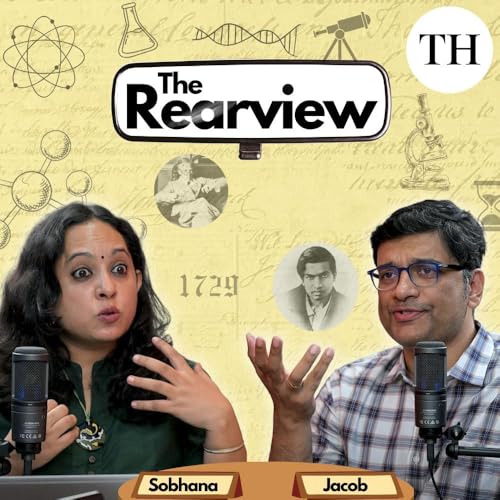
    On June 3rd, Lord Mountbatten, the last Viceroy of India, revealed that India will be divided into two -- India and Pakistan. Eight days later the State of Travancore, which occupied 7662 square miles in present-day Kerala announced that it would stay independent. The Dewan of Travancore, Sir CP Ramaswamy Iyar, argued that, like Belgium or Thailand, Travancore can exist independently of the two dominions. His ambitions were powered by the extensive Monazite reserve of India. Monazite is a reddish-brown phosphate mineral that contains rare-earth elements, primarily cerium, lanthanum, neodymium, and thorium, often with small amounts of uranium. In the atomic age with all countries, especially the US, looking for sources of nuclear fuel, this was a credible bargaining chip. Homi J. Bhabha, the father of Indian Nuclear Science, also believed in the potential that Monazite held. He believed that this could be utilised for producing nuclear power to meet energy needs of the country. Decades later, Monazite has not lived up to its promise. The Rearview is a podcast where the hosts guide you on a scenic route through the history of science. Filled with fascinating anecdotes, deep archival dives, and a closer look at the quirky minds behind groundbreaking ideas. Hosts: Jacob Koshy and Sobhana K Nair Edited and produced by Jude Francis Weston
    Show More Show Less
    30 mins
  • Sawai Jai Singh II - The Royal who was an Astronomy Geek
    Aug 25 2025
    ‘Sawai’ Jai Singh II (1688-1743) is largely remembered today for establishing the foundations of Jaipur. His life-story is mostly told through a political lens - as is that of most rulers in medieval India - via conquests and loyalty (or disloyalty!) to the extant Mughal empire. However Jai Singh was a scholar of considerable talent and devoted considerable time, energy and resources to astronomy. He developed and improved astronomical tables that tracked planetary motion as well as important stars. He is best known for building a series of observatories or ‘Jantars’-- called ‘Jantar Mantar’-- in Jaipur, Delhi, Ujjain, Mathura among others. Though they are in disuse, they are still testimony to the fact that some Indian medieval rulers contributed to advancing science and led quests to unearth new knowledge about nature. There is also the abiding mystery of how a man as scholarly as Jai Singh completely missed the news in 16th and 17th century of the emerging Scientific Revolution The Rearview is a podcast where the hosts guide you on a scenic route through the history of science. Filled with fascinating anecdotes, deep archival dives, and a closer look at the quirky minds behind groundbreaking ideas. Hosts: Jacob Koshy and Sobhana K Nair Edited and produced by Jude Francis Weston For more episodes of The Rearview:
    Show More Show Less
    47 mins